Donate to Brooks Historical

Friday, June 21, 2019

RED ALERT! Christian-GOP Dominionism and Donald Trump

This is a thread from "Mr. Spock" on twitter about one of the greatest threats our democracy has ever faced! These are America's Dark Ages!

You will note several similarities in the following thread that may sound familiar if you are used to studying history - particularly the Civil War. This is the racist "white man's" theology of the South's "god of the slavemaster".. now the dominant domain of Republican political ideology!

1898 caption from the Raleigh News & Observer - annotated by the author

The continuous criminality of the South and the GOP: Over 100 Years of GOP Crime & Fascism: https://youtu.be/qBU3lBlecaI

------

In Star Trek, one of the core story lines was the Dominion war. But it was mostly in Deep Space Nine. It was originally aired in the 1990s. But it was really speaking to America. Because America is truly at war with the Dominion, here and now. Dominion theology is Christian [in origin].

Political ideologies that seek to institute a nation governed by Christians based only on their personal understanding of Biblical law. Dominionism is a label that only applies to certain groups of Christians within the United States, nowhere else on Earth does this apply. [One particularly anti-American - and Southern neo-Confederate - one is "Church of God Evangelistic Association" operated by David J. Smith]

Dominionism is a radical movement, it cloaks itself in the mantle of Christian faith and American Patriotism, when what it is actually trying to do is dismantle democracy. These people put themselves on a pedestal and dictate the morals of a country based on their limited subjective views that they cherry pick from the Bible and ignore the parts that would effect them. So for example, they will press for oppression of LGBTQ, but not divorce or adultery. They are raping the faith of millions and calling themselves moral whilst acting amorally.

Dominionism has a belief in magic along with adoration of a leader - sound familiar? They believe in the supremacy of a master race, this master race is the bastardised version of American Christianity where Jesus is white and protects only America 🙄🙄🙄🙄🙄

But most importantly, the give away is not on what they say, but on how they act. The Dominion movement is a totalitarian movement, exploiting those of faith, but of people that don’t truly understand their faith. They will use religious and patriotic language, usually combined. For example, one cannot be truly a patriot American unless you are a Christian, but not true Christianity, it has to be the White bastardised version of Christianity. Everyone else is the enemy. Everyone else is evil and must be eradicated. One must do as they say..


It is the only way to be a Christian and American [according to Dominionism]. Adhere to all of their rhetoric. Find a leader to adore, no matter how unethical he is [GOP's Donald Trump in this case].

So what is their ultimate goal? A legal system based on “Christian Values.” Labor unions & Civil rights movements will be abolished. It will form the basis of the educational system. Women will be removed from the workforce to stay at home [if this reminds you of the "Handmaid's Tale" series on Hulu, you're not wrong!].

Seen these women protestors dressed in red robes? That's from "Handmaid's Tale"

The most important book for the Dominionist is the “Institute of Biblical Law,” which calls for a Christian society that is harsh, unforgiving and violent.

It calls for the death penalty of LGBTQ, blasphemy, astrology and incorrigible juvenile delinquency and women only to be chaste before marriage. The book calls for the Christian United States. There are 2000 radio stations feeding this in America and 6 TV channels. Right now!

So who are the poster boys of Dominionism? Well Pat Robertson for one and I’m sure that surprises no one.


Here’s an article from 2006 which speaks of the rise of Dominionism.

This is why WE HAVE TO STICK TOGETHER. We cannot ever allow this Draconian society to occur. This is why we must call out this fake version of Christianity which is all about white straight men having all of the power. We must say no. Never surrender.

The enemies of morality will not stop and will not back off. The Left cannot and will not change.

"If the Democrats in the Senate try again to usurp the President's constitutional authority by filibustering, there will be a battle of enormous proportions from sea to shining sea." —James Dobson

[more Civil War news & rhetoric by Robert Reich, Franklin Graham,

Politics is religion, and the right is getting ready for the end times


Pete Buttigieg: "Hypocrisy" of Evangelical Christians Supporting Trump


The Evangelical Civil War: An Interview With Russell Moore - Bloomberg ]


Can you understand why tRump is so important to them and their movement?

So the religious right now have 30 million active voters. They go out and vote no matter what. This is why we must ALWAYS VOTE.

None of my tweets I must add are attacking Christians. Real Christians. Not at all. Christians are needed to push back, to speak the truth, to say no to the cheapening of their daily spirituality. I think America needs true Christians now more than ever, to speak out more.

Why Christian nationalists love Trump

------------------

My thanks to Mr. Spock for his ever logical and fascinating analysis!

I have written a quite a few blog entries myself on Southern conservatism combined with theology and originating from early American piracy and crime:

North Carolina: The Subtle Politics of Slavery Before and After the Civil War 

Progressive Liberal Minister Born in the Confederacy!  

"Quest for Blackbeard" and the "Counterfactual" Politics of the South 

Why do Poor White Voters Vote Against Themselves?

North Carolina's Political Pirate Nest

Really! Pirates and Tea Party Conservatism 

Carolana to Carolina: Imperialism, Science, and Early Huguenot Interest in Bath County

Pirates and Capitalists: Two Sides of the Same Coin 

The National Rifle Association in a Culture of Terrorism

A Proud North Carolina Tradition!

North Carolina: The Subtle Politics of Slavery Before and After the Civil War

Republicans were Liberal Before the Confederacy Took Them Over!

North Carolina's Most Amusing Governor and Wilmington Founder 

Political Agenda of "Redeemer Historians" in North Carolina

Responsibility in Business: Imperialism, Africans, and Rice in the South Carolina Trade


Sunday, June 16, 2019

The Mueller Report: Watch As We Read The Whole Thing Live


A 12-hour long reading of the Mueller Report... it starts slowly, so be patient.
https://www.youtube.com/watch?v=G73iRRgoLKg

Wednesday, May 22, 2019

Progressive Liberal Minister Born in the Confederacy!

Rev. E. M. Brooks (1861-1943)
Parties are quite enjoyable for me. You see, I have the best ice-breaker. My family is unique for having their kids at an advanced age and stretching out the generations and it provides me with the best conversation starter!

My grandfather - no, not a great grandfather - was born two months before the start of the Civil War - the reactions from my fellow party-attendees are usually shock and surprise! 

Still, the Civil War started only 158 years ago... by chance the precise range between my Grandpa and myself (plus my current age of 57). The shelling of Fort Sumter was actually not that long ago! 

Grandpa was born 5 Feb 1861. The Southern States had already seceded after the election of Abraham Lincoln on 20 Dec 1860, and the Montgomery (Alabama) Convention (to organize the Confederacy) was held 4 Feb 1861-17 Feb 1861 - so he was essentially a child of the emerging new country - the Confederate States of America

But the war would not begin until 12 Apr 1861 when Confederate forces demanded the surrender of Federal Fort Sumter in Charleston and shelled it. So, Grandpa was actually born a couple of months before the Civil War! 


You should have seen the looks from my history professors in college!

Map of the Confederate States and Territories - c1860. In early 1865, after four years of heavy fighting which led to 620,000–850,000 military deaths, all the Confederate forces surrendered and the Confederacy vanished. The war lacked a formal end; nearly all Confederate forces had been forced into surrender or deliberately disbanded by the end of 1865, by which point the dwindling manpower and resources of the Confederacy were facing overwhelming odds. By 1865 Jefferson Davis, the President of the Confederate States of America for the duration of the civil war, lamented that the Confederacy had "disappeared" - but that wasn't exactly true. See: North Carolina: The Subtle Politics of Slavery Before and After the Civil War for events leading to the Election of Donald Trump in 2016

Despite Grandpa's birth as a Confederate, he later became a staunch liberal progressive of the restructured United States who actually practiced what he preached! He desired not money, just good will to all men and opposed the conservatives of that former Confederacy in which he was born - a hateful racist political machine active in recovering their harsh dominance after the end of Reconstruction and ridding their society of African-American influence. They were essentially successful in 1896 with Plessy v. Ferguson - or the establishment of "separate but equal" education. This did not end until 1954 and Brown v. Board. The subsequent Civil Rights Act in 1964 was simply a slap in the Southern face - and signed by a Southern Democrat!

Consequently, Grandpa could have been in danger from hometown terrorists in his home in Stanly County, North Carolina, especially after the special election in 1898 when conservatives retook the state and reinforced their control... almost exactly the time he was ordained as a minister! This was a time of white political dominion and African-American suppression. It eventually led to the Great Migration of nearly half of the African-American population to the North - refugees from a hateful Southern theocracy. By 1970, the African-American population in the United States fell from 90% living in the South in 1890 to 53%. They were lucky compared to the Syrian people. The 37% who left the South is only paralleled by a full 60% of the Syrian population needing humanitarian relief today - whereas only 22% have actually been able to leave Syria as refugees.

Ironically, Grandpa had been the great-grandchild of a slave-owner, William Brooks I of Stanly County, North Carolina - just east of Charlotte. His grandfather William Brooks II also owned slaves, but may have manumitted them. His maternal great grandfather (father of his grandmother Mary Burleson), David Burleson (later of Rutherford County, Tenn.) had transacted slaves with him. The most notable thing about this deed was that Burleson paid about ten times the going rate of a horse for this single slave from William Brooks II. Slaves were an enormously valuable commodity in the South - they were simply free labor for a harsh capitalistic society, a boon to any business' "bottom line." William Brooks I owned as many as thirteen slaves at one time, the financial equivalent of 130 horses of free labor on his farm! The family lost their financial prominence (most probably gained through slave labor) after the war ended in 1865 - about $150,000 - calculated at $4,618,337 today!


1814 deed for a slave from William Brooks

The war occurred during the time that my great-grandfather Culpeper "Cullen" P. Brooks and his wife Louisa Lowery Allen birthed and raised my grandfather and their only surviving son, Edgar Marcelus Brooks (he had two sisters who lived and two brothers who died young). This was only 4-5 years following the death of Culpeper's mother, Mary Burleson.

William II and Mary both died in 1846 and 1852 respectively, so very little is known about their son's life in 1861 - all of the court documents ended before - but we can extrapolate from census records. Unfortunately, there are no slave census records to help. The first census they appear on is the 1850 Union County, as a young couple of two years with two young children. Union was formed from Anson just a few years before and was the home county of his father on the south side of the Rocky River, just adjacent to the old Brooks home of William Brooks I, still standing on north side of the river in Stanly County. 

William Brooks I (1736-1818) homeplace near Oakboro, Stanly County, North Carolina

My Uncle Cullen (Dad's brother, named for Culpeper) found it fascinating when I told him that his grandfather was listed as "Cullen" and not "Culpeper" on this census (and a few other records). He never knew! Turns out that "Cullen" was a nickname that got passed down to him - he had no idea, but then like myself, he had never met his grandfather... who died before he was born. That's that having kids late in life thing... rough on the grandkids!

In 1860 - just before the war started - Culpeper was a 43-year-old farmer living on the north side of Rocky River in what was then Stanly County, but further east from the old Brooks homeplace. Apparently, Culpeper and Louisa Allen Brooks had moved closer to her family's homestead near the Pee Dee River. Her grandfather, a wealthy former Revolutionary War soldier originally from Henry County, Virginia by the name of Darling Allen (emigrated c1792) may have died a decade after arriving in North Carolina in an interesting way, according to History and Genealogy of the Nances (Charlotte, 1930), 22:

History and Genealogy of the Nances (Charlotte, 1930), 22

This was, of course, passed down by oral tradition, so.. it may or may not be true. Still makes for a good tale. It's interesting that an alleged murderer "Mose Speaks" was captured in Anson County almost twenty years before publication of the Nance history book. Although he wasn't a slave, this event may have influenced the oral tradition somewhat since "Mose" or "Moses" was a common slave name. The story could still be true, however... I have no way of knowing except that I can't find details in any other source - including court records. As a genealogist, I'm always fascinated - when I read amateur genealogies - by how all us white folks are suddenly descended from "Indian Princesses," too.. lol

Messenger and Intelligencer (Wadesboro, Anson County), 23 Feb 1911, 2.


Culpeper and Louisa Brooks had $2,000 in real estate in 1860 - worth $61,577 today. They owned personal estate valued at $4,200 or $129,313 today - worth a total of about $191,000 in today's value (not poor by any means - but not rich either.. certainly a small smattering of William Brooks I's $4 million!). They probably lived near Norwood, Center Township, Stanly County. In 1870, they appear again in Center Township, with land at $1,500 value with personal estate at only $500 - a total then of about $61, 577. Their total worth had reduced by 56% in a single decade. By the time Culpeper grew sick some years before his death in 1893, they had relocated to Anson County near Polkton and both he and his wife were buried at Rocky River Baptist Church Cemetery, Polkton, Anson County... back to their old home territory.

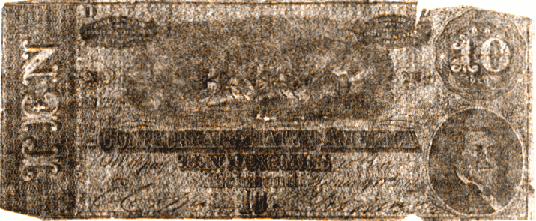
Where did most of the money go? My Brooks-Allen family had supported the Confederacy in the war, converting their U.S. currency into Confederate bills in 1864 when their nation was badly in need of funds. When the Confederacy fell in 1865, these bills were then made worthless.

Interestingly, Grandpa, who settled his father Culpeper's estate, kept the pre-war chest of his family's old Confederate money, including a bundle of the family's papers wrapped in tobacco twine. My Aunt Clara noted that the chest full of $150,000 worth of Confederate money was just "worthless paper," probably repeating just what her relatives had told her after the war. I have seen a sample of several of those bills scooped up by my Uncle Cullen when Grandpa died in 1943 - xeroxing a copy of a ten dollar note after interviewing him back in the 1990s:


$10 note from Brooks Family fortune before the Civil War

A somewhat clearer facsimile of the same $10 note from 1864


Few details of a farmer's life - even well off - entered the newspapers. After the war, everyone had it hard, but there's little evidence that Culpeper kept slaves. There's not much on him at all, actually, after the deaths of his parents - so I don't really know if he inherited slaves from his father's estate - or Louisa from her Allen family. William Brooks II's estate was settled in 1846 in Union County and included the old family land adjacent to Drury Morgan on the Rocky River. If he owned slaves, they were not on his 3-page estate sale inventory nor were there any on his wife Mary Burleson Brooks' estate in 1852.  Still, William I's original thirteen slaves would have been divided at his death in 1818, so few slaves were inherited by any single kid and no further purchases have been found. Still, this was an agricultural community and slaves were often used, especially by the wealthier families.

The most liberal Brooks to certainly break with this trend became my grandfather, a late arrival in Culpeper and Louisa Brooks' home. Their first three sons, William H., Robert Julian, and Preston L., died in infancy. The last two were buried in the Wall-Almond Cemetery (AKA Almond Cemetery, William Wall Cemetery) near Norwood in Stanly County. My Grandpa's two sisters, Eliza Jane Teal and Mary Frances High were a full ten years older than him and their families rarely associated with my grandfather's children. 

The Monroe Journal, 17 Aug 1909, 2
What was a young boy growing up just after a major war - then in dire straights - with only older sisters as an influence, bound to experience? Cullen and Louisa's Rocky River Baptist Church, founded in 1776, became a definite influence in my Grandpa's lonely and sparse life - penance and poverty surrounded him - as well as thousands of freed slaves.  

It may be that Grandpa had planned to settle on a small farm of seventeen acres in Burnesville near Ansonville in 1894, but - thanks to Rocky River Baptist Church and various influences after the war, I believe - he soon became an itinerant Baptist Minister and family historian, bringing the family back together for numerous reunions and writing The Brooks of Union County in 1925. 

It should also be said that he certainly influenced me to study genealogy since I was 16 and to obtain my master's degree in America History. Thanks, Grandpa.. even though we've never met!

Brooks Reunion, c1940


His first appearance in the Biblical Recorder (Raleigh, NC) was on 17 Aug 1898, telling that he was ordained 3 Aug and then served two churches in Anson and Stanly Counties:

Biblical Recorder, 17 Aug 1898, 22

The North Carolinian
Raleigh, North Carolina
21 Jun 1900, Thu  •  Page 4
As I said, thousands of freed slaves searched for a new life when Grandpa was just a young boy of four years. He grew up seeing destitute blacks and whites panhandling and begging, suffering from the ravages of a lost war... the "Lost Cause." That desire for vengeance to get back at the "Damn Yankees" of the United States would spark much resentment among whites after William Woods Holden and Reconstruction ended abruptly. Henry Louis Gates' RECONSTRUCTION: AMERICA AFTER THE CIVIL WAR is a must see presentation!

The special election in North Carolina for 1898 which sparked the racial violence and killings in the Wilmington Race Riot coincided with the beginning of his service in the ministry. Grandpa had to be very careful, for 40% of the people lynched in America were white! Most were killed by the Ku Klux Klan for supporting blacks or for other reasons not considered "desirable" in their neighborhood. It was typical for the KKK or "red shirts" (active in 1898 Wilmington Race Riot) to make up a valid-sounding story to uphold their mob verdict of death by lynching - especially when their victim was a white man.

Ku Klux Klan on horseback

One lynching occurred in Stanly County in 1892 - a white man named Alexander Whitley, allegedly for murder. But, there was little evidence and more hearsay, he stood no trial, and was lynched by a vigilante mob "all wearing red shirts." His descendant has written a book with a title that expresses how society dealt with such violence: Stanly Has a Lynching: The Murder of Alexander Whitley: A Family Legacy Entangled in a Web of Fiction & Folklore 

Enterprise, 13 Aug 1903
As M. Lynette Hartsell tells in chapter nine, a lynching of "Pharoah the Bull" occurred in 1880 - a tale which carried many racially-charged anecdotes of a black man as "savage," a reflection of one Prohibitionist preacher's political animus. I have included the article in Stanly News and Press: "Old King Pharoah Was Stoned For Goring Man". Prohibitionists had tied race to their cause, suggesting that anti-Prohibitionists were in league with the " beastly negroes." As Hartsell suggests, this gave their racism - even violence - a religiously righteous flavor - another parallel with Trump's evangelical supporters today, angered as they are by "Negro Rule" reminiscent of Barack Obama's administration. Hartsell does an excellent job of weaving through the political rhetoric to find reality. 

Still, lynching or attempts to lynch seemed forever on the minds of the more meek shepherds - like I suspect my Grandpa was - attending their flock!

"Indian Doctor" J. L. White was held in prison a full year and narrowly escaped lynching for rape in 1896. In 1900, another lynching of a black man accused of killing a Dr. S. J. Love occurred "by a mob of some 25 person, all disguised" who took the man from the jail, with no resistance from Sheriff McCain, at 2 a.m. in Stanly County. Henry Young was accused of assaulting a white woman in 1908 and nearly lynched by a mob. And, yet another lynching was narrowly averted in Dec 1909 and again, with two black men accused of murder in 1913. Certainly, only a few lynchings and other forms of racial violence had been recorded in newspapers and, contrary to my reporting, they were not just happening in Stanly County - this was a Southern-wide phenomenon. 

The "Lynching Mania" appeared in Stanly Enterprise of 7 March 1901 and almost a full column appeared in the Stanly Enterprise for 13 Aug 1903 which asked the question "But lynching is now on? How can we stop it?" The insincere answer was for faster trials! Whites should ensure swifter justice and that "it would largely stop in the South if negroes would stop committing rape, and this is true." Look at the cartoon below from 1892 of the large black man with bats wings, reaching out for the young white fleeing women - tine and helpless. The caption read "The dangers that hover over North Carolina." It is certain that these accused black men had not raped these women, but were accused nevertheless and hanged. The article went on "It comes of course, as a result of low, uncontrolled bestiality, fed fat by the habits of the life of the negro." As we've seen especially today, "bestiality" appears rather a human quality, practiced by anyone, regardless of any particular skin hue. 

Lynchings from 1835-1964. From data of Monroe Work.

Grandpa's association with, or admiration for, the liberal secretary for populist Gov. Lindsey Russell would be the first clue as to his liberal Christian nature. That secretary was Rev. Baylus Cade of Lenoir, inventor and Baptist Minister, a man who was reviled by conservatives as "Decayed Cade," "once a useful Baptist preacher," for "slandering his church." The North Carolinian of 21 June 1900 spouted a lot of likely "non-sense" as Donald Trump's supporters today, but the last sentence told the strongest sentiments and the original spark for the "righteous flames" - "When a man joins with the negroes in politics, he is ready to tear down the church and slander its good name!" Another article of similar venom spouted "[Cade] is not content to misrepresent the amendment and traduce the white people - that's what all fusion orators do - and Decayed Baylus could not stand to be merely conventional." 
The Semi-Weekly Messenger
Wilmington, North Carolina
03 Jul 1900, Tue  •  Page 2


Oddly enough, Rev. Cade was also a man respected by a quite reverent servant of God, and frequent contributor to the same Christian journals as Rev. Cade - my Grandpa - who named his 4rd son and 5th child - my father - Baylus Cade Brooks in 1916 in his honor!

Rev. Cade's story is an extraordinary tale of rife with the conservative political machine of the day in their battle against "Negro Rule!" The parallels with the Trump Administration today cannot be ignored! I encourage you to click the link above and read about him!


Raleigh News and Observer, 27 Sep 1898


It was in the middle of this tense racial division that my grandfather met and married my grandmother, Emma Eugenia Morton, daughter of Rev. David Stanley Morton on 23 Jan 1902. Their first son was born in 1902 - my Uncle Cullen - already mentioned with the handful of "worthless paper."

Rev. E. M. Brooks and Emma Eugenia Morton, married 23 Jan 1901


Many articles in both the Biblical Recorder and in the Stanly Enterprise newspaper detail his biblical devotion to living a humble life. His personal ministry was directly with the people - he was a do-gooder for sure - and he made various contributions to several Baptist churches in Stanly, Union, and Anson Counties. One of these articles details how Grandpa lived this life and even gave a family historian like myself a unique surprise about my great-great-great grandfather!


Enterprise of 6 Sep 1906 told that Pleasant Grove Baptist Church had given him a "handsome gold watch, Elgin movement" that they wanted him to have to replace his "98-cent timepiece he has been wearing." The article also mentioned a gift he gave them in return - a family heirloom of his great-grandfather's which I'll come back to momentarily.

The same wording appeared also in Carolina Watchmen of Salisbury, 12 Sep 1906. The paragraph before it also included a bit of political news that hints at a "great evil" from which we suffer today - voter suppression by the modern conservative Republican Party. It's helpful to know that, in the 1898 Election, conservatives tried to kill Gov. Lindsey Russell on his train trip home to vote Republican:
It is to be hoped that in Stanly this year there will be no vote buying or vote selling. If a man is honestly a Republican [liberal], he deserves credit and should be allowed his right of suffrage. If honestly a Democrat [conservative], he is entitled to the same privilege. There can be no honesty in elections when there is traffic in votes. In the end the country suffers therefrom and the voter holds the remedy for granting us immunity from this great evil.
[but...] "If the radicals [liberal Republicans] stay in power two years more, the roads in Stanly will be in such a fix that a man won't be able to get anywhere," remarked a citizen of Harris township on Monday.
It seems that any excuse against liberals was fit to print. Everything I read about my grandfather convinces me that he would be seen as a liberal Democratic Socialist today. Of course, in his time, conservatives - actually ex-slavers - were termed the "Democrats," and these cruel conservatives would move into the Republican Party by 1968. My grandfather would certainly not have associated "Democrat" with his own way of thinking!


As promised... Grandpa also mentioned that he gave Pleasant Grove Church a gift in return - one powder horn, "considerably over a hundred years of age," that had belonged to his "grandfather," William Brooks II, made from a gourd. Messenger and Intelligencer of Wadesboro reported in its issue of 10 Apr 1890 that "Cullen" or Culpeper Brooks had the horn in his possession then, that it was his grandfather's (William I) and that it had been used so often it "appeared to be varnished." The 1906 article mentioned "from the seventies," meaning that it had definitely belonged to Ensign William Brooks I when he and his brother Lt. John Brooks went in Capt. John Culpeper's regiment of Rutherford's Campaign against the Cherokee about 1770, before the Revolution. BTW, care to guess where my Great Grandpa "Culpeper" got his name? The powder horn "furnished many a charge when a deer proved a fallen victim," they said. It had done more than that, but I doubt that my Grandpa knew its full history! Or maybe he did and that 's why he gave it away?

Grandpa helped establish the Stanly Baptist Union, a circuit of Baptist churches in Stanly County. He often preached at various locations, but was limited to his place of residence. He had worked in Norwood from 1909 to November of 1915. He and his wife, Emma, pregnant with my father then moved to Palmerville, near Oakboro and "Big Lick" and their child arrived on New Year's day, 1916. 

The next day, Grandpa penned a letter to Rev. Baylus Cade, informing him of his "little namesake" and named "for a great man. One whose ripe scholarship and faultless English excites our admiration.":


Letter of Rev. E.M. and Emma Brooks of Palmerville, NC to Rev. Baylus Cade of Shelby, 2 Jan 1916

Rev. Cade responded ten days later, saying "I value the honor you have done me in giving your dear little boy my name...."


Letter of Rev. Baylus Cade of Shelby to Rev. E. M. Brooks, 12 July 1916

The next year, for my Dad's first Christmas, the family transferred to New London, Stanly County. There, the true followers of a beneficent Jesus celebrated a special "White Christmas" for the "destitute poor" of Stanly County. But, he still visited to other parts of Stanly, like the more western village of Pleasant Grove.

It was not longer after my father's birth, in May 1916, that my grandfather demonstrated his interest as historian - not just as family historian - when "E.M. Brooks of Palmerville gave a historical sketch of the history of" Norwood Baptist Church. He gave a "field meeting" in the open for Palmerville, Ebenezer, and New London in 1918.

By 1919, while living at New London, Grandpa helped initiate an effort to educate the people of Stanly county, with a "Mobile School" for which he served as Dean. According to the Stanly County Herald of 17 July 1919, the school would travel from town to town and spend five days at a time teaching to the children. While the curricula was based on church studies, it did also include various scholarly subjects. The next year, the town of Badin presented him with a gift of $24 to further the poor preacher's pursuits. 

Stanly County Herald of 9 Oct 1919 announced a distant move for the Brooks - nearly to the town of my own birth of Fayetteville - in the small town of Lumber Bridge, southwest of Fayetteville. My father would spend his childhood and later years here - maybe why he chose to purchase his first home near Hope Mills, a bit closer to the metropolis of Fayetteville. 

 
Stanly County Herald, 9 Oct 1919, 1


The Robesonian of Lumberton noted his arrival 20 Nov 1919, where he instructed their parishioners "more perfectly in the ways of finance," and Emma Morton Brooks appeared to have become ill late in September of 1922 but the paper noted that she was "convalescing." On 7 June 1923, the same paper noted him as "Rev. E.M. Brooks of Fayetteville, pastor of the Baptist Church of Boardman," a small town ten miles south of Lumberton. My Grandpa, Rev. E.M. brooks served as pastor at the Person Street Baptist Church in downtown Fayetteville and was listed on the Fayetteville City Directory for 1924. Albemarle Press reported that they were back in Albemarle 25 Oct 1925, but still noted him as "of Fayetteville." My father spent six years from ages 3 - 9 in Lumber Bridge, but his family then resided in Peachland for a number of years.

I remember my father telling me that he walked about a mile to go to school while in Peachland. He and his elder brother Julian Allen used to play pranks on folks by tying fishing line to a dollar and laying it in the street. When someone bent over to pick up the dollar, they'd snatch it away. Dad also told me that he and Allen would try to hit each other's mouths with milk, squeezed straight from a cow! Of course, he laughed at the look on my face!

At some point, my father left Peachland and moved to Fayetteville to live with his older brother Macon - I'm guessing by time of the 1930 census - certainly by the 1931-2 school year, when he was found attending Fayetteville High School (today's Terry Sanford) and working at Matthew's Pharmacy on Hay Street. He graduated from there in 1933 and continued "jerking sodas" at the pharmacy. 

Grandpa retired about that time. He spent his remaining years reading the local papers, clipping articles and exploring history, as he loved it so much. Grandpa saved a collection of newspaper articles, personal anecdotes, and facts that he collected in a scrapbook, dating from about 1931-1939. One of those articles was "Black Mammy Tells Graphic Story of Slavery." This huge article caught my Grandpa's liberal eye.. and I know why. It described a woman who had been severely affected by her servitude as a slave and, later, as a free woman. She never left the home of her former master. This sparked a long, detailed study you'll find in "North Carolina: The Subtle Politics of Slavery Before and After the Civil War." It's not hard to imagine what must have gone through my Grandpa's mind when he read it.


Article written by Charlotte Story Perkinson titled "Black Mammy' Tells Graphic Story of Slavery," Charlotte Observer (North Carolina), 19 March 1933
I can't say that Grandpa was an activist in any meaningful way, but I can discern his thoughts. Maybe the South was the source of the general meek image of a liberal today... as Grandpa would say, they "shall inherit the Earth." Let's hope he's right.

Rev. Edgar Marcelus Brooks passed away from a heart attack at his home in New London, Harris Township, Stanly County just after midnight at 12:45 on the morning of 25 March 1943. My Dad was away in the Navy, oddly enough, stationed at New London, Connecticut. He received an early discharge as a result. 

And, I received one of the best family histories of all time!


Monroe Enquirer, 8 Apr 1943


-----------------------------------------------


Fountain of Hope: Dimensions

Available at Lulu.com

Epub version, too!

Also on Amazon.com!


Monday, April 08, 2019

The Fountain of Youth Exists!


Itchetucknee Springs
in Fort White, Florida stars as the 
Fountain of Youth in...


The epub version is available here


A brief synopsis:
The history of St. Augustine, Florida may be wrong. Native Americans from a North Florida tribe are said to have lived for centuries due to the inexplicable power of a mysterious source of water. Some say this is merely legend. Early explorers went in search of this “Fountain of Youth” only to come back disappointed. Still, the Fountain did indeed exist (at Itchtucknee Springs, Ft. White, Florida)!

Young Lt. Stephen Hathorne, shipwrecked in Spanish La Florida in 1808 will discover the secrets of this tribe if he can survive the trip. Indeed, he discovers that he and his own family are responsible for their very existence! Traveling through threads of time's sensitive fabric, Stephen and his new-found love will have to face many dangers: pirates, zealots, slavers, and a madman from the future before they can find peace in the past.

In this story, four time periods of the beautiful and exotic Floridian town of St. Augustine are explored. Although a sci-fi romance, lovers of history will be thrilled at the meticulous detail.

Incidentally, for North Florida fans of historical fiction, Itchetucknee Springs near Fort White stars as the legendary "Fountain of Youth"... with a real scientific explanation!

Watch the video above for all the detail!

-------------------------------------------------

 Fountain of Hope: Dimensions

Available at Lulu.com

Epub version, too!

Also on Amazon.com!


-----------------------------

Murder at Ocracoke!

Paperback, 76 Pages
Murder at Ocracoke!
List Price: $9.95
Price: $8.96
You Save: $0.99 ( 10% )
Prints in 3-5 business days
Read the exciting details concerning the most notorious murder of all time! You decide who to blame! Edward "Blackbeard" Thache has been misrepresented, misunderstood, and rhetorically damned in the 300 years since "A General History of the Pyrates" was first published in 1724. Indeed, Thache and his reputation has all but been lost to us. This book explores the details, motivations, and literary evidence used against Blackbeard leading up to his death and in the profitable aftermath. It has been presented as a publication of "Blackbeard 300: Nov. 22, 1718-2018" tri-centennial.


http://baylusbrooks.com

Monday, February 18, 2019

"Quest for Blackbeard" and the "Counterfactual" Politics of the South

Adapted from the Preface of the new edition of Quest for Blackbeard - an updated version to reflect upon America's continuing troubles as a "Commonwealth of Pyrates": 

I began my study of Colonial American History in a large part to understand my own Southern culture. As a young genealogist living near my family’s seat of Wilmington, North Carolina, I studied my mother’s ancestry. I found that a great grandfather of hers fought in the Civil War. He died at Gettysburg on July 3, 1863, the last day of the battle. His entire company sacrificed themselves for the dying Confederacy!

John Spicer Meadows was a member of Company H, 55th NC Regiment and his captain was Edward Fletcher Satterfield, shown in center of the photo group below. That last day of the battle – largely regarded as the “turning point” for the Union against the Confederacy – was a time of great Southern loss and their odd reaction to that loss. Satterfield’s company, including John Spicer Meadows, had been considered for a high honor in the South: being “Farthest at Gettysburg” or closest to the Union line. Two companies were considered for this honor, finally settling on Satterfield’s:
Both North Carolina and Mississippi claimed the laurels for the farthest Confederate advance on 3 July. Based in part on the spot where Capt. E. Fletcher Satterfield of the 55th North Carolina reportedly fell dead, North Carolina later adopted as its state motto: “First at Bethel, Farthest to the front at Gettysburg and Chickamauga, and Last at Appomattox.” 

As a young North Carolinian, I was proud that my family had participated in such a significant part of my state’s history. But, I was to be greatly humbled – you see, I tend to research history much too thoroughly, it seems - much to my family's ire and consternation - just ask them! Exposure to facts and reason always destroys the Southern Redeemer fictional rewriting of our history.

I looked for the number of deaths on the three days of the battle, and particularly, on the last day: July 3rd, when my great-great grandfather died. Out of a company of fifty, Company H lost forty-eight men on July 3rd! 

What happened, I asked? 

An article in Confederate Veteran Magazine explained that the entire company had been chosen for the high honor of “Farthest at Gettysburg.” A collation of data from several articles explained the entire story: that Capt. Satterfield and the remaining forty-eight members of his company, realizing the futility of their “lost cause,” hid themselves behind John Benner’s Barn, waiting for the 12th New Jersey line to advance over a rock wall adjacent to the barn and then, committed suicide en masse! “Captain  Satterfield and other North Carolinians of the Fifty-Fifth North Carolina fell within nine yards of that wall,” one reference stated, and “fairly earned the title ‘Farthest at Gettysburg.” Another author spoke with great pride, telling about how my great-great-grandfather’s company ran from behind that barn to surprise the “Yankees,” screaming the “Rebel Yell” and shooting, basically making a very expensive statement of defiance! The 12th New Jersey literally erased Company H - and, my grandfather - from existence that day. So, yes, North Carolina was “farthest at Gettysburg,” but the entire story – told with gleeful pride by former Confederate soldiers at the turn of the twentieth century – was horrifying to my younger self! Southern writers after the war held them up as heroes – but, I greatly differed with that misplaced sentiment. 


Glowing pride in my family’s historical accomplishments forever hit a snag that day – but, I learned a valuable historical analytical method: research questions! What would make my great-great-grandfather and his entire company sacrifice their lives in such a useless and wasteful display of utter defiance? They could have lived to fight another day, but instead, they virtually committed suicide by firing squad – all of them – again, forty-eight people – all who remained of his company! 

As I learned, this was an unconscionable display of behavior so like many adherents to the South’s “lost cause” and ex-president Donald Trump's MAGA! Ever since, I’ve delved back centuries in our history trying to understand my family’s – indeed, my entire Southern culture’s – ideology and its resulting mortal recklessness. I began to see a definite trend from sugar and slaving for profit in the rough West Indies, the religious justification for that slavery, and the anti-government, self-serving, Stuart conservative Anglo-Americans who transferred that ideology to the Carolina swamps. These men regarded life as necessarily short, unimportant next to their greed, and best left in God’s hands. America – especially the Confederacy – truly was, and still is, a “Commonwealth of Pyrates!” We’ve simply traded the red bandana and eye-patch for a farmer's pair of overalls and then, when Republicans adopted their ruthless business model in 1890 & Southern Democrats joined the Republican Party in 1968, a business suit!

Colin Woodard’s American Nations was one such valiant effort to explain this. Quest for Blackbeard is largely the result of that same reasoning, correlated with Woodard’s ground-breaking work. Happily for me, he also happened to write pirate history! “Birds of a feather,” as they say.

I’ve found that much of our history has been told wrong – counter to the facts. Many of you familiar with Southern Redeemer rhetoric will understand immediately. In great contrast, the book you are reading now is not so much about pirate legends, whether West Indian or Confederate, but about distilling the honest search for our history virtually buried by the tremendous “counterfactual” weight of popular historical fiction.  This book also represents a social history, which can be fun, too – literally searching for buried ancestral treasure! Ok, well… about pirates and treasure, though, I should warn you that I’ve heard one archaeological pirate scholar tell an audience that pirates “never, ever, buried their treasure. Please, put down the shovel and stop digging up your neighbor’s yard,” or something to that effect. In other words, the wild legends that you’ve heard are often not real – though often were loosely based upon fact – this is from where Dr. Manushag N. Powell gets the term “counterfactual.” Any possible achievements of our ancestors have been hidden by the “white lies” of past writers with an agenda. The same occurred with pirates of the Caribbean, thanks to Johnson's General History of the Pyrates!

Associate Professor of English at Purdue University Dr. Manushag N. Powell, in "The Piratical Counterfactual from Misson to Melodrama (summary)" The Workshop, No. 5 (June 2018), 105-108 states that Nathaniel Mist was not telling a history, but writing an entertaining and experimental type of "piratical counterfiction." She regarded "Blackbeard, meanwhile, was popular in large part due to his sensational treatment as a theatrical, lascivious devil in A General History of the Pyrates (1724-1728)." Her treatise "The Piratical Counterfactual from Misson to Melodrama" properly explores Johnson or Mist's book as a work of fanciful historical fiction, experimenting with "a number of modes—including history and romance and, through their combination, counterfactual writing. This is more than just an interesting quirk of composition. It is radical experimentation, an extremely early and atypical example of the counterfactual mode... This is what counterfactual writing does: it plays upon readers’ willingness and even desire to invest in an alternative world in which we pretend a thing we know did not happen, did." This is also the point of Southern Redeemer fiction or MAGA "alternative fact" narratives today!

This sincere attempt at history is no easy task to accomplish because these legends have been popularized and modified over nearly 300 years of those Saturday afternoon outings. Another monkey wrench in the historical corpus is that many people have also tried to grasp a bit of the legend for themselves, altering whatever possible historical elements may actually have existed in the seldom viewed primary records. Yes, most of us are pirates at heart! And, those few of us who are not – well, we want our ancestry to be filled with pirates anyway! Genealogies evolved that include famous and infamous people, including Cherokee Indian princesses, Abraham Lincoln, gangsters, and, of course, pirates. Everyone had to have one in the family, you understand. History was lost in the personalized popular haze of self-serving legend. History was beaten and scattered among the literary landscape – often by personal and political agenda.

By far, the worst effects have been achieved through politics – yes, the dreadful and willful destruction of reality to gain power – pirate loot with a different shine. As this book will detail, the British began this effort against American pirates – or maybe just America in general – but after British anti-pirate rhetoric gained ground, we carried it even further against our own. Our ancestor pirates of the West Indies settled the mainland – through Barbadians of Carolina. Much of their Stuart conservative ideology transferred to the pre-United States and has remained with us throughout our history. From the focal point of Carolina, this ideology expanded throughout the Deep South and resulted in the harsh politics that created the Civil War and the Trump-era Republicans, willing to commit treason to maintain power! As I said, Americans have pirate blood.

The pirates’ narrative did not end there. At the end of the Civil War, their descendants, Southern Redeemers, have attempted to guard their version of history and they have perverted the historical narrative as a result. For North Carolina specifically, the “great men” of the Confederacy, usually ex-Confederate soldiers, became politicians and lawyers. They wrote volumes of amateur redeemer “history” that only represented their stubborn point of view. Pirate history was used and abused in this effort – especially Edward Thache, being North Carolina’s “own” pirate. These “great man” pseudo-historians never received training in the historical sciences – and never truly wanted to understand it – only to use it to support the “Lost Cause.” Ex-Confederate Captain Samuel A’Court Ashe positioned himself as North Carolina’s embodiment of redeemer history – and, we adored his valiant and forthright support of our heritage! We also adored his "counterfactual" rhetoric of the South as the original destroyers of "notorious" pirates! As a result, he was immortalized on a bronze plaque that still adorns a prominent street in Raleigh! Still, he was lying.

So, why the heavy animus on their own ancestral pirates? Why did these redeemers turn on their own? What were they trying to say - or avoid - exactly? The intent seems vague – until you analyze the methods and results. A closer study can illuminate this expertly hidden connection and if you consider the politics of Civil Rights, you get to see what created our modern troubles with the modern Republican Party.

[updated 31 Jul 2021] About 1890, conservatives adopted the plantationists' business model - particularly in the area of labor - and adopted the "trickle-down" that later President Ronald Reagan became so well identified with. In 1929, three consecutive Republican administrations so abused the economy that they caused the Great Depression. 1933, conservatives attempted an insurrection against President Franklin D. Roosevelt when he tried to repair the damage they caused - much like the insurrection we just experienced on January 6th, 2021 at the Capitol. 

In 1968, the Republican Party suffered a troublesome waning of their constituency. Republican president Richard Nixon, recognizing a mutual identity with the conservatism - although an extreme version - of Southern Democrats, invited them to "re-people" the formerly more socially liberal GOP in his "Southern Strategy." Southerner's endless anger over the Civil Rights Act of 1964 caused conservatives of the South to despise Lyndon Baines Johnson, the Democratic president who signed the Act in 1964, and the Democratic Party to which they all once belonged and then despised! They then took over the modern Republican Party. Yes, this is the same group of extreme conservatives who support the alleged criminal traitor to the United States formerly in the White House!

Educated students of history could better inform our electorate in every election so that we might avoid these inherited issues. The trick is to get MAGA to listen and learn!


------------------------------------------


admiralty, adventure, Africa, african, alternative facts, appalachee, arcadia, art glass, bahamas, bar harbor, Barbados, barham, baylus, baylus brooks, bbc, blackbeard, bonnet, book, boston, boston news-letter, bourbon, bristol, British, brooks, burgaw, burrington, buse, calusa, cape fear, capitalism, caribbean, carolana, carolina, castillo, charles johnson, church, cimaroon, cimarroon, clone, cnn, cocklyn, colchester, colonial, condent, confederacy, confederate, congdon, conservative, corruption, Davis, democrat, depression, document, dunn, dutch, east carolina, east indies, ecu, England, fake news, family, florida, french, gale, Gambia, genealogy, genetics, glass, grovesnor, hispaniola, historian, history, hornigold, howell davis, indians, iron gall, itchetucknee, jamaica, jersey, jesus knocking, jolly roger, kkk, la concorde, lawler, lawson, levasseur, liberal, lighthouse, lillington, lyme, lyndon, madagascar, maine, Manhattan, maritime, maroon, martel, maynard, McLaggin, mist, moore, mortar, moseley, mount desert, New York, newfoundland, newspaper, north carolina, original, painting, panama, paper, pearl, pender, pestle, phenney, philadelphia, phoenix, piracy, pirate, pirates, plantation, politics, privateer, profit, progressive, pyrate, QAR, racism, rebel, republican, rice, robert e. lee, rogers, romance, rothschild, Royal African, royal navy, Salem Towne, sawtelle, seager, seal cove, seminole, shark, Sierra Leone, slave, slavery, smithsonian, south, south carolina, southern, spanish, St. Augustine, st. helena, stained glass, staines, symonds, Taylor, teach, thache, thatch, theach, timberlake, time travel, timucua, traitor, treason, treasure, trump, victory, walker, west indies, windows, windsor, witchcraft, witches, woodard, worley, wrecking, write


https://www.bbc.co.uk/sounds/play/p06s6zfx

BLACKBEARD: 300 YEARS OF FAKE NEWS.
from BBC Radio Bristol

300 years ago on Thursday - 22 November 1718 - Bristol born Edward Teach (aka Blackbeard, the most famous pirate in the history of the world), was killed in a violent battle off the coast of North America. And after 300 years we can finally separate the truth from the myth. You can hear the whole story this Thursday at 9am in a one off BBC Radio Bristol special: BLACKBEARD: 300 YEARS OF FAKE NEWS. With new research by Baylus C. Brooks, narrated by Bristol born Kevin McNally - Joshamee Gibbs in PIRATES OF THE CARIBBEAN, and produced by Tom Ryan and Sheila Hannon this is a very different Blackbeard from the one in the story books...

https://youtu.be/AnaYDaNoufE


Author Spotlight

#Blackbeard #pirate #twitterstorians


Also:


Three Centuries After His Beheading, a Kinder, Gentler Blackbeard Emerges - Smithsonian Online

By Andrew Lawler
smithsonian.com
November 13, 2018


http://www.lulu.com/shop/baylus-c-brooks/murder-at-ocracoke/paperback/product-23588556.htmlRead about the final end of Edward Thache:
Murder at Ocracoke! Power and Profit in the Killing of Edward "Blackbeard" Thache


In commemoration of "Blackbeard 300 Tri-Centennial":


As always, drop by baylusbrooks.com and check out the primary source transcriptions