Donate to Brooks Historical

Showing posts with label white supremacy. Show all posts

Wednesday, August 07, 2019

Actual English Invaders over the Mexican Wall of San Francisco de Campeche!

San Francisco de Campeche on the Yucatan peninsula of Mexico maintains the appearance of a fortress to this day. It looks like a fortress because the entire city indeed was one, surrounded by a masonry wall built to keep out actual invading Englishmen and other foreigners - yes, Donald Trump - we English were the original pirates and criminals in America - and we preyed upon the Spanish!

They also built a full fort there that very much resembles the Castillo de San Marcos in St. Augustine, Florida. And, Fort of San Miguel also still stands!

"Ah Kim Pech," or "Cam Pech,"  the site of future Campeche City was originally an indigenous village, called "Calakmul" by the Mayans, where the Spanish first landed in Mexico in 1517. It boasted a population of 50,000 at its height in the 6th and 7th centuries A.D. The Pre-Columbian city was described as having 6,000 houses and other structures. San Francisco de Campeche was founded there in 1540 by Francisco Montejo, Merida in 1542, along with 30 monasteries throughout the region. As a vulnerable port, Campeche was systematically terrorized by pirates and marauders until the city started fortification in 1686.

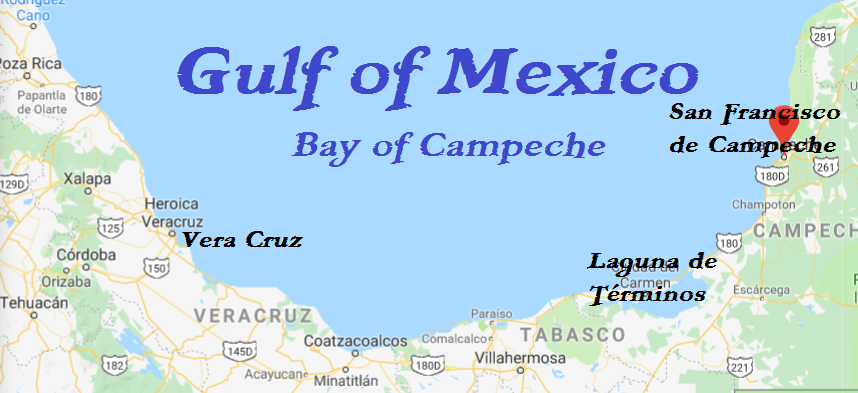
An eminent example of the military architecture of the 17th and 18th centuries, Fort of San Miguel is part of an overall defensive system set up by the Spanish at Vera Cruz to protect the ports on the Gulf of Mexico from pirate attacks like the infamous English 1663 Sack of Campeche.

Laying roughly 65 miles SW of Campeche lay the Laguna de Términos and it's associated Isla Del Carmen (formerly known as Isla Triste) which had finally been liberated from English pirates on July 16, 1717. Another 250 miles away - across the Bay of Campeche in the southern Gulf of Mexico - lay Vera Cruz, the capital of New Spain's province of Mexico.


Fort of San Miguel, San Francisco de Campeche

A local beach on the shores of San Francisco de Campeche, Mexico - shows the Bay of Campeche in the Gulf of Mexico

Hubert Howe Bancroft, in his History of Mexico, Vol. XI told of the struggles that Campeche had incurred due to the English, French, and Dutch pirates of the 17th century. Since 1632, these foreign buccaneers attacked all of New Spain, but Campeche had been especially troublesome for viceroys of New Spain at Vera Cruz. He wrote:
In 1632 six vessels threatened Campeche, but timely succor made them retreat. In August of the following year the town was again visited, this time by ten vessels under a leader known to the Spaniards as Pie de Palo. Guided by a renegade, he advanced against the entrenchment behind which Captain Gal van Romero had retired, but a well directed fire killed several of his men, and caused the rest to waver. It would not answer to lose many lives for so poor a place, and so a ruse was resorted to. The corsairs turned in pretended flight. The hot-headed Spaniards at once came forth in pursuit, only to be trapped and killed. Those who escaped made a stand in the plaza, whence they were quickly driven, and thereupon the sacking parties overran the town. Seven years later Sisal was visited by a fleet of eleven vessels and partly burned after yielding but little to the raiders.
In the following year they returned under the command of their two famous leaders Pie de Palo and Diego the Mulatto. After a hot fight the town was taken and sacked. Efforts to obtain a ransom failed, however, and when rumors of a force approaching from Merida became known to the corsairs, they departed.
In April 1648 these same pirates captured a frigate with more than a hundred thousand pesos on board, and a few weeks later boldly attacked a vessel in the very port of Campeche. At about the same time another band, commanded by the Dutch pirate Abraham Blauvelt, captured Salamanca.

During the second half of the seventeenth century pirate raids became more frequent. In 1659, 1663, and 1678 Campeche was again taken and sacked by English and French freebooters. "They were aided on this occasion by logwood-cutters, who since that time had begun to establish themselves on the peninsula; and, notwithstanding the repeated efforts of the Spaniards to expel them, successfully maintained their positions, till in 1680 they were driven from the bay of Terminos by forces sent against them from Mexico and Yucatan."

This raid of 1663 was particularly devastating. Christopher Myngs and Edward Mansvelt led an expedition of 14 vessels from Jamaica with 1400 men to raid the Spanish town and establish themselves at the Laguna de Términos. They were joined by four more French vessels and three Dutch for a total force of 20 vessels. It was an all-out invasion of Mexico by other squatter nations in Spanish America! But, the English were the primary aggressors in this action. Like most walls in history - especially those in the modern day - the wall around Campeche was wholly ineffective against English pirates!

Eva Leticia Brito Benítez, in "Pirate Assaults and the Defense of the Old Seaport of Campeche, Mexico (16Th-18Th Centuries)," Journal of Global and Area Studies writes:
In the same year, a raid of pirates burned lands but Captain Maldonado, commanding 200 soldiers and 600 Indian archers, forced them to retreat. Several criminals were captured and sentenced to death, among them was a man called Bartolomé Portuguese and known for having previously escaped Campeche.
In 1669, Spanish slaves rose up and decimated Campeche, and in 1670s Campeche was continually set upon by English pirates, who enjoyed protection from Gov. Thomas Lynch of Jamaica. English corsair Lewis Scott assaulted the village in 1678 and according to witness’s testimonies, he kidnapped 250 families. He also stole a lot of gold, silver, jewelry, sacred ornaments, sugar, soap, and meat; additionally, he took three of the fortress’s flags, broke down all of the artillery, and drilled 150 muskets. The garrison consisted of but two companies of half-clad and poorly fed soldiers, until after the raids of Scott and Lorencillo in 1678, when two more companies were sent from Spain.

In 1680, English and French logwood pirates, were expelled from the Laguna de Términos and in 1690, the Spanish fortified Isla Triste or today’s Carmen Island with artillery. A serious effort was made to defend the lagoon or bay, for the garrisons at Campeche were "constantly threatened by the wood-cutters of the bay of Terminos," as Bancroft inferred.

In San Francisco de Campeche, up the coast, the project of Martin de la Torre, begun in 1680, was passed to the French engineer Louis Bouchard de Becou. It was commissioned to unify all the defensive works that surrounded the city with a wall against the incessant English attacks from Jamaica. At its completion, the wall was 2,560 meters in length, forming an irregular hexagon around the main part of the city, with eight defensive bastions on the corners. Bancroft wrote "The total cost of the fortification of Campeche, derived from contributions by the crown and the inhabitants, and from certain imposts, amounted to more than 200,000 pesos. In February, 1690, the first pieces of heavy artillery ever seen in the province were landed at the town." The fortress was completed by 1710. Much of these walls still exist.

Project of Martin de la Torre - 1680


Mapa-histórico-de-Campeche-la-Muralla


Modern city of San Francisco de Campeche

Wood-cutters returned to Laguna de Términos in two years, but Viceroy Conde de Galve reinforced the garrison there and repelled them again. Like the “place of snakes and ticks” of "Cam Pech's" name, the pirate pests returned again and again, persistent as ever.

Location of Isla Triste or Isla Del Carmen or Carmen Island.


About the pirate encampment, Bancroft wrote that a favorite rendezvous of these adventurers was the Isla Triste, or as it is now known the Isla del Carmen, at the entrance of the bay of Terminos. This base made for a perfect launching point and outpost to watch for and chase the Treasure Fleet carrying gold and silver back to Spain. During the war of the Spanish succession they frequently attacked Spanish vessels trading between Campeche and Vera Cruz. When pirates again became a nuisance after the Hurricane of 1715, another minor attempt to clear them was made in 1716, [but again, like the pests that Spaniards had always perceived them to be,] they returned. The new Viceroy in Vera Cruz, Baltasar de Zúñiga y Guzmán, 1st Duke of Arión, 2nd Marquess of Valero, then launched
... an expedition… despatched from Mexico by way of Vera Cruz to Campeche, and being reinforced by the troops stationed there, drove the intruders from all their settlements on the bay of Terminos. The attack was made on the 16th of July 1717, the feast of the virgin of Carmen, and hence the island [formerly Triste] received its name.

Bancroft continued:
A large amount of booty was wrested from the buccaneers, many of whom were slain, those who escaped harboring in Belize [in Bay of Honduras], where, being joined by others of their craft, they organized a force of three hundred and thirty-five men and returned to the bay of Terminos. Landing on the Isla del Carmen they sent a message to Alonso Felipe de Andrade, the commander of the Spanish fort which had been erected during their absence, ordering him to withdraw his garrison. The reply was that the Spaniards had plenty of powder and ball with which to defend themselves. The freebooters made their attack during the same night and captured the stronghold without difficulty, taking three of the four field pieces with which it was defended. But Andrade was a brave and capable officer, and his men were no dandy warriors. Placing himself at the head of his command he led them against the enemy, forced his way into the fort, recaptured one of the field pieces, and turned it against the foe. During the fight a building filled with straw was set on fire by a hand grenade. This incident favored the Spaniards, who now made a furious charge on the invaders. Their commander was shot dead while leading on his men; but exasperated by the loss of their gallant leader, they sprang at the buccaneers with so fierce a rush that the latter were driven back.

Contrary to this historical rendering, Adam Anderson of the British South Sea Company wrote of unwarranted English problems with the Spanish, asserting that the English had every right to cut logwood (a valuable source of die) from the area of Campeche surrounding the Laguna de Términos... a location that included the Isla Triste, a frequent settlement of "British subjects."  He titled his treatise "The Right of British Subjects to Cut Logwood at the Bay of Campeachy, Fully Stated" (1717).

Before the massive raid, in 1716, the Marques de Monteleone delivered a memorial to the "British subjects" - as Anderson referred to these moral-less merchants and brigandish boatmen - at the Isle of Triste "That, if, in the space of eight months, they did not leave the said place, they shall be considered and treated as pirates." This pronouncement alarmed the South Sea Company's Anderson, who believed it of vital importance to his company's business to state firmly (read: propagandize) British rights to the land at Términos - land that they had basically squatted upon and were run off from repeatedly for more than 50 years - although Anderson never mentioned that detail!

Anderson did admit that the English - he didn't say "pirates" - had taken the Spanish port of San Francisco de Campeche three times in recent history - though they never occupied it. He basically argued that the port and inland towns of  Merdida and Valladolid were "in a manner, wholly desolate and uninhabited." Well, why would pirates go through the trouble of taking it three times, then?

The Yucatan region did become the slowest growing area in Mexico, but not until the turn of the 19th century. San Francisco de Campeche was a bustling and important port of New Spain in the early 18th century - not as important as the capital at Vera Cruz, of course - and currently boasts of more than 200,000 residents. The state of Campeche has almost 900,000. The entire state of Mexico contained approximately 5-5.5 million residents in 1810. It's doubtful that the region was as desolate as Anderson inferred - perhaps disingenuously.

Anderson said that the English at Laguna de Términos magnanimously allowed the Spanish to occasionally cut their own logwood "in several parts near their own settlements" from time to time. He asserted that "pirates" - not necessarily "English" pirates - were numerous before the Treaty of Madrid in 1667, when the Spanish gave them rights to Laguna de Términos.

Did the Spanish actually give them rights to Laguna de Términos?

The man who negotiated that treaty for England, Richard Fanshawe, was charged by his superiors to demand reparations for wrongs committed against English merchants and to point out Spain's impotency in the West Indies and to assert the superiority of England's maritime strength. Fanshawe was not achieving England's demands, even against a Spanish Empire inflicted with a weak ruler, King Phillip. England replaced Fanshawe with Edward Montagu, 1st Earl of Sandwich.

Negotiations were inclined against Spain when Portugal and France signed a treaty in March 1667 and France agreed to support an invasion of weakened Spain. Sandwich simply revisited Fanshawe's original treaty with some variation - mostly that England was granted ‘most favoured nation status’ and particularly that England was allowed to carry into Spain her colonial products and goods bought by their agents on either side of the Cape of Good Hope. Although the treaty never mentioned Laguna de Términos by name, British merchants, companies, and their oft-associated pirates used this treaty as an excuse to lay claim to the area. Essentially, the treaty stated that they both promised not to navigate or trade in the places occupied by the other.

So, no, Adam... Spain did not give the English specific rights to Laguna de Términos.

What's worse for Spain is that Portugal suffered a coup the next year, essentially removing the greatest fear that caused her negotiators to allow such magnanimous concessions to England.

Still, Anderson said that "the British privateers [after the Treaty] were then induced to quit their former course," which is not really true, but the most narcissistic part came next... "and to settle with the Logwood cutters in Laguna de Terminos, so that in the year 1669, their numbers were considerably increased, and great quantities of wood were transported both to Jamaica and New England."

He argued that the Spanish never acted as though the English "cutting of logwood was then esteemed an invasion." Yet, still, booted them from the lagoon in 1680. Anderson simply did not acknowledge the English crossing the border into Spanish territory and stealing their logwood precisely constituted that "invasion." He only touted the great profits accrued by his company through their cutting logwood (stealing valuable merchandise) in Campeche.. and, of course, the boon to the entire British Empire. In a textbook example of sheer narcissism, Anderson expressed anger at the Mexican authorities for resenting this theft!!!

No wonder they were back at war in December of 1718. 

Welcome to America - abode of pirates - those at sea and those in business suits! Nothing personal, of course.. just "friendly" competition. Just ask the pirates who razed San Francisco de Campeche, stole their slaves and Indians, and robbed and burned their citizens .

Reinforcing the "desolate" narrative, Anderson also told that Sir Thomas Lynch, then governor of Jamaica, had informed Secretary of State Earl of Arlington that their privateers had ventured seven or eight miles into the country although they "never saw any Spaniards!" And, that "our King's subjects [again, not "pirates"] have been used, for some years, to hunt, to fish, and to cut logwood, in divers bays, islands, and parts of the continent, not frequented or possessed by any of the subjects of his Catholic Majesty, and without any molestation." He also asserted that their activities were approved by the King's Privy Council.

Indeed, this piracy was approved by British authorities - since 1588! That was the problem. The ideology of harsh British capitalism-piracy created the United States. And, America has not changed.. only grown even more detached and "businesslike" - capitalists of the United States ideologically descended from the British South Sea Company - in its martial treatment of and capitalist trickery used against the Spanish.

The rhetoric used by Trump and Republicans today - of a wall against our friends - words like "animals" or "invasion" to describe immigrants at the Mexican border - is abominable in the extreme. Our Mexican friends in Campeche today only welcome us to their shores. Historically, from 1632 through today - for 387 years, we Anglo-Americans have climbed Spanish walls intended to keep us out - we raided, pillaged, and murdered these fine folks - rarely have we been good neighbors!


------------------------------------------------


Fountain of Hope: Dimensions

Available at Lulu.com

Epub version, too!

Also on Amazon.com!


https://www.bbc.co.uk/sounds/play/p06s6zfx

BLACKBEARD: 300 YEARS OF FAKE NEWS.
from BBC Radio Bristol

300 years ago on Thursday - 22 November 1718 - Bristol born Edward Teach (aka Blackbeard, the most famous pirate in the history of the world), was killed in a violent battle off the coast of North America. And after 300 years we can finally separate the truth from the myth. You can hear the whole story this Thursday at 9am in a one off BBC Radio Bristol special: BLACKBEARD: 300 YEARS OF FAKE NEWS. With new research by Baylus C. Brooks, narrated by Bristol born Kevin McNally - Joshamee Gibbs in PIRATES OF THE CARIBBEAN, and produced by Tom Ryan and Sheila Hannon this is a very different Blackbeard from the one in the story books...

https://youtu.be/AnaYDaNoufE


Sunday, July 21, 2019

Racism - the Door is Now WIDE Open

"My own Southern mother recently called me a 'full-fledged Democrat,' but the flying spit and venom made it feel like 'Damn Yankee!'.. a phrase I have heard come from her lips on many an occasion! Earlier, she called me a 'died-in-the-wool Democrat' which has a specifically Confederate meaning.. Rebel wool uniforms were grey because they couldn't afford the blue die that the Union could, thus... a died wool uniform was worn by a Yankee."

Key point for Trump's Confederate fans: Democrat = Yankee

This is what Trump has brought to full fruition! This is also what Civil War did to us the first time... not surprisingly over the same damned White Supremacist issues!

My mother and her family are from an area of North Carolina which I have researched for many years.. the Lower Cape Fear - an area that retained more of a South Carolina flavor than the rest of the state.

As I grew up, I had witnessed many clues to the white-supremacy of this region and have often felt the hatred and resentment of the old war had never died.

Understand that the Old South had never truly relinquished any significant amount of sovereign supremacy to the Union - the United States of America after 1865. You may have heard, as I have many times, that "The South Will Rise Again!" This is the cultural stubbornness that I witnessed on those many trips from my home in Fayetteville (a large city) to the rural Lower Cape Fear (LCF) to see my grandmother - we all have seen it in the plethora of Confederate statues at courthouses across the United States! Understand that this is virtual worship of a defeated traitorous nation.. on our current government soil! It would be merely uncomfortable anywhere else, but outrageous on government property!

Why did we allow this? I'll never quite understand that... 

Illustrating Southern intransigence, there comes another personal tale. I once lived about two years with my cousin in the LCF, and my cousin had an aunt on the paternal side - descended from the aristocratic Hollingsworths in the Duplin-Pender County area. She was visiting with us one day when a guy I worked with in Wilmington (a large city in the LCF) had stopped by to tell me something. This fellow - I'll call him "John" - had always seemed like anyone else, regardless of his color (he was of African American descent). He, too, was from the Pender County area where we then lived.

As soon as John walked through the front door and saw the aristocratic iconic Southern woman - like Scarlett O'Hara - in all her glorified Southern majesty -minus the mint julep - in the center of the room, he immediately began to behave differently. They had obviously known each other.

Remember, I worked with John for months and he behaved like everyone else, so his mutation into... this something truly archaic was unbelievable!

I looked at him like he was a different person... had John lost his mind??! He was genuflecting strongly, his voice had altered to something resembling that of a child, or at least something quite subservient, and he was repeating the phrase "Yes, Miss Pearl, why it's good to see you Miss Pearl." The oddest part.. he sounded like a 19th century slave on the plantation!!! My cousin (from Fort Lauderdale, Florida) and I were both shocked that his demeanor would have changed so drastically.

After John left, the aristocratic Pender County socialite woman announced to us all - in a surprisingly tender way - that John had "always been such a nice young nigger boy!"

My citified mind went: Wham!!! John was 60 years old!!! The LCF was a virtual time capsule! But, it wasn't just in the LCF...

This was the paternal sense of white supremacy that has always pervaded the South - ever since Carolina was founded in 1671 by crude slaving Barbadians. Southerners of that ideology absolutely cannot see any other way to be! For them, whites are designated by God himself to rule over Blacks, Hispanics, Indians, and anyone else of color - until the end of time - which they would gladly welcome over "Negro Rule!"


My mother and her family have marinated in this hateful ideology all their lives. And, the election of Barack Obama to two terms as president of the United States simply confirmed to them how USA has defied God and his divine order! It is no surprise that these vengeful white supremacists elected Donald Trump - a man more like their biblical version of the "Anti-Christ" or "Deceiver," or "Man of Sin" in Revelations. Compare this "White Jesus" or Satan with the Socialist Jesus of Matthew 14, who fed the hungry, housed the homeless, and healed the sick... all non-grate, for no pay whatsoever!

After caging brown children for fear's sake, Trump just identified as "un-American" (read: "anti-Trump") four Congresswomen (two of whom are of Islamic origin) - as if they were enemies!! He was quite un-presidential and un-American when he pointed these women out to his violent followers. He, the South's "Anti-Christ" has just - after a whole 2.5 years of semantic shell-game - finally revealed the racist violent truth of his presidency - and their Confederacy!

Trump and his followers also see that their minority of racist voters will always stay in the minority and that American democracy - or rule by majority - will always disfavor them, so they need democracy to end! To equally-violent-minded "Lost Cause" adherents of the Old South, it was high time for another Civil War or perhaps the End of the World! So, bring on the Anti-Christ Donald Trump, no matter he chooses to collude with!


------

A reflection on my grandfather's life experience with racism at the turn of the 20th century is quite instructive: https://bcbrooks.blogspot.com/2019/05/my-grandpa-progressive-liberal-minister.html
#Racism #WhiteSupremacy


Saturday, April 26, 2014

Rev. Baylus Cade, Progressive North Carolinian and Inventor


Added 6 Sep 2020

Capt. Samuel A'Court Ashe of Wilmington, former Confederate soldier, conservative North Carolinian apologist, defender of slavery, and, not surprisingly, considered "eminent" North Carolina "[redeemer] historian," told in Cyclopedia of Eminent and Representative Men of the Carolinas of the Nineteenth Century (1892) that "Rev. Baylus Cade, a prominent citizen of Raleigh, was born in Barker's settlement, Va (now West Virginia), September 3, 1844."  Ashe, in his desire to reflect the prominence, dare I say "greatness" of the "Lost Cause" and the "extraordinary" men who exemplified it with distinguished honor, told how Rev. Cade joined the Confederate Army and surrendered with Lee at Appomatox.  He then went on extolling the many virtues of the supposedly great conservative ex-warrior, turned Baptist minister and lawyer. 


Samuel A'Courte Ashe

Ashe wrote this in 1892.  Only six years later, things changed... 

By 1912, Eugene Clyde Brooks edited a book of poetry in which a short biography was included on each poet.  Rev. Cade was a poet of some state-wide renown and he was listed with two poems in Brooks' book. 

Rev. Cade's biography in that book told the same details as Ashe's, with the added detail of his age at the time of enlistment in the Confederate Army: the tender age of eighteen.  It also told of his subsequent education from 1866-1869 at Richmond College and his becoming a Baptist minister in 1868.  Being a good conservative North Carolinian, Eugene Brooks also expressed some regret after extolling the many virtues of Rev. Cade when he said "But when Daniel L. Russell was elected Governor of North Carolina, he became the governor's private secretary." 

Always makes me cringe when a racist Southern Democrat (or Republican today) says "But.." when describing anything...

Shortly after his death, the Williamston Enterprise, on June 7, 1918, apologized for Cade's service under Russell, saying that financial matters necessitated him taking the position.  "The appointment as private secretary came unsought," stated the Enterprise, "His brethren in the Baptist denomination, ministers and laymen as well, understood the circumstances and motives and maintained their high respect for him and appreciation of his worth."  Still, this does not explain Cade's later service as head of the liberal Lincoln Republicans, to which Russell belonged, at the Waynesville Convention.  Furthermore, his finances were never uncertain, as he purchased the University at Chapel Hill's printing business in 1895, earned $50,000 and a 17-yr royalty from the sale of one of his inventions just before he left for North Carolina.  Cade had money.  Brooks and the Enterprise almost made it sound like there was something seriously wrong with being Russell's secretary... 

Hon.
Daniel Lindsay Russell (1897-1901)

I should mention that conservative North Carolinians tried to assassinate Gov. Russell when he defended unionist policies in the state and the enfranchisement of African-Americans, against the wishes of the state's-rights ex-Confederates, part of whom were retaking Wilmington's government in 1898 and murdering black citizens without any consequences whatsoever.  Russell was not held in high favor by citizens of the state, who opposed any black enfranchisement policy as "ungodly." The Williamston Enterprise assumed every one of their readers to agree. 

We now call this affair, the only coup d'etat ever to occur in the United States, the "Wilmington Race Riot of 1898."  Conservative U.S. Congressman (and ex-Confederate soldier) Alfred Moore Waddell installed himself as mayor of Wilmington after his declaration that he would "choke the Cape Fear River with carcasses" if blacks weren't "put in their place" like they were before the war.  Conservatives may not have been able to enslave blacks as before, literally, but there were other ways (like Jim Crow laws and Black-laws) to prevent their political empowerment and force their suppression in the great white Godliness of "Progressive"-era North Carolina and today.

Add caption
Ashe supported the classical North Carolinian  conservative agenda... he certainly had no problem with Waddell's group's massacre of blacks.  Ronnie Wayne Faulkner tells that, in the latter years of his life after the riot, "Ashe became obsessed with the War between the States."  Faulkner's thesis, "Samuel A'Court Ashe: North Carolina Redeemer and Historian, 1840-1938" tells that "Ashe did not purposely distort the facts," but his lack of training as a professional historian opened him to bias and Wayne assures that "he often gave a somewhat unusual interpretation to them."  

Ashe was, after all, first a lawyer, not an historian.  Late in his life, he published the short treatise "A Southern View of the Invasion of the Southern states and the War of 1861-65" to reiterate the virtues of slavery and the right of the South to engage in it.  He included much rhetoric in this polemical pamphlet, much of it sheer conservative bias.  

Compare Ashe's cherry-picking style of self-congratulatory rhetoric to today's conservative apologist entertainment of FOX NEWS and their intentional distortion of facts.  1898 began the 100-yr long conservative re-entrenchment in our state that still affects us today... still leaves us open to snake oil salesmen like FOX NEWS, not unlike the "redeemer history" of Ashe's day.  It was a battle for conservative control that almost killed Daniel L. Russell (attacked by a force of paramilitary Red Shirts on a train while traveling back from Wilmington after casting his vote) and lowered the local opinions of those associated with him... like Rev. Baylus Cade... and like any professional historian today who attempts to tell the truth... the "good ol' boys" simply say it's my "interpretation" of the truth, so much like their forebears.  A great deal of propaganda is pushed by conservatives, very much afraid of change. Yes, I get this propaganda daily on Facebook... ;)

William L. Saunders tombstone showing the word "patriot" although for which country is not clear: The USA or the CSA.  It also has the phrase "I refuse to answer" carved into it, a reflection of the trial in which he used the 5th amendment.
Populism, "popular" opposition politics, in the South has generally taken the form of white-supremacy, like George Wallace in 1968 or David Dukes, KKK leader in 1984.  A form of Populism, the Farmer's Alliance (formed in Texas in 1876), called for collective economic action against elites: brokers, railroads, and merchants and for reform in national politics, notably, by 1890, the exclusion of African Americans from politics.  

In December 1890, Rev. Cade became associate editor of the Progressive Farmer, the Farmer's Alliance organ in North Carolina under editor Leonidas L. Polk, who pushed the "Sub-treasury bill,"  This position lasted six months.  Still, Cade would not support Polk's policies, particularly the Sub-treasury bill, which he and Gov. Zebulon Vance viewed as unconstitutional (6 Sep 2020: compare to the un-Constitutionality of most of Donald Trump's policies today):

"After a careful and patient study of the sub treasury bill, I am convinced that its enactment into a law would be disastrous to the country, and especially to the agricultural interests.  Holding this view, I cannot write one word in favor of that bill. The dominant sentiment of the Alliance upon this measure is in irreconcilable conflict with my views, and the only manly and honorable course left for me is to retire and let some other editor take charge whose views are in harmony with the friends of the sub treasury bill." [Cade, quoted by The State (Columbia, South Carolina), June 25, 1891]

How much of this quote of Cade's was accurate and how much the words of the Farmer's Alliance supporters, is impossible to tell.   The "manly and honorable" part, however, about stepping down to make room for supporters of the sub treasury bill, makes this sound suspiciously like the Farmer's Alliance "booted" out a non-conformist Rev. Baylus Cade.  The news coming directly from South Carolina, who supplied the Red Shirts a few years later during the Wilmington Race-riot affair, also makes it sound suspiciously like white-supremacists who didn't like the Reverend.  This was the only article from South Carolina to include a reference to "Rev. Baylus Cade" that I could find and it sounds very much like "good ol' boy - make us sound better-than-thou" politics.   

Populists and liberals had certain common goals that brought them together... 

In the elections of 1894, a Fusionist coalition of anti-elitist Populists and early liberal Republicans led by Populist Marion Butler swept state and local offices in North Carolina.  The coalition would go on to elect Republican Daniel Lindsay Russell as governor in 1896 against conservative Southern-Democrats.  

Fusionists were seen as an "unholy" alliance of Populists with "Negro-loving" liberals, reviled by staunchly conservative ex-Confederates.  They were not Farmer's Alliance men.  To the point, they were not wholly white-supremacists, concerned more with economics than social conservatism. 

Due to his close association with Russell, Rev. Cade, already "tainted" in the ultra-conservative Alliance's eyes, was no longer seen as a true ally.  These included men like Polk, Ashe, and William L. Saunders, the infamous leader of the North Carolina Ku Klux Klan who became the first person to make use of the 5th amendment in a Congressional hearing.  "I refuse to answer" is on his tombstone... literally "written in stone." 

These white-supremacists were the political winners of 1898 and perhaps why no one was ever prosecuted for the Wilmington-riot massacre of black citizens.  Still, that never explained the federal ignorance of justice.  Literally, these murders were ignored by everyone!  In the one-sided political apathy, truth and justice lost meaning. We continue to fight that same fight against ultra-conservative white-supremacists in the North Carolina of today, but perhaps with a bit more hope of winning this time. 

Reflecting Ashe's new opinion of Rev. Cade's more progressive sympathies after the war, in 1908, the prolific ex-Confederate (he seemed anxious to make his point) published his Biographical History of North Carolina from Colonial Times to the Present in eight volumes and, in this post-riot work, Ashe only mentions Cade once: his reference to Cade's actions as lawyer defending Elias Carr, president of the Farmer's Alliance.  There is no mention of his association with Governor Russell, assuredly his most prominent work to that date.  There was also no mention of his leading the state's Republican party after Russell's leaving office as governor.  

White supremacists won.  Russell's, Cade's, and Lincoln's party of liberal Republicans were thoroughly suppressed.  They even gave up on getting African-Americans into politics; the conservative white-supremacist opposition was simply too great.  

What happens when you oppose the powers-that-be in any particular political entity?  Well, like Rev. Baylus Cade, you become the "wayward" young idealist who didn't know any better... according to voluminous "redeemer history." 

Like most of these amateur "historians" of North Carolina's so-called "Progressive Era" (now, there's a misnomer), many truly progressive personalities of North Carolina's past were cast into a political bonfire.  Their contributions were no longer admired by a state full of white-supremacists who could no longer stomach them and their anti-slavery, unionist views.  They became lost in a sea of rhetoric.  "State's rights" or Anti-Union sentiment won North Carolina's future and continues to choke our democracy to death.  

History makes the present.  Southerner conservatives, officially the "Tea Party" today, call themselves "patriots," wave the stars and bars, display the American Eagle on their websites, all the time while waving a Confederate flag, some even promoting groups like the KKK... you'd think they'd realize that this is incompatible, even dysfunctional, but... it's most certainly traditional.


My grandfather, who was born at the start of the Civil War, respected Rev. Baylus Cade, enough to name a child after him.  This child was my father (born in 1916 while Cade was still alive), Baylus Cade Brooks Sr. and I also possess the man's name as "Baylus Cade Brooks Jr."  In my view, the progressive nature of Rev. Baylus Cade lives on in myself and, no doubt in his own descendants.  

Understanding this historical sense of resistance to white-supremacist conservatives in my own lineage makes me proud and I think that it's time that North Carolina should recognize and restore Rev. Cade's contributions as scientist, inventor, minister, poet, lawyer, editor, journalist, and thoughtful North Carolina progressive. He began as most southerners, believing as they did in state's rights, even fought the federal government in the Civil War while too young to even be allowed a drink to celebrate today, but had slowly changed his outlook through his mental acuity, education, exposure to social inequalities, and his opposition to North Carolina's harsh suppression of African American justice. 

One of the characteristics that distinguished Rev. Cade above the lawyers and politicians of polite (meaning "white") conservative society was his scientific prowess.  He obviously focused more upon electrical and practical inventions rather than using his prominence and legal abilities to oppose the wishes of the people in the form of the federal government.  As the Ku Klux Klan and Red Shirts rode across the country frightening blacks and supporting Southern Democrats like Furnifold Simmons, William L. Saunders, and Charles Aycock in their conservative agenda, Baptist minister Rev. Cade sought to better our world through science and technology. 

Cade began his scientific work while still living in Scott's Depot, West Virginia.  In 1883, he proposed a better railroad car coupler.  It was a simple start, involving a "peculiar construction" of the duplex pin and bifurcating bar in traditional couplers.  

His interest in rail continued.  Cade's first invention while living in Louisburg, Franklin County, North Carolina involved telegraphy and he proposed to use the rail system to carry the transmission.  On March 6, 1888, he proposed his ideas for the "Railway Telegraphy" idea, "to provide simple and effective means whereby telegraphic communications may be established between moving trains and the stations along their tracks, or elsewhere.":

Baylus Cade's "Railway Telegraphy" patent


This was closely followed by the actual telegraph device.  In February 1890, eight years before the state's conservative coup d'etat in Wilmington, the Scientific American reported on Rev. Cade's "Electric Railroad Telegraph:"  He sold this device in 1889 for $50,000 plus royalties for 17 years!


Scientific American (February 1, 1890), 76.
Cade's "Railroad Telegraph" patent

Carolina Watchman, October 24, 1889

Carolina Watchman, December 12, 1890


In 1890, Cade involved himself in Populist, or anti-federal government politics and became assistant editor of the Progressive Farmer magazine, under editor Leonidas L. Polk.  Another of their publications included the Carolina Watchman, from which the ad above is taken. 

However, Rev. Cade was also interested in social reforms and had a growing progressive streak ("Progressive" Farmer was something of an intentional misnomer to distract from the white-supremacist conservative agenda of the organization).  

While serving as chaplain for Fort Leavenworth, Kansas, Cade witnessed a serious failure of the prison system and offered solutions.  In 1897, the Proceedings of the Annual Congress of the National Prison Association of the United States, Rev. Baylus Cade submitted an article that revealed a bit of his progressive nature.  


THE REFORM OF CRIMINALS.
AN ADDRESS BY REV. BAYLUS CADE, CHAPLAIN OF UNITED STATES
PENITENTIARY, AT FORT LEAVENWORTH, KANSAS.

  • Excerpt: "When society creates conditions which make either starvation, or theft to satisfy hunger, necessary in a given case, it cannot innocently punish him who takes bread to escape death by hunger.   In that case society is the criminal, and is as guilty before God, and in the esteem of all righteous men, as any other criminal ever was guilty."

Cade argued for welfare and food stamps, long before they ever became available.   Although the ex-Confederate soldier, Private Cade still regarded himself Populist, his social sentiments became increasingly progressive.  While Cade was still in Kansas, Daniel Russell "battled several detractors in both the Republican and Populist parties before he received the fusion nomination for governor. In a resounding victory for the fusionists, Russell was elected to the state's highest office."  Cade would continue the metamorphosis into a Lincoln Republican upon his return to North Carolina and during his tenure as Gov. Russell's private secretary, beginning in April 1898.  

As the Raleigh News & Observer, under Josephus Daniels was the mouthpiece for the conservative white-supremacists, the Charlotte Observer served as opposition and printed the following on October 26, 1898:


Charlotte Observer, Oct. 26, 1898
--------------------
"KEEP THE PEACE, GOV. RUSSELL'S PROCLAMATION, HE MAKES PUBLIC A MANIFESTO"  ---
...
Where as it has been made known to me by the public press, by numerous letters, by oral statements of diverse citizens of the State, and buy formal written statements that the political canvas now going forward has been made the occasion and pretext for bringing about conditions of lawlessness in certain counties in the State, such, for example as Richmond and Robertson County, and...

Whereas it has been made known to me in such a direct and reliable way and that I cannot doubt its truthfulness, that certain counties lying along the southern border of the State have been actually invaded by certain armed and lawless men from another State [South Carolina, invited by the conservatives of North Carolina]; that several political meetings in Richmond and Halifax County has been broken up and dispersed by armed men in using threats, intimidation, and in some cases actual violence; that in other cases property has been actually destroyed and citizens fired on from ambush; that several citizens have been taken from their homes at night and whipped; that in several counties peaceful citizens have been intimidated and terrorized by threats of violence to their persons and their property until they are afraid to register themselves, preparatory to exercising that highest duty of freedmen - casting of one free vote at the ballot box, for men of their own choice, in the coming election...

Now, therefore, I, Daniel L. Russell, Governor of the State of North Carolina in pursuance of the Constitution and laws of the said State and by virtue of its already vested in me by the said Constitution and laws do any issue this my proclamation commanding all ill-disposed persons, whether of this or that political party, or of no political party, to immediately desist from all unlawful practices and all turbulent conduct and to use all lawful efforts to preserve the peace and to secure to all people the quiet enjoyment of all their rights of free citizenship; and I do further command and enjoin it upon all good and law-abiding citizens not to allow themselves to become excited by any appeals that may be made to their passions and prejudices by representatives of any political party whatsoever, but to keep cool heads and use their good offices to preserve the public peace and protect the humblest citizen in all his rights, political and personal, and I do further command and enjoin it upon all judges and all the other civil magistrates and upon all solicitors, sheriffs, and other officers of the law to use the best efforts under the Constitution and laws of the State to apprehend and bring to speedy trial all the offenders against persons and property and political and civil rights of any and all persons in this state whosoever...

(signed), Daniel L. Russell

By the Governor, Baylus Cade, Private Sec.
----------------------

Two weeks later, on November 8, "Russell traveled home to Wilmington and cast his ballot without incident, but he barely made it back to Raleigh. A group of armed Red Shirts boarded the train at Hamlet looking for the governor, but Russell had been tipped off and was hiding in the baggage car. With the [conservative Southern] Democrats once again in control of the legislature, Russell considered resigning but eventually served out the remainder of his term, leaving office in 1901."[North Carolina Election of 1898]

Compare these events to Tea Party groups like "Operation American Spring" who now plan a May 16th, 10-million-strong invasion of Washington, DC to demand President Obama's surrender of the government.  This time, it's not just North Carolina, but the entire Tea-Party portion of crazy America.  Of course, the Tea Party's last Washington "invasion" amounted to a slumber party, so, certainly, times have changed. 

Still, at the turn of the 20th century, times were different (undoubtedly more aggressive and unfair) and North Carolina, a strongly conservative and white-supremacist state, easily resorted to violence to disfranchise blacks and prevent their service as leaders in the community, much like the reaction to President Obama today.  In that respect, North Carolina has not yet changed enough.  

Rev. Baylus Cade had aspirations of running for Congress on the Populist ticket before the violence in New Hanover County.  Upon leaving office, Russell tried to secure Cade the position of "court reporter," but that failed and Cade moved away from Raleigh briefly to Baltimore, Maryland before heading back to North Carolina in Morehead City.  He had adopted a clearly progressive mindset, joining Lincoln's Republicans and heading the Waynesville convention in 1902.  He became the state's leader in that party briefly before realizing the futility of fighting against the white-supremacists who ran the state.  


Baltimore Sun, January 30, 1901

Charlotte Observer, July 25, 1902


By the end of 1902, Cade had begun publishing his work on poetry and the next few weeks, he had announced his removal from politics.  He and Lincoln's Republicans were thoroughly beaten in North Carolina.  The state would remain conservative until this very day, when, ironically, conservatives have switched from the old traditional Southern Conservative to the modern Republican party, which has no resemblance whatsoever to Lincoln's Party.  So, now the white-supremacists have joined the Republicans.  I know, it gets confusing... but, that's politics! 

 
Charlotte Observer, December 21, 1902


Charlotte Observer, January 9, 1903


Six years after leaving politics and moving to Shelby, North Carolina, the ever-faithful Charlotte Observer announced Cade's newest invention.  It was a typesetting machine that promised to revolutionize printing.  The "inventive genius" Cade took numerous trips to Philadelphia to negotiate a contract for developing it.  

Cade filed the original patent August 10, 1908.  The mechanism was much more complicated than his previous inventions.  The patent paperwork was 13 pages long.  

"Composing and Line-Casting Machine," U.S. Patent Office patent for Baylus Cade, August 10, 1908.
 
Charlotte Observer, July 12, 1909
 
Charlotte Observer, August 2, 1909


Asheboro Courier, November 10, 1910


Charlotte Observer, March 22, 1911


Charlotte Observer, September 10, 1911

The real trial came in Philadelphia in 1911 and Rev. Baylus Cade was said to be quite pleased by it.  In the short interview between train stops at Lincolnton, Cade said, "the test was in every way satisfactory and if the present plans materialize the machines will be on sale one year hence."  Cade told the reporter that the decision had not yet been made whether to manufacture it in Shelby at his own facilities or in Philadelphia at those of his investors.  

Manufacturing a new product is always filled with numerous delays and Cade's "Compotype" Typesetter was no exception... apparently the price of its manufacture also increased, which, again, is no shock... 


Charlotte Observer, September 13, 1911
Charlotte Observer, January 7, 1912
Still, Cade returned from Philadelphia in March of 1912 with glowing news!  The Charlotte Observer reported that "He has a number of line slugs cast on the new machine and left one here which will be published in the Cleveland Star and will be the first printing done by the Cape Typesetting Machine."

"The inventor's friends have the sincerest confidence in its success.  Experts have visited the shop in Philadelphia and declare it a marvel. Mr. Cade has been working out the principles of his machine for 20 years or more and now the dream of its life is about to be realized in perfecting a machine that will revolutionize the printing industry."

My grandfather was a Baptist minister himself and an avid reader of the Charlotte Observer.  He followed Rev. Cade's success almost daily.  When his fourth son was born, Rev. E. M. Brooks and his wife, Emma wrote to Rev. Cade informing him of their decision to name their son after him.  Rev. Cade wrote back:


Letter: "Rev. Baylus Cade to Rev. Edgar M. & Emma Morton Brooks of Palmerville" (January 12, 1916)
Not long after my father, Baylus Cade Brooks Sr. was born, on January 1, 1916, this ad came out in the Charlotte Observer on July 15, 1917.  Another article from the Statesville Landmark shared the enthusiasm that the "returns will be marvelous."  A new patent had been filed on November 15, 1917 possibly due to the many changes that had been made by either Cade or the manufacturers in Philadelphia, Arnold and Frank D. Nacke, machinists (A. Nacke & Sons at 236 S 9th Street), or it could have been an added mechanism that was required to make it work better.  Another ad came out the following March 28, 1918.

Charlotte Observer, July 15, 1917

Statesville Landmark , July 13, 1917


"Casting Mechanism for Typographical Machines," U.S. Patent Office for Baylus Cade, November 15, 1917.
Charlotte Observer, September 9, 1917


Charlotte Observer, March 28, 1918


Charlotte Observer, May 27, 1918


Charlotte Observer, May 28, 1918

Reverend, lawyer, poet, politician, and inventor Baylus Cade died at the age of 74, on May 24, 1918 while seeking to further the manufacture of his typesetting machine.  The Charlotte Observer's obituary appeared in the May 27th issue, but the most complete biography appeared the next day.  That thoughtful friend/writer assured us that his invention would continue:


Rev. Baylus Cade

By far one of the most interesting characters in North Carolina passed away in the death of Rev. Baylus Cade who came into fame in recent years as the inventor of Cade typesetting machine and invention over which he had wrought in hopeful expectancy for more than 15 years. There were many who had faith in the invention and from time to time Mr. Cade was financed in the progressive steps towards attaining the perfected machine. This, it was understood, had been accomplished and the more recent efforts were in the direction of building a factory for the making of the machines.  At this writing it has not developed what effect the death of the inventor will have on the future of the Cade typesetter, but the possibilities are that it had been forwarded to such a state of completeness that there will be no difficulty in going on with it. Mr. Cade was a Baptist preacher, a man of great stature, and in his clerical coat, top hat and side whiskers was a personage of imposing appearance on the country circuit or on the crowded city streets.  He was a man of marvelous energies in the long years he devoted to his invention he did not neglect the pulpit.  He was the father of a large family having been blessed by 14 children of whom three daughters and two sons survive.  In the earlier days of his inventive work he received but little encouragement, but he never relaxed his efforts. He was handicapped by lack of proper machinery for the construction of the various parts of his machine, and for a time had to be content with the ordinary facilities of a Philadelphia machine shop, where there was finally turned out several years ago, his first crude typesetting machine. The "slugs" turned out he brought home as evidence of his triumph, but he did not contend that the machine was complete.  It needs adjustment of several kinds, and upon this finishing task patiently and hopefully set to work. Later came word that the imperfections in the machine had been removed and the stockholders had passed the stage of disappointment. The Cade typesetting machine stood a completed invention and the next move was the founding and equipping of a plant for its manufacture.  For several months Mr. Cade had been in Philadelphia superintending the making of the machinery which was to go into this factory and he was engaged in the supervision when called to its final abandonment.

The career of Cade, the Baptist preacher, was uneventful; the life of Cade, the inventor was picturesque - romantic. People with whom he came into contact could not resist the depth of his faith. He would never here to the suggestion of failure.  He persisted in convincing a man even against his will, and so, people came to have faith in both Cade and the Machine. It was a hard fate that directed the taking off of the inventor when the reward of all his years of labor and expectations seem to be within his grasp.

----------------------------


The Cade Manufacturing Company of Shelby, North Carolina lived after Rev. Baylus Cade, under its president, E. B. Hamrick, president also of Shelby Cotton Mills; another Shelby Cotton Mill man, Vice-president J.C. Smith of Shelby; Secretary-treasurer J. H. Quinn, and many other officers and investors across the state.  By 1918, they were seeking new manufacturing facilities in Greensboro on the corner of Lithia and West Lee, with frontage on the Southern Railroad line... the former Arctic Ice and Coal Company.   


Inland Printer/American Lithographer (1917), 698-9


Editor & Publisher, 51 (August 10, 1918), 24.


Many times, I have been told that my telling of history is overshadowed by my progressive politics.  This is the absolute truth and my intention!  My point is not to tell our history the way that North Carolinians have traditionally viewed it or want me to tell it, but to tell the truth instead.  In order to do that, I have to give the old historians a thorough reaming from a political point-of-view.  "Redeemer" history or "Revisionism"is a blight on professional history and a purposeful avoidance of justice.  Samuel A'Court Ashe and his "good-ol-boys" have reduced real progress to the realm of the distant "ether" and intentionally maimed our state's past.  Those with the wrong politics have been left out of the history books.

Rev. Baylus Cade made his contributions to society and because of his association with Daniel Lindsey Russell and liberal politics, conservative North Carolinians, who won the final battle of 1898, drove him into insignificance.  He was seen as a political traitor, a castaway, and eventually gave up on politics.  He devoted his energies to his scientific inventions and the Baptist ministry - he was largely successful as an inventor.  Despite his later scientific successes, even to this day, almost no one has heard of him.  Mine is an "odd name," people say, but it would not be if white-supremacists hadn't taken over the state at the turn of the 20th century and robbed Rev. Baylus Cade of his rightful recognition. 

I'm not bitter... well, maybe a little. ;)