Donate to Brooks Historical

Thursday, April 06, 2017

Capt. Charles Johnson's Dishonesty

A page from Wikipedia concerning pirate history in 1717
 
Johnson's Dishonesty 

Capt. Charles Johnson, pen-name of Nathaniel Mist, polemical Jacobite newspaper publisher of London wrote the questionable A General History of the Robberies and Murders of the Most Notorious Pyrates (1724), in which he stated that Benjamin Hornigold (the supposed mentor) and Edward Thache (surprisingly, his supposed pupil) together had accomplished the greatest feat of Blackbeard's career - the capture of the Nantes slave ship La Concorde or later known as Queen Anne's Revenge. This story had long held favor among pirate enthusiasts and influenced pirate history (as seen in the Wikipedia article above) for lack of records to admonish Johnson's account. French records, however, do just that and completely dispel this rumor, stating that the two pirate vessels were 12-gun (Revenge) and an 8-gun sloop (probably Thache's older vessel), both under Thache's command. See French record excerpt for the capture of La Concorde below:


Actual copy of French record showing that "tous les deux," or "both vessels were commanded by Edward Thache."

Johnson may have misunderstood his sources. Still, it is more likely that Johnson lied. In another part of his book, he purposely used the feats of Samuel Bellamy (the pirate's name was clearly stated in only one deposition) of April 1717 off Virginia, jumbling names and dates, for those he attributed to Thache's partner Stede Bonnet supposedly in August that year. In this case, Johnson clearly lied, needing background history for Bonnet, Thache's partner. Two of the ship's names he gave were actually master's names of other ships instead. Compare the deposition of Andrew Turbett and Robert Gilmore to this excerpt from Johnson:
[Supposedly, Bonnet's] first Cruize [August 1717] was off the Capes of Virginia, where he took several Ships, and plundered them of their Provisions, Cloaths, Money, Ammunition, &c. in particular the Anne, Captain Montgomery, from Glascow; the Turbet from Barbadoes, which for Country sake, after they had taken out the principal Part of the Lading, the Pyrate Crew set her on Fire; the Endeavour, Captain Scot, from Bristol, and the Young from Leith.
This information is not only wrong, but completely jumbled and purposely falsified! 

The actual information available from the deposition:

The Information of Andrew Turbett Master and Robert Gilmer Super Cargo of the Ship Agnes of Glascow, taken this 17th day day of Aprill 1717. Before His Majys Lieut. Governor of Virginia

These Informants declare That being bound from Barbados to Virginia laden with Rum Sugar & Molasses, and sundry European goods on the 7th day of this month about eight a clock in the morning five leagues or thereabouts to the Eastward of Cape Charles a Pyrate bore down upon the said Ship, and commanded the Masters to come on board. That the sd Pyrate Ship was mounted with 28 guns and had on board 200 men; That as the Informants heard from the Crew, the said Ship was formerly called the Widda Galley of London, commanded by one Edward Prince, and was taken by the Pyrates in her return from Jamaica and is now commanded by one Samuel Bellamy an English man borne in Plymouth and said to have a Wife and family in or near Canterbury. That the Informants together with the Crew of the sd Ship Agnis being carryed on board the Pyrates, the greater part of the Cargo was plundered by the sd Pyrates cutt away the Masts of the Informant's Ship, and then sunk her; That on the said 7th of April the sd Pyrates took the Anne Galley of Glascow, Alexr. Montgomery Master and the Endeavour Pink of Brighthelmstone John Scott Master; And on Wednesday the 12th instant they also took a ship belonging to Leith[,] Young Master all three bound for Virginia: That after having plundered the said Ships of what goods they thought fitt, they put the Informants with the Crew of their Ship on board the Endeavour Pink and then on friday the 12th discharg'd the sd Pink and the Leith Ship, but carryed the Anne Galley with her Crew along with them as they said to assist in Careening their Ship: That the sd Pyrates took with them Six of the said Leith Ship's Crew, and two man Servants who voluntarily joined with the sd Pyrates; That by discoursing with the sd Pyrates, the Informants came to know the names of the following persons on board vizt Richard Nowland the Quarter Master born in Dublin ___ Lambert Master borne in New Castle, David Turner a North Country Man who (as the Master of the Brighthelmston Pink reports) he knew to have served as Apprentice to one Jno Ffreeland of London, and the said Master also knew one Davis who was borne in Bristoll & bred a Ship Carpenter: That the greater part of the sd Pyrates Crew are Natives of Great Britain and Ireland, The rest consisting of divers Nations and about 25 Negroes taken out of a Guinea Ship: That the sd Pyrates declared they intended to Cruise for ten days off Delaware Bay, and ten days more off Long Island, in order to intercept some Vessels from Philadelphia and New York bound with provisions to the West Indies, That they then designed to go & Careen their Ship at a place called Green Island, to the Eastward of Cape Sable, That the sd Pyrates told the Informants that a Pyrate Sloop came in company with them in a short time, and that there are ten Sail of them in all about the West Indies and the Coast of America

                                                      Andrew Turbett

                                                      Robt Gilmor

 CO 5/1318 Deposition of Andrew Turbett and Robert Gilmore - 17 Apr 1717


There are other examples of Johnson's dishonesty, but outright lies such as this are fatal to any journalist hoping for integrity!
--------------------------------

http://www.lulu.com/spotlight/bcbrooks


"Quest for Blackbeard" is now available in ebook format and can be found on Amazon, Barnes & Noble, Alibris, and other online booksellers. Look for it on my Lulu site at: http://www.lulu.com/spotlight/bcbrooks

The book is already previewable on Google Books.

baylusbrooks.com

Blackbeard's Fatal Battle with Politics - Lies!

Haematoxylum "bloodwood" campechianum or Logwood
Capt. William Wyer of Boston traded in Jamaica routinely for at least a decade in the early 18th century. After a brief stop in that island about the middle of March 1718, he left the Jamaican port of Port Royal in his ship, Protestant Caesar, bound for the Bay of Honduras. Like many before him, his intent was to load with logwood, a 30-40 foot tall, irregular-trunked tree whose dark heartwood is still used today as a source of dark bluish-red dye, nearly black, most notably in the biological stain hematoxylin. 

This profitable tree was found from southern Mexico to Central America, straddling the Bay of Campeach north of the Yucatan Peninsula, and to the south in the Bay of Honduras, both territories that long belonged to Spain. English crews, either under treaty with the Spanish or not, had often illegally cut the lucrative wood for nearly a century, despite the dangers from their Spanish owners.*  
* Later, Dr. Henry Barham Jr. (once husband of Elizabeth Thache before her death, presumed daughter of the famed pirate Edward "Blackbeard" Thache),  transplanted logwood to his plantation in St. Elizabeth Parish, Jamaica in the mid-18th century. This Henry was the son of naturalist and author Henry Barham and his wife Alice, who made their home in Spanish Town, Jamaica in the late 17th century.
Stealing Spanish trees was only part of the ideology of the times. The formative years of America was the century of Stuart rule (former Scottish king James VI or England's James I from 1603 to Queen Anne, ending in 1713). Virginia, New England, and Carolina were all settled by the Stuarts during this period. Furthermore, in the England and West Indies of the Stuarts, the main point was treasure - greed and profit - to steal everything Spain and France owned, including the land and the trees that grew there. Piracy was policy.

William Wyer, master of briganteen Adventure, shown in this 1712 Jamaican shipping record on the same page as later pirate Henry Jennings, then master of the sloop Diamond.

After departing Port Royal and sailing 360 miles (120 leagues) toward the Bay of Honduras, Protestant Caesar encountered a pirate sloop of ten guns off the island of Rattan [Roatan] nearly two weeks later. Protestant Caesar well over matched and outgunned the 10-gun sloop, at 400 tons and 26 guns. Still, at nine o'clock on the evening of March 28, 1718, the daring pirate sloop came under Wyer's stern and fired several cannon and a round of small shot into Protestant Caesar. 


Determined to resume his voyage, Wyer returned fire with two stern chase guns and a similar volley of small shot. The pirate hailed Wyer in English that if he fired again, they would "give him no Quarter." Not intimidated by the smaller vessel, Wyer continued his defense. The two vessels exchanged fire for three hours, with the pirate sloop breaking off the engagement and making sail northward. Wyer's Protestant Caesar must have been alone, for the pirate sloop would not have dared take on more ships!

Wyer continued his course for the southern coast of modern Belize to gather the logwood, arriving on the first of April. He remained there for a week, loading his ship. On the 8th, Wyer and his crew had already loaded 50 tons with more cut and ready to load waiting on shore. On the following 12th, Capt. Wyer's Protestant Caesar would see its demise... again, at the hands of pirates. The pirate sloop would return... with a much larger companion.


While Capt. Wyer loaded his wood, north of Roatan, near the island of Turneff, Thomas Newton in the sloop Land of Promise, spied a large ship accompanied by several sloops approaching him on April 5th. As they neared, he must have recognized the "black flags with death's heads" in them and realized they were pirates. It may have been a relief to Newton that they were not Spaniards because the Spanish would probably not treat them as well as Englishmen, pirate or not! He would soon surrender and come face to face with Blackbeard himself - Capt. Edward Thache of the Queen Anne's Revenge. With Newton in tow, Thache continued on to the Bay of Honduras. He was in search of Protestant Caesar, specifically, and he had a score to settle! He found Wyer and his crew loading their cargo of logwood.

Artist's conception of QAR at Bequia in the French Windward Islands, ca Dec 1717
A Little About Edward Thache:

These events seem incidental, but they are very important in regards to a part of Blackbeard's tale that has maligned him for 300 years! Specifically, the "notorious" parts found in a long-revered text of 1724 and added to his final days in North Carolina: beginning with the alleged purposeful wrecking of his flagship, Queen Anne's Revenge. The details following this event of his sexual carnage and evil behavior are legend - they are probably also outright lies.

Son of wealthy plantation owner Capt. Edward Thache, Edward Thache, Jr. of St. Jago de la Vega or Spanish Town, Jamaica, was an ex-Royal Navy man who had served aboard HMS Windsor during Queen Anne's War. After the war and the end of Stuart rule, this Jamaican gentleman turned pirate for probable political reasons against the new Whiggish or liberal German King George I (who spoke no English) and to fish highly lucrative Spanish wrecks on the coast of Florida - an unprecedented 11 wrecked vessels in all with 14,000,000 pesos worth of silver alone! A fortune for thousands and, for Thache and gentlemen like him, a damned good reason to defy a liberal or anti-Stuart government 3,000 miles away!

Before coming to the Bay of Honduras, he had just captured the French slaver La Concorde about four months earlier. That was 60 miles northeast of Martinique. Captain Charles Johnson, in the questionable A General History of the Robberies and Murders of the Most Notorious Pyrates (1724), stated that Benjamin Hornigold (the supposed mentor) and Edward Thache (surprisingly, the alleged "pupil" of a common pirate) together had accomplished this feat. 

This story had long held favor among pirate enthusiasts for lack of records to admonish Johnson's account. French records, however, do just that and completely dispel this rumor, stating that the two pirate vessels were 12-gun (Revenge) and an 8-gun sloop (probably Thache's older vessel), both under Thache's command. Still, Johnson's derogatory account persists. See French record excerpt for the capture of La Concorde below:


Actual copy of French record showing that "tous les deux," or "both vessels were commanded by Edward Thache, Englishman."
After taking La Concorde, Thache fitted her with extra guns and assumed command. He quit the sloop Revenge, in which he had captured the undermanned and undergunned slaver, giving command of Revenge to one Richards. Thache's pirates had lingered among the French Windwards until nearly Christmas, when the pirate forces in America had supposedly plotted an attack upon the French capital of St. Domingue (modern Haiti and long an old enemy of Jamaica). Rumors told to the French authorities by French pirate Jean Martel (also declared to be English by the fallible Johnson) were that as many as 17 pirate vessels planned the attack on Pètit Goâve. Martel had been worried that his brother and sister-in-law, who lived there would be in danger. 

Apparently, the massive attack on Pètit Goâve never occurred. Pirates, especially wealthy gentlemen with much to lose, likely lost interest in such radical endeavors after the king offered his pardon. Thache, though, as a staunch Stuart conservative, obviously wanted to continue the fight. La Concorde was the perfect weapon to do just that. He renamed her Queen Anne's Revenge, signifying his intent to fight against the liberals in a new Britain who wanted piracy eradicated in America. 

The newly -formed Board of Trade passed reforming legislation to that effect since the day it formed in 1694, following in the footsteps of William of Orange a few years earlier. Piracy, the tool of older Stuart Tory conservatives no longer served the national purpose - indeed, pirates hampered Britain's endeavors in times of peace. The days of pirate heroes ended - at least for England - poetically coinciding with the death of Sir Henry Morgan on Jamaica in 1688. Still, America, 3,000 miles away from a government they began to despise, still remembered the ideology that made them great and profitable. They longed for the glory days of the Stuarts to return!

For most of December 1717 and the winter to come, Thache and Richards probably remained in the Caribbean. They also probably had contact with Thache's family in Spanish Town, Jamaica, perhaps to dispose of slaves they had taken in La Concorde. Capt. Jonathan Bernard, whose family was also of Spanish Town, and some of his vessels probably accompanied Thache and Richards to the Bay of Honduras the next Spring 1718, flying "bloody red flags," usually meant to indicate "no quarter" to be given. 

By late March and early April, Thache and his flotilla cruised the Bay of Honduras. Revenge and QAR briefly split up, Revenge meeting with Protestant Caesar on the 28th of March and losing the fight. After Richards in Revenge rejoined Thache and informed him of the lost battle, the experienced pirate searched for Protestant Caesar, finding Land of Promise first at the Island of Turneff.

Details of these events in the Bay of Honduras are supplied through Thomas Newton and William Wyer, both of whom found their way to Rhode Island in Newton's sloop. Their story is found in the Boston News-Letter issue of June 16, 1718. No one had reason to dispute them.

Deception?

There is, however, another contradictory tale of these events from a few months later. It is found in the deposition of David Herriot at pirate Stede Bonnet's trial at Charleston, South Carolina, in October 1718. This tale is probably not entirely true - having evolved through an elaborate deception by Herriot, trying to avoid the noose, and colonial administrators to ruin Capt. Edward "Blackbeard" Thache. The Board of Trade wanted more than to capture the dangerous Thache. As a pirate, he was certainly dangerous to British shipping concerns, but perhaps there was also a political reason to stop this ex-Royal Navy pirate.

David Herriot's trial deposition in Charleston was a key piece of evidence used by Johnson in his book - evidence against Blackbeard. Still, Herriot appears to have lied in that deposition about his own innocence and - probably through coercion of Board-appointed Admiralty authorities in Charleston - about Edward Thache's actions in North Carolina. Johnson's list of Thache's foul deeds in North Carolina is unparalleled for its ruthlessness - and also for its lack of proof - other than this deposition!

Events surrounding Herriot's joining with Thache, Bonnet, and Richards, allegedly at the Bay of Honduras, may not have occurred as Herriot told in his deposition. He probably joined them freely in Jamaica, but wanted to exonerate himself, to be sure. Freely joining pirates would not look so innocent to the Admiralty. The Admiralty was after Thache and Herriot likely recognized similar goals between them. They developed a pact. 

The following is Herriot's version of events at the Island of Turneff in early April when Thache and his partners arrived and took Land of Promise. Herriot explained in his deposition:
That about the 4th or 5th of April last this Deponent [Herriot] came into the Bay of Turneff, about ten Leagues from the Bay of Honduras, and there saw a Ship and two Sloops [Newton mentioned no other ships with him in his version], which this Deponent first apprehended to be Capt. Wyar, who came out of Jamaica with four other Sloops about a Week before this Deponent, and designed to come to an Anchor there. But soon after he perceiving the said Ship did not belong to the said Wyar, this Deponent took them for Spaniards, and then tacked about, and then the Ship fired a Gun at this Deponent's Sloop [Adventure]; and the said Sloop Revenge, then commanded by one Richards, a Pirate, slipped her Cable, and came up to this Deponent with a Black Flag hoisted, and ordered this Deponent to hoist out his Boat, and come on board them, which he did; and then the said Sloop Revenge sent five of their Hands in this Deponent's Boat back again to this Deponent's Sloop, and brought this Deponent's Sloop to an Anchor under the Ship's Stern. [Herriot testified - probably falsely - that he was taken on April 4th or 5th, 1717.]
Says, That the Ship which this Deponent imagined to belong to Mr. Wyar, was a Ship of forty Guns mounted, named the Queen Anne's Revenge, commanded by one Edward Thatch, a Pirate. And says, He then was inform'd by the Pirate Crew, that the said Major Stede Bonnet was on board the said Thatch, but out of Command, being some time before turn'd out of his Command by the said Thatch and the Pirate Crew, as he was inform'd.
Herriot had likely worded his version of the tale to make it appear that he had been innocently passing by when Thache and Richards captured him and forced him and his ship to join their pirate band. Still, Daniel Axtell, the man who contracted for Herriot to go to that location was the co-owner of pirate sloop Barsheba and co-conspirator with Capt. Henry Jennings, gentleman pirate of Bermuda and Jamaica. According to one deposition [Joseph Eels], the future Jamaican Assemblyman was complicit in disposing of the French goods stolen by Jennings in April 1716 and was then arrested for it. Axtell was likely also friends with Thache and Bernard. Axtell was an important man, so Herriot probably felt confident by mentioning him in his deposition.

David Herriot feared that he may be hanged for piracy at White Point in Charleston. His testimony, offered in trade for his release, differed greatly from the story told by Thomas Newton and William Wyer to port authorities in Rhode Island. Herriot said that Bernard's three ships had accompanied Wyer earlier to the Bay of Honduras. He also indicated two other sloops with Newton. The Boston News-Letter's account, however, suggests that there were no other ships with either Wyer or Newton. Herriot's Adventure probably sailed with Thache, Richards, and Bernard's vessels when they left Jamaica, also suggested by the newspaper article. Furthermore, neither Wyer nor Newton, nor any other witnesses to these events were present in Charleston during the trial and would not be able to dispute Herriot's testimony - nor was this Bay of Honduras part ever questioned. Following is the Boston News-Letter article of June 16, 1718, shown in its entirety below: 
 

Boston News-Letter article from issue of June 16, 1718, page 2
Though seen as innocent and immune to prosecution because of this deposition's benefits to him, David Herriot must have still felt some guilt. He yet attempted to escape custody with Stede Bonnet and was killed in the attempt - not the act of an innocent man! 

As for the Board of Trade's wishes to damage Thaches reputation, Herriot also deposed (probably at the urging of Admiralty officers): 
'Twas generally believed the said Thatch run his Vessel a-ground on purpose to break up the Companies, and to secure what Moneys and Effects he had got for himself and such other of them as he had most Value for.
Note that Herriot and Ignatius Pell were the only two of Stede Bonnet's pirates immune to prosecution because of their testimony. They were also the only two (actually one) of forty odd pirates to say that Thache wrecked QAR on purpose. Herriot gave the almost 5-page deposition that indicated this - Pell, in the last paragraph, merely agreed with him. As witnesses for the prosecution, neither of these men were listed in the indictment, nor were they to ever be charged for their piracies. 

Johnson took this deposition at face value and quoted these trial records closely, elaborating on this specific damning sentence. Still, why would Thache wreck his own vessel on purpose when it should have been his greatest advantage to keep QAR intact. 

It simply does not make sense. QAR should have been of enormous advantage to Thache - assuming he planned to keep pirating. He even refused an offer of pardon from the governor of South Carolina a week earlier because he intended to continue his fight. 

Thache was not the monster presented to the new king by the new Board of Trade and the Admiralty or later written about in A General History. As indicated by Wyer and Newton, Thache's fair treatment of his captives exonerates him from the damaging rhetoric of Charles Johnson. And, by contrast to the Board and Admiralty, the king seemed fairly inclined toward all his subjects, even Edward Thache!

As the Boston News-Letter continues...

After securing Land of Promise with Newton and his crew aboard QAR, Thache's flotilla weighed anchor in search of Protestant Caesar. Newton later related the tale to port authorities in Rhode Island, that Thache intended that "Wyer might not brag when he went to New England that he had beat a Pirate," referring to Capt. Wyer's battle with the sloop Revenge a week earlier at Roatan Island. There would be more to tell of Thache's not-so-brutal thinking. 

On the 8th of April, as Wyer and his crew loaded their logwood, cut from the surrounding forest ashore, several vessels rose from the horizon in the bay. Wyer called his crew together. Wyer saw the black and red flags and believed them to be pirates and still intended to defend his ship. The crew agreed that, if they were Spaniards, they would fight every man to the death, but if they were English pirates, they should just surrender, no doubt expecting better treatment from their own. They were, after all, stealing Spanish trees from Spanish land.

Wyer acquiesced and sent his second mate in their pinnace to greet the ships, discovering that they were indeed pirates, in five vessels, the largest of which, QAR, had 40 guns and 300 men! Wyer had to agree that their 26 guns and 50 men were certainly no match for all five of these ships. Wyer's officer then informed Capt. Edward Thache of their surrender. 

Thache requested that Wyer come aboard, promising no harm to him or his men. Once aboard, Thache learned of their origin. Unfortunately for its owners, Protestant Caesar was a ship of Boston. Thache informed Wyer that he burned all vessels from Boston. He informed the captain that he good reason for this. Some months earlier, a storm had driven Samuel Bellamy's Whydah into the rocks off Cape Codd in Massachusetts, destroyed her, and killed almost all of Bellamy's pirate crew. The few survivors were captured and placed on trial by the Admiralty Court there, who hanged them. For Thache, this offense needed an answer - so, he burned ships belonging to Bostonians who allowed it.

Wyer's crew were then all removed and sent ashore from Protestant Caesar, which Thache set ablaze before them in the bay on April 12th. Newton and Wyer and their crews who had not joined with pirates, returned to Rhode Island on Newton's sloop, given back to them by Thache, who had not harmed a soul. Edward Thache had his Stuart-conservative political views, but still behaved as a reasonable man.

After the events at the Bay of Honduras, Thache and his flotilla headed north to Charleston for his famous blockade, the wrecking of his flagship in Beaufort Inlet, and his final destiny in the colony of North Carolina at the hands of Virginian forces. David Herriot's false accusations would ring in American's ears for another 300 years, thanks to Johnson's polemical reinforcement. 

Par for the course, Virginia's Lt. Gov. Spotswood violated colonial sovereignty, the king's wishes, and murdered Edward Thache on November 22, 1718. Spotswood's personally-paid assassin, Lt. Robert Maynard cut Thache's head from his body and displayed it in triumph on his Ranger. It was mounted on a poll at Lynhaven Bay - a symbol of Spotswood's control and domination over his little piece of America.

Blackbeard died less than a month before the start of the War of the Quadruple Alliance, a war that King George knew was coming and in which he would again need the experienced ex-Royal Navy man, Capt. Edward "Blackbeard" Thache. Anticipation of that war was probably the very reason that he extended the pardon to August 18, 1718 - to include Blackbeard's continued piracies from the Charleston blockade that May. The king must have hoped that losing the QAR might make Thache see reason. 

With the new war looming, the Admiralty finally had to agree. London merchant Micajah Perry, in close communication with the Admiralty, sent Capt. Joshua Lirland in Avarilla in haste to Virginia with the newly-dated pardon, leaving England in October. He arrived too late - by then, Thache's gruesome rotting head welcomed him at the mouth of James River


Head of Edward "Blackbeard" Thache hanging from Lt. Robert Maynard's Ranger

 A General History of the Robberies and Murders of the Most Notorious Pyrates (1724) - the final rhetorical nail in Thache's reputation - 52 years to successful revolution.

Thache's death was not the end of his troubles, "for the evil that men do lives long after them while the good is oft interred with their bones."

The Board of Trade probably influenced Capt. Charles Johnson, or Nathaniel Mist as he is known to readers of his Jacobite (Stuart favoring) polemical newspaper, Weekly Journal of London. Mist suffered arrest by their agents quite often, accompanied with heavy fines. He was in great need of money and was easily influenced to do their bidding. 

Eventually, he had gone too far and fled Britain in 1728 for France. But, before he left, a few years before his flight, in 1724, having possibly been convinced by the Board of Trade six years after Blackbeard's death, Johnson-Mist wrote these harsh words about Edward "Blackbeard" Thache:
Captain Teach, assumed the Cognomen of Black-beard, from that large Quantity of Hair, which, like a frightful Meteor, covered his whole Face, and frightened America more than any Comet that has appeared there a long Time. 
If he had the look of a Fury, his Humours and Passions were suitable to it; we shall relate two or three more of his Extravagancies, which we omitted in the Body of his History, by which it will appear, to what a Pitch of Wickedness, human Nature may arrive, if it’s Passions are not checked.
Some of his Frolicks of Wickedness, were so extravagant, as if he aimed at making his Men believe he was a Devil incarnate; for being one Day at Sea, and a little flushed with drink:—Come, says he, let us make a Hell of our own, and try how long we can bear it; accordingly he, with two or three others, went down into the Hold, and closing up all the Hatches, filled several Pots full of Brimstone, and other combustible Matter, and set it on Fire, and so continued till they were almost suffocated, when some of the Men cried out for Air; at length he opened the Hatches, not a little pleased that he held out the longest.
One Night drinking in his Cabin with Hands, the Pilot, and another Man; Black-beard without any Provocation privately draws out a small Pair of Pistols, and cocks them under the Table, which being perceived by the Man, he withdrew and went upon Deck, leaving Hands, the Pilot, and the Captain together. When the Pistols were ready, he blew out the Candle, and crossing his Hands, discharged them at his Company; Hands, the Master, was shot thro’ the Knee, and lam’d for Life; the other Pistol did no Execution. —Being asked the meaning of this, he only answered, by damning them, that if he did not now and then kill one of them, they would forget who he was.
Teach began now to think of breaking up the Company, and securing the Money and the best of the Effects for himself, and some others of his Companions he had most Friendship for, and to cheat the rest: Accordingly, on Pretence of running into Topsail Inlet to clean, he grounded his Ship, and then, as if it had been done undesignedly, and by Accident; he orders Hands’s Sloop to come to his Assistance, and get him off again, which he endeavouring to do, ran the Sloop on Shore near the other, and so were both lost.
Few of these details are supported by any evidence. For Edward Thache, specifically, perhaps the single most damning words against him, also unsupported, are these:
His Behaviour in this State, was something extraordinary; for, while his Sloop lay in Okerecock Inlet, and he ashore at a Plantation, where his Wife lived, with whom after he had lain all Night, it was his Custom to invite five or six of his brutal Companions to come ashore, and he would force her to prostitute her self to them all, one after another, before his Face.
The message was clear - pirates of America could not be trusted! Does this sound like the Edward Thache just described above? Johnson-Mist abused Thache in especial fashion. Charles Vane deserved Thache's reputation, but was never treated so roughly by this author. It was in his section on Blackbeard that Johnson-Mist also wrote a message directly about piratical America:
In the Commonwealth of Pyrates [America], he who goes the greatest Length of Wickedness, is looked upon with a kind of Envy amongst them, as a Person of a more extraordinary Gallantry.
It was a warning to all of civilized Europe that America was wild - an unsafe, despotic abode of pirates! It may also have been intended to wake America up - to come to their senses!

Many threw accusations at Jamaica's gentleman Edward Thache, but Johnson-Mist truly created the evil character of Blackbeard, the "notorious" Pirate! Despite all of Britain's greatest efforts with rhetoric - untrue words - however, their attempts to eradicate America's love of Stuart piracy and policy apparently failed. Fifty-two years later, Thache's "Stuart" nation, a gentleman's nation of profit and freedom, became reality. Unfortunately, the new independent America lost the West Indies in the 1783 treaty that ended the Revolution - and the logwood that came with it.


See more at  Capt. Charles Johnson's Dishonesty!
And more at American Pirates in the News!
And again at French Pirate Jean Martel

------------------------------


http://www.lulu.com/spotlight/bcbrooks


"Quest for Blackbeard" is now available in ebook format and can be found on Amazon, Barnes & Noble, Alibris, and other online booksellers. Look for it on my Lulu site at: http://www.lulu.com/spotlight/bcbrooks

The book is already previewable on Google Books.

baylusbrooks.com


Thursday, March 30, 2017

American Pirates in the News!

The Boston News-Letter first published in 1704. The first issue of April 24th on page 2 showed mention of an alarm given by a French privateer on the 18th near Boston. As England was then at war with France and Spain, this occurrence did not overly surprise anyone. French and Spanish privateers commonly appeared off English ports as English privateers appeared off Martinique, French St. Domingue (present Haiti), and Spanish ports all around the Caribbean like Porto Bella. "Privateer" was a commonly-occurring word in the news between 1702-1713, during Queen Anne's War or the War of Spanish Succession and during any official conflict. 


Boston News-Letter, 24 Apr 1704 - first issue
Oddly enough, the word "pirate" or its variant "pyrate" did not occur in the Boston News-Letter (BNL) but once in an entire decade and this solitary occurrence referred to a "French pirate" or, most likely, a privateer. A privateer was essentially a legally-commissioned fighter for one particular sovereign nation, usually during a war. They preyed upon shipping and other privateers of other nations. Essentially, a "pirate," or a fighter who worked for themselves, literally had not been used before 1715... in an American newspaper.  

The word "pirate" had been used many times in official English and British records - even in British newspapers. For instance, the Board of Trade referred to "those pirates now in New England" in March 1705 and two "pirates" captured in New England in April 1705, but this did not get mentioned in the BNL those months. In March 1706, the Governor of New England wrote to the Lord Chancellor of the Exchecquer about "prosecuting a notorious pirate and sending over his effects to England." Indeed the Board discussed at length the procedures for trying pirates - not privateers - and even issued circular letters to the colonies about pirates. In November 1710, they also discussed a "pirate" named James Briggs of Bermuda at length, including depositions taken in Bermuda. Again, no mention in BNL. In March 1715, the Marquis of Cassatorres, Spanish governor at Havana, wrote to Thomas Walker of New Providence in the Bahamas his "thanks for his arrest of 8 pirates who have done much damage on that coast and taken several Spaniards." The BNL only mentioned Walker's appointment as customs agent at that time - no hint at all in the newspapers of the troubles with pirates. Also, there were eleven mentions of "marquis," but not the Spanish governor plagued by pirates and only one mention of "Havana."

Weirdly, the term's lack of use in the first decade of the first American newspaper indicates that America may have had a different viewpoint as to what "pirate" actually meant, as opposed to the standard meaning used by the mother country... or they did not care as much as England about pirate depredations in America. If true, why?

In Quest for Blackbeard, I demonstrated that government officials, since the 1690s had argued for reducing piracy, which used to benefit the empire:
On October 13, 1696, Sir Charles Hedges, judge of the Admiralty Court under William III, changed piracy, at least from England’s point-of-view. It was no longer seen, or needed as, the heroic efforts used by “Sea Dogs” to deprive Spain of her wealth. Piracy had become a threat to English commerce. Official objectives became less one of theft and more one of protecting ones products from theft. Thus, the labeling of pirates as “Hostis Humani Generi,” or “enemy of all mankind,” in the modernized Act for the More Effectual Suppression of Piracy of 1698. Hedges revised Admiralty law so that “Now piracy is only a sea term for robbery, piracy being a robbery committed within the jurisdiction of the Admiralty.”
Historian Douglas R. Burgess Jr., however, goes much further and asserts that most English authorities viewed all of America, not just the Bahamas as “pirate nests.” English administrators asked how could such uncivilized persons claim the right to convene courts over themselves? Pirates could not try pirates…
… an English administrator [Edward Randolph] described the colonies as nests of "vice and lawlessness," and an American colonial governor warned his fellow colonists not to fall within the bonds of slavery… an open breach had appeared between Crown and colonies, and some observers predicted incipient rebellion… [the Crown recognized] that its American colonies had developed a system of laws startlingly different, and contradictory, to those communicated by the King, his ministers, and Parliament. More specifically, the colonies had appropriated admiralty jurisdiction—the law of all things related to the sea—and used this prerogative to adopt a definition of piracy that was both eminently suited to their own commercial purposes and anathema to those of the Crown.
If true, then America would be seen as a "Commonwealth of Pirates" and view their heroes quite differently - well... as "heroes!" That is, until even the colonies began to see them as a nuisance. America probably had help changing their mind, too. This view may have been aided by the newspapers and in other British print media aimed at reducing American violence.

Captain Charles Johnson, pseudonym of Jacobite newspaper publisher Nathaniel Mist, wrote in A General History of the Robberies and Murders of the Most Notorious Pyrates that:
I shall not repeat what I have said in the History concerning the Privateers of the West-Indies, where I have taken Notice they live upon Spoil; and as Custom is a second Nature, it is no Wonder that, when an honest Livlyhood is not easily had, they run into one so like their own; so that it may be said, that Privateers in Time of War are a Nursery for Pyrates against a Peace.

It's true that, in wartime, those that would be pirates generally found official wartime employment on a privateer or as a privateer. It was Johnson's belief that out of work privateers devolved into pirates in peacetime. He quoted the loss of income and resources following a peace treaty as the reason for the flood of illegal pirate activity in which Edward "Blackbeard" Thache, Stede Bonnet, Samuel Bellamy, and other notable pirates came to be known generally as "Golden Age" pirates. Also interesting, an ironically Jacobite Johnson's words chastised America, not as a part of a kingdom such as Great Britain, but as a "Commonwealth of Pyrates" where "he who goes the greatest Length of Wickedness, is looked upon with a kind of Envy amongst them, as a Person of a more extraordinary Gallantry." This is, of course, a definite opinion - and perhaps a peculiar pirate-loving anti-government Jacobite one at that. Perhaps reflecting a piratical endearment, the BNL did not mention pirates for two years after the war.

I proposed in Quest for Blackbeard: The True Story of Edward Thache and His World (new ebook version available) that the end of the war probably did not primarily influence the buildup of piracy in America. Another event coincided more closely and had a much more "American" reason for the beginning of the "Golden Age"... Treasure! GREED!

On pages 207-213, can be found:
Many factors contributed to make the Golden Age special, but one factor stands out as most significant. Furthermore, it began precisely on July 30, 1715 and, ironically, it was about gold and silver – quite like the 1690s and Puritan New England’s attack upon Muslim shipping and treasure in the Red Sea. “Golden Age of Greed” might be more apt in describing this period and it involved more than just lowly wreckers and pirates from the Bahamas. It also involved a direct political element somewhat tied to Jacobitism, anti-authoritarinism, and independence from a liberalizing Britain. It became America’s first almost revolution!
As Arne Bialuschewski writes in “Between Newfoundland and the Malacca Strait,” Spanish treasure fleets found it nearly impossible to transport their New-World wealth home during the war, from 1702-1713. “Thus, at the close of war, huge amounts of silver piled up in Veracruz, Mexico’s major port,” he tells, and early in 1715, one expedition alone accounted for a massive fortune worth more than £12,000,000.
...
[This] squadron of Ubilla and Echeverz totalled eleven vessels plus one Frenchman. They transported “merchandise, 14,000,000 pesos in silver, and significant quantities of gold; much-needed bullion for merchants whose trade had been victimized by the war and the long delay since the 1713 Peace of Utrecht, and by a monarchy overwhelmed with war debts.”  Only one of the vessels, the French ship La Grifon, ever reached home.
Four days out of Havana, on July 30, 1715, the fleet met with a hurricane near Cape Canaveral, at latitude of 28 [deg] north. Two ships sank in deep water, one went down in the shoals near shore, another ran ashore (Urca de Lima, now one of Florida’s Underwater Archaeological Preserves), two ships destroyed, and the flagship got off a single boat before taking 225 people, including Juan Esteban de Ubilla, to the reputed Davy Jones’ locker.
One Spanish treasure ship that wrecked on Point Pedro Keys near Jamaica in the 1690s produced enough "pieces of eight" for the Jamaican wrecker crews for more than a year. The 1715 wrecks consisted of eleven heavily-loaded treasure galleons and all of them wrecked in the shallow waters on the Florida coast. The silver was quite easy to reach! The response was enormous! Page 216 of Quest shows:
News of the Spanish wrecks in 1715 spread like wildfire. The news of eleven Spanish wrecks attracted everyone’s attention – this would not remain a local affair or the project of a small group of investors. The Bahamas, Bermuda, Jamaica, indeed the whole Atlantic community learned of these wrecks and planned to fish them for the gold and silver. Even the most upstanding of gentlemen would not be able to avoid the call of the treasure gleaming from the Florida shores!

The most infamous efforts of Jamaican privateers-turned-wreckers occurred by late fall. Captain John Balchen of HMS Diamond testified that in November 1715, two sloops fitted out of Jamaica, under authority of six-month commissions by Hamilton. These commissions, however, did not give privateers the right to steal – only to take other pirates who did. One privateer was under command of Capt. Edward James and another under Capt. Henry Jennings [two wealthy gentlemen merchants - like Edward Thache]. Dr. Samuel Page testified that Jennings and James were commissioned on November 21st and the “tawny Moor” Fernando on December 12th. Balchen stated that they had declared to hunt for pirates, but had instead pilfered the Spanish wrecks and their ships. He told the secretary of the Admiralty that Jennings and James “went to sea and in a shorter time than cou'd be expected, return'd again with a considerable sum of mony.”  This, however, was not prize money from captured pirates. 

Veteran merchants, gentlemen privateers from Jamaica began fitting out vessels under commissions from Gov. Archibald Hamilton ostensibly to “take pirates,” but actually, to fish wrecks and, moreso, to take the gold and silver from the Spanish salvors on the Florida coast – to steal it. This theft quickly devolved into outright piracy – taking Spanish ships – then any ship that carried away the silver, whatever the nationality. Even Virginia’s [anti-pirate] Lt. Gov. Spotswood specifically suggested fishing the wrecks as a way of increasing British income, despite the dubious legalities. Eventually, Bermudans and ships from all over the Atlantic sailed for a piece of “Spanish demise.” The reaction was so intense that Balchen stated “at least 20 sloops fitted out for the wrecks, and if I had stay'd a week longer, I do believe I shou'd not have had men enough to have brought home, I lost ten in two days before I sail'd being all mad to go a wrecking as they term it.” 
Indeed, the 1715 wrecks shone as the most significant profit opportunity in the Americas in several decades, perhaps that century! These wealthy privateers and ship-owners did not lack for food - they were not hungry - and they had family money to fall back upon. The logwood cutter vessels at the Bay of Campeache had even deserted their operations in that modern Mexican location just north of the Yucatan peninsula to fish the Florida wrecks. A stranded skeleton crew was all that remained there in 1716. 

As for the response in the Boston News-Letter, the word "pirate" finally became much more popular and remained part of the usual lingo in the American colonial paper ever since. 

The first mention of these wrecks came from a Boston News-Letter (BNL) report of December 19th in the January 2, 1716 issue (No. 611!), just before the infamous Christmas event of former privateers Henry Jennings, Edward James, and James Wills when they attacked the Spanish salvage camps on the Florida shores, beginning the definitive acts that could be called nothing but piracy! That's 610 issues of no English pirate news in America, a place the British clearly understood as piratical!

Events of December 19th in the January 2, 1716 issue of BNL
 
Note that attacking the Spanish was hardly viewed as a "bad thing" by American merchants. An element of xenophobia developed as a result of the old Stuart English national goal of stealing everything belonging to Spain in the Americas, which they had held since 1492!

The chart below shows chronological events and mentions of the terms "pirate" and "privateer" in the American newspapers. The faint red line shows the occurrence of the word "privateer" in the BNL between 1710-1726 and the solid blue line represents the word "pirate" and variants. The occurrence of "pirate" usage began directly after Jennings et al made their attack and afterward. A second war with Spain is also shown that effects the usage of "privateer" versus "pirate," especially that "privateer" use fades dramatically after the war while "pirate" increased as dramatically and remained high for the first time! 

Table researched and created by Baylus C. Brooks and copyrighted 2017

The Spanish wrecks popped a cork for American violence! Greedy and already wealthy pirates like those who infested the wrecked 1715 Treasure Fleet were here to stay in the media - even influencing the name of the Spanish treasure ship (Urca de Lima) in the opening episodes of the popular Starz! television series Black Sails! These Spanish-hating brigands never left America, the "Commonwealth of Pyrates," and may still be lurking among the treasure-laden shores of Wall Street and Washington, DC!

  ------------------------------


http://www.lulu.com/spotlight/bcbrooks


"Quest for Blackbeard" is now available in ebook format and can be found on Amazon, Barnes & Noble, Alibris, and other online booksellers. Look for it on my Lulu site at: http://www.lulu.com/spotlight/bcbrooks
 
The book is already previewable on Google Books.

baylusbrooks.com

Sunday, February 19, 2017

Trial of Dr. John Howell - Pirate Events of 300 Years Ago!

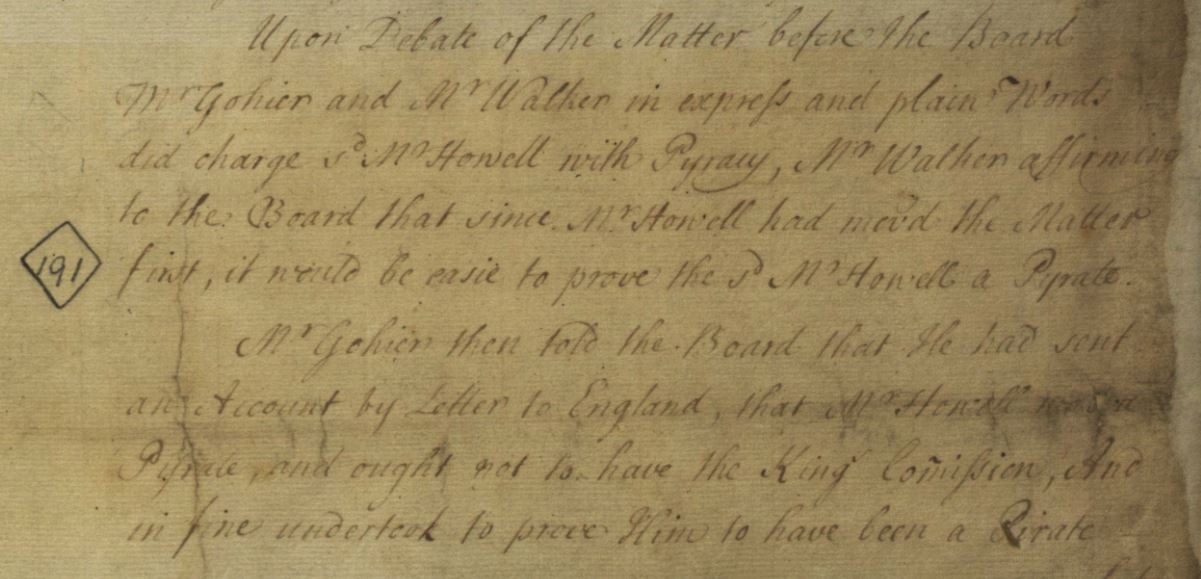
National Archives, London, CO 23/1 (1717-1725), 42 iii, Trial of John Howell, 18-29 December 1721
About the events of early 1717... 300 years ago:

Excerpt from Quest for Blackbeard, pages 306-311 (full trial transcript available in my website's "Pirate Library" ):

Capt. Musson’s kind words in support of former Admiralty Judge Thomas Walker’s alleged anti-pirate stance may have been somewhat forced. The later trial documents of John Howell in late 1721 tell a great deal about the pirates and their families of the so-called “Flying Gang” in 1717. Illuminated was their leader Benjamin Hornigold from Harbour Island, and his local nemesis, Walker, who had later occupied the position of Bahamian Chief Justice under the islands’ first royal governors Woodes Rogers and George Phenney. The evidence reveals that the Walker-Hornigold feud may have been more personal rather than official. While the Walkers had not been directly identified as pirates themselves, they, at least, benefitted from the practice – a legal definition of guilt under then current British law. Walker, in a haphazard attempt to damage a rival’s reputation, had inadvertently incriminated himself.

How a trusted, renowned Irish surgeon and former Councilman for Gov. Woodes Rogers, then serving in the island's Independent Company in Fort Nassau, a man known by many to have been captured by pirate captain Benjamin Hornigold off Florida early in 1717, and forced against his will to endure sailing with the pirate's crew twice, under guard, and well-known by his community to have never taken shares of pirate loot, became accused after three years of royal rule – of all things, piracy – is the question. The trial did not seem necessary, but two members of the governor's council accused him of this “heinous” charge: James Gohier and Thomas Walker, then Chief Justice of the Bahamas. These two angry men even wrote to England demanding annulment of Howell's commission. 


The trial occurred strategically at the change in government from Woodes Rogers to his successor George Phenney. Rogers had returned to England in financial ruin, as he alleged, a consequence of his opposition to piracy. Gov. George Phenney replaced him in November 1721 and was, thus, presiding over Dr. Howell's trial the very next month. 


Other members of the governor's council present for the proceedings were, of course, James Gohier and Thomas Walker, who had taken this opportunity of the change in government to oust their rival. Also present were Walker's son-in-law William Fairfax, Pedro Galfrido Parabow Skynner, Charles Wainwright Carrington, Nathaniel Taylor, Peter Courant, William Spatchers, Senr., Joseph Cookes, and Thomas Wood. Mr. Carrington noted the "charge of a grievous nature" and affirmed its likely truth with "I am the rather persuaded to believe it too true against Mr. Howell."  The testimony of every single witness, however, was overwhelmingly against Carrington's assertion of guilt and an obvious exoneration of Howell. By chance, a great deal of rich detail can be learned about Hornigold’s “Flying Gang” in 1717 and early the next year.
Mr. Gohier, one of the two men who had accused Mr. Howell of piracy presented four witnesses to the court to prove Howell's alleged guilt. The testimonies of Richard Noland, William Howard, Robert Brown, and Pearce Wright, as mentioned, all tended to exonerate Dr. Howell, not condemn him. 


Richard Noland, then "Inhabitant & Mariner of N[ew] Providence," Samuel Bellamy's former quartermaster and afterward, recruitment and financial agent for Hornigold, told the court that "He has known sd John Howell upwards of four Years when belonging to the Sloop Bennet, Beja. Hornigold Comander & Pirate...." Before Noland had joined Hornigold as his recruiting agent, he "then understood from one Pierce Wright Mariner belonging to sd. Sloop Bennet, that He sd Wright together with one William Howard Quartr. Msr. and others of the same Crew [had some months earlier] forcibly [taken] sd John Howell from on board a certain Snow belonging to Jamaica, [Benjamin] Blake Comander, to serve on board sd Sloop Bennet as Surgeon."  Noland, here, was mistaking the sloop Adventure, Hornigold’s former ship and the one he possessed at the capture of Blake’s snow, with the only one that he had known about after April 1717 – the sloop Bennet. He added:

Sd. Hornigold afterward took two Dutch Ships at what Time Mr. Howell was on board Sloop Bennet, But the sd Noland often heard Mr. Howell express a Dislike to the Pyratical Manner of the Living, and knows that sd Howell attempted several Times to escape but was too narrowly watcht, being the only good Surgeon whom Hornigold & Company had Dependance on.

Rd. Noland farther deposd that at the Time when the Bennet & Mary Ann Crew came from Harbour Island to Providence in quest of a Boat each wanting One, The Mary Anne Capt. Bonadvis Crew being very strenuous to take John Howell for their Surgeon; who had left Hornigold and livd then upon the Island, sd. Howell applyed himself to sd. Noland complaining that He would rather serve the English than French, if He was compelld to make choice of Either, Accordingly went with the Crew of Hornigold a Second Time but not without seeming Reluctancy.

Early 18th century map of New Providence Island, the Bahamas


Noland was merely Hornigold’s agent on Harbour Island and not a member of Hornigold’s crew at the time. He could not have witnessed certain events directly – only heard about them after the fact. Noland knew better the activities in the Bahamas where he lived. He provided seemingly damning testimony against his fellow residents Thomas Walker and his son Neal. This testimony was given openly and freely, without much thought of the conflict of interest it implied toward the former Admiralty Judge and Chief Justice Walker:
Rd Noland also observd that during his belonging to Hornigold, He saw one Hogshead of pyratical Sugar put on board a Sloop belonging to Neal Walker, And believes there might have been several More, for afterwards the sd Noland saw four or five empty Sugar Hogsheads on the Shore of a certain Key where Mr. Walker Senr. the present Chief Justice & Father of the sd Neal Walker then liv'd.
Noland indicated that the Walkers had at least traded with Hornigold, possibly through his agent Noland, for pirated goods. These goods had been stored on Thomas Walker’s own land, probably with his knowledge and similar to the actions of Jamaica’s admiralty judge earlier with Jenning’s goods and North Carolina’s officials later with Thache’s. The court then asked whether John Howell had received any share of pirated goods during his time on Hornigold's ship. Noland replied that he only knew of Howell accepting payment for his medical services for the “Cure of a free Mulatto belonging to Hornigold.”  

Benjamin Hornigold's, then Edward Thache's former quartermaster, William Howard testified next. Howard had barely escaped the hangman's noose more than three years earlier in Virginia. He returned to Nassau afterward. Five years earlier, about spring 1717, when Howard served as Hornigold's quartermaster, his boarding party, including Pearce Wright, first captured John Howell, who had since remained on Harbour Island and, later, in Nassau, New Providence Island.
Howard's testimony affirmed Noland's, that he was in charge of the boarding party off the Florida Capes, "with nine others arm'd went on board sd [Jamaican ship of Benjamin] Blake, and thence forced sd Howell with his Medicines to serve on board sd Hornigold."  Contrary to Gohier's and Walker's hopes, Howard proved to be an excellent witness for Howell's innocence. He added:

... that the sd Howell never receivd any Share for any Prize taken; But always entreated the Crew of Hornigold to put Him sd Howell on any Shore where there was any Government... sd Howell desird of H[ornigold] to permitt him to escape, but was not [allowed]. Howard also remember'd that when He and others aforesd. forct Mr. Howell from Captain Blake, that Mr. Howell desird sd Blake to do Him Justice in declaring to his Friends how He was forct. 
William Howard left Hornigold's employ late in 1717, perhaps when Hornigold and Thache briefly served as consorts off the Virginia Capes in October and just before Thache sailed to Martinique to intercept La Concorde or, the later Queen Anne's Revenge, by late November that year. He since served as Thache's quartermaster on QAR, and for which his actions since that time, he was tried by Virginia governor Alexander Spotswood and found guilty. He was barely saved by the king’s extension of an act of grace when he then returned to the Bahamas.

Artist's conception of QAR at Bequia, late Nov 1717

Neither of the next two witnesses were any help to the prosecution. Robert Brown had known Howell the longest, seven or eight years before when they were in Cork, Ireland together. He was on the Adventure when it captured Blake’s snow. Brown attested to Howell’s capture then and that he had never benefited from Hornigold’s piracy, in either of two sorties, as had the Walkers and Thompsons. Pearce Wright then affirmed his part in taking Howell from Blake’s ship. He also said that Howell had never taken prize money from Hornigold or benefited in any way.

After Gohier and Walker’s four witnesses for the “prosecution” had given their testimony, Howell presented his own; William Pindar, Robert Hawkes, Edward Carr, Neal Walker, Peter Courant, Richard Thompson, William Fairfax, Thomas Spencer, William Spatchers, Sr., and Thomas Barnett. These ten witnesses rang a resounding death knell to Gohier and Walker’s case against Howell. 


John Howell lodged with William Pindar on Harbour Island once he realized that Hornigold was not going to allow him to leave to go back to Jamaica, or leave with a recently trading Virginian vessel. Pindar, his father-in-law Thomas Barnett, and Richard Thompson all attested to Howell’s treatment under Hornigold. Pindar told of their near-assault by Bonadvis’s French crew in their home over a gallon of rum, but mostly they came to take Howell with them. Hornigold later toyed with Bonadvis over Howell, yet kept the surgeon for himself. Hornigold told Howell to get aboard his ship, to which Howell suggested that he would mix some medicines for him, but hinted that he would remain at Harbour Island and not go out with Hornigold’s crew on the next sortie. This angered Hornigold, who told Howell, “Get you on board You dog or I will mix your Soul!” 


William Fairfax, Thomas Walker’s own son-in-law, later regarded Howell as a gentleman, always opposed to piracy, whom he had met upon his arrival three years ago with Gov. Rogers. He said that he spoke with…

… sd Howell on board of his Majesty's Ships Milford, Rose, & Sloop Shark whose Comanders, Capt. Chamberlen, Whitney & Pomeroy sd Fairfax perceivd to receive and entertain sd Howell on board as a Gentleman whom they approved of, In a little Time afterwards Mr. Briett Surgeon of the Kings Garrison dying, Mr. Howell was recomended to Govr. Rogers as the fittest Person to Succeed Mr. Briett.
Chief Justice Walker’s own son, Neal, easily admitted to having been on Hornigold’s sloop Bennet. He saw a forced Howell being guarded there by nine of Hornigold’s crew. William Spatchers, Sr.’s testimony, however, accused Thomas Walker and James Gohier of bringing these proceedings for purely political purposes. He said:
… that if Messrs Gohier & Walker had not taken Quarrel wth Mr. Howell when He was One of his Majts. Council & assented with the Dty. Governor & rest of the Council to suspend Mr. Walker from being Ch. Justice for Reasons mention'd in the Council Book, and deeming sd Gohier & Walker otherwise than Friends to the Welfare of the Government, Mr. Howell would not after three Years serving his Majesty in publick Capacity been now accused of Pyracy by [them.]
After several days of testimony, essentially wasted time, an annoyed governor’s council made their recommendations to acquit Dr. Howell. They also demanded that a copy of this trial transcript be sent to England – probably demonstrating to the king the dreadful hypocrisy and malicious machinations of James Gohier and the chief justice. It undoubtedly proved that Howell was earlier justified when he recommended Thomas Walker’s removal from the Council before Gov. Rogers’ return to England. 


--------------------------


http://www.lulu.com/spotlight/bcbrooks


"Quest for Blackbeard" is available on Amazon, Barnes & Noble, Alibris, and other online booksellers. Look for it on my Lulu site at: http://www.lulu.com/spotlight/bcbrooks
 
It is already previewable on Google Books.

baylusbrooks.com

Saturday, January 14, 2017

Why do Poor White Voters Vote Against Themselves?

1898 caption from the Raleigh News & Observer - annotated by the author

Why do poor, rural, usually uneducated Southern white voters always vote against their own interests? Why did they choose a deplorable human being and alleged traitor like Trump to be their champion? This had to be an emotional reaction and it had to be because they hate Democrats. That is the ONLY reason. Otherwise, they'd vote against repealing healthcare that they desperately need. They'd vote against corporate control of our entire economy that's oppressing them. They'd vote against inequality. They'd be pro-labor (usually them). They'd be for raising the minimum wage, which is usually all they get. If they did not fervently hate Democrats as much as they do, they would vote for the things that Democrats usually represent and have won for them since FDR in the 1930s - things that Republicans now despise with a passion.

Would you be surprised to find that the most conservative party ever in America were Southern Democrats? But, they no longer exist. When did that change? What did the Democratic Party do that made these Southern conservatives want to cast their party away forever? What eats at these poor white voters? 

Two things: the first happened in July 1964 when a Democratic president from Texas, Lyndon Baines Johnson, signed the Civil Rights Act. Even LBJ knew that this act would change forever the political make-up of America. He told Bill Moyers immediately afterward, "We just gave the South to the Republicans," because he knew that the then Southern Democrats would not abide this betrayal of white-supremacy. Just ask your Southern neighbors how they feel about Johnson. Do they even know why they hate him?

Southern Democrats immediately switched to Republican after 1964 (see maps below). Matched with this first reason, LBJ also understood the mindset of the defeated Southern voter (defeated because of the old Civil War) - he said that "If you can convince the lowest white man he's better than the best colored man, he won't notice you're picking his pocket. Hell, give him somebody to look down on, and he'll empty his pockets for you." 

The solution for the seemingly unsolvable race problem since 1896 was segregation (an avoidance of the problem) and resulted from a fear of "Negro Rule" (see the cartoon from 1898)  - the separation of white and black in ALL areas - even drinking fountains, bathrooms (what is it with these people and bathrooms!?), and sidewalks! But the Civil Rights Act changed everything. Everyone now had to learn to exist together. This was extremely difficult and resulted in the destruction of a whole political party - the conservatively-rabid Southern Democrat. 

The second reason destroyed the allusion of LBJ's last quote: it was the untenable and unconscionable election of the Democrat Barack Obama as president - the dreaded NEGRO RULE, the straw that broke the camel's back - the greatest fear of the Southerner was realized. Even worse - from an abomination of white blood perverted with African. As to this subtle nuance, Toni Morrison wrote:
"William Faulkner understood this better than almost any other American writer. In “Absalom, Absalom,” incest is less of a taboo for an upper-class Southern family than acknowledging the one drop of black blood that would clearly soil the family line. Rather than lose its “whiteness” (once again), the family chooses murder." 
All white men were forced to look UP to a black president that they could NOT ignore - they couldn't pick Obama's pockets! Making matters worse, this abomination was eloquent and intelligent - a slap in the face to their delusions, deified by their Confederate ancestors who spilled their blood to prevent the Negro from rising! 

Yes... both are racist reasons. It is, has been, and for many decades still to come - racism, pure and simple - a deeply-rooted cultural pattern of "white privilege" now in danger of being eradicated - both demographically and culturally. As Toni Morrison explains:
And it is for these reasons — the imminent “collapse of white privilege,” as Morrison calls it — “that many Americans have flocked to a political platform that supports and translates violence against the defenseless as strength. These people are not so much angry as terrified, with the kind of terror that makes knees tremble.”
This, alone, trumped patriotism (to the United States at any rate) and explains why former Southern Democrats and their poor rural brethren across the states vote against their own best interests. They would take arms if they have to, as they did in 1861, when the Confederacy sided with the British to destroy the United States. They would rather die than see Democrats ever rule again - especially after Barack Obama! Russia would make an excellent partner in that endeavor... as the British did for the Confederacy...


Trump's  voters will never admit to us or anyone that THIS is the reason why most of them voted for him. But, it is. 

---------------------------------------

Interestingly enough, in my book, Quest for Blackbeard, I explain the meaning of Charles Johnson's quote about a faraway America and how radical it had become, treating "wickedness" as "Gallantry," resembling Toni Morrison's quote above and the reaction of white male dominance of which she spoke. Johnson's book, A General History of the Robberies and Murders of the Most Notorious Pyrates, was about America's infestations with pirates, a rather conservative phenomenon, as I explain. You can see where these pirates went after the 18th century, can't you?

Reviews:
 "... a masterpiece about the history of the South... While researching the origins of Blackbeard, Brooks has delved deep into the politics, family connections, worldly influences, sources of slavery, the connection between the Caribbean Sea and Virginia and North Carolina, and much more ... I am learning much about my own ancestry and origins and how the South came to be."  ~ V. Sumner
"This is an excellent history of piracy in general, as well as of Blackbeard the Pirate. The best part of it is that the author does not make copious use of Charles Johnson's questionable book, A General History. He relies instead on primary sources and he cites each one meticulously. The general theme of the book follows the world in which piracy began, but specifically, Edward Thache in that world. The author has discovered quite a bit about Blackbeard and that information dispels many myths that have survived the centuries. There is also a definite comparison of the politics in the West Indies with that of its ideological descendant, the United States. The book ends quickly, however, with the death of Blackbeard - but, it also ended the period of piracy that the author alludes to as having been the era of the gentlemen pirates from Jamaica and Bermuda. Thache was one of these pirates from Jamaica and his family history is explored in depth. Other pirates are also covered in detail. This book is remarkable in its different approach and refreshing writing style. Still, it's history and can be complicated at times. Still, I very much enjoyed reading it!" ~ J. Grandl


Sunday, December 04, 2016

Commonwealth of Pyrate's First Revolution


Read the quote above one more time. Those few words carry great meaning and may have been Capt. Charles Johnson's (pseudonym for Nathaniel Mist) crowning achievement in A General History of the Robberies and Murders of the Most Notorious Pyrates. Mist warned the whole of the British Empire of that insane world across the seas, that provincial wilderness of America – a lascivious world "beyond the lines of amity" that had long filled with villains and desperadoes kicked out of civilization – a collection of criminals who had completely lost all veneer of civilization. These people had forsaken God and goodness, king and country, privilege and right. 

“Commonwealth of Pyrates” alluded directly to America, a forsaken land where “Wickedness” equates to “Gallantry.” Americans, colonials, provincials, or simply... them envied this “Wickedness.” And, this commonwealth attempted its first revolt during the Golden Age of Piracy.

What went wrong in America? 

For nearly a century, America developed under the more imperialistic and conservative Stuarts. In 1688, the Glorious Revolution occurred and more liberal Whigs slowly came to power. Eventually, England's Parliament forced a German ruler to the throne, still trying to reduce the power of the monarchy and resist the old Tory conservatism of the Stuart Dynasty. Americans had been growing apart from their mother country for a century, but these actions accelerated the widening gap. They wholly resented the change. Britain began enacting legislation against piracy, but Americans resisted them. Americans still viewed their domain from the old Stuart perspective - militarily, a martial land of feudalism where Christianity became a force of evil intent upon subjugating slaves. They still revered and needed piracy. Americans frightened the liberalizing, civilizing world. They learned to depend upon and even worship their pirates and resent British efforts against them! The British rightly worried of the loss of their tremendous investment in America - a land previously stolen from Spain... and soon to be lost to the wickedness across the sea.


Even by 1700, Americans were no longer British...

The Johnson-Mist quote described a rogue population of criminality - indeed, England had exiled their criminal population to America for decades. The quote did not inspire patriotic unity under the Union Jack. At best, it expressed division. This evil, villainous band of miscreants across the ocean needed to be corrected – and their society as well. America had to be righted – brought to heel. Blackbeard and his society needed to face the king’s justice or be removed!  

Blackbeard may have been the George Washington of the first American Revolution... one that failed and devolved into rebellion...

None of the political speculation or depth appeared in A General History, but then, that might detract from its direct point – its ghastly charm - of America as a place where uncouth degenerates lived. The argument was easy to make that America had become an evil place - pirates and slavery were everywhere. Stuart conservatives continued to conduct their business without regulation. 


Nathaniel Mist wrote this book as historical fiction - and made some good points like this one - still, he sold the book as history, fact – a popular criminal biography based on recent events, and sold to a hungry audience of mariners sure to be at sea for weeks at a time. It was liberal propaganda to reduce piracy and its accompanying evils so that Britain could regain control. 

These travelers to the virtual "hell" across the seas had time to absorb his infectious words, craving entertainment, and would spread the word that pirates there were evil and "notorious." The propaganda would spread across the Atlantic community like a computer virus in software. The wild stories attracted the gullible masses and were often not subtle in their anti-historicity, despite lightly sardonic affirmations of sincerity. A General History was not a history. The ardent wordsmith found it useful to treat the numerous gaps in sources as a blank canvas on which to paint Blackbeard’s “black” infamy and delight his indiscriminate audience - to convince America not to follow pirates, many of them former privateers, into battle against Britain.

A General History delighted in and, yet, admonished Edward “Blackbeard” Thache – for a reason. According to Johnson-Mist, Blackbeard was born in Bristol. His rise begins sometime in late 1716, just prior to the Admiralty’s strongest efforts to put an end to American piracy and regain control over their foreign plantations in the wilds of America. His wealthy family descended from a substantial Anglican minister in Gloucestershire is never mentioned by Johnson-Mist. His service in the Royal Navy on HMS Windsor, totally neglected. His gentlemanly qualities were erased... and, today we assume that discovering pirates' pasts are almost impossible! But, this is simply not true. Quest for Blackbeard tells the past of several of these pirates...


British Anti-piracy efforts and Blackbeard’s simultaneous appearance were probably not coincidental. Johnson-Mist completely confused Thache’s entry into pirate history, perhaps intentionally. He probably knew more than he wrote about Thache’s past. Furthermore, Arne Bialuschewski had pondered the change in tone of the reports coming from the first and quite new colonial news media of the day: the Boston News-Letter. He suspected that propaganda probably infiltrated these news reports, especially the month after Burchett’s instructions against pirates to the colonial fleet – another coincidence? This author of A General History was also financially in trouble and seen as a likely candidate for recruitment by Secretary Joseph Addison’s patron, Lord Sunderland and the Whig ministry, then in charge of Britain. 

Obviously, Britain's efforts only worked for a short time... by 1776, America declared independence on more solid ground and this time, beat the liberal Whigs soundly!


For whatever reason, A General History took great license to alter history and turn Blackbeard, and other conservative American heroes, into villainous monsters. It was an easy transition, though. Still, the book's continued use is a serious problem in history today.

Propaganda is a serious problem in any century. A General History has long been extolled as a reliable source, but it cannot be. The book isn't even necessary for telling pirate history. Johnson-Mist’s sources for his historically-accurate segments are available elsewhere – he used the same sources that we would today. He used the same sources that I used to write Quest for Blackbeard; though, thanks to modern advances in technology, I had many more. The part that annoys all historians, including myself, is that perhaps not all of the sources he used still remain. Still, taking into consideration the liberties, obfuscations, and outright lies that Johnson-Mist used intermingled with the facts, perhaps it is best to largely ignore his book as a historical source and rely upon the primary sources still available. 


After all, America, like its pirate heroes, is concerned with profit... not the truth.

-------------------------------------------------------------


"Quest for Blackbeard" has finally been approved for Global Distribution which means that it will be available on Amazon, Barnes & Noble, Alibris, and other online booksellers very soon. Look for it on
my Lulu site at: http://www.lulu.com/spotlight/bcbrooks
 

It is already previewable on Google Books.