Donate to Brooks Historical

Saturday, May 06, 2017

Brief History of American Violence


Many folks criticize me for the assertion that Pirates of the Caribbean actually founded America's Deep South through Carolina and, ultimately, infected the whole country with their extreme conservative ideology. Remember the Civil War? What about the recent presidential election? Guess where the conservative anti-government theme comes from...

This should, however, be rather obvious to most historians. I'm sure it is to Richard Dunn, author of Sugar & Slaves,  author Douglas R. Burgess, Jr., of The Politics of Piracy, and especially to Colin Woodard, author of American Nations.  This is especially obvious when you truly see pirates for who they actually were, instead of just reading about "alternative" pirates in Robert Louis Stevenson novels or in 300-year-old texts written in London by a man with an agenda - no, not a politician - but, a "running mouth" who owed money to politicians.

"Alternative" Pirates of the 18th century "fake media"

A "pirate" was generally a sea-going vessel run by a crew who raided and stole from you - your government and its citizens - yes, sometimes the other guy's, but you only cared about yours - that's very important. Only those personal-affecting marauding types were called "pirates." Now, "you" might mean English, Spanish, Dutch, French, Portuguese... even Swedish! Your own "pirates" were called "privateers" and you generally loved them - yours, I mean - not the ones who preyed on you! Everyone fought like cats and dogs to steal each others' stuff... for centuries! Not only did they get their stuff taken, but they died a lot, too.

Consequently, the West Indies was a maelstrom of all of these governments vying for the gold, silver, sugar, and slaves concentrated there. It was like a gigantic factory where all the companies competed against one another on a daily basis - in the same building - while taking each others' profits! Pirates were once greatly needed to steal from other companies/nations and they even invigorated heroic visions among their thieving descendants. Sir Francis Drake, Sir John Hawkins, Sir Henry Morgan and many others were often knighted flamboyant treasure-seekers - especially even Morgan, who held an official office of power in the West Indies. Morgan was once governor of Jamaica some years after the English conquest of 1655 - a colony stolen from Spain, of course.

Sir Francis Drake being knighted by Queen Elizabeth

Needless to say, only the roughest, most ruthless, unprincipled corporate-types were successful in the American business of piracy and its cousin, chattel slavery. Every man in America with a ship, sloop, or even a canoe and the know-how to navigate probably committed piracy at one time or another. This is important: only educated gentlemen of some stature were capable of the math necessary to navigate. Pirate captains and many of their crew were not born poor folks! Most of these unprincipled ruthless gentlemen were cast out of England for various reasons, usually religious (Anglicanism played a significant role - if only to alleviate the guilt of slavery) or criminal, especially after the Jacobite Rebellions. This may have affected any links they may have had to their original family fortunes, but America offered great treasures in gold, silver, and slaves! Rebellion paid well!

"Beyond the line..." of Civilization

The Brits had a saying for this faraway lucrative "Frankenstein" creation of theirs - "anything was possible beyond the line in America," referring to the southwest quadrant of the Atlantic community - specifically Southern America and the West Indies. This meant that any deprivation, no matter how disgusting or reviled it would be in European civilization, could be conducted with impunity across the Atlantic - "over there" - as long as it wasn't brought back home. This continued for centuries and became well-ingrained in a newer more unique American culture.

Nathaniel Mist, the controversial Jacobite polemicist who wrote as "Capt. Charles Johnson," even called America the "Commonwealth of Pyrates," in print! He did this most likely because Lord Sunderland threatened him, but the appellation was still appropriate. 

Now, you can imagine how a growing population of outcast conservative rebel gentlemen, with multiple generations in America and Stuart politics firmly planted in their psyche, might view their "mother country," right? From 3,000 miles away in England -  too far for the government to mount a serious opposition? They dallied a bit with the idea of separation... especially in Barbados during the Interregnum or Parliamentary rule when the Stuart king's head was removed and his son and heir kicked out - Stuart rule was re-established in a short time, after the son came back from France. The Interregnum only lasted eleven years - a bit longer than a two-term American president. Still, the Interregnum proved that the world did not explode when you chopped off a king's head. It also gave Parliament a taste of what government could be like without a monarch controlling everything like a dictator!

Liberal Reform and Cultural Divergence

Now, imagine that the formerly unprincipled (and already weakened by distance) government that once created an unprincipled America in its own Stuart image began to fall from power in England itself -  they were replaced by Parliamentary reformers of a more liberal persuasion. Parliament, growing ever more powerful, finally ousted the elite Stuarts, rejecting their heir to the throne, James III, and replacing him with a "Dutch dog," as one American referred to him, Protestant Dutchman William of Orange.

Suppose these reformers then passed anti-piracy legislation following that Great Revolution of 1688? Rules such as proper flag use on vessels so as not to fool an adversary (favorite pirate tactic), new regulations involving condemning prizes, wreck salvage, reinforced tax laws, etc. - and, they expected Americans to abide by these regulations - regulations designed to handicap their success and profit! How did these piratical Americans see their liberalizing, weakening "mother" once she began to betray their conservative Stuart principles and time-honored practices - like their beloved piracy?

Edward Randolph, colonial administrator, understood all too well! He fought for revocation of politically corrupt private colonies like Carolina, the Bahamas, and the Jerseys - colonies run by wealthy aristocrats who never left their comfortable homes in London or other great estates. Lord Carteret, for instance, carried on a strong political rivalry with one of the Whig reformers, Sir Robert Walpole, known as England's first prime minister. Randolph scorned the Stuart or Tory abuse of power and privilege of men like Carteret, and the careless allowance of the colonies to hold Vice-Admiralty courts over themselves - how could pirates try pirates, he argued?

From an outside perspective, South Carolina, one of Randolph's favorite reform projects, appeared to respond to reform measures. This was, however, only superficial at best. Their merchants had no intention of reforming, but merely responded to being picked on so heavily and personally by pirates since 1717. After all, it was James Moore, a former governor of South Carolina, who had recently said in court that “Mr. [Peter] Painter having comitted Piracy & not having his majesties Pardon for ye Same [meaning South Carolina's permission].  Its resolved he is not fit for that trust.”

South Carolina, founded in 1671 by the "Corporation of Barbados Adventurers" to "Conquer and Dominate the World," once viewed piracy as a "trust" - not at all a crime! How reform-minded were they in 1717? Not really - just pissed, actually. Americans adored their pirates as well as their conservative political ideology. I wrote American Pirates in the News! telling of how even the word "pirate" was never used in a colonial newspaper in reference to Englishmen until 1716. England, however, used the term regularly in their records and newspapers. Again, they were 3,000 miles away from the land "beyond the line," in the "Commonwealth of Pyrates," a land where even the governors dealt in stolen goods with men like Edward "Blackbeard" Thache, Henry Jennings, and Benjamin Hornigold. Even the Puritanical north had been affected by the pirate William Kidd in 1699. Gov. Samuel Cranston had bartered with him for gold and jewels from a Red Sea raid.

South Carolina administrators' open policy on piracy had changed only a little - and only when it interfered with their profit. Merchants' property had been taken, their ships prevented from leaving harbor, at least three times by pirates Stede Bonnet, Edward "Blackbeard" Thache, and Charles Vane... it was threatened a fourth time by Richard Worley, but by then, South Carolina's merchants had had enough. Their "privateers" sought Vane, captured Bonnet, and killed Worley in their harbor, both of his ships confiscated. There was nothing personal about any of this, you understand - only business!

Stede Bonnet was to be tried by their Vice Admiralty court. But, before that could happen, a local resident of South Carolina, Richard Tookerman, a wealthy man with an estate in Goose Creek, several slaves, and owner of two ships, broke Stede Bonnet from jail. He loaned him a canoe, two slaves and ammunition to get away from Charles Towne - at least until they cooled off!

South Carolina's official administrators, sent from England, might have been more upset than the locals - residents who helped Bonnet, like Richard Tookerman of Goose Creek, a pirate himself, referred to notoriously by Woodes Rogers, governor of the Bahamas. Remember, Rogers came from England to clean up the Bahamas' pirate nest.

Americans in general, still revered their pirate heroes and dealt regularly with pirates and their illicit goods, available to an often disenfranchised destitute people for pennies on the pound. Wealthy men like Tookerman were the upper crust, the 3% merchant class of landed, rich, and voting South Carolinians - men who desired to live their lives in the style of their own heroes: Drake, Hawkins, and Morgan, early thieves, slavers, and murderers of America! Corruption was simply the norm. South Carolina usually looked the other way when you had power, influence, and money.

In fact, a great many of those pirates, men who once sailed with Thache, Hornigold, Rackham, Vane, Burgess, Nichols, Napping, and many others, who surrendered in the Bahamas to the Rogers administration, came to privately-run South Carolina afterward. They knew that they could retire there with their illegally-acquired wealth - even continuing to pirate treasure from their new base - with permission, of course. That "permission" entitled South Carolina to a cut of the booty.

Thomas Porter, brother of Daniel Porter, and former master of the pirate vessel Mayflower (then captained by his brother), came to South Carolina in 1718 in the company of a surrendered pirate, Othniel Davis. Porter had earlier purchased a South Carolina estate of over a thousand acres from the Bahamian customs collector John Graves - probably while conducting pirate raids with Benjamin Hornigold in Bennett late in 1717. He settled there while Davis became a commissioned privateer for South Carolina and went on to become another great American hero, destroying Spanish privateers in 1719 and 1720. Who knows what money he collected on the side... or how?

This excerpt from Quest for Blackbeard illustrates Thomas Porter's wealth and South Carolina's ingrained corruption:
Consequently, the will of Thomas Porter of Colleton County, South Carolina, planter (11 Sep 1755-12 Oct 1755) appears rather interesting. Porter appeared to begin his family in the mid-1720s, as his pirate career wound down. He purchased his 1,036-acre plantation in Colleton County from an aged John Graves, former collector for the Bahamas who argued fervently for Resumption of private charters for two decades, 1697-1717, and died soon after Woodes Rogers arrived as the Bahamas’ first royal governor. Porter served on a SC Grand Jury in 1740. In his will, he mentions 100 acres of land at Beechill that borders Richard Be[a]don, son of George and brother of Stephen Beadon, who claimed the slave Peter from the effects on board Stede Bonnet’s Revenge when Richard and Katherine Tookerman claimed their slave Ned Grant. He also refers to two houses and fifty acres near Dorchester. Porter was rather wealthy at the time of his death. The slaves York, Phillis, and Caser [Caesar], he left to his wife Elizabeth along with the Beechill estate. His eldest son Thomas received half of the old Graves land, along with “wearing apparel: my Gold Buttons, my Gold Buckles, my Gold headed Cane, my sword & other of my Weapons of War,” and a mulatto boy named Elick with the assorted silver in the house. George received the other half of the main estate. His daughter Elizabeth acquired “one necklace of Pearl with a Gold Locket, one pair of Gold shoe Buckles, one Diamond Ring,” a gold crop, a prayer book, and £2,000. His daughter Mary received a similar collection of gold and jewels. Thomas Porter, Bahamian ship owner and repeat-offender former pirate, later upstanding South Carolinian, was not, by any stretch of the imagination, a poor man.
America’s Deep South, the later Confederacy, came into being with Carolina whose Barbadian founders even then fully intended to fill the land with rice and slaves. The sugar islands and the wealth that they generated contributed significantly to Carolina, intended as a "breadbasket" of sorts to a West-Indian colony who sugar crop was too lucrative to grow food! Driven by the profits of a lucrative West Indian sugar production, laissez-faire capitalism also developed “with the convergence of agricultural improvements, global explorations, and scientific advances.” America became independent and resented government control from a nation that no longer served their interests.

So, as you can see by Porter's will, in the Deep South of the "Commonwealth of Pyrates," crime paid pretty well! Ask any corporate CEO how it pays today - remember that "crime" - to you - is defined by your own country's laws and your own cultural influences. America called the shots after 1783 - and, it's written history reflects the new power structure.

Carolina was not the glorified and gilded fantasy, ordained by God, often displayed in early history textbooks, with Stevenson's visions of imaginary "alternative pirates" diverting criticisms of America's corporate ancestry. It was an often overlooked and religiously-justified immoral and bloody affair, a crime by any other name. Woodard wrote:
Scholars have long recognized that cultures organized around [chattel] slavery rely on violence to control, punish, and terrorize—which no doubt helps explain the erstwhile prevalence of lynching deaths [see map] in Deep South and Tidewater. But it is also significant that both these nations, along with Greater Appalachia, follow religious traditions that sanction eye-for-an-eye justice, and adhere to secular codes that emphasize personal honor and shun governmental authority. As a result, their members have fewer qualms about rushing to lethal judgments. 

Woodard, in his book, painted Deep South slave society as “a system so cruel and despotic [that it] shocked even its seventeenth-century contemporaries.” He further clarified that it has remained a “bastion of white supremacy, aristocratic privilege, and modeled upon the classical Republicanism of the slave states of the ancient world.” Moreover, they practiced a religiously-justified plantation economy based upon slave labor - modernizing a brutal Stuart conservative-Jacobite culture in every sense.

Wealthy English corsairs and businessmen perpetrated heinous deeds from Carolina's shores, not unlike the Crusades of the Middle Ages: Spain’s territory invaded, their treasures stolen, Dutch and French trade and lands forcefully bootlegged, and Africans, Indians, and even Europeans murdered, mutilated, and/or enslaved. Of course, the fact that the Spanish, French, Dutch, etc. committed their own crimes against the English often rhetorically justified those of the English, citing their own "gentler treatment" as a sign that they most deserved God's blessings!  One’s “adventurer” is another’s “criminal,” just like one’s “privateer” is another’s “pirate.” And, the violence continues...

----------------------------------------------


"Quest for Blackbeard" is now available in ebook format and can be found on Amazon, Barnes & Noble, and other online booksellers, including Apple iTunes.

Quest is already previewable on Google Books.

baylusbrooks.com


Thursday, April 27, 2017

Johnson's Alternative Pirate Facts!

The Board of Trade and Plantations in London, c.1808
Most of us think of the wheels of government as slow. America and its irascible author and humorist Mark Twain had a particular disgust with Congress! Before the Monday Evening Club in Hartford in 1873, Twain reflected a rather common view of Congress:
It [the press] has scoffed at religion till it has made scoffing popular. It has defended official criminals, on party pretexts, until it has created a United States Senate whose members are incapable of determining what crime against law and the dignity of their own body is—they are so morally blind—and it has made light of dishonesty till we have as a result a Congress which contracts to work for a certain sum and then deliberately steals additional wages out of the public pocket and is pained and surprised that anybody should worry about a little thing like that.
Twain likened Congress to thieves or bandits. We can't truly call them pirates since "piracy" is conveniently defined as "theft at sea." I guess Twain could say that Congress are the equivalent of pirates on land.

This opinion of Congress or government in general as crooks may not have been so fervently held in England as it is in America, at least not at the time of actual pirates in the Golden Age of Piracy. Their Board of Trade and Plantations had acted rather like any politicians. Truly, these petitioners whom you are about to meet were 139 experienced fighters on the sea who may be useful in the new war against Spain, the War of the Quadruple Alliance, as we now call it. That should have prompted a quicker reaction from the Board.

Carter Lane in London. By Gary Davis
Still, there are many varieties of pirate. Literary Pirates occasionally used the written word to assail their opponents. There was no one more effective at such word play as Nathaniel Mist, the controversial Jacobite newspaper publisher of the Weekly Journal and Saturday Evening's Post in London with offices on Great Carter Lane, not far from the government offices at Whitehall.

Mist wound up in jail on numerous occasions and was repeatedly fined for his attacks upon the king and his government. Mist was known to borrow our government's modern practice of "alternative facts" from time to time in these attacks - carefully crafted lies that were not so easily discernible to the average reader. Admittedly, he was much better at it than our current administration.

A little know "real" fact is that Mist also wrote a book about pirates under a pseudonym, Capt. Charles Johnson. This book was called A General History of the Robberies and Murders of the Most Notorious Pyrates, long thought to have been penned by Daniel DeFoe, who actually worked for Mist at one time - in fact, DeFoe was hired by the British government to calm Mist's printed libeling of the king. A General History was published twice in 1724, the second time with numerous alterations.

Johnson-Mist introduced us to the 139 trained seamen of whom I referred. One of his "alternative facts" shows up subtly in his passage on pirate Capt. Thomas Anstis: 
This being approved of, it was unanimously resolved on, and the underwritten Petition drawn up and signed by the whole Company in the Manner of what they call a Round Robin, that is, the Names were writ in a Circle, to avoid all Appearance of Pre-eminence, and least any Person should be mark’d out by the Government, as a principal Rogue among them.

 To his most sacred Majesty George, by the Grace of God, of Great-Britain, France and Ireland, King, Defender of the Faith, &c.

The humble PETITION of the Company, now belonging to the Ship Morning Star, and Brigantine Good Fortune, lying under the ignominious Name and Denomination of PYRATES.
Humbly sheweth,

THAT we your Majesty’s most loyal Subjects, have, at sundry Times, been taken by Bartholomew Roberts, the then Captain of the abovesaid Vessels and Company, together with another Ship, in which we left him; and have been forced by him and his wicked Accomplices, to enter into, and serve, in the said Company, as Pyrates, much contrary to our Wills and Inclinations: And we your loyal Subjects utterly abhoring and detesting that impious way of Living, did, with an unanimous Consent, and contrary to the Knowledge of the said Roberts, or his Accomplices, on, or about the 18th Day of April 1721, leave, and ran away with the aforesaid Ship Morning Star, and Brigantine Good Fortune, with no other Intent and Meaning than the Hopes of obtaining your Majesty’s most gracious Pardon. And, that we your Majesty’s most loyal Subjects, may with more Safety return to our native Country, and serve the Nation, unto which we belong, in our respective Capacities, without Fear of being prosecuted by the Injured, whose Estates have suffered by the said Roberts and his Accomplices, during our forcible Detainment, by the said Company: We most humbly implore your Majesty’s most royal Assent, to this our humble Petition.

And your Petitioners shall ever pray.
This Petition was sent home by a Merchant Ship bound to England, from Jamaica, who promised to speak with the Petitioners, in their Return, about 20 Leagues to Windward of that Island, and let them know what Success their Petition met with. When this was done, the Pyrates retires to the Island before proposed, with the Ship and Brigantine.

This Island (which I have no Name for) lies off the Southwest End of Cuba, uninhabited, and little frequented. On the East End is a Lagune, so narrow, that a Ship can but just go in, tho’ there’s from 15 to 22 Foot Water, for almost a League up: On both Sides of the Lagune grows red Mangrove Trees, very thick, that the Entrance of it, as well as the Vessels laying there, is hardly to be seen. In the Middle of the Island are here and there a small thick Wood of tall Pines, and other Trees scattered about in different Places.
Johnson-Mist goes on to explain how these crews survived on that Cuban island for nine months, eating mostly four different kinds of turtle. He even went into a long excerpt from a mock trial that they supposedly portrayed to amuse themselves. How he could know these details is a good question. Mist may have spoken to some of the defendants in jail - if he had that much energy.

Johnson-Mist said they stayed on this Cuban island for nine months, awaiting an answer to their petition, and that they eventually went into the Windward Passage in search of a ship from London that might have news of the answer to this petition. As Johnson-Mist wrote, "The beginning of August 1722, the Pyrates made ready the Brigantine, and came out to Sea, and beating up to Windward, lay in the Track for their Correspondant in her Voyage to Jamaica, and spoke with her; but finding nothing was done in England in their Favour, as ’twas expected, they return’d to their Consorts at the Island with the ill News, and found themselves under a Necessity, as they fancied, to continue that abominable Course of Life they had lately practis’d."

So, Johnson-Mist declared that the pirates did not receive an answer. The crews of the Morning Starr and Good Fortune left Bartholomew Roberts in April 1721, waited on a Cuban island for nine months, until January 1722... no... wait... he wrote "August 1722." That's 16 months from April 1721!

What Johnson-Mist did not know was that the crews of the Morning Starr and Good Fortune might have left Roberts in April 1721, but they did not submit their petition until 28 April 1722 - to Nathaniel Lawes of Jamaica... wait again... they supposedly gave the petition to a "Merchant Ship bound to England, from Jamaica, who promised to speak with the Petitioners, in their Return, about 20 Leagues to Windward of that Island." They didn't actually speak with the governor himself - did they?

Wait again... 20 leagues to windward? Of Jamaica? Why, that's not in the Windward Passage! What the hell?


All of this confusion exists because Nathaniel Mist "alternative-facted" or lied - as usual. In my opinion, he didn't even seem to have the common knowledge of a seaman familiar with the West Indies.

It was not unusual for writers in the early eighteenth century to lie or to copy other written work and republish it as their own - with conveniently "rearranged" facts or "alternative facts" more inclined toward their agenda - in essence, plagiarize it. American government officials and their wives are not the only ones who ever thought of plagiarizing.

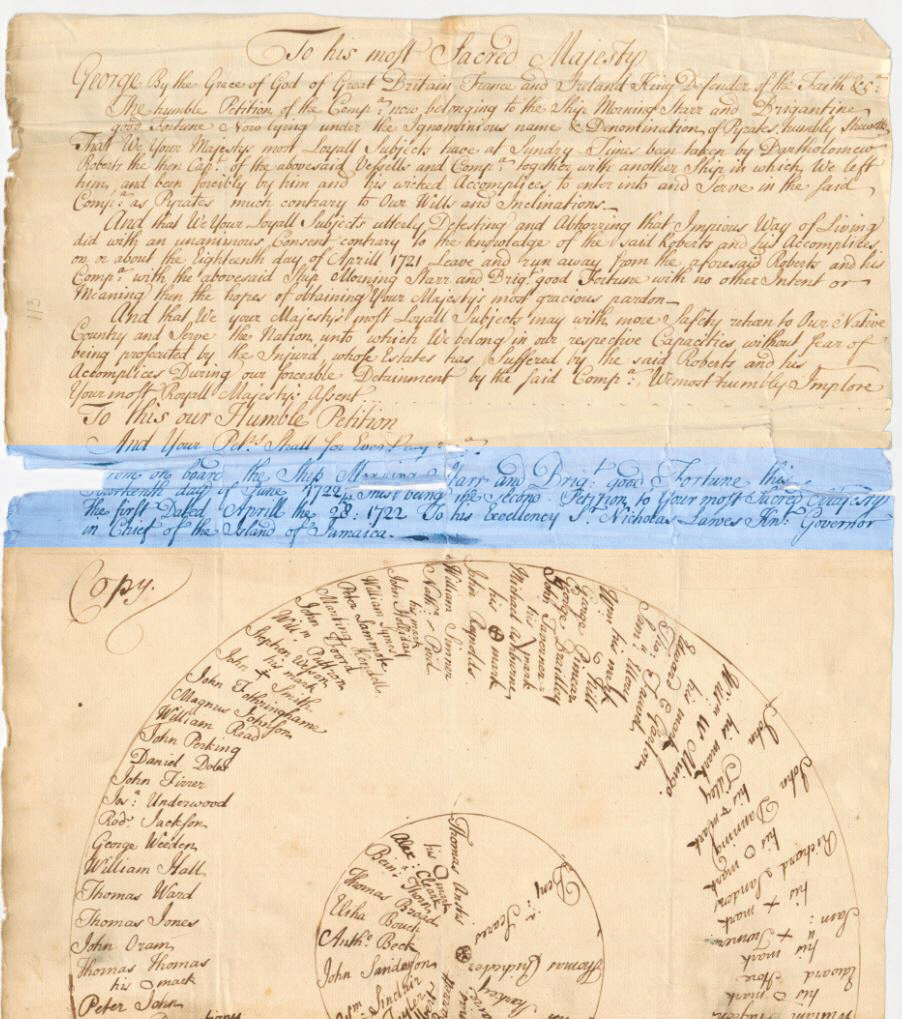
The crews of the Morning Starr and Good Fortune sent their petition to England probably through Gov. Lawes' connections. The answer would of course be delivered to Gov. Nathaniel Lawes himself. They probably had it sent through the usual communications of Lawes with the Board of Trade. That's why the copy of the petition and its reply are found to this day in CO 323/8, the repository in England for letters from governors whose names began with an "L":

Portion of Pirates' Petition in CO 323/8 - interestingly, about 80% of the pirates shown in this round robbin could sign their own name, a possible indicator of literacy not normally believed about mariners of the day.
Even though the paper is torn in the middle part of the petition copy above in blue, one can still make out:
X x x x x paper torn x x x x Starr and Brigt. Good F x x x x x
Fourteenth? Day of June 1722 This vangs x x x x x tion to Your Most Sacred Majesty The First Dated April the 28th: 1722. To His Excellency Sr. Nicholas Lawes Knt. Governour in Chief of the Island of Jamaica.
This copy was made for recording the Board's and the king's answer to these pirates - to be kept in their records - in London. Yes, this is just down the street a bit from Great Carter Lane. The date of 14 June 1722 is the date that it was officially transmitted to the Board and recorded and that date could not have been much greater than two weeks after they received the petition from Lawes! Pretty spiffy for government work, hey? Well, let's not get excited...

Did Nathaniel Mist, the controversial Jacobite polemicist who wrote under the pen-name "Capt. Charles Johnson," see this petition, but not see who relayed it from the West Indies?

England actually got the petition and answered it, addressing the reply to Gov. Lawes - but well after December 1722, as the Board still deliberated with West Indian merchants at that time. A later deposition tells the pirates waited eight months - from April 1722! That would be December 1722 - still not enough time to get the laborious answer. Mist wrote his book and published it in May 1724, then again, with many modifications in Dec 1724. Still, all of this petition parley was said and done by then.

But, still... if Mist had found the original petition, why had he not asked about the Board's deliberations and answer? Was he not welcome in their offices and forced to rummage their trash for bits and pieces and just found the original petition, no longer needed by the Board? Considering his reputation... very possible!

Most likely, he had access to their records, or at least a source on the Board who would speak with him. He obviously had found a copy of the petition itself - to copy it so precisely into his book. He most likely saw the Board's copy and their answer to Gov. Lawes. But, Mist never mentioned Lawes. Did Mist just ignore the part in blue above, assuming that he saw it? The part about Gov. Lawes? If he saw it, then why did he stop his transcription just as he came to this part? Did he want his readers to know that Lawes was involved? That the petitioners may actually have gone to Lawes instead of this clandestine route - more piratish in execution? More desperate in literary terms?

He should also have seen the answer to the petition immediately following it:

Also in CO 323/8 appears the answer, immediately following the copy of their petition.
The long-awaited answer was "YES!" The pirates received their pardons:
To the Right Honoll. Lords Commissioners for Trade and Plantations

Whereas Your Lordships [Admiralty?] have Communicated the Coppy of a Petition addressed to his Majesty on behalf of the Company belonging to the Ship Morning Star and Brigantine Good Fortune, dated the 14th June 1722. Alledging themselves to have been Forced by Bartholomew Roberts and his Accomplices to serve as Pirates which Impious way of Living the said Petitioners utterly detest and Abhor and praying his Majesties most Gracious Pardon.

Wee the Underwritten in Case his Majesty of his Great Wisdom and Compassion, shall think Fitt to Signifie by Proclamation his Gracious Pardon to these and mo x x others here being, or deemed, or taken to be Pirates as Shall Conforme to the Conditions in such Proclamation to be incerted, do hope that his Majesties Grace Extended to those Offenders will not be attended with any evil Consequence to Trade of Navigation but on the Contrary prevent Many Mischiefs which may otherwise happen.
Unfortunately, there is no date on the document, but Mist didn't print it either. He wanted his readers to believe that these pirate rogues and scoundrels were totally on their own - brigands against the world! Oh, the tragedy and hopelessness of the poor, "notorious" pirate!


Of course, what they would have done with these pardons was unpardonable. They remained on the account, were arrested a couple of years later, and executed. So, the story may actually have worked out for Mist no matter what happened.

At their trials and in their depositions, they mention that the crews of the Morning Starr and Good Fortune waited for their answer - not on a Cuban Island with four kinds of edible turtle, but rather on the Island of Roatan at the Bay of Honduras, where many a Jamaican ship came to gather logwood - the quicker to hear about a response from Jamaica no doubt.

Mist had read their depositions, too... or, at least one of the depositions made by Thomas Lawrence Jones, Bridstock Weaver, William Whelks, and Henry Treehill, all men whose names appeared on the petition above. Still, Johnson-Mist mentioned Thomas Anstis as captain, John Fenn as captain, a Phillips as carpenter - all men whose jobs were not mentioned on the petition itself, but only in the depositions. How did he know that? Unless he read the depositions from 1723 and 1724, especially the one by Treehill. All of those petitions also told about the Island of Roatan... nothing at all about a Cuban Island with turtles.

At best, Nathaniel Mist or "Capt. Charles Johnson" was lazy with his facts - you might even say "alternative facts!" Yeah, he probably just outright lied... um, like Congress! Certainly, the wheels of government have always been indescribably slow. Somebody tell Mark, would you? ;)


-----------------------------------------

http://www.lulu.com/spotlight/bcbrooks


"Quest for Blackbeard" is now available in ebook format and can be found on Amazon, Barnes & Noble, and other online booksellers, including Apple iTunes.

Quest is already previewable on Google Books.

baylusbrooks.com

Tuesday, April 18, 2017

Pirate Trials and Wasting Precious Paper!

Fallout with Iron Gall ink use.
Iron gall ink is the typical ink used on older documents, especially official documents. The long-term mal-effects have only been noticed decades or centuries later, such as the acidic properties that eat holes in the paper where the ink was applied - as you can see in the document to the left. As a paper conservation specialist, I can tell you that there is a relatively easy solution to neutralizing this acid and preventing "fallout" or "lacing."

Most useful, however, is its waterproof qualities. If you got a deed to some property, you might walk the property with deed in hand to see where your boundaries were. You may also drop your deed into a creek, or leave it on a stump under a rock when a rainstorm came along. Either way, and without modern waterproof amenities, you could lose the legal document giving you rights to that land. Thus, iron gall ink was used to prevent the loss. 

Iron-gall ink was used routinely, especially in court documents and other important papers, like Admiralty Court records. 

I have made iron gall ink before. It's not hard, really. You need a source of iron, like rusty nails - in my case, I used an iron vitamin supplement - can't beat the modern age! Put said iron into a bottle with a little water and tannic acid, easily obtained by crushing one of those round oak galls you find on tree branches. The round, odd-looking galls are created by wasps interacting with the tree and they're loaded with concentrated tannic acid (see? wasps do have a purpose!). Of course, you could also buy some tannic acid in powder form from a chemical supply house. It's a mild acid, like vinegar - not controlled - so you won't need a license and you could even get it on you with no ill effects.

Still, in the 18th century, tannic acid was easy to produce. The hard part was the paper...

Once made, you have to have something to write on with your iron gall ink. You could write on animal skin or parchment, but for the daily routine, mundane, boring, work of the colonial scribe who went through a lot of paper, he used cloth-made paper. Yeah, I said "cloth." You thought I was going to say "wood pulp," didn't you?

As Roseanna M. White tells in her description of paper-making, "Paper, in Colonial days, was like most things: precious, and coming as a result of much toil." If you've ever been to Colonial Williamsburg, you probably saw a demonstration about paper-making, with giant vats of bleach water and cloth pulp, wood and metal screens that you run through the water to collect the pulp, drying and pressing, etc. - a lot of messy, messy work!

You wouldn't want to waste this paper - would you? 

 So... 

What's up with the clerk or clerks of South Carolina's Vice-Admiralty Court!? I say "clerk or clerks" because the style varies a bit. Charles Hart was the clerk of the general court and Marshall Thomas Conyers may have helped out as clerk for the Vice-Admiralty Court. It would make sense - especially because of his age.

Conyers was one of those gentlemen who participated in the rebellion of the Duke of Monmouth in 1685 against then king, James II. At the time, Conyers was 47 years old, born in Barton St. Mary, York, England to Johannes Conyers. For his impertinence, the anti-Stuart rebel Conyers was cast out of England, 3,000 miles away to America, ironically filling with Jacobite, or Stuart-loving rebels - like many pirates. 

By the time of Richard Worley's pirate sloop's condemnation trial 17-30 Dec 1718, he was 80 years old! And, this particular clerk, who may have been Conyers, wrote "mencõn" for "mention" or "intentõn" for "intention" and such older 17th-century Latin styles in the trial records. Conyers may not have written these, but an older gentlemen most likely did. 

Moreover, these clerks wasted paper! Most scribes, clerks, and other officials wrote long, drawn-out passages in their deeds and official records that we call "legal-eeze," but this particular older clerk excelled at it! This must have been the most boring guy in America! Maybe it isn't Conyers - I just can't see him picking up a pistol and pike to fight in a rebellion! 

Check out this passage:

Example of Conyer's style. Note the "bleed-through" of the iron-gall ink that can make transcriptions pure hell!
Mr. Hume then moved that Doctor Hutchinson might enter into the Usual Recognizances which was don.

Mr. Allein then moved Interogatories on the part of the Captors Arthur Loan &t and the Depositions of Nathaniel Oade and Thomas Willard might be read & filed which was Ordered Accordingly

Mr. Allein then moved that the Judge would pronounce the Decree which Decree is as followeth.

Then the Court Adjourned till further Sumons

In the name of God Amen Whereas at a Court of Vice Admiralty holden before me Nicholas Trott Esqr. Judge of the Said Court the Seventeenth day of December In the Year of our Lord One Thousand Seven Hundred and Eighteen at Charles Town in the Province of South Carolina Arthur Lone Comander of the Ship Mediterranian Galley &c; John Mason Quarter Master and Agent for the Said Ship's Company John Watkinson Comander of the Ship King William & Lyonelle Wood Quarter Master and Agent for Same Ship's Company, John Masters Comander of the Sloop Revenge and John Smith Quarter Master and Agent for the Said Sloop's Company and ffayrer Hall Comander of the Sloop Sea Nymph and John Howard Quarter Master &c
[Masters and Hall, with Col. William Rhett, also captured Stede Bonnet a few months earlier]; Agent for the Said Sloop Sea Nymph's Company in behalfe of themselves and all other the Offics. and Marriners of the Same Ships and Sloops Exhibited

------------------------ (page break - new sheet of precious paper!)

their Libell by Richard Allein their Lawfull Procurator against a certain Pyrate Sloop Named the New Yorks Revenge of the burthen of ffifty Tonns or thereabouts now lying in the Harbour before Charles Town whereof Richard Worley a Pyrate was late Comander and against certain Negro and Indian Slaves Goods and Merchandizes found on board the Said Sloop the New Yorks Revenge the Particulars whereof are menconed in a Schedule to the Said Libell and this Decree Annexed and by their Said Libell did Sett forth and alledge that they the Said Arthur Lone John Watkinson, John Masters and ffayrer Hall about the Eleventh day of November last were comissioned by the Honble Robert Johnson Esqr. Governour of the Province aforesaid to take certain Pyrates which lay off the Barr of Charles Town aforesaid and obstructed all vessels going out and coming in to the said Harbour and that about the Thirteenth day of November aforesaid they proceeded over the Bar of Charles Town aforesaid and came up with the said Sloop the New Yorkes Revenge about halfe a league xxxxxxxxxxx paper missing xxxxxxxxxxxxx then comanded by the Said Worley with about fforty Men and Six Gunns mounted who attacked the said Captors under a black fflagg and that She had at the Same time in her Company a Pyrate Ship Named the New Yorkes Revenges Revenge which the said Worley had taken some short time before and Manned with a great Number of men and Six Gunns mounted and that after a ffight and Chase of ffour Hours the Said Pyrate Sloop the New York Revenge Struck and was taken and brought as Prize into this Province by the Captors aforesaid and Prayed that the Said Pyrate Sloop the New Yorks Revenge and the Negro and Indian Slaves and Goods and Merchandizes menconed in the Said Schedule to the Said

------------------------- (page break)

Libell and to this Decree Annext might be Adjudged and Condemned as Lawfull Prize to the Captors aforesaid in the Said Court of Vice Admiralty relacon thereunto being had more fully and at large Appear All which Matters Allegacons and things in the Said Libell contained were duely proved in the Said Court to be true by the Oaths and Deposicons of Persons of Good credit to certain Interrue?? Exibited in the Said Court in the Cause aforesaid as in and by the Said Interryes and Deposicons Otherwise remaining filed and of record in the Said Court of Vice Admiralty relacon thereunto being had Doth and may more fully and at large Appear And whereas there hath duely issued out of the Said Court of Vice Admiralty ffour Severall Monicon to Notify all Persons haveing any Claime Right Title Interest or Property in the Said Sloop the New Yorks Revenge to the Negro and Indian Slaves Goods and Merchandizes menconed in a Schedule to the Said Menicons and this Decree Annext to be Appear at the Said Court of Vice Admiralty at the Severall days hours & Places wherein is menconed and all Since past and to Shew Cause if any they could wherefore the Said Sloop the New Yorkes Revenge and the said Negros and Indian Slaves and Goods and Merchandize menconed in the Said Schedule Should not be Adjudged and Condemned as lawfull Prize to the Captors aforesaid on which ffour Severall Monicons. Thomas Conyers Marshall of the Said Court of Vice Admiralty make his Severall Returns that he had duely Affixed the Same at the Publick Watchhouse in Charles Town A?in and by the Severall Monicons and Returns remaining filed and on Record in the said Court of Vice Admiralty doth Appear and all and Singular the Said Persons So generally cited & monited did not or do take are to Appear to make any Claime to the Said Sloop the New Yorkes Revenge or to the Negro and Indian Slaves or Goods & Merchandizes menconed in the Said Schedule to the Said Libell monicons of this Decree Annext (other thant as hereinafter is menconed but contumaciously have & do Absent themselves thereby incurring four defaults as in & by the Said Severall Monicons and Schedules duely returned into

--------------------------- (page break)

The said Court doth likewise Appear And Whereas afterwards to witt the Thirtyeth day of December aforesaid John Hutchinson Gentl. in behalfe of Richard harrison of Potuxant in Maryland Merchant put in his claims to two Negroes menconed in the Said Schedule to the Said Libell Annext Named Peter and Hary and thereby Alledged that the said Two Negroes Peter and Harry (whereas informed) being on board a Shallop bound for Philadelphia were both taken by the Said Richard Worley the Pyrate then Comander of the Said Sloop New Yorks Revenge about the month of September past and Continued on board the Said Pyrate Sloop untill they were taken out of the possession of the Said Pyrate by the Said Pyrates and brought into the Harbour of Charles Town at Such time and in Such Manner as by the Said Libellants in their Said Libell as Sett forth and Prayed that the Said Negroes Peter and Harry might be released from the Seizure aforesaid and Delivered to him the Said John Hutchinson for the Use of the Said Richard Harrison upon his paying Such reasonable Salvages and Cost and Charges to the Captors aforesaid as to the Court Should Seem fitt and likewise prayed the Court to allow a reasonable time to prove the property of the Said Richard Harrison of in to the Negroes Peter and Harry abovesaid in case the Court Should doubt thereof as in and by the Said Claime remaining filed and of Record in the Said Court relacon thereunto being had may more fully and at large Appear...
I know. I could hardly read it all myself. And, this goes on and on and on.... by the time you're finished skimming/reading it, you will certainly know that Richard Worley was a pirate and his ship was named New York's Revenge and the name of his consort, that he had captured, manned, and gunned, was named New York's Revenge's Revenge.  Real inventive, huh?  

Every single morning of the trial that went on for weeks began with this same nearly exact phrase:
In the name of God Amen Whereas at a Court of Vice Admiralty holden before me Nicholas Trott Esqr. Judge of the Said Court the Seventeenth day of December In the Year of our Lord One Thousand Seven Hundred and Eighteen at Charles Town in the Province of South Carolina Arthur Lone Comander of the Ship Mediterranian Galley & John Mason Quarter Master and Agent for the Said Ship's Company John Watkinson Comander of the Ship King William & Lyonelle Wood Quarter Master and Agent for Same Ship's Company, John Masters Comander of the Sloop Revenge and John Smith Quarter Master and Agent for the Said Sloop's Company and ffayrer Hall Comander of the Sloop Sea Nymph and John Howard Quarter Master & Agent for the Said Sloop Sea Nymph's Company in behalfe of themselves and all other the Offics. and Marriners of the Same Ships and Sloops Exhibited...
And, then would follow the same "legal-eeze" as every day as before. It's 29 pages with the same paragraphs that only contain a few sentences of unique material. This was one trial for two slaves, Peter and Harry, taken from New York's Revenge! A key point is that the colony wanted money for salvage and court costs. Go figure!

There are a few trials commencing at the same time, depending on who is claiming what and whether those claimants, their documents, and witnesses have arrived or representatives appointed. And, there's goods from two vessels to consider! Can you tell that these guys didn't have television or the internet... or, most definitely, a mimeograph or xerox machine? And, what about the king getting his copy across the pond? Well, you'd have to write the same 29-odd pages all aver again for each trial!

If I hear the phrase "... a Schedule to the Said Libell and this Decree Annexed and by their Said Libell did Sett forth..." one more time, I think I will sleep for a week! I best go back to working on paper conservation - even the wasps in my oak trees weren't nearly as annoying! 

Imagine the ink and paper wasted when only a few lines would have sufficed? Thank you to my computer with cut and paste, my scanner-printer, and especially thank you, email!


-------------------------------------


http://www.lulu.com/spotlight/bcbrooks


"Quest for Blackbeard" is now available in ebook format and can be found on Amazon, Barnes & Noble, and other online booksellers, including Apple iTunes.

Quest is already previewable on Google Books.

baylusbrooks.com

Wednesday, April 12, 2017

"Fake News" in the Golden Age of Piracy!

New Providence Island, c.1700
I missed an opportunity when I wrote Quest for Blackbeard: The True Story of Edward Thache and His World. Still, that's what I have this blog for... to correct mistakes or add something of interest that I may have left out. Really, the opportunity I missed may have been of greater interest to me personally, as it has to do with my continued harassment of the infamous pirate author, plagiarist, and scoundrel Capt. Charles Johnson. I like tearing his dishonesty apart and even have a Facebook page for it now. Yes, I daily encourage rebellion in pirate historical circles. Like Thomas Jefferson, I'm bold and will shed some patriotic blood for the cause!

Thanks to recent scholarly work, we all know the Jacobite polemicist, journalist, and opportunist, forever in legal trouble because of his mouthing off at important folks - like the king! He went by the name of Nathaniel Mist, as well as his pen name "Charles Johnson," controversial publisher of London's Weekly Journal and Saturday Evening Post. I've argued on numerous occasions, indeed found absolute proof, that Mist was a liar and profiteer quite worthy of membership in the "Commonwealth of Pyrates" he so enthusiastically wrote about from 3,000 miles away. Mist was a purveyor of what we call today "Fake News" and provided plenty of "alternative facts" on pirates. The worst is that he mixed the lies with the truth, muddling it all - much like Bertram G. Nelson back in the 1920s radio craze.

Mist claimed that Frenchman Jean Martel was an English pirate and gave him credit for many things that he never did. He said that Stede Bonnet had pirated a set of vessels in August 1717 off the Virginia coast that Samuel Bellamy had actually done in April - and forgot to even mention Bellamy's name - he even mixed up ships and people by name to intentionally confuse the data. Worst of all, he made Edward Thache out to be a cruel and vicious man when no record even shows that he ever harmed anyone outside of battle. Indeed, he was courteous to his opponents, as you might expect of any Royal Navy officer. I do have to say that Mist was not entirely responsible for Thache's liable problem - a lot of that had to do with Britain's new Board of Trade and their desire to put piracy down in America, that "Commonwealth of Pyrates" I referred to earlier. I'll let you be the judge of whether or not you think that effort was successful! 

What wild tirade is he on, now! I'm sure you asked that...

Well, he did it again. Mist did it again! The man can't stop lying. As usual, he used a bit of truth to pad his fantasies. I can't tell you how this irks an historian like myself, trained with the solemn task of finding truth in documentation. When you purposely falsify the documents, my job is 100 times harder than it needs to be. 

We have a modern term for Mist's Piracy, don't we? No, I don't mean "Fox News." I'm referring to the more general category of "Fake News" to which Fox News deserves special consideration!

In my book, I discussed a pirate named Othniel Davis and partner to pirate Thomas Porter (brother of Daniel, sloop Mayflower, who dealt with Richard Tookerman at Curaçao and joined with Bartholomew Roberts occasionally), both recently of the Island of New Providence, Bahamas. I found that Othniel Davis came to the Bahamas from the direction of New York. He pirated a bit and took the king's pardon, along with 208 other penitent types - well, mostly penitent. Davis and Porter together owned a sloop known as Moville Trader and Gov. Woodes Rogers commissioned Davis to go after pirates. Some communication got twisted and Davis apparently committed piracy again. The two men left the Bahamas after Davis' surrender and backsliding, to the colony of South Carolina. Thomas Porter experienced the true American dream with lots of gold everything in his South Carolina will! Hey! Nothing personal, I'm sure. When the two on-off pirates reached South Carolina, Davis again surrendered to Gov. Robert Johnson and again received a commission to go after Spanish ships - now that Britain was back at war again with Spain (Dec 1718) and needed fighters. He turned out to be much better at keeping that promise of hunting the Spanish and stealing their treasure. He was even spoken of as a hero in the admiralty court!
 
South Carolina Admiralty Court - Sep 1719
Well... an interesting tidbit appears in Charles Johnson's A General History of the Robberies and Murders of the Most Notorious Pyrates. I did not notice this bit when I researched Othniel or Othenius Davis. His name was listed as "Othenius" on his surrender to Capt. Pearse at the Bahamas in March 1718. 


Anyway, Johnson apparently conflated Othniel Davis with a least part of his history that he listed for Howell Davis. Of course, "Howell" and "Othniel" look a lot alike... I guess. He told that:
[Howell Davis] knowing that the Island of Providence was a kind of Rendevouz of Pyrates, he was resolved to make one amongst them, if possible, and to that Purpose, found Means of shipping himself for that Island; but he was again disappointed, for when he arrived there, the Pyrates had newly surrendered to Captain Woods Rogers, and accepted of the Act of Grace, which he had just brought from England.

However, Davis was not long out of Business, for Captain Rogers having fitted out two Sloops for Trade, one called the Buck, the other the Mumvil Trader; Davis found an Employment on Board of one of them [the Mumvil Trader as he later mentions - he also later tells it was Buck... anyway...].
Obviously, this was Othniel Davis, not Howell Davis. South Carolina Admiralty records clearly show that Moville Trader was co-owned by both "Othniel" Davis and Porter. 
Note that in this same section on Davis, Johnson mentions "Coxon's Hole" on the east end of Cuba. A "Coxen Hole" is actually on Roatan Island in the Bay of Honduras. Still, "Coxen" is short for "coxwain" and there are probably quite a few places that carry this name. I can't find reference to any on Cuba, though. Johnson may have been thinking of current Guantanomo Bay

Coxen Hole, Roatan, Bay Islands, Honduras

 This, however, was not the worst part. The really worst part involved not only a serious jumbling of data by Johnson, or Mist, but another lie told by a different newspaper, the Weekly Packet of London. This bit was truly worthy of the term "fake news." And, wouldn't you know? Johnson copied it and added a lot more fake stuff!

The Really Worst Part...

While reading the part on Howell Davis, I read another bit that I couldn't quite identify in my research. Johnson's version goes:
Cadogan Snow of Bristol, Captain Skinner Commander, bound for the Coast of Guiney, of which Snow [Howell] Davis was chief Mate: They were no sooner arrived at Sierraleon on the aforesaid Coast, but they were taken by the Pyrate England, who plunder’d them, and Skinner was barbarously murdered, as has been related before in the Story of Captain England.
As it turns out, the Weekly Packet of August 2, 1718 printed this:

Weekly Packet of August 2, 1718
Bristol, July 28...  Yesterday Morning arriv'd the Lydia and Sarah, Capt. Briant, in six weeks from Barbados, and brings News of the following ships arriv'd there: ... Coulston, Capt. Skinner, from the coast [Africa]. The Coulston and Society, both of this Port, were plunder'd by two Pirates, of 30 Guns each, at [Sierra] Leone. They took thirty-seven Slaves out of the Coulston, and a Considerable Quantity of Gold. 
The Boston News-Letter picked up the story from London on August 1, 1718, although they called the ship Skinner and its captain, Coulston:

Boston News-Letter, 17 Nov 1718, 1.

It would appear that the Weekly Packet confirmed Johnson's story, with the exception of the ship's name, Coulston rather than Cadogan. These were the events supposedly from the 1718 voyage of Coulston. Indeed, Johnson most likely pulled this article from the newspapers and then added more detail in his section on Edward England and Howell Davis. There is no way to determine if a Howell Davis ever actually served as the mate on Coulston, but he did not appear to take command of this vessel after the captain died, as Johnson said that he did. Davis was not the mate on this voyage!

The beauty of the modern age is that we have digital access to many records that Johnson and people of his day never had - which makes them look pretty sorry, actually - not always their fault. For instance, Ancestry.com tells that a Peter Skinner of Bristol married a Mary Carpenter in 1712, that he was a mariner, well-acquainted with the Tunbridges of Bristol. He made a will in 1713 in which he left everything to his new bride and made his "loving friend Robert Tunbridge of the City of Bristol" executor. It was probated in 1719, a year after this 1718 voyage.

Will of Peter Skinner - probated 23 Jun 1719 - PROB 11/569/170

Another convenience is the ability to access programs like the Atlantic Slave Trade Database "Voyages" in which every extant newspaper and official record has been scoured to obtain details of every slave voyage possible. Every single voyage contains multiple sources, so the list should be rather comprehensive. This database shows the voyage of Coulston, from the time it departed Bristol on December 3, 1717 until it returned September 28, 1718, nearly ten months. This date range straddles the August edition of the Weekly Packet - nearly a year for a round-trip voyage for this ship! No other possible voyages are possible for the bulk of 1718. In other words, the Weekly Packet article was definitely talking about this particular trip on August 1, 1718.

Voyages database tells a great deal more than dates. First of all, the only Cadogan in the database was commanded by Richard Baugh and sailed in 1731. Coulston of Bristol, 70-tons 4 guns, built 1717, was owned by Robert Tunbridge, with master Capt. Peter Skinner - yes, the one whose will was mentioned above. Skinner had not died en route in 1718 - he died the year after and it wasn't by pirate torture. Furthermore, his mate was Hugh Vaughn, not Howell Davis. They arrived at Sierra Leone, purchased 41 slaves and arrived at Barbados June 9, 1718 with 33 slaves left. They only lost 8 slaves (a loss of 19.5% - average was about 15%), nominal for these types of Middle Passage trips. They didn't lose 37, what amounted to their entire complement - why even continue if they had? Most telling, this ship was listed as "not captured" by pirates or Spanish privateers on this 1718 voyage.*
*Sources for the 1718 Coulston voyage: Richardson, David, Bristol, Africa and the Eighteenth Century Slave Trade to America: Volume 1, The Years of Expansion, 1698-1729 (Bristol, 1986); Volume 2, The Years of Ascendancy, 1730-1745 (Bristol, 1987); Volume 3, The Years of Decline, 1746-1769 (Bristol, 1991); Volume 4, The Final Years, 1770-1807 (Bristol, 1997); Post Man (London), 31 Jul 1718 & 2 Oct 1718.
Peter Skinner's last voyage had not ended with his ship being captured by two pirate ships of Edward England or any other pirate, despite reports in at least two newspapers. He was not assaulted by a pirate crew and killed. They did not do as Johnson wrote:
[England's crew] laid hold of the Captain, and made him fast to the Windless, and there pelted him with Glass Bottles, which cut him in a sad Manner; after which they whipp’d him about the Deck, till they were weary, being deaf to all his Prayers and Intreaties, and at last, because he had been a good Master to his Men, they said, he should have an easy Death, and so shot him thro’ the Head.
Yeah... that entire list was supposedly an "easy Death." A pirate Howell Davis does appear in newspapers, but truth be told, the majority of Johnson's Howell Davis section is vague and impossible to prove... just like this wild-eyed fish tale.

The Weekly Packet story was obviously "fake news!" Furthermore, this fake news was spread across the Atlantic Ocean to the Boston News-Letter. "Fake News" is truly akin to a virus - stowing away in the creaky moldy hull of a ship, waiting to infest other places! It may be that Tunbridge wanted to write off this 1718 voyage and collect on insurance - he might have anonymously slipped notes of a fake disaster involving his ship into the local "Fox News of London." Lloyd's of London did pay for cargo lost to pirates, assuming it was insured with them. Still, the slaves made it to Barbados - someone reported 33 received out of 41 loaded in Africa from Coulston that trip. You know the buyer would have made noise if they hadn't!

Charles Johnson simply copied this fake news from the newspaper and then added a whole bunch of juicy fake stuff truly worthy of Sean Hannity and his Fox News guys. And, he changed the name of the ship, which was probably wise... because no scholars of Nathaniel Mist's day could "fact check" what lies he told without the internet! Oh, and... the pirate Edward England's name never came up in any of these records...


-------------------------------------

http://www.lulu.com/spotlight/bcbrooks


"Quest for Blackbeard" is now available in ebook format and can be found on Amazon, Barnes & Noble, and other online booksellers, including Apple iTunes.

Quest is already previewable on Google Books.

baylusbrooks.com


Monday, April 10, 2017

Blackbeard and Henry Timberlake of Boston

Boston Harbor
Henry Timberlake, born c. 1680, son of Corporal Henry Timberlake of Rhode Island, married Mary Langdon on November 22, 1709 in Boston, Suffolk County, Massachusetts. On the 27th of January, 1711, the couple's first son, Henry Jr. was born. Indeed, the Timberlakes had a moderate family of mostly sons: Henry, Daniel, James, and Sarah.   

Henry Timberlake provided for his family as a mariner, working for various ship owners of Boston. During 1715-1716, he generally followed the Jamaican run. On April 13, 1715, he returned from sugar plantations of Dutch Suriname on the northern coast of South America in Leopard, 50 tons, with 101 hogsheads of molasses and 2 hogsheads of rum to his home port in Massachusetts. Massachusetts had quickly become an importer of molasses for Boston's distilleries and rum manufacturers. 

Afterward, as master of the sloop Adventure, of 35 tons, he departed June 6th for Jamaica. On the same page of Boston's outgoing vessels, future pirate of Bermuda, then living on Jamaica, Henry Jennings in the Rhode Island-built Bathsheba (AKA Barsheba), departed July 7th for home (see photo). Another record shows that Timberlake again departed Boston on September 27th for Jamaica and again in Leopard

By November of 1716, he sailed the brigantine Lamb. Shipping records are no longer remaining for 1716. Still, the details of Timberlake's November-December Jamaica run are known because his brigantine Lamb was the first vessel captured on record for the famed pirate Edward "Blackbeard" Thache. 

June-July departures from Boston, 1715

Capt. Timberlake departed Boston on November 16, 1716, bound for Jamaica, as usual, with a load of staves and shingles. The trip usually took about a month, having to sail against the northward current of the Gulf Stream in the Florida Straits. Timberlake would have passed the eleven Spanish wrecks on the Florida shores (wrecked in a hurricane July 30, 1715) south of Cape Canaveral before opting for a southeastward course over Cuba. Here, he entered along the Windward Passage. He then turned south between Capes Maize (Cuba) and Nicholas (Hispaniola), on his way to Port Royal, Jamaica. 

Path of Henry Timberlake's brigantine Lamb, Dec 1716

 As Timberlake passed between Navassa Island and the western or French end of Hispaniola, at eight o'clock the night of the 13th of December, a sloop fired several warning shots at him, ordering him to come to. The pirate sloop that faced Timberlake was a small one of 8 guns and about 90 men named Delight and was commanded by pirate Benjamin Hornigold of Harbour Island, Eleuthera, Bahamas. Hornigold was an older man, about fifty years of age whose family was from the maritime town of Ipswich, England with family, including a sister, in Massachusetts. He probably settled on Harbour Island about 1710-1714. 

As Lamb and Delight came alongside, Hornigold signaled for Capt. Timberlake to come aboard Delight. Timberlake and two of his men climbed into a dory or launch and paddled to the pirate's sloop. Once aboard, Capt. Timberlake was treated to a couple of brags: that Hornigold had just that Thursday, taken a 40-gun Spaniard (quite the feat in an 8-gun sloop!) and a ship from Bristol, Capt. Quarry, days before that, but also that fifteen of his men had absconded with a canoe and 40,000 pieces of eight! This was quite an admission from Hornigold to his captive. Then, Hornigold blustered a bit and declared "give my Service to the Captn of the man of warr [HMS Diamond, Royal Navy vessel at Jamaica] and tell him I design to have his Ship from him if I meet him." 

Hornigold himself led a party of about a dozen men aboard Lamb to take her cargo. He ordered Timberlake to remain on Delight as he unloaded the Bostonian's brigantine. This went on for about six hours, requiring two or three trips in Hornigold's boat. After the first hour, another pirate by the name of Edward Thache [ex-Royal Navy man from Spanish Town, Jamaica] arrived in his own sloop, equal in size and power to Hornigold's. Thache sent his own boat to plunder Lamb as well. Two crews then plundered Timberlake's food supply and clothing. 

From: Deposition of Henry Timberlake, 17 December 1716, 1B/5/3/8, 212–3, Registrar General’s Department, Spanish Town, Jamaica - This is the first official document that shows Edward "Blackbeard" Thache engaged in piracy!
The pirates informed Timberlake that they were after provisions and Timberlake's later description confirms this: "Three Barrils of Porke, one of Beef, two of peese, three of Markrill [fish?] five Barrils of onions Several Dozen Caggs of oysters most of his Cloaths and all his Ships Stores Except about Fforty Biskets and a very Small quantity of meat just to bring them in [to Jamaica, about 150 miles or 50 leagues] and threw Some of their Staves over board." 

The provisions made sense - but throwing staves overboard was unnecessary, unless they intended to make a pirate vessel of Lamb. Timberlake later guessed that the loss was about £60 worth. 

When Hornigold returned to Delight after pirating Lamb, he told Timberlake about news he learned from the Bristol ship the week before. The news vexed the old pirate somewhat. Hornigold "understood... that Captn [John?] Quarry was in Goal [in Jamaica] for being concerned in a Pyracy with him but Said he was wrongfully accused therein." The pirate captain further informed Timberlake that "Quarry did not act [in this piracy] and was by [Hornigold] forced to be in their Company." Hornigold "declared that it was him and his Crew alone that had robbed that Spaniard."

Hornigold charged Timberlake that so "Soon as he got into Jamaica" he would inform the authorities there that they might set Quarry free. If he would do this, Hornigold told him, then he had a mind to let him go with his own brigantine. 

Four days later, after traversing the last 150 miles of his nearly 2,000-mile journey, Henry Timberlake gave his deposition on December 17th before Peter Heywood, who had just assumed the acting governorship of Jamaica. Gov. Lord Archibald Hamilton had been removed by the king and recalled to London for his alleged involvement in piracies against the Spanish government. This involved Henry Jennings' raid of their salvage camps on the Florida shores. More than likely, however, Heywood and the other "piratish" gentlemen of Jamaica bad-mouthed Hamilton in an attempt to have him removed - they wanted the British appointee out of the way so they could profit fully from the lucrative wrecks on the Florida coast. Almost everyone in America was a pirate - land or sea! 

A few years later, Henry Timberlake could be found on the Boston - St. Christopher's (St. Kitts) run... he quite gave up on that "nest of pirates," Jamaica!

---------------------------------------------------------


http://www.lulu.com/spotlight/bcbrooks


"Quest for Blackbeard" is now available in ebook format and can be found on Amazon, Barnes & Noble, and other online booksellers, including Apple iTunes.

Quest is already previewable on Google Books.

baylusbrooks.com