Donate to Brooks Historical

Wednesday, August 07, 2019

Actual English Invaders over the Mexican Wall of San Francisco de Campeche!

San Francisco de Campeche on the Yucatan peninsula of Mexico maintains the appearance of a fortress to this day. It looks like a fortress because the entire city indeed was one, surrounded by a masonry wall built to keep out actual invading Englishmen and other foreigners - yes, Donald Trump - we English were the original pirates and criminals in America - and we preyed upon the Spanish!

They also built a full fort there that very much resembles the Castillo de San Marcos in St. Augustine, Florida. And, Fort of San Miguel also still stands!

"Ah Kim Pech," or "Cam Pech,"  the site of future Campeche City was originally an indigenous village, called "Calakmul" by the Mayans, where the Spanish first landed in Mexico in 1517. It boasted a population of 50,000 at its height in the 6th and 7th centuries A.D. The Pre-Columbian city was described as having 6,000 houses and other structures. San Francisco de Campeche was founded there in 1540 by Francisco Montejo, Merida in 1542, along with 30 monasteries throughout the region. As a vulnerable port, Campeche was systematically terrorized by pirates and marauders until the city started fortification in 1686.

An eminent example of the military architecture of the 17th and 18th centuries, Fort of San Miguel is part of an overall defensive system set up by the Spanish at Vera Cruz to protect the ports on the Gulf of Mexico from pirate attacks like the infamous English 1663 Sack of Campeche.

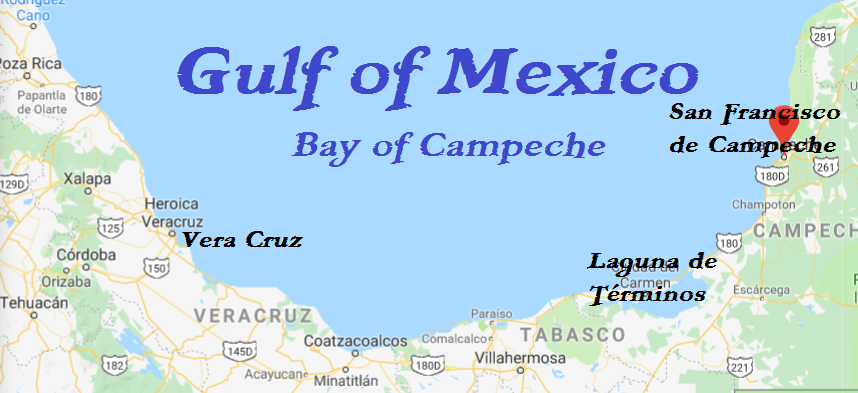
Laying roughly 65 miles SW of Campeche lay the Laguna de Términos and it's associated Isla Del Carmen (formerly known as Isla Triste) which had finally been liberated from English pirates on July 16, 1717. Another 250 miles away - across the Bay of Campeche in the southern Gulf of Mexico - lay Vera Cruz, the capital of New Spain's province of Mexico.


Fort of San Miguel, San Francisco de Campeche

A local beach on the shores of San Francisco de Campeche, Mexico - shows the Bay of Campeche in the Gulf of Mexico

Hubert Howe Bancroft, in his History of Mexico, Vol. XI told of the struggles that Campeche had incurred due to the English, French, and Dutch pirates of the 17th century. Since 1632, these foreign buccaneers attacked all of New Spain, but Campeche had been especially troublesome for viceroys of New Spain at Vera Cruz. He wrote:
In 1632 six vessels threatened Campeche, but timely succor made them retreat. In August of the following year the town was again visited, this time by ten vessels under a leader known to the Spaniards as Pie de Palo. Guided by a renegade, he advanced against the entrenchment behind which Captain Gal van Romero had retired, but a well directed fire killed several of his men, and caused the rest to waver. It would not answer to lose many lives for so poor a place, and so a ruse was resorted to. The corsairs turned in pretended flight. The hot-headed Spaniards at once came forth in pursuit, only to be trapped and killed. Those who escaped made a stand in the plaza, whence they were quickly driven, and thereupon the sacking parties overran the town. Seven years later Sisal was visited by a fleet of eleven vessels and partly burned after yielding but little to the raiders.
In the following year they returned under the command of their two famous leaders Pie de Palo and Diego the Mulatto. After a hot fight the town was taken and sacked. Efforts to obtain a ransom failed, however, and when rumors of a force approaching from Merida became known to the corsairs, they departed.
In April 1648 these same pirates captured a frigate with more than a hundred thousand pesos on board, and a few weeks later boldly attacked a vessel in the very port of Campeche. At about the same time another band, commanded by the Dutch pirate Abraham Blauvelt, captured Salamanca.

During the second half of the seventeenth century pirate raids became more frequent. In 1659, 1663, and 1678 Campeche was again taken and sacked by English and French freebooters. "They were aided on this occasion by logwood-cutters, who since that time had begun to establish themselves on the peninsula; and, notwithstanding the repeated efforts of the Spaniards to expel them, successfully maintained their positions, till in 1680 they were driven from the bay of Terminos by forces sent against them from Mexico and Yucatan."

This raid of 1663 was particularly devastating. Christopher Myngs and Edward Mansvelt led an expedition of 14 vessels from Jamaica with 1400 men to raid the Spanish town and establish themselves at the Laguna de Términos. They were joined by four more French vessels and three Dutch for a total force of 20 vessels. It was an all-out invasion of Mexico by other squatter nations in Spanish America! But, the English were the primary aggressors in this action. Like most walls in history - especially those in the modern day - the wall around Campeche was wholly ineffective against English pirates!

Eva Leticia Brito Benítez, in "Pirate Assaults and the Defense of the Old Seaport of Campeche, Mexico (16Th-18Th Centuries)," Journal of Global and Area Studies writes:
In the same year, a raid of pirates burned lands but Captain Maldonado, commanding 200 soldiers and 600 Indian archers, forced them to retreat. Several criminals were captured and sentenced to death, among them was a man called Bartolomé Portuguese and known for having previously escaped Campeche.
In 1669, Spanish slaves rose up and decimated Campeche, and in 1670s Campeche was continually set upon by English pirates, who enjoyed protection from Gov. Thomas Lynch of Jamaica. English corsair Lewis Scott assaulted the village in 1678 and according to witness’s testimonies, he kidnapped 250 families. He also stole a lot of gold, silver, jewelry, sacred ornaments, sugar, soap, and meat; additionally, he took three of the fortress’s flags, broke down all of the artillery, and drilled 150 muskets. The garrison consisted of but two companies of half-clad and poorly fed soldiers, until after the raids of Scott and Lorencillo in 1678, when two more companies were sent from Spain.

In 1680, English and French logwood pirates, were expelled from the Laguna de Términos and in 1690, the Spanish fortified Isla Triste or today’s Carmen Island with artillery. A serious effort was made to defend the lagoon or bay, for the garrisons at Campeche were "constantly threatened by the wood-cutters of the bay of Terminos," as Bancroft inferred.

In San Francisco de Campeche, up the coast, the project of Martin de la Torre, begun in 1680, was passed to the French engineer Louis Bouchard de Becou. It was commissioned to unify all the defensive works that surrounded the city with a wall against the incessant English attacks from Jamaica. At its completion, the wall was 2,560 meters in length, forming an irregular hexagon around the main part of the city, with eight defensive bastions on the corners. Bancroft wrote "The total cost of the fortification of Campeche, derived from contributions by the crown and the inhabitants, and from certain imposts, amounted to more than 200,000 pesos. In February, 1690, the first pieces of heavy artillery ever seen in the province were landed at the town." The fortress was completed by 1710. Much of these walls still exist.

Project of Martin de la Torre - 1680


Mapa-histórico-de-Campeche-la-Muralla


Modern city of San Francisco de Campeche

Wood-cutters returned to Laguna de Términos in two years, but Viceroy Conde de Galve reinforced the garrison there and repelled them again. Like the “place of snakes and ticks” of "Cam Pech's" name, the pirate pests returned again and again, persistent as ever.

Location of Isla Triste or Isla Del Carmen or Carmen Island.


About the pirate encampment, Bancroft wrote that a favorite rendezvous of these adventurers was the Isla Triste, or as it is now known the Isla del Carmen, at the entrance of the bay of Terminos. This base made for a perfect launching point and outpost to watch for and chase the Treasure Fleet carrying gold and silver back to Spain. During the war of the Spanish succession they frequently attacked Spanish vessels trading between Campeche and Vera Cruz. When pirates again became a nuisance after the Hurricane of 1715, another minor attempt to clear them was made in 1716, [but again, like the pests that Spaniards had always perceived them to be,] they returned. The new Viceroy in Vera Cruz, Baltasar de Zúñiga y Guzmán, 1st Duke of Arión, 2nd Marquess of Valero, then launched
... an expedition… despatched from Mexico by way of Vera Cruz to Campeche, and being reinforced by the troops stationed there, drove the intruders from all their settlements on the bay of Terminos. The attack was made on the 16th of July 1717, the feast of the virgin of Carmen, and hence the island [formerly Triste] received its name.

Bancroft continued:
A large amount of booty was wrested from the buccaneers, many of whom were slain, those who escaped harboring in Belize [in Bay of Honduras], where, being joined by others of their craft, they organized a force of three hundred and thirty-five men and returned to the bay of Terminos. Landing on the Isla del Carmen they sent a message to Alonso Felipe de Andrade, the commander of the Spanish fort which had been erected during their absence, ordering him to withdraw his garrison. The reply was that the Spaniards had plenty of powder and ball with which to defend themselves. The freebooters made their attack during the same night and captured the stronghold without difficulty, taking three of the four field pieces with which it was defended. But Andrade was a brave and capable officer, and his men were no dandy warriors. Placing himself at the head of his command he led them against the enemy, forced his way into the fort, recaptured one of the field pieces, and turned it against the foe. During the fight a building filled with straw was set on fire by a hand grenade. This incident favored the Spaniards, who now made a furious charge on the invaders. Their commander was shot dead while leading on his men; but exasperated by the loss of their gallant leader, they sprang at the buccaneers with so fierce a rush that the latter were driven back.

Contrary to this historical rendering, Adam Anderson of the British South Sea Company wrote of unwarranted English problems with the Spanish, asserting that the English had every right to cut logwood (a valuable source of die) from the area of Campeche surrounding the Laguna de Términos... a location that included the Isla Triste, a frequent settlement of "British subjects."  He titled his treatise "The Right of British Subjects to Cut Logwood at the Bay of Campeachy, Fully Stated" (1717).

Before the massive raid, in 1716, the Marques de Monteleone delivered a memorial to the "British subjects" - as Anderson referred to these moral-less merchants and brigandish boatmen - at the Isle of Triste "That, if, in the space of eight months, they did not leave the said place, they shall be considered and treated as pirates." This pronouncement alarmed the South Sea Company's Anderson, who believed it of vital importance to his company's business to state firmly (read: propagandize) British rights to the land at Términos - land that they had basically squatted upon and were run off from repeatedly for more than 50 years - although Anderson never mentioned that detail!

Anderson did admit that the English - he didn't say "pirates" - had taken the Spanish port of San Francisco de Campeche three times in recent history - though they never occupied it. He basically argued that the port and inland towns of  Merdida and Valladolid were "in a manner, wholly desolate and uninhabited." Well, why would pirates go through the trouble of taking it three times, then?

The Yucatan region did become the slowest growing area in Mexico, but not until the turn of the 19th century. San Francisco de Campeche was a bustling and important port of New Spain in the early 18th century - not as important as the capital at Vera Cruz, of course - and currently boasts of more than 200,000 residents. The state of Campeche has almost 900,000. The entire state of Mexico contained approximately 5-5.5 million residents in 1810. It's doubtful that the region was as desolate as Anderson inferred - perhaps disingenuously.

Anderson said that the English at Laguna de Términos magnanimously allowed the Spanish to occasionally cut their own logwood "in several parts near their own settlements" from time to time. He asserted that "pirates" - not necessarily "English" pirates - were numerous before the Treaty of Madrid in 1667, when the Spanish gave them rights to Laguna de Términos.

Did the Spanish actually give them rights to Laguna de Términos?

The man who negotiated that treaty for England, Richard Fanshawe, was charged by his superiors to demand reparations for wrongs committed against English merchants and to point out Spain's impotency in the West Indies and to assert the superiority of England's maritime strength. Fanshawe was not achieving England's demands, even against a Spanish Empire inflicted with a weak ruler, King Phillip. England replaced Fanshawe with Edward Montagu, 1st Earl of Sandwich.

Negotiations were inclined against Spain when Portugal and France signed a treaty in March 1667 and France agreed to support an invasion of weakened Spain. Sandwich simply revisited Fanshawe's original treaty with some variation - mostly that England was granted ‘most favoured nation status’ and particularly that England was allowed to carry into Spain her colonial products and goods bought by their agents on either side of the Cape of Good Hope. Although the treaty never mentioned Laguna de Términos by name, British merchants, companies, and their oft-associated pirates used this treaty as an excuse to lay claim to the area. Essentially, the treaty stated that they both promised not to navigate or trade in the places occupied by the other.

So, no, Adam... Spain did not give the English specific rights to Laguna de Términos.

What's worse for Spain is that Portugal suffered a coup the next year, essentially removing the greatest fear that caused her negotiators to allow such magnanimous concessions to England.

Still, Anderson said that "the British privateers [after the Treaty] were then induced to quit their former course," which is not really true, but the most narcissistic part came next... "and to settle with the Logwood cutters in Laguna de Terminos, so that in the year 1669, their numbers were considerably increased, and great quantities of wood were transported both to Jamaica and New England."

He argued that the Spanish never acted as though the English "cutting of logwood was then esteemed an invasion." Yet, still, booted them from the lagoon in 1680. Anderson simply did not acknowledge the English crossing the border into Spanish territory and stealing their logwood precisely constituted that "invasion." He only touted the great profits accrued by his company through their cutting logwood (stealing valuable merchandise) in Campeche.. and, of course, the boon to the entire British Empire. In a textbook example of sheer narcissism, Anderson expressed anger at the Mexican authorities for resenting this theft!!!

No wonder they were back at war in December of 1718. 

Welcome to America - abode of pirates - those at sea and those in business suits! Nothing personal, of course.. just "friendly" competition. Just ask the pirates who razed San Francisco de Campeche, stole their slaves and Indians, and robbed and burned their citizens .

Reinforcing the "desolate" narrative, Anderson also told that Sir Thomas Lynch, then governor of Jamaica, had informed Secretary of State Earl of Arlington that their privateers had ventured seven or eight miles into the country although they "never saw any Spaniards!" And, that "our King's subjects [again, not "pirates"] have been used, for some years, to hunt, to fish, and to cut logwood, in divers bays, islands, and parts of the continent, not frequented or possessed by any of the subjects of his Catholic Majesty, and without any molestation." He also asserted that their activities were approved by the King's Privy Council.

Indeed, this piracy was approved by British authorities - since 1588! That was the problem. The ideology of harsh British capitalism-piracy created the United States. And, America has not changed.. only grown even more detached and "businesslike" - capitalists of the United States ideologically descended from the British South Sea Company - in its martial treatment of and capitalist trickery used against the Spanish.

The rhetoric used by Trump and Republicans today - of a wall against our friends - words like "animals" or "invasion" to describe immigrants at the Mexican border - is abominable in the extreme. Our Mexican friends in Campeche today only welcome us to their shores. Historically, from 1632 through today - for 387 years, we Anglo-Americans have climbed Spanish walls intended to keep us out - we raided, pillaged, and murdered these fine folks - rarely have we been good neighbors!


------------------------------------------------


Fountain of Hope: Dimensions

Available at Lulu.com

Epub version, too!

Also on Amazon.com!


https://www.bbc.co.uk/sounds/play/p06s6zfx

BLACKBEARD: 300 YEARS OF FAKE NEWS.
from BBC Radio Bristol

300 years ago on Thursday - 22 November 1718 - Bristol born Edward Teach (aka Blackbeard, the most famous pirate in the history of the world), was killed in a violent battle off the coast of North America. And after 300 years we can finally separate the truth from the myth. You can hear the whole story this Thursday at 9am in a one off BBC Radio Bristol special: BLACKBEARD: 300 YEARS OF FAKE NEWS. With new research by Baylus C. Brooks, narrated by Bristol born Kevin McNally - Joshamee Gibbs in PIRATES OF THE CARIBBEAN, and produced by Tom Ryan and Sheila Hannon this is a very different Blackbeard from the one in the story books...

https://youtu.be/AnaYDaNoufE


Sunday, July 28, 2019

Over 100 Years of GOP Crime & Fascism!

Gen. Smedley D. Butler
Since the late 19th century, wealthy capitalists known as "Robber Barons," have dominated wealth in America. With the metamorphosis of the Republican Party from liberal Lincoln ideals into the "Gospel of Wealth" in the late 19th century, the GOP became the profiteering, greedy party that we know today.

In 1933, wealthy conservatives attempted a fascist coup d'etat over the United States. Their aims were to re-establish the "gold standard" on which their fortunes depended and to overthrow Franklin D. Roosevelt's Democratic administration.

The plot failed thanks to their betrayal by the patriotic man they chose to become their fascist "American Caesar," the twice-decorated Marine Maj. Gen. Smedley D. Butler!

Butler even resembled the patriotic hero Robert Mueller does today!

E Pluribus Unum!
"Promote the General Welfare!
#Resist #Resistance

Not made for profit! Please share widely and often!

DEMOCRACY FIRST!
 
Over 100 Years of GOP Crime and Fascism (video):


Sunday, July 21, 2019

Racism - the Door is Now WIDE Open

"My own Southern mother recently called me a 'full-fledged Democrat,' but the flying spit and venom made it feel like 'Damn Yankee!'.. a phrase I have heard come from her lips on many an occasion! Earlier, she called me a 'died-in-the-wool Democrat' which has a specifically Confederate meaning.. Rebel wool uniforms were grey because they couldn't afford the blue die that the Union could, thus... a died wool uniform was worn by a Yankee."

Key point for Trump's Confederate fans: Democrat = Yankee

This is what Trump has brought to full fruition! This is also what Civil War did to us the first time... not surprisingly over the same damned White Supremacist issues!

My mother and her family are from an area of North Carolina which I have researched for many years.. the Lower Cape Fear - an area that retained more of a South Carolina flavor than the rest of the state.

As I grew up, I had witnessed many clues to the white-supremacy of this region and have often felt the hatred and resentment of the old war had never died.

Understand that the Old South had never truly relinquished any significant amount of sovereign supremacy to the Union - the United States of America after 1865. You may have heard, as I have many times, that "The South Will Rise Again!" This is the cultural stubbornness that I witnessed on those many trips from my home in Fayetteville (a large city) to the rural Lower Cape Fear (LCF) to see my grandmother - we all have seen it in the plethora of Confederate statues at courthouses across the United States! Understand that this is virtual worship of a defeated traitorous nation.. on our current government soil! It would be merely uncomfortable anywhere else, but outrageous on government property!

Why did we allow this? I'll never quite understand that... 

Illustrating Southern intransigence, there comes another personal tale. I once lived about two years with my cousin in the LCF, and my cousin had an aunt on the paternal side - descended from the aristocratic Hollingsworths in the Duplin-Pender County area. She was visiting with us one day when a guy I worked with in Wilmington (a large city in the LCF) had stopped by to tell me something. This fellow - I'll call him "John" - had always seemed like anyone else, regardless of his color (he was of African American descent). He, too, was from the Pender County area where we then lived.

As soon as John walked through the front door and saw the aristocratic iconic Southern woman - like Scarlett O'Hara - in all her glorified Southern majesty -minus the mint julep - in the center of the room, he immediately began to behave differently. They had obviously known each other.

Remember, I worked with John for months and he behaved like everyone else, so his mutation into... this something truly archaic was unbelievable!

I looked at him like he was a different person... had John lost his mind??! He was genuflecting strongly, his voice had altered to something resembling that of a child, or at least something quite subservient, and he was repeating the phrase "Yes, Miss Pearl, why it's good to see you Miss Pearl." The oddest part.. he sounded like a 19th century slave on the plantation!!! My cousin (from Fort Lauderdale, Florida) and I were both shocked that his demeanor would have changed so drastically.

After John left, the aristocratic Pender County socialite woman announced to us all - in a surprisingly tender way - that John had "always been such a nice young nigger boy!"

My citified mind went: Wham!!! John was 60 years old!!! The LCF was a virtual time capsule! But, it wasn't just in the LCF...

This was the paternal sense of white supremacy that has always pervaded the South - ever since Carolina was founded in 1671 by crude slaving Barbadians. Southerners of that ideology absolutely cannot see any other way to be! For them, whites are designated by God himself to rule over Blacks, Hispanics, Indians, and anyone else of color - until the end of time - which they would gladly welcome over "Negro Rule!"


My mother and her family have marinated in this hateful ideology all their lives. And, the election of Barack Obama to two terms as president of the United States simply confirmed to them how USA has defied God and his divine order! It is no surprise that these vengeful white supremacists elected Donald Trump - a man more like their biblical version of the "Anti-Christ" or "Deceiver," or "Man of Sin" in Revelations. Compare this "White Jesus" or Satan with the Socialist Jesus of Matthew 14, who fed the hungry, housed the homeless, and healed the sick... all non-grate, for no pay whatsoever!

After caging brown children for fear's sake, Trump just identified as "un-American" (read: "anti-Trump") four Congresswomen (two of whom are of Islamic origin) - as if they were enemies!! He was quite un-presidential and un-American when he pointed these women out to his violent followers. He, the South's "Anti-Christ" has just - after a whole 2.5 years of semantic shell-game - finally revealed the racist violent truth of his presidency - and their Confederacy!

Trump and his followers also see that their minority of racist voters will always stay in the minority and that American democracy - or rule by majority - will always disfavor them, so they need democracy to end! To equally-violent-minded "Lost Cause" adherents of the Old South, it was high time for another Civil War or perhaps the End of the World! So, bring on the Anti-Christ Donald Trump, no matter he chooses to collude with!


------

A reflection on my grandfather's life experience with racism at the turn of the 20th century is quite instructive: https://bcbrooks.blogspot.com/2019/05/my-grandpa-progressive-liberal-minister.html
#Racism #WhiteSupremacy


Friday, June 21, 2019

RED ALERT! Christian-GOP Dominionism and Donald Trump

This is a thread from "Mr. Spock" on twitter about one of the greatest threats our democracy has ever faced! These are America's Dark Ages!

You will note several similarities in the following thread that may sound familiar if you are used to studying history - particularly the Civil War. This is the racist "white man's" theology of the South's "god of the slavemaster".. now the dominant domain of Republican political ideology!

1898 caption from the Raleigh News & Observer - annotated by the author

The continuous criminality of the South and the GOP: Over 100 Years of GOP Crime & Fascism: https://youtu.be/qBU3lBlecaI

------

In Star Trek, one of the core story lines was the Dominion war. But it was mostly in Deep Space Nine. It was originally aired in the 1990s. But it was really speaking to America. Because America is truly at war with the Dominion, here and now. Dominion theology is Christian [in origin].

Political ideologies that seek to institute a nation governed by Christians based only on their personal understanding of Biblical law. Dominionism is a label that only applies to certain groups of Christians within the United States, nowhere else on Earth does this apply. [One particularly anti-American - and Southern neo-Confederate - one is "Church of God Evangelistic Association" operated by David J. Smith]

Dominionism is a radical movement, it cloaks itself in the mantle of Christian faith and American Patriotism, when what it is actually trying to do is dismantle democracy. These people put themselves on a pedestal and dictate the morals of a country based on their limited subjective views that they cherry pick from the Bible and ignore the parts that would effect them. So for example, they will press for oppression of LGBTQ, but not divorce or adultery. They are raping the faith of millions and calling themselves moral whilst acting amorally.

Dominionism has a belief in magic along with adoration of a leader - sound familiar? They believe in the supremacy of a master race, this master race is the bastardised version of American Christianity where Jesus is white and protects only America 🙄🙄🙄🙄🙄

But most importantly, the give away is not on what they say, but on how they act. The Dominion movement is a totalitarian movement, exploiting those of faith, but of people that don’t truly understand their faith. They will use religious and patriotic language, usually combined. For example, one cannot be truly a patriot American unless you are a Christian, but not true Christianity, it has to be the White bastardised version of Christianity. Everyone else is the enemy. Everyone else is evil and must be eradicated. One must do as they say..


It is the only way to be a Christian and American [according to Dominionism]. Adhere to all of their rhetoric. Find a leader to adore, no matter how unethical he is [GOP's Donald Trump in this case].

So what is their ultimate goal? A legal system based on “Christian Values.” Labor unions & Civil rights movements will be abolished. It will form the basis of the educational system. Women will be removed from the workforce to stay at home [if this reminds you of the "Handmaid's Tale" series on Hulu, you're not wrong!].

Seen these women protestors dressed in red robes? That's from "Handmaid's Tale"

The most important book for the Dominionist is the “Institute of Biblical Law,” which calls for a Christian society that is harsh, unforgiving and violent.

It calls for the death penalty of LGBTQ, blasphemy, astrology and incorrigible juvenile delinquency and women only to be chaste before marriage. The book calls for the Christian United States. There are 2000 radio stations feeding this in America and 6 TV channels. Right now!

So who are the poster boys of Dominionism? Well Pat Robertson for one and I’m sure that surprises no one.


Here’s an article from 2006 which speaks of the rise of Dominionism.

This is why WE HAVE TO STICK TOGETHER. We cannot ever allow this Draconian society to occur. This is why we must call out this fake version of Christianity which is all about white straight men having all of the power. We must say no. Never surrender.

The enemies of morality will not stop and will not back off. The Left cannot and will not change.

"If the Democrats in the Senate try again to usurp the President's constitutional authority by filibustering, there will be a battle of enormous proportions from sea to shining sea." —James Dobson

[more Civil War news & rhetoric by Robert Reich, Franklin Graham,

Politics is religion, and the right is getting ready for the end times


Pete Buttigieg: "Hypocrisy" of Evangelical Christians Supporting Trump


The Evangelical Civil War: An Interview With Russell Moore - Bloomberg ]


Can you understand why tRump is so important to them and their movement?

So the religious right now have 30 million active voters. They go out and vote no matter what. This is why we must ALWAYS VOTE.

None of my tweets I must add are attacking Christians. Real Christians. Not at all. Christians are needed to push back, to speak the truth, to say no to the cheapening of their daily spirituality. I think America needs true Christians now more than ever, to speak out more.

Why Christian nationalists love Trump

------------------

My thanks to Mr. Spock for his ever logical and fascinating analysis!

I have written a quite a few blog entries myself on Southern conservatism combined with theology and originating from early American piracy and crime:

North Carolina: The Subtle Politics of Slavery Before and After the Civil War 

Progressive Liberal Minister Born in the Confederacy!  

"Quest for Blackbeard" and the "Counterfactual" Politics of the South 

Why do Poor White Voters Vote Against Themselves?

North Carolina's Political Pirate Nest

Really! Pirates and Tea Party Conservatism 

Carolana to Carolina: Imperialism, Science, and Early Huguenot Interest in Bath County

Pirates and Capitalists: Two Sides of the Same Coin 

The National Rifle Association in a Culture of Terrorism

A Proud North Carolina Tradition!

North Carolina: The Subtle Politics of Slavery Before and After the Civil War

Republicans were Liberal Before the Confederacy Took Them Over!

North Carolina's Most Amusing Governor and Wilmington Founder 

Political Agenda of "Redeemer Historians" in North Carolina

Responsibility in Business: Imperialism, Africans, and Rice in the South Carolina Trade


Sunday, June 16, 2019

The Mueller Report: Watch As We Read The Whole Thing Live


A 12-hour long reading of the Mueller Report... it starts slowly, so be patient.
https://www.youtube.com/watch?v=G73iRRgoLKg

Wednesday, May 22, 2019

Progressive Liberal Minister Born in the Confederacy!

Rev. E. M. Brooks (1861-1943)
Parties are quite enjoyable for me. You see, I have the best ice-breaker. My family is unique for having their kids at an advanced age and stretching out the generations and it provides me with the best conversation starter!

My grandfather - no, not a great grandfather - was born two months before the start of the Civil War - the reactions from my fellow party-attendees are usually shock and surprise! 

Still, the Civil War started only 158 years ago... by chance the precise range between my Grandpa and myself (plus my current age of 57). The shelling of Fort Sumter was actually not that long ago! 

Grandpa was born 5 Feb 1861. The Southern States had already seceded after the election of Abraham Lincoln on 20 Dec 1860, and the Montgomery (Alabama) Convention (to organize the Confederacy) was held 4 Feb 1861-17 Feb 1861 - so he was essentially a child of the emerging new country - the Confederate States of America

But the war would not begin until 12 Apr 1861 when Confederate forces demanded the surrender of Federal Fort Sumter in Charleston and shelled it. So, Grandpa was actually born a couple of months before the Civil War! 


You should have seen the looks from my history professors in college!

Map of the Confederate States and Territories - c1860. In early 1865, after four years of heavy fighting which led to 620,000–850,000 military deaths, all the Confederate forces surrendered and the Confederacy vanished. The war lacked a formal end; nearly all Confederate forces had been forced into surrender or deliberately disbanded by the end of 1865, by which point the dwindling manpower and resources of the Confederacy were facing overwhelming odds. By 1865 Jefferson Davis, the President of the Confederate States of America for the duration of the civil war, lamented that the Confederacy had "disappeared" - but that wasn't exactly true. See: North Carolina: The Subtle Politics of Slavery Before and After the Civil War for events leading to the Election of Donald Trump in 2016

Despite Grandpa's birth as a Confederate, he later became a staunch liberal progressive of the restructured United States who actually practiced what he preached! He desired not money, just good will to all men and opposed the conservatives of that former Confederacy in which he was born - a hateful racist political machine active in recovering their harsh dominance after the end of Reconstruction and ridding their society of African-American influence. They were essentially successful in 1896 with Plessy v. Ferguson - or the establishment of "separate but equal" education. This did not end until 1954 and Brown v. Board. The subsequent Civil Rights Act in 1964 was simply a slap in the Southern face - and signed by a Southern Democrat!

Consequently, Grandpa could have been in danger from hometown terrorists in his home in Stanly County, North Carolina, especially after the special election in 1898 when conservatives retook the state and reinforced their control... almost exactly the time he was ordained as a minister! This was a time of white political dominion and African-American suppression. It eventually led to the Great Migration of nearly half of the African-American population to the North - refugees from a hateful Southern theocracy. By 1970, the African-American population in the United States fell from 90% living in the South in 1890 to 53%. They were lucky compared to the Syrian people. The 37% who left the South is only paralleled by a full 60% of the Syrian population needing humanitarian relief today - whereas only 22% have actually been able to leave Syria as refugees.

Ironically, Grandpa had been the great-grandchild of a slave-owner, William Brooks I of Stanly County, North Carolina - just east of Charlotte. His grandfather William Brooks II also owned slaves, but may have manumitted them. His maternal great grandfather (father of his grandmother Mary Burleson), David Burleson (later of Rutherford County, Tenn.) had transacted slaves with him. The most notable thing about this deed was that Burleson paid about ten times the going rate of a horse for this single slave from William Brooks II. Slaves were an enormously valuable commodity in the South - they were simply free labor for a harsh capitalistic society, a boon to any business' "bottom line." William Brooks I owned as many as thirteen slaves at one time, the financial equivalent of 130 horses of free labor on his farm! The family lost their financial prominence (most probably gained through slave labor) after the war ended in 1865 - about $150,000 - calculated at $4,618,337 today!


1814 deed for a slave from William Brooks

The war occurred during the time that my great-grandfather Culpeper "Cullen" P. Brooks and his wife Louisa Lowery Allen birthed and raised my grandfather and their only surviving son, Edgar Marcelus Brooks (he had two sisters who lived and two brothers who died young). This was only 4-5 years following the death of Culpeper's mother, Mary Burleson.

William II and Mary both died in 1846 and 1852 respectively, so very little is known about their son's life in 1861 - all of the court documents ended before - but we can extrapolate from census records. Unfortunately, there are no slave census records to help. The first census they appear on is the 1850 Union County, as a young couple of two years with two young children. Union was formed from Anson just a few years before and was the home county of his father on the south side of the Rocky River, just adjacent to the old Brooks home of William Brooks I, still standing on north side of the river in Stanly County. 

William Brooks I (1736-1818) homeplace near Oakboro, Stanly County, North Carolina

My Uncle Cullen (Dad's brother, named for Culpeper) found it fascinating when I told him that his grandfather was listed as "Cullen" and not "Culpeper" on this census (and a few other records). He never knew! Turns out that "Cullen" was a nickname that got passed down to him - he had no idea, but then like myself, he had never met his grandfather... who died before he was born. That's that having kids late in life thing... rough on the grandkids!

In 1860 - just before the war started - Culpeper was a 43-year-old farmer living on the north side of Rocky River in what was then Stanly County, but further east from the old Brooks homeplace. Apparently, Culpeper and Louisa Allen Brooks had moved closer to her family's homestead near the Pee Dee River. Her grandfather, a wealthy former Revolutionary War soldier originally from Henry County, Virginia by the name of Darling Allen (emigrated c1792) may have died a decade after arriving in North Carolina in an interesting way, according to History and Genealogy of the Nances (Charlotte, 1930), 22:

History and Genealogy of the Nances (Charlotte, 1930), 22

This was, of course, passed down by oral tradition, so.. it may or may not be true. Still makes for a good tale. It's interesting that an alleged murderer "Mose Speaks" was captured in Anson County almost twenty years before publication of the Nance history book. Although he wasn't a slave, this event may have influenced the oral tradition somewhat since "Mose" or "Moses" was a common slave name. The story could still be true, however... I have no way of knowing except that I can't find details in any other source - including court records. As a genealogist, I'm always fascinated - when I read amateur genealogies - by how all us white folks are suddenly descended from "Indian Princesses," too.. lol

Messenger and Intelligencer (Wadesboro, Anson County), 23 Feb 1911, 2.


Culpeper and Louisa Brooks had $2,000 in real estate in 1860 - worth $61,577 today. They owned personal estate valued at $4,200 or $129,313 today - worth a total of about $191,000 in today's value (not poor by any means - but not rich either.. certainly a small smattering of William Brooks I's $4 million!). They probably lived near Norwood, Center Township, Stanly County. In 1870, they appear again in Center Township, with land at $1,500 value with personal estate at only $500 - a total then of about $61, 577. Their total worth had reduced by 56% in a single decade. By the time Culpeper grew sick some years before his death in 1893, they had relocated to Anson County near Polkton and both he and his wife were buried at Rocky River Baptist Church Cemetery, Polkton, Anson County... back to their old home territory.

Where did most of the money go? My Brooks-Allen family had supported the Confederacy in the war, converting their U.S. currency into Confederate bills in 1864 when their nation was badly in need of funds. When the Confederacy fell in 1865, these bills were then made worthless.

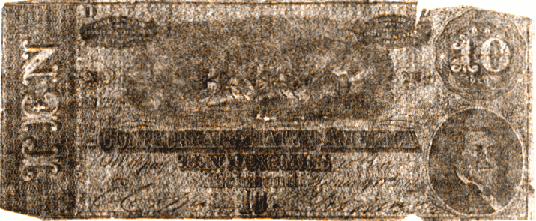
Interestingly, Grandpa, who settled his father Culpeper's estate, kept the pre-war chest of his family's old Confederate money, including a bundle of the family's papers wrapped in tobacco twine. My Aunt Clara noted that the chest full of $150,000 worth of Confederate money was just "worthless paper," probably repeating just what her relatives had told her after the war. I have seen a sample of several of those bills scooped up by my Uncle Cullen when Grandpa died in 1943 - xeroxing a copy of a ten dollar note after interviewing him back in the 1990s:


$10 note from Brooks Family fortune before the Civil War

A somewhat clearer facsimile of the same $10 note from 1864


Few details of a farmer's life - even well off - entered the newspapers. After the war, everyone had it hard, but there's little evidence that Culpeper kept slaves. There's not much on him at all, actually, after the deaths of his parents - so I don't really know if he inherited slaves from his father's estate - or Louisa from her Allen family. William Brooks II's estate was settled in 1846 in Union County and included the old family land adjacent to Drury Morgan on the Rocky River. If he owned slaves, they were not on his 3-page estate sale inventory nor were there any on his wife Mary Burleson Brooks' estate in 1852.  Still, William I's original thirteen slaves would have been divided at his death in 1818, so few slaves were inherited by any single kid and no further purchases have been found. Still, this was an agricultural community and slaves were often used, especially by the wealthier families.

The most liberal Brooks to certainly break with this trend became my grandfather, a late arrival in Culpeper and Louisa Brooks' home. Their first three sons, William H., Robert Julian, and Preston L., died in infancy. The last two were buried in the Wall-Almond Cemetery (AKA Almond Cemetery, William Wall Cemetery) near Norwood in Stanly County. My Grandpa's two sisters, Eliza Jane Teal and Mary Frances High were a full ten years older than him and their families rarely associated with my grandfather's children. 

The Monroe Journal, 17 Aug 1909, 2
What was a young boy growing up just after a major war - then in dire straights - with only older sisters as an influence, bound to experience? Cullen and Louisa's Rocky River Baptist Church, founded in 1776, became a definite influence in my Grandpa's lonely and sparse life - penance and poverty surrounded him - as well as thousands of freed slaves.  

It may be that Grandpa had planned to settle on a small farm of seventeen acres in Burnesville near Ansonville in 1894, but - thanks to Rocky River Baptist Church and various influences after the war, I believe - he soon became an itinerant Baptist Minister and family historian, bringing the family back together for numerous reunions and writing The Brooks of Union County in 1925. 

It should also be said that he certainly influenced me to study genealogy since I was 16 and to obtain my master's degree in America History. Thanks, Grandpa.. even though we've never met!

Brooks Reunion, c1940


His first appearance in the Biblical Recorder (Raleigh, NC) was on 17 Aug 1898, telling that he was ordained 3 Aug and then served two churches in Anson and Stanly Counties:

Biblical Recorder, 17 Aug 1898, 22

The North Carolinian
Raleigh, North Carolina
21 Jun 1900, Thu  •  Page 4
As I said, thousands of freed slaves searched for a new life when Grandpa was just a young boy of four years. He grew up seeing destitute blacks and whites panhandling and begging, suffering from the ravages of a lost war... the "Lost Cause." That desire for vengeance to get back at the "Damn Yankees" of the United States would spark much resentment among whites after William Woods Holden and Reconstruction ended abruptly. Henry Louis Gates' RECONSTRUCTION: AMERICA AFTER THE CIVIL WAR is a must see presentation!

The special election in North Carolina for 1898 which sparked the racial violence and killings in the Wilmington Race Riot coincided with the beginning of his service in the ministry. Grandpa had to be very careful, for 40% of the people lynched in America were white! Most were killed by the Ku Klux Klan for supporting blacks or for other reasons not considered "desirable" in their neighborhood. It was typical for the KKK or "red shirts" (active in 1898 Wilmington Race Riot) to make up a valid-sounding story to uphold their mob verdict of death by lynching - especially when their victim was a white man.

Ku Klux Klan on horseback

One lynching occurred in Stanly County in 1892 - a white man named Alexander Whitley, allegedly for murder. But, there was little evidence and more hearsay, he stood no trial, and was lynched by a vigilante mob "all wearing red shirts." His descendant has written a book with a title that expresses how society dealt with such violence: Stanly Has a Lynching: The Murder of Alexander Whitley: A Family Legacy Entangled in a Web of Fiction & Folklore 

Enterprise, 13 Aug 1903
As M. Lynette Hartsell tells in chapter nine, a lynching of "Pharoah the Bull" occurred in 1880 - a tale which carried many racially-charged anecdotes of a black man as "savage," a reflection of one Prohibitionist preacher's political animus. I have included the article in Stanly News and Press: "Old King Pharoah Was Stoned For Goring Man". Prohibitionists had tied race to their cause, suggesting that anti-Prohibitionists were in league with the " beastly negroes." As Hartsell suggests, this gave their racism - even violence - a religiously righteous flavor - another parallel with Trump's evangelical supporters today, angered as they are by "Negro Rule" reminiscent of Barack Obama's administration. Hartsell does an excellent job of weaving through the political rhetoric to find reality. 

Still, lynching or attempts to lynch seemed forever on the minds of the more meek shepherds - like I suspect my Grandpa was - attending their flock!

"Indian Doctor" J. L. White was held in prison a full year and narrowly escaped lynching for rape in 1896. In 1900, another lynching of a black man accused of killing a Dr. S. J. Love occurred "by a mob of some 25 person, all disguised" who took the man from the jail, with no resistance from Sheriff McCain, at 2 a.m. in Stanly County. Henry Young was accused of assaulting a white woman in 1908 and nearly lynched by a mob. And, yet another lynching was narrowly averted in Dec 1909 and again, with two black men accused of murder in 1913. Certainly, only a few lynchings and other forms of racial violence had been recorded in newspapers and, contrary to my reporting, they were not just happening in Stanly County - this was a Southern-wide phenomenon. 

The "Lynching Mania" appeared in Stanly Enterprise of 7 March 1901 and almost a full column appeared in the Stanly Enterprise for 13 Aug 1903 which asked the question "But lynching is now on? How can we stop it?" The insincere answer was for faster trials! Whites should ensure swifter justice and that "it would largely stop in the South if negroes would stop committing rape, and this is true." Look at the cartoon below from 1892 of the large black man with bats wings, reaching out for the young white fleeing women - tine and helpless. The caption read "The dangers that hover over North Carolina." It is certain that these accused black men had not raped these women, but were accused nevertheless and hanged. The article went on "It comes of course, as a result of low, uncontrolled bestiality, fed fat by the habits of the life of the negro." As we've seen especially today, "bestiality" appears rather a human quality, practiced by anyone, regardless of any particular skin hue. 

Lynchings from 1835-1964. From data of Monroe Work.

Grandpa's association with, or admiration for, the liberal secretary for populist Gov. Lindsey Russell would be the first clue as to his liberal Christian nature. That secretary was Rev. Baylus Cade of Lenoir, inventor and Baptist Minister, a man who was reviled by conservatives as "Decayed Cade," "once a useful Baptist preacher," for "slandering his church." The North Carolinian of 21 June 1900 spouted a lot of likely "non-sense" as Donald Trump's supporters today, but the last sentence told the strongest sentiments and the original spark for the "righteous flames" - "When a man joins with the negroes in politics, he is ready to tear down the church and slander its good name!" Another article of similar venom spouted "[Cade] is not content to misrepresent the amendment and traduce the white people - that's what all fusion orators do - and Decayed Baylus could not stand to be merely conventional." 
The Semi-Weekly Messenger
Wilmington, North Carolina
03 Jul 1900, Tue  •  Page 2


Oddly enough, Rev. Cade was also a man respected by a quite reverent servant of God, and frequent contributor to the same Christian journals as Rev. Cade - my Grandpa - who named his 4rd son and 5th child - my father - Baylus Cade Brooks in 1916 in his honor!

Rev. Cade's story is an extraordinary tale of rife with the conservative political machine of the day in their battle against "Negro Rule!" The parallels with the Trump Administration today cannot be ignored! I encourage you to click the link above and read about him!


Raleigh News and Observer, 27 Sep 1898


It was in the middle of this tense racial division that my grandfather met and married my grandmother, Emma Eugenia Morton, daughter of Rev. David Stanley Morton on 23 Jan 1902. Their first son was born in 1902 - my Uncle Cullen - already mentioned with the handful of "worthless paper."

Rev. E. M. Brooks and Emma Eugenia Morton, married 23 Jan 1901


Many articles in both the Biblical Recorder and in the Stanly Enterprise newspaper detail his biblical devotion to living a humble life. His personal ministry was directly with the people - he was a do-gooder for sure - and he made various contributions to several Baptist churches in Stanly, Union, and Anson Counties. One of these articles details how Grandpa lived this life and even gave a family historian like myself a unique surprise about my great-great-great grandfather!


Enterprise of 6 Sep 1906 told that Pleasant Grove Baptist Church had given him a "handsome gold watch, Elgin movement" that they wanted him to have to replace his "98-cent timepiece he has been wearing." The article also mentioned a gift he gave them in return - a family heirloom of his great-grandfather's which I'll come back to momentarily.

The same wording appeared also in Carolina Watchmen of Salisbury, 12 Sep 1906. The paragraph before it also included a bit of political news that hints at a "great evil" from which we suffer today - voter suppression by the modern conservative Republican Party. It's helpful to know that, in the 1898 Election, conservatives tried to kill Gov. Lindsey Russell on his train trip home to vote Republican:
It is to be hoped that in Stanly this year there will be no vote buying or vote selling. If a man is honestly a Republican [liberal], he deserves credit and should be allowed his right of suffrage. If honestly a Democrat [conservative], he is entitled to the same privilege. There can be no honesty in elections when there is traffic in votes. In the end the country suffers therefrom and the voter holds the remedy for granting us immunity from this great evil.
[but...] "If the radicals [liberal Republicans] stay in power two years more, the roads in Stanly will be in such a fix that a man won't be able to get anywhere," remarked a citizen of Harris township on Monday.
It seems that any excuse against liberals was fit to print. Everything I read about my grandfather convinces me that he would be seen as a liberal Democratic Socialist today. Of course, in his time, conservatives - actually ex-slavers - were termed the "Democrats," and these cruel conservatives would move into the Republican Party by 1968. My grandfather would certainly not have associated "Democrat" with his own way of thinking!


As promised... Grandpa also mentioned that he gave Pleasant Grove Church a gift in return - one powder horn, "considerably over a hundred years of age," that had belonged to his "grandfather," William Brooks II, made from a gourd. Messenger and Intelligencer of Wadesboro reported in its issue of 10 Apr 1890 that "Cullen" or Culpeper Brooks had the horn in his possession then, that it was his grandfather's (William I) and that it had been used so often it "appeared to be varnished." The 1906 article mentioned "from the seventies," meaning that it had definitely belonged to Ensign William Brooks I when he and his brother Lt. John Brooks went in Capt. John Culpeper's regiment of Rutherford's Campaign against the Cherokee about 1770, before the Revolution. BTW, care to guess where my Great Grandpa "Culpeper" got his name? The powder horn "furnished many a charge when a deer proved a fallen victim," they said. It had done more than that, but I doubt that my Grandpa knew its full history! Or maybe he did and that 's why he gave it away?

Grandpa helped establish the Stanly Baptist Union, a circuit of Baptist churches in Stanly County. He often preached at various locations, but was limited to his place of residence. He had worked in Norwood from 1909 to November of 1915. He and his wife, Emma, pregnant with my father then moved to Palmerville, near Oakboro and "Big Lick" and their child arrived on New Year's day, 1916. 

The next day, Grandpa penned a letter to Rev. Baylus Cade, informing him of his "little namesake" and named "for a great man. One whose ripe scholarship and faultless English excites our admiration.":


Letter of Rev. E.M. and Emma Brooks of Palmerville, NC to Rev. Baylus Cade of Shelby, 2 Jan 1916

Rev. Cade responded ten days later, saying "I value the honor you have done me in giving your dear little boy my name...."


Letter of Rev. Baylus Cade of Shelby to Rev. E. M. Brooks, 12 July 1916

The next year, for my Dad's first Christmas, the family transferred to New London, Stanly County. There, the true followers of a beneficent Jesus celebrated a special "White Christmas" for the "destitute poor" of Stanly County. But, he still visited to other parts of Stanly, like the more western village of Pleasant Grove.

It was not longer after my father's birth, in May 1916, that my grandfather demonstrated his interest as historian - not just as family historian - when "E.M. Brooks of Palmerville gave a historical sketch of the history of" Norwood Baptist Church. He gave a "field meeting" in the open for Palmerville, Ebenezer, and New London in 1918.

By 1919, while living at New London, Grandpa helped initiate an effort to educate the people of Stanly county, with a "Mobile School" for which he served as Dean. According to the Stanly County Herald of 17 July 1919, the school would travel from town to town and spend five days at a time teaching to the children. While the curricula was based on church studies, it did also include various scholarly subjects. The next year, the town of Badin presented him with a gift of $24 to further the poor preacher's pursuits. 

Stanly County Herald of 9 Oct 1919 announced a distant move for the Brooks - nearly to the town of my own birth of Fayetteville - in the small town of Lumber Bridge, southwest of Fayetteville. My father would spend his childhood and later years here - maybe why he chose to purchase his first home near Hope Mills, a bit closer to the metropolis of Fayetteville. 

 
Stanly County Herald, 9 Oct 1919, 1


The Robesonian of Lumberton noted his arrival 20 Nov 1919, where he instructed their parishioners "more perfectly in the ways of finance," and Emma Morton Brooks appeared to have become ill late in September of 1922 but the paper noted that she was "convalescing." On 7 June 1923, the same paper noted him as "Rev. E.M. Brooks of Fayetteville, pastor of the Baptist Church of Boardman," a small town ten miles south of Lumberton. My Grandpa, Rev. E.M. brooks served as pastor at the Person Street Baptist Church in downtown Fayetteville and was listed on the Fayetteville City Directory for 1924. Albemarle Press reported that they were back in Albemarle 25 Oct 1925, but still noted him as "of Fayetteville." My father spent six years from ages 3 - 9 in Lumber Bridge, but his family then resided in Peachland for a number of years.

I remember my father telling me that he walked about a mile to go to school while in Peachland. He and his elder brother Julian Allen used to play pranks on folks by tying fishing line to a dollar and laying it in the street. When someone bent over to pick up the dollar, they'd snatch it away. Dad also told me that he and Allen would try to hit each other's mouths with milk, squeezed straight from a cow! Of course, he laughed at the look on my face!

At some point, my father left Peachland and moved to Fayetteville to live with his older brother Macon - I'm guessing by time of the 1930 census - certainly by the 1931-2 school year, when he was found attending Fayetteville High School (today's Terry Sanford) and working at Matthew's Pharmacy on Hay Street. He graduated from there in 1933 and continued "jerking sodas" at the pharmacy. 

Grandpa retired about that time. He spent his remaining years reading the local papers, clipping articles and exploring history, as he loved it so much. Grandpa saved a collection of newspaper articles, personal anecdotes, and facts that he collected in a scrapbook, dating from about 1931-1939. One of those articles was "Black Mammy Tells Graphic Story of Slavery." This huge article caught my Grandpa's liberal eye.. and I know why. It described a woman who had been severely affected by her servitude as a slave and, later, as a free woman. She never left the home of her former master. This sparked a long, detailed study you'll find in "North Carolina: The Subtle Politics of Slavery Before and After the Civil War." It's not hard to imagine what must have gone through my Grandpa's mind when he read it.


Article written by Charlotte Story Perkinson titled "Black Mammy' Tells Graphic Story of Slavery," Charlotte Observer (North Carolina), 19 March 1933
I can't say that Grandpa was an activist in any meaningful way, but I can discern his thoughts. Maybe the South was the source of the general meek image of a liberal today... as Grandpa would say, they "shall inherit the Earth." Let's hope he's right.

Rev. Edgar Marcelus Brooks passed away from a heart attack at his home in New London, Harris Township, Stanly County just after midnight at 12:45 on the morning of 25 March 1943. My Dad was away in the Navy, oddly enough, stationed at New London, Connecticut. He received an early discharge as a result. 

And, I received one of the best family histories of all time!


Monroe Enquirer, 8 Apr 1943


-----------------------------------------------


Fountain of Hope: Dimensions

Available at Lulu.com

Epub version, too!

Also on Amazon.com!