Donate to Brooks Historical

Showing posts with label brooks. Show all posts

Sunday, August 25, 2024

Introduction to Primary Sources and Their Use: Analysis of Depositions - John Vickers (bef. 28 May 1716)

Depositions are legal documents taken to investigate a legal matter. It's the same as an interrogation. That does not mean, however, each deposition and the person being deposed are trustworthy. Many criminals have lied to the police! There's no reason to suspect that any witness cannot be lying as well - maybe they want to keep their cousin out of jail! Depositions become matters of public record and will survive indefinitely. Lies can persevere as well as truth.

The task of the historian is to investigate the events mentioned in the deposition, who the deponent is, why are authorities engaged in this investigation, and what are the deponent's motivations for telling the authorities about the event. Yes, this is a lot of work. [Sarcasm alert:] That's why historians are paid the big bucks! 😂

Today, we take a look at the Deposition of John Vickers, enclosed in a letter to the Admiralty from Lt. Gov. Spotswood, dated 3 July 1716. 

Where was this deposition taken? York County, Virginia. The governor then was Lt. Gov. Alexander Spotswood (because the actual governor George Hamilton did not think coming to America was necessary for his paycheck!) and he had much angst for pirates at this time. Williamsburg, Virginia was the capital of the Virginia Colony from 1699 to 1780. Presumably, the deposition was taken there - no specifics were mentioned as to location. British magistrates were in the habit of visiting deposers at their place of residence (whether a rental or home). So, the assumption is that the same occurred in Virginia with Thomas Nelson, the presumed interviewer and magistrate in this case. Thomas Nelson signed as witness to Vicker's deposition and no one else was mentioned in a magisterial context. A postscript is attached, mentioning Barbados merchant Alexander Stockdale (b. circa 1656), was taken by pirates and was with Vickers in Providence, Bahamas at the time of these events. He confirmed the veracity of Vicker's testimony and Nelson also witnessed his statement. This is an important point - a second person validated the deposition at the time the deposition was taken and was involved in the events in the deposition. 

The date of 3 July 1716 is not the actual date of the deposition. It's the date of Spotswood's letter and he mentions in his letter that the enclosure is a duplicate from 28 May 1716. So, the actual deposition had to have occurred before that date. The events in the deposition span the period Nov 1715 - 22 Apr 1716, and accounting for the travel time from the Bahamas to Virginia, the deposition most likely occurred sometime in May 1716. Whether Vickers was present for all the events he testifies upon at Providence is not certain - only that he knew about them possibly from word of mouth from others, but it is reasonably certain that he was there for the conclusion of these events. 

Now, who is John Vickers? My book Dictionary of Pyrate Biography was written partly to provide historians biographical information on key players related to piracy simply to provide context for such investigations. Thus, an entry on John Vickers - an important witness to pirate history - was included:

Vickers, John - from Bermuda, grandson of original wealthy immigrant (1635) Severin Vickers, had once served on the council of St. Christopher’s Island [St. Kitts] in the 1680s. His uncle Richard, in 1677, replaced Simon Musgrave as Customs agent for Jamaica. Then, John Sr. was appointed to the General Assembly of the Leeward Islands, on October 1, 1683.  Perhaps it was his son who, a younger man in 1716, had been living on New Providence when the growing band of multinational rovers infested the island in the spring and summer of that year and caused him to leave for Virginia. 

The young merchant Vickers, barely twenty, gave his deposition before Thomas Nelson, originally of Penrith, Scotland, then a twelve-year resident of Yorktown, Virginia with a son on the way (Thomas, Jr., a future governor of Virginia). 

Vickers was a young man at the time he gave his testimony. Alexander Stockdale was 58 years old, yet Vickers was the one deposed. Spotswood's letter provides the context: Vickers was the man chosen by Spotswood to obtain this information. Did Spotswood think that a younger man might be more idealistic and less experienced in deception than an older man? Or, did Spotswood think that Vickers was impressionable and willing to curb his testimony to fit the desires of possibly pirate-hating Spotswood himself? 

Reading Spotswood's letter gives clues as to his possible state of mind. He mentioned the dangers of a "Nest of Pirates" and that they could possibly grow by the addition of "loose disorderly people" from the logwood cutters at the Bay of Campeche on the Spanish mainland. This might have been professional concern, but his history and the later murder of Blackbeard in another colony seem extreme and may also indicate more than a professional pecuniary interest in rooting out pirates. Spotswood had recently dealt with Forbes and three others, pirates who wrecked upon Cape Hatteras (in North Carolina, BTW.. same place he went after Blackbeard) and were brought back to Virginia. They had since escaped. By this time, Spotswood had determined that the Proprietary government of northern Carolina was not trustworthy and he took upon himself the charge of policing their waters - as we later see with the expedition against Blackbeard in the Pamlico region. In May 1715, he also sent Capt. Harry Beverly on an expedition to Florida in Spanish territory to investigate Providence, but Beverly was caught in the Hurricane of 30 July 1715 which wrecked eleven Spanish treasure ships on the coast of Florida. 

Spotswood perhaps showed a tendency toward obsession in these matters that did not directly pertain to the administration of his colony. Spotswood might have been aware of his precarious position and noted in his letter that his authority came through:

... having power by a Commission from His late Majesty King William under the Great Seal of Admiralty for the appointment of the Officers of the Admiralty in these Islands to make particular enquiry into the state thereof: and to that end have encouraged the Master of a Sloop bound from hence on a Trading Voyage to these parts [the Bahamas] to mann extraordinarily the Vessel under his Command, and endeavour to obtain the best account he can of the number Strength and design of those Pirates....

But, any colonial administrator could have claimed this authority. Beverly and Vickers were actually sent on a spy mission for Spotswood. Was Spotswood perhaps abusing his authority? One could argue that he was merely more attentive to his admiralty duty than most negligent colonial administrators. Still, Spotswood and Beverly repeatedly insisted that Spotswood had the authority. When you often officially voice your authority, there's at least a chance that you're not quite certain that you had authority! The old "where there's smoke" argument. 

I know this seems quite critical, but that's the point, isn't it? Not all questions are answerable, but we must at least consider all possibilities and investigate what we can. Always ask questions! Again, this requires meticulous research - much easier and faster now in the computer age! But, veracity of the deposition should be established as well as possible before it is used to argue a point. The reputation of the historian is on the line with every conclusion he/she makes!

Finally, as to the deposition itself, we start with a timeline of the events mentioned (which originally appear somewhat out of chronological order). Placed in chronological order:

 ~ July 1715, Daniel Stillwell of Jamaica moved to the island of Eleuthera and went in a small shallop with John Kemp, Matthew Low, two Dutchmen, and [Jonathan] Darvill to Cuba stole 11,050 pieces of eight from a Spanish launch and took it back to Eleuthera. 

Later, Capt. Thomas Walker of Providence heard about the theft from the governor of Jamaica and took Stillwell and his vessel into custody, but Benjamin Hornigold arrived at Providence and declared all pirates were under his protection. He then had Stillwell and his vessel released.

👉Nov 1715 - Benjamin Hornigold arrives at Providence with sloop "Mary of Jamaica, owner Augustine Golding," and another "Spanish sloop" to dispose of the goods. BCBNote: Vickers then said "but, the Spanish Sloop was taken from the said Hornigold by Captain Jennings of the Sloop Bathsheba of Jamaica." Afterward, Jennings supposedly stayed in the Bahamas until Mar 1716. There are errors in this part - possibly because Vickers may have been told about these events and may not have actually witnessed them. 

Jan 1716 - Hornigold leaves Providence in "said sloop Mary" and captures another Spanish sloop off Florida. Hornigold fits out the Spanish sloop and sent Golding's "Mary" back to him.

~1 Mar 1716 -  Capt. Fernandez of Jamaica in sloop Bennett took a Spanish sloop and robbed them of about "Three Millions of money" and split the shares at Providence, then went back to the north shore of Jamaica. 

Mar 1716 - Hornigold leaves Providence in his new Floridian prize - the captured Spanish sloop.  

👉Mar 1716 - Jennings departs Providence. 

👉22 Apr 1716 - Jennings arrives at Providence with a French sloop taken at Bahia Honda on Cuban Coast. Jennings takes this sloop to the wrecks off Florida to fish for treasure. 

Vickers then mentions there are about 50 men who deserted while fishing the wrecks and caused disorders at Providence. 

He tells of Thomas Barrow, formerly mate of a Jamaican Brigantine, who stole money and goods from a Spanish Marquis - now wants to go pirating. Barrow claims to be governor of Providence and says that 5-600 more Jamaicans will join them to make war on French & Spanish, but will leave English vessels alone. But, Barrow later took a New England Brigantine in Providence Harbor and a Bermuda sloop, beat and confined its master Butler, then discharged the sloop.

It's also common for the sailors there, says Vickers, to extort money from the inhabitants. Stockdale was extorted as well, but then Barrow and Peter Parr gave Stockdale a receipt for the money he paid them.

These events were jotted down from memory, somewhat out of order. Moreover, Hornigold may indeed have arrived in Nov 1715 with a sloop named Mary, but having a sloop "Mary" stolen from him by Jennings did not happen until April 1716. Vickers confused these two events - Jennings arriving on 22 Apr 1716 is probably correct and the date when Jennings took back the French sloop - not Spanish. That's why I've marked it in colored text. 


According to three other depositions about theft of two French sloops at Bahia Honda on the coast of Cuba, Jennings in Bathsheba and two other sloops had taken these ships in Apr 1716. They were Mary of Rochelle and Marianne. Hornigold and his men stole Mary of Rochelle from Jennings et al. Hornigold then took the ship back to Providence and Jennings followed him there. That could be the 22 Apt 1716 date given by Vickers - incidentally the month before he gave the deposition, so a recent event. The earlier date, however, of March 1716 for when Jennings left Providence may have been in error. These depositions can be found here, here, and here

Henry Jennings followed Hornigold back to Providence that April 1716 and then took Mary of Rochelle back from him, leaving him with Marianne. This Marianne is the same one taken from Hornigold by Samuel Bellamy when they later parted company with Hornigold. 


Yeah, my brain hurt when I researched this the first time. Persistence and thorough research was the key! Many researchers have confused these events and I believed they needed a thorough investigation to confirm them.

Vickers was a reasonably accurate reporter, but he had probably only heard some of Hornigold's deeds as hearsay in Providence bars (Nov 1715 data) and may have actually seen Jennings take Mary of Rochelle away from Hornigold in late April 1716 and assumed it was the same vessel Mary that belonged to Augustine Golding of Jamaica. An honest mistake, really.... 


Tuesday, June 09, 2020

La Gazette Pirate References - 1717-1719

p. 323:

From London on June 14, 1717

The Parliament of this country is still extended until August 16. We have heard from Jamaica that the Forbans [Pirates] who have taken a lot of the English, in the American Seas, have seized Isle of Providence, in the Gulf of Florida, after having done a lot of captures, which caused a great prejudice to the Merchants: & they make new instances to obtain aid from three Vessels of war, in order to increase the squadron which is in these countries.


p. 334:

From London, July 1st, 1717

According to the last letters of Jamaica, the Forbans [Pirates] continued their piracies; & one of their Vessels mounted with forty eight guns, had recently taken five richly loaded English Ships, which caused a great disturbance in commerce.


p. 454:

From London, September 9, 1717

... Merchants & others Interested in American Commerce, have obtained a general pardon from Roy [king], for the English Pirates who have done more than a year of damage in the country. This resolution was taken, because we saw that many were ready to accept it, & that it seemed more advantageous to pile in to bring them back by softness, than to use forces as considerable, that it would be necessary to destroy them.


p. 478-479:

From London there on September 10, 1717.

... The Negotiators obtained that the general pardon, which they requested for the Corsairs, who made many [prizes] in America, will be granted to them; & we confirm that Captain Roger, who was made Governor of the Isle of Sapience [Providence?], will wear it, in order to have it published. As this Isle served as their main retreat, it was resolved to make new fortifications there, the Fort which was there being not of great defense, and needing to be repaired. The interested in the commerce of the English Colonies of America, offered to contribute to the greater part of the expense, & to increase the armament which must be employed to oblige these Corsairs to be subjected. This resolution seems all the more necessary, because by a [vessel] recently arrived from America, we received that two of their Vessels: one of forty, the other of thirty-two guns, had taken recently several English vessels & others, on the coasts of Carolina & Virginia, & that they were to join seven or eight others in the Gulf of Florida [possibly a reference to the pirate fleet gathering at Long Island in the lower Bahamas - indicates plans to do so before the taking of La Concorde by Edward Thache].
... A ship from Virginia which arrived in Kinsale in Ireland, met on the road a Forban [Pirate] of those who run indifferently on the Vessels of all Nations, who met him on the road, by the crossing of the Grand Bank, where he had made other takes. Several New Dealers have formed an Insurance Company for Merchant Vessels, the bottom of which must be two million pounds sterling, and they will expect to receive the payments on the 17th of next month.


p. 59:

From London, January 17, 1718.

... We have heard that an English Vessel coming from Buenos Airés, with a considerable load of rich goods, had been attacked near Jamaica, where it had gone to make water, by a forban [pirate ], who had become master of it, after a long resilience in vengeance in which these Corsairs had massacred the whole crew.


p. 129:

From London, March 10, 1718.

On the 3rd of this month, the Commons examined the State of the English Colonies in America, and resolved to request the communication of the Memoirs sent to the Admiralty Commissioners, touching the Pirates who have extremely disturbed the trade in this country: number of the Ships who have been there send, and instructions given to the Commanders, to pursue them, and to destroy them.


p. 154-155:

From London, March 24, 1718

... On the 13th, they examined various clauses added to the Act for the transport of thieves: others relating to the repairs of the Port of Douvre, & on a draft Act which looks at specific regulations for the City of Bristol, in which according that he proposed, it is claimed that there are dangerous consequence clauses for the Anglican Church. Today, they heard the Advocars of the Merchants, who complain about the clauses inserted in the Act, to prevent smuggling, & claim that it gives excessive power & against the Loix, to the Customs & Excise Officers & that the penalties imposed on Ship Masters in the event of a violation are too harsh. The Act for the transport of thieves, passed after various changes, as well as that which ensures the effects of the Vessels which will be wrecked, to prevent them from being plundered. According to the latest news received from the English Colonies in America, the Corsairs, most of the English pirates, as well as had been offered Amnesty on very favorable terms, threatening them with no quartering, if they refused to to submit within the term prescribed by the proclamation published on this subject, had had no regard for it, and they continued their piracy as much as ever. They had recently taken eleven richly loaded English Vessels, and most of the Sailors and soldiers of the crews, had taken sides with these Corsairs, who thus became fortified. Those who had refused to take sides, had been knocked down on the next coasts, when they had surrendered without resistance: the others who had defended themselves, had obtained no quarter. The letters from Lisbon also note that three Corsairs of Salé, notwithstanding the three-month Treve concluded with the King of Morocco, had taken a merchant ship from Bristol: that another from this city which they had attacked, had jumped in the air, with all the crew, the fire having started there with the first cannon shots. The Pirates who are cut off in Bombay, & at Fort Saint Georges, also disturb the trade of the East Indies. The Company has obtained letters patent, to make the trial on the spot, to all those who may be caught. It has resolved to reduce to four percent the interest it paid to individuals, starting June 24, according to the old stile. The squadron of sixteen warships, two Galiotes with bombs & two Brulots designed for the Mediterranean Sea, which was at Buoy de Nore, was ordered to sail, and we still armed such a number of Vessels.


p. 185:

From Madrid, April 5, 1718.

... Some vessels have been detached, to cross on the coasts, in order to hunt down the Corsairs of Barbary [North Africa], particularly those of Salé * & some English Forbans [Pirates] who made various captures.

*The Salé Rovers, also Sale Rovers or Salle Rovers, were a dreaded band of Barbary corsairs in the 17th century. They formed the Republic of Salé on the Moroccan coast. The most famous of the rovers was Jan Janszoon, a Dutchman who had been a pirate for Holland in the Mediterranean.

p. 190-191:

From London, April 14, 1718.

... The opinions coming from the English Colonies of America, oblige to a larger armament than that which to have been resolved, to go to drive them from the Isle of Providence, where they are fortified in such a way that it it is difficult to attack them, if not with greater force, all the more since they had armed several buildings which they had taken: whether the sailors and the soldiers who were on them, had enlisted with them willingly or because they did not see no quarter given to those who have refused to do so, and thus continue their piracies with more boldness than ever. Captain Rogers, who was commanded with a warship & a few others to attack them, was ordered to postpone his enterprise, until other measures were taken, to try to reduce them.
... Three of the Pirates [see below] of America who were caught some time ago, were sentenced to death at the sessions of the Old-Baily, for having taken the Vessel Anglesey, and used it to race, after to have exposed the Captain & another Officer in a desert Isle, without letting them eat anything.

Boston News-Letter "London, April 3 [1718]" in 25 Aug 1718 issue.

From Proceeding of the Old Baily:

Tuesday, May 27. 1718.

NB. Those that enquire after, or are desirous to see the strange and unaccountable Letter lately sent to the Ordinary of Newgate, may read it (with Animadversions thereon) in the Printed Paper giving an Account of Tho. Peacock, a Pirate, executed at Wapping on Friday the 25th of April last, and Sold by J. Morphew.


p. 197:

From Madrid, April 12, 1718.

... We write from A Coruña, that four warships of the Squadron that cruises on the costes for the safety of the trade, against the Corsaires de Barbarie [
Salé] and some English Forbans [Pirates], arrived there on the 3rd, & that they had brought two Vessels of Salé: one of forty, the other of forty-eight pieces of cannon: that of two hundred and eighty men of crew, the other of two hundred, which they taken at the height of Vigo [in Galicia, Spain], after a very stubborn fight of more than three hours. They also brought three prizes, two Portuguese and an English one that these Corsairs had made, across the Cape of Finisterre. Two Vessels of the same Wing, arriving on the same day in A Coruña in the evening, with two English Forbans [Pirates] that they took outside of Bilbao, where they have been cruising for a month & disturb the navigation of the Merchants. The orders have been given to cause Cadiz to take all the Corsairs who have been taken, and who number more than six hundred, in order to strengthen the Chiourmes des Galeres [slave-rowed royal galleys]. The two Vessels of Salé must be refitted, having been very damaged in combat; As they make new & good sailboats, they intend to be joined to those who make up the two Wings of nine Vessels each, so one will cross on the costes of Andalusia: the other on the costes of Galicia &: Biscay.


p. 169-170:

From Madrid, May 24, 1718.

... On the 18th, there arrived a Gentleman despatched by the Commander of the South Sea Wing, who had left Cadiz in the first days of 1717, to hunt down the Pirates, who disturbed the commerce of the Nation , & to the Foreigners, who against the old Loix [SE coast of France] of Navigation, & the defenses of their Sovereigns, negotiated on the sides of Peru and Chile. He brought letters of December 9, which learn that this Wing had chased & taken in the ports of Arica & Cobija six large Vessels & a Boat load booty or goods, the value of which was estimated at more than three million piastres. The Commandant having brought them to the port of Callao, two leagues from Lima, where he had had the goods unloaded and put in the store, and he had established an Intendant to make them sell, and receive the rights which belong to the King. As the Vessels were good & ready to serve, three of the best were given to the Prince of San Bono Viceroy of Peru, to strengthen the South Sea fleet, to chase the Corsairs, to prevent the smuggling trade, & ensure the navigation of the Spanish, & the transport of troops, ammunition, & goods, from one Province to another.


p. 306:

From Madrid, June 14, 1718.

... But we learned that the negotiation of the English to obtain Peace,
or a Treve with the King of Morocco, was broken, and that the Corsairs of Salé, had started again to run on Vaille to the merchants of the Nation, and that they had already taken some of them. The orders have been sent to Bilbao & A Coruña, to prefer the arming of some Vessels destined to increase the Wing which believe of this coast there, to give hunt to three or four Ostend Shipowners, who appeared in these seas, with the Emperor's flag, & to English Forbans [Pirates]. We are eagerly working on the construction of several Transport Vessels, and a few others. We have heard from Lisbon, that the Brazilian fleet was not far from the coast, and that two vessels had been detached, to go forward, and escort it against the Corsairs of Barbary.


Printing error on this - page 351

p. 360-361:

From London, July 18, 1718.

... Others who had been condemned to death at the Assizes, must be transported to the Colonies of America, where we sent full powers, to grant the pardon promised by a proclamation to the English Forbans [Pirates], who will come submit. Five Vessels order to go to Portsmouth, where they must be equipped, according to a certain opinion of the naval army of the Republic: it was only believed that the junction of Vessels and Galleys was made.


p. 373:

From London, August 4, 1718

... The Captain of the Ostend Vessel who had taken a loaded Vessel for Bilbao from the Dunes, seeing that he would be condemned as Pirate, promised to return it to the interested parties, provided that he was granted his freedom.


p. 394:

From London. August 11, 1718.

... We have heard from the Colonies of America that several Forbans [Pirates] have provided themselves, and that they have accepted the pardon that had promised them by the proclamation published in the country: but that there were several others who did not take pains to take advantage of this grace, but who continued their pirations, and who had made many considerable catches. Among others a Vessel [Edward Thache's QAR] which carries a black flag, with death tests[tête=head?], & three or four large Rowboats with bloody flags, had taken on the coast of Honduras, a Vessel of four hundred tons, of fifty men of crew, & of twenty-six guns, names the Cesar Protestant [Protestant Caesar]; & having looted all the goods, they had put Captain [William Wyer of Boston] & all his people on the ground, then they had set fire to it.

[Note: though perhaps generic, this reference tells of a black flag not unlike that of Samuel Bellamy, with a skull - not the type with a full skeleton, hourglass, and a spear in a bleeding heart, like that later described for Edward Low]


p. 406:

From London, August 18, 1718.

... That of America is no less so by the Forbans [Pirates], several of whom did not turn away, & who did not want to accept Amnesty, continued their course, and took several English vessels & Dutch.


p. 454-455:

From London, September 15, 1718.

... We also learn from the letters of the English Colonies of America, that the Forbans [Pirates] are starting to disturb trade more than ever: that they had made several considerable takes, and that they had led them to the Isle of Providence, where they fortified themselves in such a way, that it was necessary to send considerable forces there to reduce them. Some of those who had accepted the pardon which they had granted to them, went back to racing, which troubles trade out of this country.


p. 491:

From London there on October 6, 1718.

... We have heard from America that the Scarborough has taken a 30-gun Forban [Pirate] of 300 crew members. There are always quite a number of others, who persist in refusing the forgiveness which has been offered to them, & which are frequent catches.


p. 5:

From Lisbon, December 1, 1718

... The letters of the Bay of all Saints, state that the Count of Vimieyro who is its Governor, arrived there, after seventy-eight days of navigation, but in poor health, because he had embarked before that were fully healed of a disease which he had attacked before his departure. He met on the road a Corsair who wore the Dutch flag & who approached his Vessel, did the black flag & fired a broadside, including a gunner & a soldier who were wounded. But at the first discharge, the Corsair went ill-treated, withdrew by means of veils, & he escaped. It is believed that it can be one of the Forbans [Pirates] which made many takes on the English & other Nations in the Seas of America, because we had noticed that some carried the black flag.


p. 46:

From London, January 19, 1719.

... According to the last withdrawals from the Colonies, the Forbans [Pirates] who committed so many disorders in these countries continued their piracies notwithstanding the offers that had been made to them recently, to forgive them the past, & that of them had taken a Vessel on which were embarked several of those who had been condemned to death, obtained that their punishment would be commuted, in obligation to serve a number of years in America.


p. 70:

From London, February 2, 1719

We heard from Jamaica that the Forbans [Pirates] were continuing their races, and that the Spaniards arm several vessels, to run against the English.


p. 166-167:

From London, March 23, 1719

... The Commons continued to work on the Acts proposed & put into Committee; & on the 20th, the Lottery Act passed in their Room. She also ordered that whoever had to pay for the powder stores would be put on the net. We ask from Barbados that the Pirates of this country continue their races, and that they had taken in January a Merchant Ship from this City: another coming from Guinea, with two hundred and forty Negroes, & gold dust, another from New England is a Françoise Rowboat. They had plundered all these buildings, and they had released two, sunk one to the bottom, and took away the fourth.


p. 262:

From London, May 18, 1719.

... We heard from Lisbon that the Neptune Vessel from Porto, loaded with three hundred pipes of wine, was perished ... Interested in the Compagnie de la Mer du Sud, impatiently await news from several of their Ships, richly charged, fearing that they may have been taken by Forbans [Pirates], who are always very much in disorder, or that they may have been arrested by the Spaniards.


p. 285-286:

From London, on May 20, 1719.

... We press their departure and that of the relief destined for this country, especially since the Negotiators of the English Colonies have already lost several Vessels, some of which have been taken by Spanish Shipowners, & others by the Forbans [Pirates], who are always very hard to exterminate. It is said from Jamaica that, at the wish of Port-Royal, a Spanish shipowner from the island of Trinidad had taken the Kingston from London, whose cargo was very rich. The Frigate the Scarborough, was taken at the height of the Isle of Saint Christopher, by a Forban [Pirate], who after having cannonaded it for a long time, approached it and took it, the Captain & some Officers having been killed. A Spanish Shipowner of forty guns, took the Merchant Ship Saint George, which passed from Cork to Gibraltar & two others including one coming from New England, & the other from Cornouaille. Two other English vessels, other English vessels which preceded Lisbon, were taken by an owner of six pieces of cannon. The Commissioners for the sale of confiscated goods have recommenced the exercise of their Commission, which was suspended during the tenure of Parliament.


p. 526-527:

From London, October 19, 1719.

No news came from the squadron which had left Sainte Helene, with the troops which had assembled at the Isle of Wight; & as during a few days the wind was favorable, we thought it arrived towards the costes of Spain: but we had no opinion yet. On the 14th, the Britannia Vessel pierced with one hundred and twelve pieces of cannon, was launched in Wolwich, in the presence of a large number of people; but the Prince & Princess of Wales who had been invited, attended; point, & he must be taken to Chatam. Two or more vessels of seventy pieces of cannon are being built at Wolwich, and there are a few others on site. The Commissaries of the Admiralty assembled to deliberate on the means of ensuring navigation, which is disturbed on all coasts by the Corsairs, or by the Spanish Shipowners. We had notice from the English Colonies of the Coste de Guinée on July 1, that a Forban [Pirate] whose Nation we do not know, because he had changed their flag, had taken two Vessels which belonged to the Company of Africa; & that after having looted them & put the crews on the ground,
he had taken these same Vessels, on which he had put a part of his [crew?], & that he had started to use them, to continue the race along the coasts.


----------------------------------------------------------------------


Wednesday, May 22, 2019

Progressive Liberal Minister Born in the Confederacy!

Rev. E. M. Brooks (1861-1943)
Parties are quite enjoyable for me. You see, I have the best ice-breaker. My family is unique for having their kids at an advanced age and stretching out the generations and it provides me with the best conversation starter!

My grandfather - no, not a great grandfather - was born two months before the start of the Civil War - the reactions from my fellow party-attendees are usually shock and surprise! 

Still, the Civil War started only 158 years ago... by chance the precise range between my Grandpa and myself (plus my current age of 57). The shelling of Fort Sumter was actually not that long ago! 

Grandpa was born 5 Feb 1861. The Southern States had already seceded after the election of Abraham Lincoln on 20 Dec 1860, and the Montgomery (Alabama) Convention (to organize the Confederacy) was held 4 Feb 1861-17 Feb 1861 - so he was essentially a child of the emerging new country - the Confederate States of America

But the war would not begin until 12 Apr 1861 when Confederate forces demanded the surrender of Federal Fort Sumter in Charleston and shelled it. So, Grandpa was actually born a couple of months before the Civil War! 


You should have seen the looks from my history professors in college!

Map of the Confederate States and Territories - c1860. In early 1865, after four years of heavy fighting which led to 620,000–850,000 military deaths, all the Confederate forces surrendered and the Confederacy vanished. The war lacked a formal end; nearly all Confederate forces had been forced into surrender or deliberately disbanded by the end of 1865, by which point the dwindling manpower and resources of the Confederacy were facing overwhelming odds. By 1865 Jefferson Davis, the President of the Confederate States of America for the duration of the civil war, lamented that the Confederacy had "disappeared" - but that wasn't exactly true. See: North Carolina: The Subtle Politics of Slavery Before and After the Civil War for events leading to the Election of Donald Trump in 2016

Despite Grandpa's birth as a Confederate, he later became a staunch liberal progressive of the restructured United States who actually practiced what he preached! He desired not money, just good will to all men and opposed the conservatives of that former Confederacy in which he was born - a hateful racist political machine active in recovering their harsh dominance after the end of Reconstruction and ridding their society of African-American influence. They were essentially successful in 1896 with Plessy v. Ferguson - or the establishment of "separate but equal" education. This did not end until 1954 and Brown v. Board. The subsequent Civil Rights Act in 1964 was simply a slap in the Southern face - and signed by a Southern Democrat!

Consequently, Grandpa could have been in danger from hometown terrorists in his home in Stanly County, North Carolina, especially after the special election in 1898 when conservatives retook the state and reinforced their control... almost exactly the time he was ordained as a minister! This was a time of white political dominion and African-American suppression. It eventually led to the Great Migration of nearly half of the African-American population to the North - refugees from a hateful Southern theocracy. By 1970, the African-American population in the United States fell from 90% living in the South in 1890 to 53%. They were lucky compared to the Syrian people. The 37% who left the South is only paralleled by a full 60% of the Syrian population needing humanitarian relief today - whereas only 22% have actually been able to leave Syria as refugees.

Ironically, Grandpa had been the great-grandchild of a slave-owner, William Brooks I of Stanly County, North Carolina - just east of Charlotte. His grandfather William Brooks II also owned slaves, but may have manumitted them. His maternal great grandfather (father of his grandmother Mary Burleson), David Burleson (later of Rutherford County, Tenn.) had transacted slaves with him. The most notable thing about this deed was that Burleson paid about ten times the going rate of a horse for this single slave from William Brooks II. Slaves were an enormously valuable commodity in the South - they were simply free labor for a harsh capitalistic society, a boon to any business' "bottom line." William Brooks I owned as many as thirteen slaves at one time, the financial equivalent of 130 horses of free labor on his farm! The family lost their financial prominence (most probably gained through slave labor) after the war ended in 1865 - about $150,000 - calculated at $4,618,337 today!


1814 deed for a slave from William Brooks

The war occurred during the time that my great-grandfather Culpeper "Cullen" P. Brooks and his wife Louisa Lowery Allen birthed and raised my grandfather and their only surviving son, Edgar Marcelus Brooks (he had two sisters who lived and two brothers who died young). This was only 4-5 years following the death of Culpeper's mother, Mary Burleson.

William II and Mary both died in 1846 and 1852 respectively, so very little is known about their son's life in 1861 - all of the court documents ended before - but we can extrapolate from census records. Unfortunately, there are no slave census records to help. The first census they appear on is the 1850 Union County, as a young couple of two years with two young children. Union was formed from Anson just a few years before and was the home county of his father on the south side of the Rocky River, just adjacent to the old Brooks home of William Brooks I, still standing on north side of the river in Stanly County. 

William Brooks I (1736-1818) homeplace near Oakboro, Stanly County, North Carolina

My Uncle Cullen (Dad's brother, named for Culpeper) found it fascinating when I told him that his grandfather was listed as "Cullen" and not "Culpeper" on this census (and a few other records). He never knew! Turns out that "Cullen" was a nickname that got passed down to him - he had no idea, but then like myself, he had never met his grandfather... who died before he was born. That's that having kids late in life thing... rough on the grandkids!

In 1860 - just before the war started - Culpeper was a 43-year-old farmer living on the north side of Rocky River in what was then Stanly County, but further east from the old Brooks homeplace. Apparently, Culpeper and Louisa Allen Brooks had moved closer to her family's homestead near the Pee Dee River. Her grandfather, a wealthy former Revolutionary War soldier originally from Henry County, Virginia by the name of Darling Allen (emigrated c1792) may have died a decade after arriving in North Carolina in an interesting way, according to History and Genealogy of the Nances (Charlotte, 1930), 22:

History and Genealogy of the Nances (Charlotte, 1930), 22

This was, of course, passed down by oral tradition, so.. it may or may not be true. Still makes for a good tale. It's interesting that an alleged murderer "Mose Speaks" was captured in Anson County almost twenty years before publication of the Nance history book. Although he wasn't a slave, this event may have influenced the oral tradition somewhat since "Mose" or "Moses" was a common slave name. The story could still be true, however... I have no way of knowing except that I can't find details in any other source - including court records. As a genealogist, I'm always fascinated - when I read amateur genealogies - by how all us white folks are suddenly descended from "Indian Princesses," too.. lol

Messenger and Intelligencer (Wadesboro, Anson County), 23 Feb 1911, 2.


Culpeper and Louisa Brooks had $2,000 in real estate in 1860 - worth $61,577 today. They owned personal estate valued at $4,200 or $129,313 today - worth a total of about $191,000 in today's value (not poor by any means - but not rich either.. certainly a small smattering of William Brooks I's $4 million!). They probably lived near Norwood, Center Township, Stanly County. In 1870, they appear again in Center Township, with land at $1,500 value with personal estate at only $500 - a total then of about $61, 577. Their total worth had reduced by 56% in a single decade. By the time Culpeper grew sick some years before his death in 1893, they had relocated to Anson County near Polkton and both he and his wife were buried at Rocky River Baptist Church Cemetery, Polkton, Anson County... back to their old home territory.

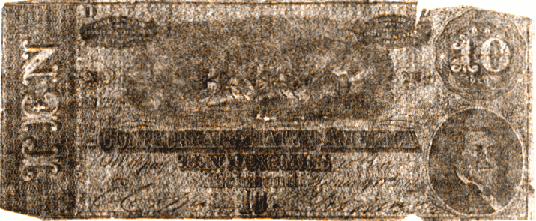
Where did most of the money go? My Brooks-Allen family had supported the Confederacy in the war, converting their U.S. currency into Confederate bills in 1864 when their nation was badly in need of funds. When the Confederacy fell in 1865, these bills were then made worthless.

Interestingly, Grandpa, who settled his father Culpeper's estate, kept the pre-war chest of his family's old Confederate money, including a bundle of the family's papers wrapped in tobacco twine. My Aunt Clara noted that the chest full of $150,000 worth of Confederate money was just "worthless paper," probably repeating just what her relatives had told her after the war. I have seen a sample of several of those bills scooped up by my Uncle Cullen when Grandpa died in 1943 - xeroxing a copy of a ten dollar note after interviewing him back in the 1990s:


$10 note from Brooks Family fortune before the Civil War

A somewhat clearer facsimile of the same $10 note from 1864


Few details of a farmer's life - even well off - entered the newspapers. After the war, everyone had it hard, but there's little evidence that Culpeper kept slaves. There's not much on him at all, actually, after the deaths of his parents - so I don't really know if he inherited slaves from his father's estate - or Louisa from her Allen family. William Brooks II's estate was settled in 1846 in Union County and included the old family land adjacent to Drury Morgan on the Rocky River. If he owned slaves, they were not on his 3-page estate sale inventory nor were there any on his wife Mary Burleson Brooks' estate in 1852.  Still, William I's original thirteen slaves would have been divided at his death in 1818, so few slaves were inherited by any single kid and no further purchases have been found. Still, this was an agricultural community and slaves were often used, especially by the wealthier families.

The most liberal Brooks to certainly break with this trend became my grandfather, a late arrival in Culpeper and Louisa Brooks' home. Their first three sons, William H., Robert Julian, and Preston L., died in infancy. The last two were buried in the Wall-Almond Cemetery (AKA Almond Cemetery, William Wall Cemetery) near Norwood in Stanly County. My Grandpa's two sisters, Eliza Jane Teal and Mary Frances High were a full ten years older than him and their families rarely associated with my grandfather's children. 

The Monroe Journal, 17 Aug 1909, 2
What was a young boy growing up just after a major war - then in dire straights - with only older sisters as an influence, bound to experience? Cullen and Louisa's Rocky River Baptist Church, founded in 1776, became a definite influence in my Grandpa's lonely and sparse life - penance and poverty surrounded him - as well as thousands of freed slaves.  

It may be that Grandpa had planned to settle on a small farm of seventeen acres in Burnesville near Ansonville in 1894, but - thanks to Rocky River Baptist Church and various influences after the war, I believe - he soon became an itinerant Baptist Minister and family historian, bringing the family back together for numerous reunions and writing The Brooks of Union County in 1925. 

It should also be said that he certainly influenced me to study genealogy since I was 16 and to obtain my master's degree in America History. Thanks, Grandpa.. even though we've never met!

Brooks Reunion, c1940


His first appearance in the Biblical Recorder (Raleigh, NC) was on 17 Aug 1898, telling that he was ordained 3 Aug and then served two churches in Anson and Stanly Counties:

Biblical Recorder, 17 Aug 1898, 22

The North Carolinian
Raleigh, North Carolina
21 Jun 1900, Thu  •  Page 4
As I said, thousands of freed slaves searched for a new life when Grandpa was just a young boy of four years. He grew up seeing destitute blacks and whites panhandling and begging, suffering from the ravages of a lost war... the "Lost Cause." That desire for vengeance to get back at the "Damn Yankees" of the United States would spark much resentment among whites after William Woods Holden and Reconstruction ended abruptly. Henry Louis Gates' RECONSTRUCTION: AMERICA AFTER THE CIVIL WAR is a must see presentation!

The special election in North Carolina for 1898 which sparked the racial violence and killings in the Wilmington Race Riot coincided with the beginning of his service in the ministry. Grandpa had to be very careful, for 40% of the people lynched in America were white! Most were killed by the Ku Klux Klan for supporting blacks or for other reasons not considered "desirable" in their neighborhood. It was typical for the KKK or "red shirts" (active in 1898 Wilmington Race Riot) to make up a valid-sounding story to uphold their mob verdict of death by lynching - especially when their victim was a white man.

Ku Klux Klan on horseback

One lynching occurred in Stanly County in 1892 - a white man named Alexander Whitley, allegedly for murder. But, there was little evidence and more hearsay, he stood no trial, and was lynched by a vigilante mob "all wearing red shirts." His descendant has written a book with a title that expresses how society dealt with such violence: Stanly Has a Lynching: The Murder of Alexander Whitley: A Family Legacy Entangled in a Web of Fiction & Folklore 

Enterprise, 13 Aug 1903
As M. Lynette Hartsell tells in chapter nine, a lynching of "Pharoah the Bull" occurred in 1880 - a tale which carried many racially-charged anecdotes of a black man as "savage," a reflection of one Prohibitionist preacher's political animus. I have included the article in Stanly News and Press: "Old King Pharoah Was Stoned For Goring Man". Prohibitionists had tied race to their cause, suggesting that anti-Prohibitionists were in league with the " beastly negroes." As Hartsell suggests, this gave their racism - even violence - a religiously righteous flavor - another parallel with Trump's evangelical supporters today, angered as they are by "Negro Rule" reminiscent of Barack Obama's administration. Hartsell does an excellent job of weaving through the political rhetoric to find reality. 

Still, lynching or attempts to lynch seemed forever on the minds of the more meek shepherds - like I suspect my Grandpa was - attending their flock!

"Indian Doctor" J. L. White was held in prison a full year and narrowly escaped lynching for rape in 1896. In 1900, another lynching of a black man accused of killing a Dr. S. J. Love occurred "by a mob of some 25 person, all disguised" who took the man from the jail, with no resistance from Sheriff McCain, at 2 a.m. in Stanly County. Henry Young was accused of assaulting a white woman in 1908 and nearly lynched by a mob. And, yet another lynching was narrowly averted in Dec 1909 and again, with two black men accused of murder in 1913. Certainly, only a few lynchings and other forms of racial violence had been recorded in newspapers and, contrary to my reporting, they were not just happening in Stanly County - this was a Southern-wide phenomenon. 

The "Lynching Mania" appeared in Stanly Enterprise of 7 March 1901 and almost a full column appeared in the Stanly Enterprise for 13 Aug 1903 which asked the question "But lynching is now on? How can we stop it?" The insincere answer was for faster trials! Whites should ensure swifter justice and that "it would largely stop in the South if negroes would stop committing rape, and this is true." Look at the cartoon below from 1892 of the large black man with bats wings, reaching out for the young white fleeing women - tine and helpless. The caption read "The dangers that hover over North Carolina." It is certain that these accused black men had not raped these women, but were accused nevertheless and hanged. The article went on "It comes of course, as a result of low, uncontrolled bestiality, fed fat by the habits of the life of the negro." As we've seen especially today, "bestiality" appears rather a human quality, practiced by anyone, regardless of any particular skin hue. 

Lynchings from 1835-1964. From data of Monroe Work.

Grandpa's association with, or admiration for, the liberal secretary for populist Gov. Lindsey Russell would be the first clue as to his liberal Christian nature. That secretary was Rev. Baylus Cade of Lenoir, inventor and Baptist Minister, a man who was reviled by conservatives as "Decayed Cade," "once a useful Baptist preacher," for "slandering his church." The North Carolinian of 21 June 1900 spouted a lot of likely "non-sense" as Donald Trump's supporters today, but the last sentence told the strongest sentiments and the original spark for the "righteous flames" - "When a man joins with the negroes in politics, he is ready to tear down the church and slander its good name!" Another article of similar venom spouted "[Cade] is not content to misrepresent the amendment and traduce the white people - that's what all fusion orators do - and Decayed Baylus could not stand to be merely conventional." 
The Semi-Weekly Messenger
Wilmington, North Carolina
03 Jul 1900, Tue  •  Page 2


Oddly enough, Rev. Cade was also a man respected by a quite reverent servant of God, and frequent contributor to the same Christian journals as Rev. Cade - my Grandpa - who named his 4rd son and 5th child - my father - Baylus Cade Brooks in 1916 in his honor!

Rev. Cade's story is an extraordinary tale of rife with the conservative political machine of the day in their battle against "Negro Rule!" The parallels with the Trump Administration today cannot be ignored! I encourage you to click the link above and read about him!


Raleigh News and Observer, 27 Sep 1898


It was in the middle of this tense racial division that my grandfather met and married my grandmother, Emma Eugenia Morton, daughter of Rev. David Stanley Morton on 23 Jan 1902. Their first son was born in 1902 - my Uncle Cullen - already mentioned with the handful of "worthless paper."

Rev. E. M. Brooks and Emma Eugenia Morton, married 23 Jan 1901


Many articles in both the Biblical Recorder and in the Stanly Enterprise newspaper detail his biblical devotion to living a humble life. His personal ministry was directly with the people - he was a do-gooder for sure - and he made various contributions to several Baptist churches in Stanly, Union, and Anson Counties. One of these articles details how Grandpa lived this life and even gave a family historian like myself a unique surprise about my great-great-great grandfather!


Enterprise of 6 Sep 1906 told that Pleasant Grove Baptist Church had given him a "handsome gold watch, Elgin movement" that they wanted him to have to replace his "98-cent timepiece he has been wearing." The article also mentioned a gift he gave them in return - a family heirloom of his great-grandfather's which I'll come back to momentarily.

The same wording appeared also in Carolina Watchmen of Salisbury, 12 Sep 1906. The paragraph before it also included a bit of political news that hints at a "great evil" from which we suffer today - voter suppression by the modern conservative Republican Party. It's helpful to know that, in the 1898 Election, conservatives tried to kill Gov. Lindsey Russell on his train trip home to vote Republican:
It is to be hoped that in Stanly this year there will be no vote buying or vote selling. If a man is honestly a Republican [liberal], he deserves credit and should be allowed his right of suffrage. If honestly a Democrat [conservative], he is entitled to the same privilege. There can be no honesty in elections when there is traffic in votes. In the end the country suffers therefrom and the voter holds the remedy for granting us immunity from this great evil.
[but...] "If the radicals [liberal Republicans] stay in power two years more, the roads in Stanly will be in such a fix that a man won't be able to get anywhere," remarked a citizen of Harris township on Monday.
It seems that any excuse against liberals was fit to print. Everything I read about my grandfather convinces me that he would be seen as a liberal Democratic Socialist today. Of course, in his time, conservatives - actually ex-slavers - were termed the "Democrats," and these cruel conservatives would move into the Republican Party by 1968. My grandfather would certainly not have associated "Democrat" with his own way of thinking!


As promised... Grandpa also mentioned that he gave Pleasant Grove Church a gift in return - one powder horn, "considerably over a hundred years of age," that had belonged to his "grandfather," William Brooks II, made from a gourd. Messenger and Intelligencer of Wadesboro reported in its issue of 10 Apr 1890 that "Cullen" or Culpeper Brooks had the horn in his possession then, that it was his grandfather's (William I) and that it had been used so often it "appeared to be varnished." The 1906 article mentioned "from the seventies," meaning that it had definitely belonged to Ensign William Brooks I when he and his brother Lt. John Brooks went in Capt. John Culpeper's regiment of Rutherford's Campaign against the Cherokee about 1770, before the Revolution. BTW, care to guess where my Great Grandpa "Culpeper" got his name? The powder horn "furnished many a charge when a deer proved a fallen victim," they said. It had done more than that, but I doubt that my Grandpa knew its full history! Or maybe he did and that 's why he gave it away?

Grandpa helped establish the Stanly Baptist Union, a circuit of Baptist churches in Stanly County. He often preached at various locations, but was limited to his place of residence. He had worked in Norwood from 1909 to November of 1915. He and his wife, Emma, pregnant with my father then moved to Palmerville, near Oakboro and "Big Lick" and their child arrived on New Year's day, 1916. 

The next day, Grandpa penned a letter to Rev. Baylus Cade, informing him of his "little namesake" and named "for a great man. One whose ripe scholarship and faultless English excites our admiration.":


Letter of Rev. E.M. and Emma Brooks of Palmerville, NC to Rev. Baylus Cade of Shelby, 2 Jan 1916

Rev. Cade responded ten days later, saying "I value the honor you have done me in giving your dear little boy my name...."


Letter of Rev. Baylus Cade of Shelby to Rev. E. M. Brooks, 12 July 1916

The next year, for my Dad's first Christmas, the family transferred to New London, Stanly County. There, the true followers of a beneficent Jesus celebrated a special "White Christmas" for the "destitute poor" of Stanly County. But, he still visited to other parts of Stanly, like the more western village of Pleasant Grove.

It was not longer after my father's birth, in May 1916, that my grandfather demonstrated his interest as historian - not just as family historian - when "E.M. Brooks of Palmerville gave a historical sketch of the history of" Norwood Baptist Church. He gave a "field meeting" in the open for Palmerville, Ebenezer, and New London in 1918.

By 1919, while living at New London, Grandpa helped initiate an effort to educate the people of Stanly county, with a "Mobile School" for which he served as Dean. According to the Stanly County Herald of 17 July 1919, the school would travel from town to town and spend five days at a time teaching to the children. While the curricula was based on church studies, it did also include various scholarly subjects. The next year, the town of Badin presented him with a gift of $24 to further the poor preacher's pursuits. 

Stanly County Herald of 9 Oct 1919 announced a distant move for the Brooks - nearly to the town of my own birth of Fayetteville - in the small town of Lumber Bridge, southwest of Fayetteville. My father would spend his childhood and later years here - maybe why he chose to purchase his first home near Hope Mills, a bit closer to the metropolis of Fayetteville. 

 
Stanly County Herald, 9 Oct 1919, 1


The Robesonian of Lumberton noted his arrival 20 Nov 1919, where he instructed their parishioners "more perfectly in the ways of finance," and Emma Morton Brooks appeared to have become ill late in September of 1922 but the paper noted that she was "convalescing." On 7 June 1923, the same paper noted him as "Rev. E.M. Brooks of Fayetteville, pastor of the Baptist Church of Boardman," a small town ten miles south of Lumberton. My Grandpa, Rev. E.M. brooks served as pastor at the Person Street Baptist Church in downtown Fayetteville and was listed on the Fayetteville City Directory for 1924. Albemarle Press reported that they were back in Albemarle 25 Oct 1925, but still noted him as "of Fayetteville." My father spent six years from ages 3 - 9 in Lumber Bridge, but his family then resided in Peachland for a number of years.

I remember my father telling me that he walked about a mile to go to school while in Peachland. He and his elder brother Julian Allen used to play pranks on folks by tying fishing line to a dollar and laying it in the street. When someone bent over to pick up the dollar, they'd snatch it away. Dad also told me that he and Allen would try to hit each other's mouths with milk, squeezed straight from a cow! Of course, he laughed at the look on my face!

At some point, my father left Peachland and moved to Fayetteville to live with his older brother Macon - I'm guessing by time of the 1930 census - certainly by the 1931-2 school year, when he was found attending Fayetteville High School (today's Terry Sanford) and working at Matthew's Pharmacy on Hay Street. He graduated from there in 1933 and continued "jerking sodas" at the pharmacy. 

Grandpa retired about that time. He spent his remaining years reading the local papers, clipping articles and exploring history, as he loved it so much. Grandpa saved a collection of newspaper articles, personal anecdotes, and facts that he collected in a scrapbook, dating from about 1931-1939. One of those articles was "Black Mammy Tells Graphic Story of Slavery." This huge article caught my Grandpa's liberal eye.. and I know why. It described a woman who had been severely affected by her servitude as a slave and, later, as a free woman. She never left the home of her former master. This sparked a long, detailed study you'll find in "North Carolina: The Subtle Politics of Slavery Before and After the Civil War." It's not hard to imagine what must have gone through my Grandpa's mind when he read it.


Article written by Charlotte Story Perkinson titled "Black Mammy' Tells Graphic Story of Slavery," Charlotte Observer (North Carolina), 19 March 1933
I can't say that Grandpa was an activist in any meaningful way, but I can discern his thoughts. Maybe the South was the source of the general meek image of a liberal today... as Grandpa would say, they "shall inherit the Earth." Let's hope he's right.

Rev. Edgar Marcelus Brooks passed away from a heart attack at his home in New London, Harris Township, Stanly County just after midnight at 12:45 on the morning of 25 March 1943. My Dad was away in the Navy, oddly enough, stationed at New London, Connecticut. He received an early discharge as a result. 

And, I received one of the best family histories of all time!


Monroe Enquirer, 8 Apr 1943


-----------------------------------------------


Fountain of Hope: Dimensions

Available at Lulu.com

Epub version, too!

Also on Amazon.com!