Donate to Brooks Historical

Thursday, July 15, 2010

Futile Resistance to the Wave

Hinmuuttu-yalatlat
Known by the United States as "Chief Joseph" of the Wal-lam-wat-kain (Wallowa) band of Nez Perce became known for his principled resistance to the removal of his people by United States soldiers under General Oliver O. Howard to a reservation in Idaho.


Hinmuutu-yalatlat became the chief of his band when his father died.  The elder man knew of the white man's thirst for land and warned his son that he was not give in:


The younger man said, "I clasped my father's hand and promised to do as he asked. A man who would not defend his father's grave is worse than a wild animal."

A Stubborn Hinmuutu Removed as Chief

In 1863, a treaty between the United States and the Nez Perce reduced the size of the tribe's reservation in Idaho by nearly ninety percent, from 6,932,270 acres to 748,996 acres.  The "lower" or "non-treaty" Nez Perce viewed this "thief" treaty made by Chief Lawyer and the Indian Commissioners as a sell-out, exactly what the past chief, Hinmuutu's father had warned him about.

In "THE INVALIDITY OF THE NEZ PERCE TREATY OF 1863 AND THE TAKING OF THE WALLOWA VALLEY," by John K. Flanagan, printed in American Indian Law Review, Vol. 24, No. 1 (1999/2000), pp. 75-98, Flanagan states:
 
Lawyer had been made the "principal chief of the Nez Perce tribe in 1855. It is unclear whether the Nez Perce had actually elected Lawyer or whether he was chosen and then appointed by U.S. government officials.  Nevertheless, Washington Territory Governor Issac I. Stevens and other Americans had "recognized" him as the principal representative of the tribe for the 1855 Walla Walla Council, which had created the very first Nez Perce reservation.
Reflecting on the recent past...

Cherokee Removal Before the Nez Perce

This portrait of Major Ridge was painted by Charles Bird King in 1834.

 This tactic of divide and conquer was typical in Native-American/United States relations.  The Cherokee were split into two factions by government pressures in the 1830s, with the "Ridge" party making a "back-room" deal with the United States that gave away the reservation in North Carolina and Tennessee.  The deal was that the United States would give the "Ridge" party land in Oklahoma for signing the treaty and agreeing to move their entire band.  The main problem with this treaty was that the majority of the Cherokee had never agreed to the removal and felt betrayed by Major Ridge.  The United States negotiators clearly understood the wishes of the non-Ridge Cherokee, but were encouraged to "finish the job" by a Congress heavily-influenced by Andrew Jackson's administration.  Some Cherokee avoided trouble and moved to Oklahoma.  Many did not.  These Cherokee defied the U.S. Troops and hid in the wilds to avoid being forced upon the "Trail of Tears."  This was not easy for the Cherokee who spent years acclimating to white society, developed a complex political and economic structure, an alphabet used in their own newspapers... they even owned slaves like their white neighbors.  But, Georgians wanted their land, lobbied Congress and despite their civilized ways, the Cherokee were still not of the privileged white class.  The final decision was inevitable.

The tide of greed had not yet breached the Mississippi River before the 1830s and the Nez Perce prophetically enjoyed the same trading relationship with the United States that the Cherokee, Creek, Choctaw, and others had enjoyed before the Indian Removal Act of 1830.  Still, as sociologist Stephen Cornell has noted, any reciprocity which may have existed was "weighted eventually against the Indians."

With the doctrine of "Manifest Destiny"firmly in hand, the United States continued to conquer territory on the steadily-expanding western border... until it reached the Pacific Ocean.  The Nez Perce eventually fell victim to this greed with all other Indian nations.

Peaceful Resistance of Hinmuutu

Executive Order of 1873 was signed by President Grant upon the recommendations of two government agents. John B. Monteith, the U.S. Indian Agent at Lapwai, and T. B. Odeneal, the Superintendent of Indian Affairs for Oregon, had met with Joseph and his younger brother, Ollokot, to discuss the legal aspects of the Treaty of 1863 and to convince Joseph and his band to move onto an already established reservation.

In 1873, Hinmuutu again negotiated with the militariliy-superior United States to keep his promise to his father and remain on their land.  But, President Grant, ignorant of Indian culture, grew quickly tired of the cultural objections in the negotiations.  Flanagan tells the inevitable results:


In 1875, President Grant rescinded his order and restored the land to the public domain. Any possible fraud in making the Treaty of 1863 did not much matter in the end. The nontreaty Nez Perce would inevitably lose. A decision would eventually be made to give Joseph's band an ultimatum to leave the Wallowa country of Oregon for the reservation in Idaho. By 1877, Joseph's band and other nontreaty Nez Perce would be forced to choose between war and the reservation. In the process of choosing the reservation, a war would begin and Joseph's band would lose the Wallowa country forever.

The United States once again reneged on an Indian treaty and sent General Howard to remove them.  History repeats itself.   Hinmuutu did what was best for his people and peaceably moved.


In 1941, Hinmuutu's band of the Nez Perce brought suit against the United States in the U.S. Court of Claims, seeking rights to regain their homeland.  The federal courts upheld the former "bad treaty" and denied the claim.  However, Flanagan suggests:

... the Court of Claims should have found the 1863 Nez Perce Treaty invalid in so far as it pertained to Joseph's band, and therefore should have recognized that the band had rights in the Wallowa or at least should have awarded the band appropriate compensation. 

In the suit brought by Joseph's band in 1941, the U.S. Court of Claims found that the Treaty of 1863 was valid and held the dissenting minority of Nez Perce bound by the action of the majority of the tribe. The dissenting minority included Joseph's band. The Court basically concluded that Principal Chief Lawyer and others represented the Nez Perce tribe "as an entity," thus making the 1863 treaty binding on the entire tribe. The Court failed to recognize Joseph's band as having rights in the Wallowa country separate from the tribe as a whole. The decision effectively denied Joseph's band any compensation for their land that was taken by the U.S. government and placed
in the public domain.


Bureaucratic double-speak for we win - you lose.  Thousands of words to say absolutely nothing.  The court's decision had already been made decades ago.  The Nez Perce today still fight for whatever piddling rights they still have, salmon fishing, logging, the right to environmental damage by Bonneville Power Administration, the list goes on... the United States attained the status of "superpower."  It's easy to win the game when you're holding all the cards.

 
The preceding article is provided as thoughtful reflection on the past imperialistic actions of the United States.  These acts are easy to ignore. Most of our ancestors were completely ignorant of these events.  But, would they have objected?  Still... they're history now.  But as George Orwell once said:

"Whoever controls the past, controls the future... but, whoever controls the present, controls the past"

The image of Hinmuttu in a 1901 advertisement.

History repeats itself.  Clearly, the past is instructive for our future, but what happens today is extremely important as to how that past is perceived, indeed as to how that past is transmitted to the future.  Perhaps students of tomorrow will hopefully view our actions in the Middle East today as a continuation of similar actions in the past, of the Phillipines, of Spanish territories in the West Indies and Central America and prevent these actions in the future.

Hopefully, we can learn to be more responsible, to make good decisions like Hinmuutu-yalatlat.


Tuesday, July 13, 2010

My First Grade Teacher's Act of Kindness


I'm probably not the world's biggest fan of the economic system that we call "capitalism." This poster here expresses my feelings pretty well.  Now, don't run off... I'm not going to just pout and whimper and b__ch about this without offering advice.  So, stick around and hear me out.  I would do it for you.  

Now, for an American to say absolutely anything negative about capitalism, you almost put your life at risk. Why should we fear reprisal in the land of the free? What makes arguments against capitalism so taboo? Why doesn't free speech cover this?  After all, it's just critical analysis in a democratic system... a balance, or check.

If you think about it... you've done things before that you're not proud of. I know you have, too so don't give me that "innocent ol' me" look. :) I used to smoke in a barn behind my Grandma's house when I was twelve. That's kinda young to start smoking, I know. I kept smoking on and off until my father's illness in 1983, when I realized what this crap really was. I smoked... I knew that I wasn't supposed to, but I did it anyway. I even defended it. I said that it made me look cool. I said that it really wasn't that bad for you, despite all the warnings. I fell into the psychological trap that tobacco manufacturers are hoping that you will... the illusion that smoking is a cultural thing, therefore a good thing. James Dean didn't help there, either.


The point is that there are lots of smokers and they will vehemently deny that smoking is bad for you, even though they know that the opposite is true. But, have you noticed how emotionally they defend it? Because they know it's bad, they know that you know it's bad... so they have to fight not only your good sense but they're own.


So, now think about capitalism. We depend on it like a smoker depends on cigarettes. We're addicted.  Our entire culture is based upon it. That means that our culture is based upon "Caveat Temptor, the buyer beware"... as opposed to "love thy neighbor," or "he who dies with the most toys" instead of "lend a helping hand." The system that I sometimes call "Barberica" (Barbados + America) is based upon capitalization of resources... meaning to take full advantage of every opportunity to achieve our financial ends like our abusive Bardadian ancestors and slave labor to achieve their ends. The only thing that held us in check (remember the idea of checks and balances in the Constitutiion?) was our religion.  


"Our religion"... why not the many religions that can be rightfully found in this country? By "our religion," I'm referring of course to Christianity. It's on our money (glad I'm not a hyphenated American). A wikipedia file states:


The motto IN GOD WE TRUST was placed on United States coins largely because of the increased religious sentiment existing during the Civil War. The motto first appeared on the 1864 two-cent coin, followed in 1866 by the 5 cent nickel (1866-1883), quarter dollar, half dollar, silver dollar and gold dollars. It did not become the official U.S. national motto until after the passage of an Act of Congress in 1956. It is codified as federal law in the United States Code at 36 U.S.C. § 302, which provides: "'In God we trust' is the national motto."

Our "official" motto did not become that until 1956!  I was born only 5 years later.  Something definitely changed since 1776 and despite the establishment clause in the Constitution.  Ok, fine. I don't intend to debate church and state.  So, we're religious.  But, "our religion" doesn't stop us from taking advantage of our neighbors, does it? But, it should!!!?? It's a Janus-faced twofer. On the one hand, we say "buyer beware" while on the other hand we say, "charity is a virtue."  

And religion as a control has become a great deal more impotent in recent years.  In many cases, modern religion actually supports behavior expressly forbidden in biblical texts.  A runaway behavioral effect took place and morality died in blitzkrieg of commercial conservatism.  Barbadians had Anglicanism, too.  Didn't stop them either.  It became cost-productive to work slaves literally to death.  After all, the bottom line, you know...

"Buyer beware" and "charity is a virtue."  I don't know if you've noticed, but those are completely polar ideas, inherently opposed to each other. They both can't be true. So, which is it? Do we do money, or good? Well, it seems that we do a lot more money than good. I know you have to agree with this. We all say it. To fight for that almighty dollar even if your "Almighty" tells you its a terrible thing. "The love of money is the root of all evil," right? Unless you want some more cigarettes. Then, you're whole perception of evil takes an about-face. 


Perhaps this is exactly what Charles Darwin referred to as "survival of the fittest." Capitalism does, indeed follow that precept. Still, is this what you would call civilized behavior or animal behavior? Which one of those do you most equate to? What is it, after all that separates us from animals? Most reply "intellect" to that question... the ability to think rationally. Rational thinking to achieve "survival of the fittest?" Isn't that convoluted logic, tautological reasoning that brings you right back where you started? In that world... we're still animals, fighting to die "with the most toys."


It only takes common sense to realize that this simply isn't right. And I believe that we all know it... ala the vehement and strong reactions to anything that questions capitalism. That kind of thinking is automatically called "socialist," and "communist," or any number of reactionary things that can't be said here. Marxist is another "negative" American-biased term. Still, these ideas are the ones that most closely corresponds to the morality that you will find in that book we call the "Bible." Has anybody ever read Marx's stuff?  You can't do it in public... you're not really free to do that.


I don't expect that I will change minds, here. Most of you will angrily oppose this line of reasoning... in my opinion, for exactly the reasons that I gave you. Inside, you will probably see the simple logic, however. For me, I can hear my mother saying, "share with your brother." 


My first grade teacher said the same thing one time when I forgot my lunch. I became the recipient of that teacher's sense of morality. I seriously doubt that she was a believer in capitalism. She probably never even thought about economics in that vein. But, her actions were more social, Marxist, or biblical and I was thankful for them. Will I see her morality as weak and take the food and never return it in kind? Not when I was NOT taught to be that way from the beginning... no. But, that's just me. I give everyday of what I can. I temper it with judgment... something we all have.   But, certainly not something that we all practice.

Now that I'm an adult, I shouldn't simply forget the moral lessons of childhood in order to conform to the modern ways of taking advantage... of "Caveat Temptor." Do I dump my morality at the first sign of green paper?


The problem we face is that everyone else will take what they can if we drop our guard. We cannot afford to simply follow our moral sense because someone else will capitalize upon our moment of "weakness." A system that views morality as a "weakness" is sick and ailing. After all, we seek to be civilized, to be more than the sum of our parts.


Why are we now in our present economic crisis? Because of people who practiced capitalism without a conscience. Conscience is a flimsy partition between morality and money. We can never assume that that behavior can be excised from our system completely, either. A greedy few can ruin it for all. It's like another first-grader running over and grabbing that halved peanut butter and jelly sandwich given to me by another generous kid as he scoops up everybody else's lunches, too.  My teacher would rightfully scold that little brat.  But, he's only acting in accord with the only economic system that he's allowed.  A drastic change needs to occur to change that kind of one-sided system. Education (something that's de-emphasized because of the risk of self-awareness) and our own talents of critical thinking can change this. 


Are you prepared to make life better for your kids?  Think about this: an internet-based system where we all have a true and direct say in American policy.  Is that democratic enough for you? 

I want to be civilized and I'm acutely aware that I'll never be perfect. But, I can be better than I am right now. How can I... how can WE change this? My ideas are what I like to call Moral Economics... an economic system based on producing the greatest amount of benefit for everyone... where we all work for each other and have an equal voice in government.  Thomas Jefferson proposed this idea of democratization back in the 18th century and we had it for awhile in the Articles of Confederation... but it wasn't feasible because counting votes from everyone across the country depended on a horseback courier that took weeks to get back with the answer.  It seemed kind of crazy in the eighteenth, nineteenth century or even the twentieth century and Jefferson's ideas suffered a lot since then... but, in the 21st century, we have instantaneous communication ability and can easily vote on any and every change that's proposed through the internet, within certain reasonable limitations, of course.  Thomas Jefferson would probably jump and cheer at this idea.  I rather believe that if the country could all vote on military action, we would not be in Afghanistan nor Iraq right now... the Lakota Sioux who died at Wounded Knee in 1890 might have lived.  Those were not our decisions. 


The first step, in my humble opinion, is to regulate the abusive system that puts 70% of the peanut butter and jelly sandwiches into 1% of American hands. That kind of system wouldn't last anyway... sooner or later, the American "mob" as Jefferson put it, will revolt (happened before). That much money should never be allowed in a single pair of hands. The Donald Trump's and Bill Gates, multi-mega-millionaires that are glorified on TV and have become the heroes of future capitalists must not be viewed in this way. Let's be responsible with what we show on TV... so vote on it. Mass-media really is the culprit. Lyndon Johnson wasn't ready for mass media in Vietnam, but every president since then has certainly relied upon it greatly.  They got used to closing their mouths and becoming better snake-oil salesmen.  Still, TV gives us more than we can reasonably handle. De-commercialize the average human life. Don't allow advertisers to fight over us like they do.  Vote on what products you want and end the battle there.  Vote on how much competition you would allow.  Competition is cool, but with mass media like TV, it takes on the guise of an epidemic.  

Foremost, make education the most admired tool in our repertoire by promoting critical thinking and morality side by side. Further scientific pursuit and discovery to provide us with the necessary ease in life.  And, be willing to share that ease.  Let's be more civilized than we have been.  Believe it or not, technology can bring it to us.  And, let's be ready to prosecute the corporate abuse, levy heavy fines and sentences on the abuse... literally, treason upon their fellow Americans. 

These are only preliminary arguments.  There are a lot of things that can be done... we just have to put the effort into making that discovery. It won't be so hard to find if we really look.  


Utopia? Heck, no. There's no such thing. But, the ideal is a terrific guide... strive for Utopia while understanding it's only a rhetorical tool to get the job done.

Don't blame Republicans, Democrats, or Libertarians, on even that one public personality... a visible target that we love to abuse and harangue in public (this is usually the poor president).  We're just reacting because we're scared and don't know what to do.  Again, education can provide the tools to help us find out what to do.  Corporations win because they depend on American ignorance.  Put all the effort into education that's possible and keep corporations from getting all our peanut butter and jelly sandwiches. 

Sunday, July 11, 2010

Mapping Hatteras... the White Apology

Much debate has surrounded John White's 16th century maps of the North Carolina coast and the questionable accuracy of Theodore DeBry's engraving of White's watercolor.  Any comparison between White's depictions of the natives of the Carolina coast and DeBry's engravings of those depictions and you can easily question the veracity of the map.  The faces of most of the natives look much more European in DeBry's engravings and several bits of minor details were left out.

That engraved DeBry/White map is important to us as to the accuracy of the locations of the Indian villages indicated on Hatteras Island, or "Croatoan."  The "extra cape" on White's original and on the engraving caused me more than a little concern.  Fear not, however, for White/DeBry's "questionable" detail of the "extra cape," indicated in all these versions for it actually exists... or did exist.  There's proof.  That "extra cape" turns out to be a "false cape" that is still preserved under the surface as the coastal hazard that we now know as "Wimble shoals."

Ever since our project's helpful contribution from Andy Powell, an email about that “false cape” in the area of Rodanthe on the Outer Banks, it has been bugging me about the current water levels as compared with the water levels suspected in 1585 when John White made his map. It had to be much lower in 1585. By how much was the next question. What did the Outer Banks look like at the time that John White watercolored them? Why in the world did he paint such a prominent cape that is not visible today?

Here are the two versions of White’s map, compared in DeBry’s chosen orientation of West on top:


On both maps, “Croatoan” is colored completely red, indicating that the English had spent considerable time there. Note though that on one map the mainland next to Roanoke Island is all red, while the other map has specific towns colored in. There are two dots where “Dasmemonquepeuc” is supposed to be. The supposition is that these two maps might have been done at different stages of the colonization period 1585-1588. For instance, the area of the first “false cape” area (as per Andy Powell) has no red on one map, but some indications of exploration on the other.

The point that I want to make here is that John White, without the benefit of a surveyor’s eye, drew a damned fine map! The extra cape (what I indignantly and once loudly called it) was not a figment of White’s imagination. It’s real. Andy Powell told us where to find it. So, I looked. In 2000, geologists did a survey of the Outer Banks in order to determine sand resources. They mapped the area presently under the sea (see below). On this map, the yellow areas indicate the present Outer Banks but with the water level artificially dropped to five meters, we wind up with a shoreline where the orange/red area is. Go a little further, to about seven meters (specifically for the “false cape” area at the present site of Rodanthe, and you have a shoreline in the area that I have colored purple for illustration purposes. If you go all the way down to 10 meters, you even get the little “claw hook” that White painted and DeBry engraved in the sixteenth century (shown in faint pink below the purple).


Background: Theodore DeBry map engaving of 1590; Inset: Stephen K. Boss and Charles W. Hoffman. “Final Report: Sand Resources of the North Carolina Outer Banks,” Prepared for the Outer Banks Task Force and the North Carolina Department of Transportation, April 2000.

Now, we have to temper this with the fact that this is the famed Outer Banks, site of sand-churning, killer shoals. The sands did not remain consistent over 300 years. Still, the hardened, or partially “cemented” areas of sandstone deep under the banks, are more resistant and are still there for all intents and purposes. So, the basic shape still remains of that “false cape” and we now call that area “Wimble Shoals.” By the way, the inlets that I have placed in there by erasing the landforms I did NOT do so because that’s where White put them but rather because that’s where the geologists indicated in 2000 were areas of possible inlets, or “instability.” Again, confirmation of White’s observations.

What does this have to do with our mapping of Hatteras? I’m glad you asked. John White was fairly accurate. He’s also our eye-witness and his testimony has to be the primary evidence that we use to determine the evolution of Hatteras Island, the past “Croatoan.” This analysis only vindicates John White’s observations and his recording of those observations on his maps. As to Theodore DeBry’s version (as you can see on the map comparison figure), his interpretation of White’s painting was accurate in many details. The locations of the Indian villages are easily identifiable as Buxton, Frisco and Hatteras village at Durant’s point (comparing the exaggerated “bumps” on DeBry’s map). These locations we generally agree are high ground areas where Indians would likely settle (assuming that they didn’t like having their towns flooded on occasion). Indians had centuries of experience with the Outer Banks and would have known about the feasibility of these areas, a subtlety not immediately recognizable to White or DeBry or any other European. So, why did DeBry put the towns where he did? Because that’s where White told him they were! It has to be. These town sites can be roughly defined as “Hatteras village,” “Frisco” and “Buxton” today.

Archaeology has confirmed the site of Buxton and deed records are confirming the temporally extensive (until 1788) Indian occupation at Frisco. We have yet to examine deed records for the Buxton area to determine who exactly owned the area of that town, but we’ll get there. Progress, folks! Definite progress through archaeology and team work.

Let’s all give ourselves, but especially, John White a hand… and, from me, an apology. I was really harsh on the guy. I was saying things like, “was this dude on drugs, or what?” Right now, he’d be giving me “the eye.” What can I say? Academics are typically hot-headed and spoiled, right? That’s my excuse.

Friday, July 09, 2010

Murder on Hatteras!

Beautiful, isn't it?  The North Carolina Outer Banks so calm and serene...  children playing in the surf and sand pipers running along the shores.  But, underneath this deceptive display of serenity are the gargantuan forces of mother nature, two powerful currents, the warm Gulf Stream from the south and the cool Labrador from the north... they meet in a whirlwind of tremendous power like an underwater hurricane, thrusting the loose bottom sands into piles called shoals that changed from day to day and threatened shipping close to shore.

Diamond shoals would become famous for its unpredictability and the number of shipwrecks that it contributed to the "Graveyard of the Atlantic," coined by a young Alexander Hamilton, who remembered how it almost took his life one day.  Diamond shoals was the meeting point of the currents and it also forms the tip of the island that we call Hatteras, home to the ironically peaceful Croatoan Indians that once sheltered the first English visitors to these shores.

The early days of North Carolina were filled with rough and tumble types, many of them coming to Carolina because they couldn't make it elsewhere in America.  Cape Hatteras, also was the last place in the rowdy southern colony that anyone in their right mind would settle.  So, for a murder to occur there was by no means a surprise.

Newspapers carried notices like this 1719 Boston newspaper ad... Cape Hatteras as a dangerous endpoint of a dangerous range on the eastern seaboard:


Almost every reference I have ever found was to Cape Hatteras as a place you should NOT go.  What's more is that Blackbeard (the most famous pirate of the Carolina shores) was killed just southwest of Hatteras in 1718.  He hung out in North Carolina for the weather... right!  No, it was because anyone else would be foolish to try to brave the dangerous shoals and come after him there.  Ask Kevin Duffus who just wrote a great new book on the man.

One thing that Duffus was convinced of... and that was that Capt. Edward Teach, Thatch... maybe "Beard"... was not that unusual... not compared with other North Carolina residents of the time, especially residents of the Outer Banks.  Many of his former crew members may have come back to Bath after being released by Gov. Alexander Spotswood, subsequently let off the hook by North Carolina's governor, Charles Eden (Blackbeard's buddy), and even became influential Carolina citizens (the very wealthy "cooper," Edward Salter, for one).  James Robbins came back to bath, but still liked carousing and drinking and loving the ladies too much... he even got in the court records for loving more than one lady at the same time! 

I think you get the impression that pirating was a fairly common profession for our ancestors.  Undoubtedly so on Hatteras.

Of the early colonial grants on Hatteras Island, we find three men specifically that obtained grants in the same area of the island.  Henry Davis obtained 320 Acres "joining on ye Indian town" (probably the one that John Lawson visited in 1701... of the three towns, that is) on Sept 19th, 1716.  Three weeks later, Patrick Callihan & John ONeal were granted land adjoining each other on Tom King's Creek in present Frisco.  These grants were not surveyed very well (probably from the sound in a boat) and the direction of the creek was misjudged.  Consequently, Callihan & ONeal's grants were quite a bit different than they originally assumed, with the creek suddenly turning east a few hundred feet from its mouth on the sound's edge. ONeal very likely lost a lot of land.  Callihan, on the other hand stood to gain much more than his original 200 Acres.

But, there was a problem... that Davis grant three weeks earlier had been made on both Callihan and ONeal's later patents.  That's right, there was a portion of that land owned by two men at once.  Callihan and Davis shared the greater portion.

Now, most men gathered as much land as they could in the colony and may not have even visited their grants right away with so much more to look after.  So, there was no reason to worry... for awhile.

It seems that John ONeal was doing well for himself, paying his quitrents mostly on time (he slipped one year but made up for it the next).  But, Patrick Callihan and Henry Davis were not so lucky.  Tax lists for 1718 & 1719 show both men in arrears.  A "Denis Callahan"of Currituck County (where Hatteras was at this time) lost land in 1719, perhaps a relative of Patrick Callihan.  So, the Callihan family was perhaps not financially secure.  Henry Davis was still in arrears by 1000 Acres, but not yet in dire straits.


Then, something happened.  The North Carolina Colonial Records ( http://docsouth.unc.edu/csr/index.html/document/csr02-0226 ) had this to say in 1722:

Minutes of the General Court of North Carolina
North Carolina. General CourtMarch 27, 1722 - April 07, 1722 Volume 02, Pages 463-473
A bill of Indictment agst Patrick Callihan for the murder of Henry Davis.
A Bill of Indictment agst Chas Williamson and Willm Maccoy for the Murder of Salmon Burges
A Bill of Indictment agst Wm Maccoy for ye murder of John Palmer.
A Bill of Indictment agst Patrick Callihan for an Escape

There was more than one murder on the daily docket for this wild colony (William Maccoy charged with two!  And, him being my own ancestor is not just a little uncomfortable...)... still, notice the names in bold print.  Callihan and Davis obviously had their own argument about something... I'll give you three guesses.


Continuing in court, 1722:


The Jurors for our Sovereign Lord the King Presents that Patrick Callihan late of Curratuck Precinct in ye County of Albemarle Planter not having the fear of God before his Eyes but being moved and Seduced by the Instigation of the Devill on the one and twentieth day of August in the year of our Lord one thousand seven hundred and twenty one at Curratuck aforesd in & upon one Henry Davis in the Peace of God and our Lord the King then and there being by force & Armes an assault did make and the sd Henry Davis did beat cutt & bruise by giving and striking him two Mortall blows and cutts on the head with a certain weapon called a Cymeter or Cuttlash (a sword) of the value of one shilling and so voluntarily feloniously & of malice forethought the sd Henry Davis at Curratuck aforesaid beat cutt and wounded particularly on or about his head in such violent that of the said Mortall blows Cutts & wounds he pined & languished untill the five and Twentieth day of the same Month and on the five and twentieth day of the same Month of August at Curratuck of the aforesaid beating cutting and wounding did die and so the said Jurors on their Oaths do say that the aforesaid Patrick Callihan on the aforesd five & twentieth day of August at Curratuck aforesd in manner & form as aforesd & of malice forethought did feloniously & willfully kill & murder contrary to the Peace of our Sovereign Lord the King that now is his Royall Crown & dignity &c.
DANll RICHARDSON pro Duo Rge.
Upon which Indictment the said Patrick Callihan was arraigned and upon his arraignment pleaded Not Guilty and for tryall thereof putt himself putt himself upon God and the Country.

 a little further down, on page 465, we find: 


Wee of the Jury find Patrick Callihan is guilty of Manslaughter. [Is anybody else questioning the judge's sanity, here... TWO mortal wounds (didn't mention how many others) ON THE HEAD and he only gets ... MANSLAUGHTER!!!]
then the sd Callihan being asked if he had any thing to say why sentence should not pass agst him as the Law in that case had provided and he offering nothing in avoydance thereof
Whereupon it is considerd and adjudgd that the sd Callihan be burnt in the hand with the letter (M) [oh... painful!] that he forfeit all his goods & Chattells for ever and the profits of his Lands for a year and a day [that hurts worse] also that he become bound by Recognizance in the sum of two hundred pounds wth two sureties in an hundred pounds each for his good behaviour for a year and a day and that he remain in the Marshalls custody till he has given such security and paid the accruing Costs. Memorandm yt that part of the Sentence of burning in the hand was Executed upon ye sd Callihan in open Court, And then it was further Ordered That the Provost Marshall doe seize and take into his Custody all the personall estate of the said Callihan wherever to be found in this Governmt and that he out of the said estate doe pay all the accruing costs occasiond by his prosecution and apprehension as farr as his goods will amount. And that he pay the remainder (if any) to the Receiver Genl to the use of the Lords Proprietors as Grantees from the Crowne.  [There’s how he lost his Hatteras patent on Tom King’s Creek…]

This was not the end of the story... remember that Patrick Callihan was also accused of an escape....


North Carolina—ss.
To the Honble Christopher Gale Esqr Cheif Justice of this Province & to ye rest of the Justices for holdn ye Genl Court there
The jurors for our Sovereign Lord the King upon their oaths present that Patrick Callihan late of Curratuck prcinct in the County of Albemarle Planter was arrested for the murder of Henry Davis late of the same precinct and afterwards vizl the sixth day of August Anno Dom. one thousand seven hundred & twenty one at pasquotank precinct in the same County by John ffurry Esqr Justice of our said Lord the King for keeping the Peace in the precinct of Pasquotank & County aforesaid was com̄itted into the Custody of Majr Thos Harvey then Provost Marshl for the said County of Albemarle & having in his Custody the aforesaid Patrick Callihan for the Murder aforesd within a very short time after his said Com̄ittment by force & Armes out of the Custody of the said Majr Thomas Harvey & agst the will & knowledge of the sd Thomas Harvey feloniously did gett & goe & from him did escape and fly out of the view & sight of the said Thomas Harvey agst the Peace of our Sovereign Lord the King that now is his Royall Crown & Dignity &c.
DANl RICHARDSON P Duo Rege.
Upon which Indictment the said Patrick Callihan was Arraigned & upon his Arraignment pleaded not Guilty but being a second time called to the Barr in order to his Tryall he prayed leave to withdraw his plea which being Granted him he then Pleaded Guilty as to the escape & humbly moved the Court that he might be heard by his Councill as to the ffelony And the same being argued by his Councill & likwise by the Attorney Genl on behalf of the King. The Court here is of Opinion that he is Guilty of Misdemeanour only.
Whereupon it was Considerd, and Sentence was Pronounced that he should be publickly whip't and receive nineteen lashes on his bare back well laid on  [ouch! ... still, his land profits!  Damn!]

Callihan was branded on the thumb, then whipped for attempted escape.  Up till the escape, he was only charged with manslaughter (not exactly justice, I'll warrant).  But, keep reading in the colonial records... 

John Man [probably of Mann's Harbor township & Roanoke Island] being bound by Bond to appear at this Court on Suspition of having harbourd & Concealed one Patrick Callihan who had made his Escape from the Provost Marshall to whose Custody he was Com̄itted for ye Murder of one Henry Davis made his appearance but noe person
-------------------- page 470 --------------------
appearing to prosecute or give Evidence to make good the Charge against him he is dismist without day paying Costs. 

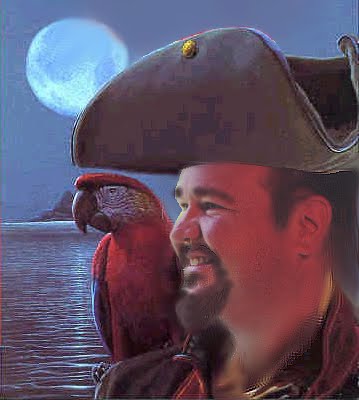
Well, at least Mann got off for harboring a fugitive (wonder if the township was named for that reputation).  That was probably a common charge, too.  North Carolina has undoubtedly matured since those days.  Still, I think we've still got a bit of the rogue in our personalities... I know I do.  :)  Maybe that's why I play a pirate almost every Halloween.... sometimes at Christmas.   Well, don't play around with the swords... you might mortally wound somebody... twice!  I'll be off to tend me wounds from the last fight, ya lubbers!  Keep the wind at yer backs!

Wednesday, July 07, 2010

By Any Other Name...

Hello, fellow genealogists. As an historian who has spent some time studying Native American culture and is currently involved in a research project on natives of Eastern North Carolina, I feel that I must caution everyone on the Indian use of surnames.

Indians of the colonial period were doing their best to cope with many European ways such as the use of alcohol, land ownership, legal rights, firearms, and just a general view of the world that was very alien to anything that Indians were used to. It is easy to assume that Indians behaved like Europeans, but I think you will find that it took a long time before that happened.

An evolving impression of Native American culture must begin with something very much like this excerpt from an introductory textbook on Anthropology:

"All societies regulate the allocation of land and other valuable resources. In nonindustrial societies, individual ownership of land is rare; generally land is controlled by kinship groups, such as the lineage or band. The band provides flexibility of land use, since the size of a band and its territories can be adjusted according to availability of resources in any particular place (Haviland, Prins, Walrath, and McBride, Essence of Anthropology, 2007, 221)."

Renowned Native American scholars, Theda Purdue and Christopher Arris Oakley have recently revised Purdue’s 1985 edition of Native Carolinians. In the 2010 edition, they propose similar anthropological ideas in the context of Native Americans:

"Europeans who came to North Carolina were part of a culture characterized by Christianity, constitutional monarchy, a commercial economy, patriarchal (or male-dominated) households, and considerable freedom for and emphasis upon the individual… Indians had little notion of monotheism, or belief in one god. Led rather than ruled, they governed themselves through open councils that arrived at decisions by consensus. Their religious and ethical systems condemned acquisitiveness and reinforced a subsistence-level economy in which people produced only enough for survival. Women had considerable power and influence within the family and, among some native peoples, within the tribe as a whole. Finally, while Carolina Indians had considerable personal freedom, the well-being of the community normally took precedence over the desires of the individual (Purdue and Oakley, Native Carolinians, 2010, 16)."

You can see that Indians simply thought differently than the European. Their families were matrilineal, meaning that the "surnames" or family identification would come from the line of your mother, and her mother, and so forth. Whereas, in European culture, it is patrilineal. I am a Brooks because my father was a Brooks. However, Red Eagle was of the Wind clan because his mother was Wind clan. He might have termed himself Red Eagle Wind, but that is a European pattern of name-taking in itself and is not consistent with Indian practice.

Indians took European surnames simply as a natural tendency of Indians to take names identified with powerful figures. In colonial times, to speak of an Indian "surname" as we might use one was simply ludicrous.

History shows us that King Sothel of the Bay/Bear River Indians only took that name because he respected Seth Sothel's authority as governor or "chief" of the Europeans in North Carolina. He probably did not pass this name to his children, but rather they took the family names of their mothers when they reached maturity. That was even different... Indians did not have a given name at birth but assumed one after their rite of passage at puberty.  Imagine that Phil wasn't called "Phil" until after his thirteenth birthday!

Other prominent Indian figures from history did likewise: King Tom Blunt of the Tuscarora took his name most likely from Captain Thomas Blount, a member of the Chowan vestry and assemblyman who had direct dealings with Indians during the killings of certain white men by Bay River Indians at the time of Henderson Walker's term as interim-governor at the turn of the 17th century.

Another such example would be William Elks of Hatteras who most likely took his name from Emanuel Elks or that family who lived in northern Currituck County, NC around that same time period, 1700-1730 or so. Understand that Emanuel Elks was a white man, William Elks was not. These Elks did break with Indian custom somewhat. The wife and daughter of William Elks, Mary & Elizabeth, used the name Elks as well... but the son-in-law, Thomas Elks took his wife's family name, Elks. Capt. Job Carr wrote to Gov. Arthur Dobbs about an Indian Elks claim to land on Cape Hatteras:

"I have made diligent inquiry as to the complaint of Thomas Elks Indian and I find the greatest part to be erroneous…the complaint of sundry persons that came and indeavor to disposess him and the rest of the indians which is a small number for there is but (faded) man beside himself and one small boy ... Thomas Elks [is not] intiteled to the royelty for he is but a son in law to the late King Elks desesed and part of the Maromosceat line of Indians for the true line of the Hatteras Indians are mostly dead. Job Carr"

Thomas Elks and two other Hatteras Indian males were left and had moved onward to the Lake Mattamuskeet area. That they might have used the Elks name once there is problematic because it simply was not their custom. European officials are the only ones who recorded any documents about the Indians and they were biased toward the patrilineal custom, referring to the male Indians only, not the females, and assuming that a male must sign a deed to make it legal when the Indians felt that only women had that authority.

It is possible that some females of the line left Hatteras as well (how would we know?), but the males would not transmit the name most likely. Elks all over the eastern North Carolina area are very likely NOT native... the Pitt County Elks have DNA-tested as European. Most of the rest will as well, I'm sure. I'm not saying that it's impossible, just very unlikely. The truth of the matter is that most of us are mutts of many varieties, with European, Native American, and African blood in the mix. Haplogroups will only show the male descent, however. So, if your father was European and your mother was the Indian, you will have a European haplogroup in your DNA test.

Rest assured, however... we all have a little of everything. But, saying that we descend from any particular Indian is nearly impossible to say definitively.

Yes, I targeted the Elks because of the great fervor in eastern North Carolina today over the "Elks line of Indians." I hope Elks families discover some Indian roots, I do. However, there won't be many of you from that line. More likely, you will find some of the clan that King Blunt and King Sothel came from... maybe King Hancock or "John Hoyter King of the Chowan Indyans."

After all, what's in a name?  If you asked a colonial Indian, his response would probably surprise you.

Thursday, July 01, 2010

Great-Great-Grandpa is my Teacher

Ohiyesa, known as "Charles Eastman" said "More than this, even in those white men who professed religion we found much inconsistency of conduct. They spoke much of spiritual things, while seeking only the material."


Are we sorry about what happened to Native Americans in this country?  It’s a rhetorical question, with an answer that’s simply expected.  A more enlightening question, perhaps is… Were our ancestors sorry in 1835 about Cherokee Removal or the later Wounded Knee Massacre?  Whose ancestors did this, exactly?  There were those, of course who thought that it was a horrible thing to do.  But, if they had opinion polls in the 19th century, what would they have said about those things? 

According to history textbooks, they were resoundingly FOR removal and “getting rid of” the Indian.  Officially, 19th century America felt that Indians were in the way.  But, did all of America feel this way?  According to the history books, they did.

An opinion poll is democratic, right?  Well… maybe not.  Today, I think that it's rather a tool of those in control to supply the illusion of public support to something that they are sure may generate opposition.  When the public learns that the “opinion polls” stated that the country was behind any act committed by the government, then they will accept it and stay quiet. But, opinion polls reflect only the opinions of those polled, not necessarily the whole population.  

Here’s another question… if opinion polls were around in the 19th century, what would they say about Wounded Knee before and after December 29, 1890?  I ask about both periods because public opinion would have certainly changed after the massacre.  Before that date, the public would probably have been less FOR the attack on the Lakota Sioux than we think… but, AFTER the massacre (indeed, it was a massacre), the public would most certainly have been against it.  They're good people, our ancestors.  But, they simply had no public venue to voice their opinion beyond newspapers.  Newspapers did carry opposing viewpoints AFTER the massacre, but people were lying dead and frozen on the ground at that point.  Still, the objective was accomplished and public opinion could not get in the way.  “Progress” would continue.  Government found it easy to push their ideology through the official channels. By Government, I'm referring to Congress, of course, the politicians, the guys and gals who follow public opinion (whose public opinion mattered then, again?).  But, then there were no opinion polls, so how did they know.  Railroad companies, Mining Companies, businesses that employed everyone else had lobbyists that threatened to pull their support unless that village got eliminated from the land that they wanted... certainly, that qualified as an opinion poll to Congress.  My Great-Great-Grandpa was probably plowing his field and had no earthly idea. Every Sunday, though, his preacher told him about what happened last month.  Not exactly the Associated Press wire service.  Still, he got to display his democratic prowess and vote every four years, right?  How informed do you think he could have been?

In the 19th century, leaders didn’t need opinion polls because speedy news would have to wait for television and CNN.  Whatever happened, happened, and THEN the country (meaning, people like you and me) found out about it. 

When did opinion polls begin?  Well, in the 19th century, the first such poll was conducted by The Harrisburg Pennsylvanian in 1824 to show that Andrew Jackson was leading John Quincy Adams.  It was a simple poll with one point and a small voter base.  Woodrow Wilson was the subject of another small poll in 1916 and in 1936, the Literary Digest ran a poll, this time with 2.3 million voters, however they were generally more affluent Americans who tended to have conservative or Republican sympathies (rich people, probably with financial interests in oil).  Great-Grandpa was probably a democrat.

What about today?  Well, today the opinion polls are necessary largely due to that annoying thing called television.  If Wilson's day had television, then everyone would have known immediately about our invasion of the newly soviet Russia who de-privatized ownership of oil fields, much to Standard Oil Company's distastes.  What?  Surprised?  1918, Russian invasion... didn't you read about this in school?  Neither did I.  Actually, neither did Congress in 1918 (slight unconstitutional booboo there).  They could've used a TV, I tell ya.  Executive power grew in the early 20th century and virtually ripped control from them, reducing the power structure from a pesky 535 to only 1.  Afterwards, the power(s) that be hated the invention of the television... at first.  They still depended on public opinion, but now that opinion was easily generated and easily broadcast.  Watch any good newscasts on Vietnam lately?  Boy, was that embarrassing for Johnson? Congress/President had to adapt to provide the services that conservative businesses still demanded.  Today, I think you'll agree that it works for them much more than it works against them.

Meanwhile, Grandpa (third generation) was still working the plow, probably another good family democrat.  Still happily plowing that same field, most likely.

 
Here’s another most annoying question (back to the 19th century... I know, I'm bouncing here)… whose opinion would have been polled, anyway?  Who was allowed to vote?  To be sure, this was not exactly a democratic system, was it?  Did African Americans have a say in the administration before the Civil War?  How about after the failure of Reconstruction?  Did Indians vote for their own removal?  No.  That simply wasn’t the pattern, here.  Public opinion didn’t mean a hill of beans, or wouldn’t have, at least not to everyone involved, only those that mattered.  Manifest Destiny assured us of a right to this land.  I was going to say “our” right, but that was simply my programmed instinct… not reality.  We weren’t happy about how Wounded Knee was done and legislated to prevent future massacres.  Of course, by then, the Indian was nearly a memory.  Railroads crisscrossed native lands all over America.  

Ok... that was awful and embarrassing.  But, we still hide from it today by not teaching this part of our history in school, a white lie about how we got here. We don't want our children to know how naughty we were.  But, they HAVE TO KNOW.  Their opinion will make a difference one day.

Certainly, we have grown a bit.  For that, we can be very proud.  We have much to learn, however.  It’s a daily process, this “learning,” making mistakes, and then learning some more.  Yes, we have much to be proud of (remember? three hard-working generations of yeoman farmers plowing that field) … but, we should never hide from our faults, faults that will teach us the greatest lessons and help us grow even more.  Ohiyesa did his best to instruct us on this point.  It is a fervent need to believe that we have reached perfection, that we have achieved civilization, especially now that everyone else knows what we're thinking (thanks again, TV).  Crime and poverty still haunt that dream, however and throw mud on the picture-perfect party.  Ideals are like that, elusive.  That’s ok.  That’s what guidelines are all about. 

What is past is past.  The future is yet to come, as the saying goes.  Look forward, not back.  But, if we don’t at least peak behind us willingly, we will not know what to expect tomorrow.  Education is absolutely vital and I’m not referring to only your kids.  Educate freely (yourself, too), without worrying about how your ancestors are going to look to you or to your kids.  Tell them that great-great-grandpa was a great man that worked hard and plowed his field, yes, but that he made some mistakes.  We all do.  We all have responsibility for America's reputation in the world community.  Learn about those mistakes so you can add to your repertoire of useful tools and be a more capable representative.  I’ll bet all of our Grandpas would be proud of us for that… they would want what is best for our futures and would willingly teach us if they could.  They can.

Ohiyesa also said, "Among us all men were created sons of God and stood erect, as conscious of their divinity."  It matters not whose God he refers to... that's a statement that cannot be denied.  Another way to think of it is "all opinions stink."  I cleaned that up a bit, but pulled out the idea, I think.  Another bad choice of words... still, all opinions matter.

Monday, June 28, 2010

End Products of History

My North Carolina and American Revolution professor, Dr. Wade Dudley, has often commented on how unusual it was for me to have a major in American History yet a minor in "Mathematics and the Sciences," a title coined by another friend and academic adviser, my African History professor, Dr. Kenneth Wilburn.  As I'm sure that I've indicated previously, I am a "non-traditional student," a term use by universities that you can read as "old fart."  My academic pursuits took the better part of 27 years (with a 2-decade interim) to achieve what most do in 4 years!  Twenty years ago, I was an Astronomy major.  "A what?," you say.  Yep... Astronomy.  I really got discouraged with that line and dropped out of school to experience the "working-man's" life.  Still, I have many science credits, including a lot of chemistry and math.  So, there's the reason for the minor... what to do with ALL of those credits.

Can I possibly relate my scientific background to American History?  Quite possibly, that answer is yes.  My reasoning is chemical in nature.  To begin a reaction, you take two chemical compounds, heretofore unrelated, mix them together, and observe the reaction.  The end products quite likely include a totally unique compound not easily identifiable chemically with the reactants.  Sodium is a metal that explodes on contact with water and chlorine is a green, poisonous gas.  Together, however, they make NaCl or common table salt that we eat, indeed, absolutely need for our survival!  Ironically, two deadly ideas can give you something unique and even useful.  Same with history.

Take for instance our present work with determining what happened with North Carolina's native inhabitants of Hatteras Island and the long unanswered question of the "Lost Colonists."  What were the Indians like that we see in the 18th-century deed records?  Were they products of the "Lost Colonists" (now, more appropriately termed "Abandoned Colonists") and the local Croatoan Indians of Hatteras Island?

The natives along the mainland viewed Europeans as deadly as that Chlorine gas while Europeans (especially Ralph Lane) saw the natives as Sodium.  Could these two come together and make such a mild compound as salt?  Maybe.

John White certainly was not as destructive as Lane.  When he brought his 100+ colonists in 1587, they intended to settle down, not privateer against the Spanish as the militant Ralph Lane had desired.  Still, others believe that the English government might have had a hidden agenda, to seek Sassafras and they have adequately demonstrated that the medicinal properties of that tree were quite valuable for a short period of time that coincided with Sir Walter Ralegh's (also involved in merchandising Sassafras) colonization period, even that Samuel Mace returned to the area in 1602 to seek it out.  Indeed, the English government may have abandoned search efforts for the colonists to instead search for the tremendously valuable Sassafras.  "Follow the dollar," says Dr. Dudley. It hasn't steered me wrong yet.  Another point that I should make here is also that Cape Hatteras was considered by mariners of the day as a deadly place to go because of the dangerous shoals, contributing even further to the relative isolation of the Croatoan.  Mariners likely viewed Hatteras as the volatile crucible of our chemical experiment.  Eighteenth-century newspaper articles adequately demonstrate this. 

The Sassafras "craze" was a short "bubble" that eventually burst, but not until the colonists were long forgotten.  Still, only a few decades went by before Englishmen from Virginia began filtering down the Outer Banks repopulating the area.  By then, natives were mostly reduced to as much as 10% of their former numbers (disease has had a widespread devastation all across the contact areas in America). 

Without a doubt, some of those colonists lived with the natives of Croatoan, now known as Hatteras.  That's where John White expected to find them because that's where they told him to find them.  Unfortunately, White was prevented from returning to Croatoan by an ever-irritable phenomenon called a "nor'easter" and he never saw his daughter nor granddaughter, Virginia Dare, again.  And, of course, Mace was busy in 1602 looking for plants instead of people (if I need rescue, don't send Samuel Mace).  No mention was made of Hatteras' inhabitants by the English who came down in the 17th century... it was up to John Lawson, in 1701, to find the blue-grey-eyed Indians on Hatteras and claimed that "several of their Ancestors were white People, and could talk in a Book..." and also, in Lawson's words, "this Settlement miscarry'd for want of timely Supplies from England; or thro' the Treachery of the Natives, for we may reasonably suppose that the English were forced to cohabit with them, for Relief and Conversation; and that in process of Time, they conform'd themselves to the Manners of their Indian Relations. And thus we see, how apt Humane Nature is to degenerate."

In my opinion, however, the Indians of Hatteras were not a degenerative end-product of the combination of the two "explosive" elements from our traditional version of the story (related in its present form since the 1939 beginning of the play that rocketed Andy Griffith to stardom).  They were the salt of the earth, so to speak.  They were the mild testimonial of what we all are capable of... getting along when we try.  Lawson was better than most of his peers, but he was still biased toward English (later, American) viewpoints of the Indian "savage."  Sadly, the winner writes history, as they say.

This may not have been the perfect analogy for the chemical reaction, for the Croatoan were never really the "explosive" enemy of the early colonists.   But, the end-products were indeed something unique.  For a time, a handful of Englishmen may have experienced life in a simpler form.  They may have forgotten the struggles of modern existence and lived a pastoral life with friends.  The romantic in me wants to see it that way.  The historian/scientist in me will present the findings, whatever they might be.  But, there's still hope.

Thursday, June 24, 2010

Colonial Squirrel Chase

Hear ye!  Hear ye!  All colonists prepare your muskets and yer snares! 

A 1723 Act of the North Carolina General Assembly, Chapter VIII, was entitled "An Act for destroying Squirrels."  Why?  Apparently, because of the furry little American natives, "much Damage and injury is Yearly done as well to the Corn as to the Mast in General in the Several precincts of Pequimins, Pasquotanck and Currituck within this province...."  Does that make sense to you?  Well, it did in 1723 apparently.  This Act was recorded in the North Carolina Colonial Records; available online specifically at http://docsouth.unc.edu/csr/index.html/document/csr25-0015

"That every person or persons who after the Ratification of this Act shall kill and. destroy any Squirrels shall, as Encouragem't therefore, have and receive for each Squirrel the Sum of three pence, to be paid to him or them or to his or their Order by the Vestry men of the parish where he or they are Inhabitants or Resident, in Such Manner and at such times and places as are herein after particularly Set forth; That is to Say, at the Vestry House or place of their Usual meeting, within one Month after Easter Monday now next ensuing..."

That's right... you shoot or capture as many squirrels as you can during the year, "bring in the Same or the scalps of the Same, with the Ears on" to your local church at a date to be set "within one Month after Easter Monday now next ensuing" and get 3 pence each for them.  And to raise the money for the Squirrel Bounty, "the said vestrymen are hereby authorized and impowered to lay a Levy or Tax equally on each Tythable in their Respective Parish to defray and discharge the aforesaid full amount, and no More, and thereupon Cause the Same forthwith to be collected and received by the Church Wardens or Church Warden or such other person or persons as he or they shall appoint for collecting and receiving the other parish Levys and at the Same time..."

Yeah, you got taxed for it.  Do we call it the "Nut tax?"  This was to be a yearly deal.  Happy hunting fellow colonists!  

Wednesday, June 16, 2010

Chasing Hatteras Indians

This summer, I have taken a break from the books to explore Hatteras Island history with Roberta Estes, Dawn Taylor, Anne Poole, Scott Dawson, and many other fine professionals and experienced volunteers to find out what happened to John White's Roanoke colonists. Yeah, I know... not again! Well, yes... this time, it's a serious and painstaking approach to find those who might have blended with the original Croatoan Indians and then spread out into Eastern NC, becoming "lost" in plain sight, as they say.

As Scott will tell you in his book, Croatoan: Birthplace of America, the colonists of 1587 were not "lost" but rather abandoned on Croatoan (Hatteras). John White knew that they had gone to Croatoan by the message they left for him on Roanoke and tried to get there but was held off by a storm. His captain told him that they couldn't stay and so they went back to England. White had waited for three years, held in check by the attack of the Spanish Armada that concentrated all of England's naval forces upon the attack. When he finally gets the chance to rescue his daughter, her husband and newborn daughter, Virginia Dare, plus the other hundred or so colonists, he is forced to leave and never to return. If Queen Elizabeth had lived, she may have sent another mission. Unfortunately, she died and James I became king. It was James I who had other directions to go... namely founding Jamestown in 1607. As a consequence, he simply abandoned the search altogether. The colonists presumably lived with the friendly Croatoan on Hatteras, possibly marrying into the tribe, to be rediscovered by John Lawson in 1701. "Grey-eyed" Indians that could "talk in a book" impressed him not too little and he made note of this in his book, A New Voyage to Carolina, text available at UNC's Documenting the American South website. [Scott Dawson is a local historian and researcher who maintains Hatteras Histories Mysteries museum in Buxton.]

Anyway, Europeans came into NC mostly through Virginia in the later half of the 17th century and probably refound the Croatoan still on the island (they had incurred the enmity of the mainland tribes for hanging out with the Europeans who had tried to kill them more than once). Still, White's colony was not Richard Grenville and his gang, the butthead that he was and the Croatoan got along just fine with them.

As for blending with the Indians, a process known as "miscegenation," a possible letter to the Society for the Propagation of the Gospel in Foreign Parts (whew!) tells of people from Hatteras and Ocracoke who came to get baptized. The letter states that, "these persons, half indian and half English, are an offense to my own and I gravely doubt the Kingdom of Heaven was designed to accomodate such. They stunk and their condition was not improved by the amounts of sacramental wine they lapped up nor by sprinkling with baptismal waters."  This letter was found in the Hatterasman, by Ben Dixon MacNeill.

If these guys are the descendants of half-English and half-Croatoans, they may also be the descendants of White's colonists! That's the supposition and that's what the Lost Colony Research Group (the group I joined) is trying to prove. DNA is going to be the answer to this question and it involves DNA comparisons across the Atlantic Ocean with samples obtained from living relatives of colonists who left Bideford, England. The former mayor of Bideford, Andy Powell, is gun-ho with this idea and would lead it himself if we didn't tag along. lol The rest of us, many of us students and researchers like myself are tasked with providing the historical research to link these early colonists with living descendants today for DNA comparison purposes. (Note that the Lost Colony Center for Science and Research has had some questionable practices lately and I do not recommend working through them.)

My task as of late has been to do Hyde County research on the surnames involved and also to piece back together a map of Hatteras in 1770. The Indian Town mentioned on many deeds from 1716 to 1801 is the target of our groups' archaeological study and we would like to know where it is. That would be a good idea before you start digging. Aside from this town, two digs have already been done, turning up thousands of artifacts, some of which are displayed in Scott's local museum. Compare this with Roanoke Island's 102 digs and the resulting lack of artifacts. Hatteras is a wealth of native knowledge yet to be explored. We could be very close to a discovery of immense importance. Time will tell. Personally, I'd like to think that North Carolina has the first English colony in North America. That would just be cool. But, to possibly be descended from those particular colonists is beyond exciting for many North Carolinians!

Tuesday, May 18, 2010

Revisionist Blues


WARNING: THIS IS FAKE! If I find out that anybody painted an historical marker because of this JOKE, I will verbally abuse you until you bleed from the ears!

Well, where do I start? This is generally about politics. I know.. EVERYTHING is about politics. When you come right down to it, politics is best described as a power struggle over the sandbox. Educated and uneducated alike dwell in this netherworld of emotion... depending on reason ONLY when it will benefit you somehow. Our country's educational system has always been plagued by this anathema towards reality.

Yes, I'm jaded. lol

Recently, I wrote a paper that retells the genesis of Wilmington, North Carolina as a product of political changes in English politics. Earlier stories going back over a hundred years or more tell the story as though there were essentially walls up around our state. We've protected anything North Carolinian because, frankly, we've had little to protect... especially in the beginning of the colony and well into the eighteenth century.

This is what created our unique beliefs and political system which Rob Christensen, a former News & Observer reporter, wrote about in his book, The Paradox of Tarheel Politics. If you haven't read this book and you want to understand why we are the way we are, get it!

That paper I wrote? It retells the history of the Lower Cape Fear in a way that no one has ever told before. It explains the references in the Colonial Records so much better than anything written in the past (in my opinion) because it allows England to be the leader of colonial America... and it was! This is not a popular opinion. In walks the dark and menacing politics! The Revolution may be long over but, the attitudes that were cultured by that conflict still affect our beliefs, ideals, and even our current decisions... especially in North Carolina, who struggled after the Revolution to be one of the "big boys" in colonial politics. We were always attached at the hip to South Carolina, more highly favored by the British administration and still favored by the early United States as well. It stuck!

Our history has been the greatest casualty in that war. Romantic historians abused the truth everywhere in the late nineteenth and early twentieth centuries and even more so here. For example, I will illustrate this with my favorite guy to pick on... Edward Moseley (my wife gets real tired of his name). This is what George Davis had to say about the man:

“Of all the men who watched and guided the tottering footsteps of our infant State, there was not one who in intellectual ability, in solid and polite learning, in scholarly cultivation and refinement, in courage and endurance, in high Christian morality, in generous consideration for the welfare of others, in all true merit in fine, which makes a man among men, who could equal Edward Moseley.”
---- Hon. George Davis

I have recently studied this war-profiteer and I can tell you that this Davis quote is NOT the real Edward Moseley by any means! Still, historians have put the guy on a pedestal because he was one of our state's first examples of a prominent "revolutionary." He may have died in 1749, but he was still a great symbol of fighting the government (in 1776, the "oppressive" and hated ENGLISH government). Understand this: George Davis was a secessionist during the Civil War (still fairly well regarded down here), a slave owner, AND a politician. It's politics that made Moseley the hero you will find on the Highway marker down Highway 117 in Pender County. You can tell by the photo attached to this article that I've had my fun with "Eddie." Davis and dozens of other historians and politicians undoubtedly helped Moseley get on that marker. Still, North Carolina historian, Samuel Ashe (great-nephew to Edward Moseley) rarely talked about his uncle when he wrote about 100 historical figures in North Carolina. He talked a lot about the Moore family though, three generations of them! Moseley was their partner in the Lower Cape Fear adventures of 1726-1733. Still, his own kin didn't acknowledge his contributions and no definitive work has yet come out to detail Edward Moseley's life. Could it be that no one wants to hear the truth? Yep!

The revisionist atmosphere in history today may finally expose Edward Moseley for the fraud he was. I'm trying hard... lol (and taking some flack). Likewise, the story of Wilmington, as opposed to the first town on the Cape Fear river, Brunswick Town, has been suppressed as well. England made Wilmington. Still, historians are guilty of succumbing to a fear that undoubtedly kept them focused away from England and away from the entire country of America in favor of telling North Carolina's "valuable" history.

Now, I'm North Carolinian and proud of it. But, I want to know exactly what I'm proud of... the truth. There's lots to be proud of... but, people like Edward Moseley (even his kin, the early Moores of Cape Fear) are seldom the kind of neighbors you want over for supper. The only coup ever recorded in American history occurred in Wilmington in 1898 and you'll never guess who the coup's leader, Alfred Moore Waddell's grandpa was. Waddell was quoted as saying that he would keep blacks out of Wilmington government even if he has to "choke the Cape Fear River with carcasses." Maurice Moore's grandsons were still causing trouble the old-fashioned, good-ol'-boy way. Oh, yeah, Waddell was a politician, too. Then, there's Jesse Helms but let's let Rob Christensen tell that story.

What got my gourd lately was when I tried to publish this piece on Wilmington. You submit a paper, then have it reviewed by your peers, then they make a recommendation to the publishers about whether or not to publish the article. Well, I had every reasonable hope that my Brunswick-Wilmington story would make it. My university had endorsed my work by crowning it with "Honors Thesis of the Year," as well as sending me to Montana to present the work nationally. Many have told me privately that they really like my writing style as well. What's to worry about? Politics. That's what. lol

My article was rejected by the reviewer... even the publisher was trying to understand why. It's seems that the article is just the sort of history the publishers want to publish. But, the reviewer had problems with my "style" and said that it wasn't publishable quality. I admit, my style is a little different but, apparently just the shot in the arm that revisionists feel is needed. The big problem was politics... the unpopularity of the truth in social circles. So, I'm back to rewrites, trying to preserve something that will be enjoyable to read while trying to educate my fellow North Carolinians on their history. Tell me... you've just read this blog... what do you think of my style?

Saturday, May 15, 2010

Mattamuskeet Indian Reservation

Complete Document; 1 April 1727: North Carolina Secretary of State Office, Land Grant Library, File 76.
His Excellency John Lord Carteret Palatine, and the rest of the true and absolute Lords Proprietors of Carolina, to persons to whome these presents shall come Greeting in our Lord God Everlasting - Know ye that we the said Lords and absolute proprietors, for and in consideration of the Sum of two Buck Skins in hand paid to our Resever General by King Squieres and the rest of the Indians, commonly called the Mattamuskeet Indians, we hereby Give, Grant, Sell, alien, enfeoff and confirm unto the said Squieres and, and the rest of the Indians commonly called the Mattamaskeet Indians, a tract of Land lying and being at Mattamuskeet on Pamplycoe sound, containing by Estimation, Ten Thousand two hundred and forty acres Beginning at the Mouth of old Mattamuskeet creek, runing up that creek and the Northern most branch of it to the head thereof, thence to the Lake SoWs (___gap___) pole, then along the Lake Southerly to Matchapungo Bluff woods, then NoEs to Pamlicoe sound, from thence along Pamlico sound to the first Station -- To Have and to Hold the said Land, with all rights and Priviledges of Hunting, Hacoking, Fishing and Fowling, with all woods, waters and rivers, with all profits and commoditys and Hereditaments to the same Belonging or appertaining, Except one half of all Gold and Silver Mines unto him the said King Squieres and Mattamuskeet Indians his Heirs and Assigns forever, Yielding and paying unto us and our Heirs and Successors Yearly, every 29th day of September the fee rent of one Shilling, for every hundred acres Hereby Granted to be Holden of us our Heirs and Successors,, in free and Common Sochage Given under the Seal of the Colloney, the first day of April, one Thousand seven hundred and twenty seven
Witness our Trusty and wall Beloved Sir Richd. Everard, Baron. Governor, and the rest of our Trusty and well Beloved Councellors who have hereunto set their Hands--
C. Gale
I. Worley
Edmd. Gale Tho. Harvey
Franics Forster
E. Mosely
I. Lovick
Richd. Everard
Wm. Reed


Is this the Mattamuskeet Reservation? If so, the Indians sold it many times, in pieces or in whole. The reference to NE from the lake edge has to be wrong. That configuration makes no sense. But, change NE to SE and we get the above plot. Edward Moseley often got his survey details wrong because he rarely surveyed them. I am sure that an Indian Reservation was not high on his list of importance as he was most concerned with personal profit and he had already reaped some rewards from Tuscarora lands, after the Indians were removed, that is.


Notice that “Long Shoal R.” (actually much farther to the north and nowhere near the lake) is the northernmost creek, then “Old Mattamuskeet Cr” (correct: about where Far Creek is, but actually should be where “Long Shoal R.” is) then “New Mattamuskeet Cr.” Third (Wysocking?). Passing all the way to the west of the lake, we find Matchapungo Bluff. The bluff is clearly directly south of the lake on other maps. I often wonder if Eddie did drugs. He probably never saw this place. I mean, how could you develop a survey like the one here for the Mattamuskeet Reservation (and he WAS the surveyor-general at the time) and still draw a map like this six years later? He was drunk or completely ignorant of the area!
There’s just one kink in this theory. If Gullrock is included in the Reservation, and Matchapungo Bluff is on the south of the lake like it is today, then this reservation was more than three times the stated 10,240 acres! But, that wouldn’t be unusual for Moseley. He never set foot on this land when it was “surveyed,” just like he did with many of his surveys. Many colonists had to have them redone because they “could not determine the sd bounds within the sd patent” or something like that. Many plots of land were as much as three times the size… or maybe that much less. I found all too common complaints in the Colonial Records.
This might explain why the supposedly “savage” (therefore, unable to take advantage of a survey error) Indians were able to sell this land at least twice… lol. If that’s the case, however, even my NE to SE fixit will not work, but Eddie drew his surveys on paper and from his 1733 map, the area that he was “surveying” was quite a bit different than he thought. It works when you look at his map! Eddie thought he was giving them a small piece of the pie.