Donate to Brooks Historical

Showing posts with label reunion. Show all posts

Thursday, April 18, 2024

M. I. Guet on Pirates at Bourbon Island 1721

 LES ORIGINES DE L'ILE BOURBON ET DE LA COLONISATION FRANÇAISE A MADAGASCAR


or


THE ORIGINS OF BOURBON ISLAND AND FRENCH COLONIZATION IN MADAGASCAR


by M. I. GUET


---------------------


p. 218-219


A question arises here of itself. In what proportion of the Bourbonnais population came from the bandits established on the island at the end of the 17th century and the beginning of the 18th century?


The answer will show that if Mascarene maintained commercial relations with this type of sailors who were commonly called bandits [pirates], the number of these "repentants", later "amnestied", established and married on the Island, was very restricted for a long time.


The documents kept in the Colonial Archives indicate two in 1687 (and the time when the census of the island already shows 308 souls) nine, in 1695; three, in 1702; eleven, in 1705; (year when the census gives a total of 734 souls); seven, in 1706; and, coming from a single ship, one hundred and thirty-five, in 1720. This makes a total of one hundred and sixty-seven rogues introduced into Bourbon in the space of thirty-three years, and even then we cannot affirm, for the last one hundred and thirty-five, that all remained in the island and married there. There is no doubt, however, that there were a certain number of them. Because, as the brief extract below will prove, reproduced from an excellent memoir written in Bourbon, by the knight Sr. Banks, surveyor, the memory of the bandits was still very well preserved at that time on the island.


Several good families who knew that their first ancestor, having established roots in the colony, had this origin, did not consider it a stain to be concealed. It was the same in Saint-Domingue and in general in the French West Indies, where your buccaneers had more than once and successfully united their bravery and intrepidity with those of the colonial militias, for the defense of our possessions.


“A part of the bandits (said M. Banks), to whom the king had granted amnesty, withdrew there (to Bourbon). We welcomed them. There was no reason to repent of it. The gentleness of their morals, their probity, of which traces still remain, clearly prove that they were not fit for the state [piracy] they professed before, and into which they were only led by circumstances of the sequence of which we are not always the master.


The temporary stay or the establishment of the bandits in Bourbon therefore did not awaken any bloodthirsty or dramatic memories among the inhabitants.


There was, however, one exception. The fact is worth mentioning. He gave such good material to a thousand more or less true stories, among which we can include those of Bernardin de Saint-Pierre, during his trip to the Indo-African islands, that we would perhaps like to know exactly how the things had happened.


In 1721, a bandit named Olivier Le Vasseur, known as La Buse (true bird of prey), captain and owner of a well-armed ship called the Victorious, already famous for his exploits, surprised in the harbor of Saint-Denis, in front of the cannons of the fort, a Portuguese ship coming from Goa, bringing back to Lisbon the knight of Eryceira, viceroy of the Indies, and the Archbishop of Goa. Upon returning to his capture, the bandit was kind enough to disembark these two persons and their suite in a row, as well as the crew of the captured ship.


The governor received these Portuguese as best he could and consoled them, by his eager welcome, for having been thus dispossessed without a fight of their vessel carrying sixty cannons. Later, after having accommodated them in Saint-Denis, he provided them with the means to repatriate.1


...


A few months later, the same rascal seized himself, similarly in the waters of the island, from a Dutch [Ostend or Flemish] ship called the City of Ostend. That was not all, in May 1721, at the same time and still in sight of the island, the Duchess of Noailles, ship of the [French] East India Company, plundered and burned by this La Buse.


The first two acts of violence had greatly upset the Bourbon government, because they could make the navigators think that it was in the power of the bandits, or at least that the surroundings were not safe.


But your third act filled you with the anger of the agents of the Company & Bourbon. If Le Vasseur did not then hear your threats made against him from the beach of Saint-Denis, it is because he did not want to hear them. The inhabitants were able to smile while witnessing the spectacle of the first two captures, because your victims were foreign ships. But the loss of the Duchess of Noailles was deeply felt by them, and they promised to avenge this crime dearly, if the opportunity ever presented itself.


However, we had the weakness (at least it seemed so) to pass the sponge on the conduct of the pirate and to include him and forty of his people in an amnesty which was granted to Bourbon, by a deliberation of the Superior Council of the , dated January 26, 1723); but on the condition "that the said John Cleyton and his people, nor that the said Captain La Buse and his people, will not commit any act of hostility, on pain of nullity of this present deliberation, and of being punished as pirates, they were caught.”


Le Vasseur, suspicious, perhaps not without reason, preferred not to take advantage of the amnesty. He continued the fruitful profession in which he had acquired such a fine reputation.


But, to continue his exploits, he had counted without a French ship, la Meduse, which came stationed in these areas, in order to ensure navigation between Bourbon and the coasts of Madagascar, where the trade was then actively carried out. for the benefit of our colony.


1 It was Captain Garnier de Fougeray, commanding the Triton, who brought them back to Lisbon. He had just renewed his possession of the Ile de France, as we will see later.


-----------------------------------------------------------------------------------------


L’ILE BOURBON PENDANT LA RÉGENCE - DESFORGES BOUCHER - LES DÉBUTS DU CAFÉ (1956)


BOURBON ISLAND DURING THE REGENCE - DESFORGES BOUCHER - THE BEGINNINGS OF COFFEE (1956)


by Albert LOUGNON, Docteur ès-Lettres


p. 165:


They intended to reach Sainte Marie de Madagascar where they flattered themselves of being supplied by a mixed race from Jamaica married to the daughter of a king of Antongil Bay21.


21 Declaration, reported by the Council of Pondicherry, of four Englishmen who had been victims of bandits in Guinea and whom the Virgin of Grace had taken on board during her passage to Anjouan, in 1720 (the Council of Pondicherry to the directors of the Company , February 18, 1721. AOMN, C2 72, fos 79 et seq.). According to a memorandum submitted to the French consul in Lisbon, on March 26, 1720, by Borelly, officer of the Portuguese royal navy (AOMN, C5 A, box 1), the mixed race in question would have built, not in Sainte-Marie itself, but on the mainland, in a place called Tellenare - Baie de Tintingue or Baie d'Antongil, thinks GRANDIDIER - a fortress of 44 pieces of cannon with a garrison of 250 men. “As he is absolutely strong in the country,” the memoir continues, “he has, when he pleases, all the provisions he needs to embark on the bandits. » Was it the famous Plantain, also from Jamaica and married to the granddaughter of a Sakalave king?

Friday, September 25, 2020

Dumas to Maurepas: The Order to Execute La Buse - 1730


FR-ANOM COL C3/5/002 ff. 120 


-----------------------------------------------------------------------------

[Attached:]
Sent to France in 1770
Bales of Coffee, harvested in Bourbon [no pirate mentioned here?]

-----

Notice to the arrest or force of pirate Olivier Le Vasseur or La Buse, our Mr. D'Hermitte.
They had read, the condemnation to his execution.

-------------------------------------------------------------------------------


[Document: FR-ANOM COL C3/5/002 ff. 120-121]
Monseigr. The Count of Maurepas

Mr. Dumas
L'isle de Bourbon this December 20, 1730 [J: 9 Dec 1730]*

My lord

This year we are shipping the vessel La Meduse commanded by Sr. D'Hermitte fully responsible for the 770 bales of coffee amounting to 3166 [.] 00[lt: livre] from the region of this Isle [Bourbon]; and we still have a considerable part of it in the store which has not been taken on board.

Sr. D'Hermitte in the last trip he made to Madagascar, having arrested and caught him there [ca. April 1730] named Olivier Le Vasseur known as La Buze, famous pirate captain, his procedure was made at the request of the Attorney General, and he was condemned by order of council of July 17, In.[instant?: 1730; this was the date of his condemnation and order of execution - still he was hanged on 7 July - might be a typo on the original document with an added "1" and repeated - see next doc]

This man made in 1721 in harbor of this Isle [Bourbon] two captures one of a vessel of King of Portugal [Nossa Senhora do Cabo or Vierge de Cap; then of only 21 guns, but pirates refitted her with 60 guns] of 60 pieces of guns, which he boarded, and the other from a vessel called The Ville d'Ostende [City of Ostend] belonging to the Comp. from the same city - he also took and burnt after taking in the same time the vessel of Comp. of France the Duchess of Noailles commanded by Sr. Grâve of St. Malo [Platel was former captain; Sr. Robert was then in command when she was destroyed, Grâve was the owner], this Buze then mounted the pirate ship the Victorious and to have with him another ship named Defense [at this time, it was Cassandra; Defense was the new name given to the refitted Nossa Senhora do Cabo; Dumas mixed up his info after 9 years] commanded by an Englishman called Taylor.*

Rhubarb [an expression or the plant?] is starting to multiply in Isle Bourbon, there are currently more so-called seedlings, I have the honor with deep respect.

Mr.

Your humble obedient servant
Dumas

* It should be noted that Pierre Benoist Dumas had not been present for the piratical events in 1721 when Nossa Senhora do Cabo or Vierge de Cap was captured by LeVasseur et al. He arrived on La Bourbon about 1727, replacing Desforges-Boucher, who in turn replaced Beauvollier, who was the governor who originally offered pardons to LeVasseur, Cleyton, Adam Johnson, and their crews in 1724.


-----------------------------------------------

From: Archives Colonials – Bourbon, carton 2 – Letter de M. Dumas, 29 December 1730 [J: 18 Dec 1730]; also Mr. Dumas, Governor of Bourbon, to Minister de Maurepas, December 29, 1730, Centre des Archives dOutre Mer, Aix en Provence, Correspondance générale de Bourbon, t. V, 1727-1731.

According to the deliberation of the Superior Council of Bourbon on 7 July 1730 [J: 26 Jun]:

By advice, the criminal proceedings extraordinarily made and instructed at the request and diligence of the Attorney General of the King [illegible] and accusation against Olivier Levasseur nicknamed “La Bouse” accused of the crime of piracy, prisoner in our prisons, defendant in the affirmation made the 26 of March [J: 15 Mar] and 19 of May [J: 8 May] last at the declaration of Sieur d’Hermitte captain of the ship La Méduse, [showing as evidence] the letter of said Levasseur dated March 25, 1724 [J: 14 Mar] addressed to Monsieur Desforges and signed Olivier La Buse, by him recognized and initialed, nor variation.

[Also offered to the court, the] Letter from the Superior Council to Sieur La Buse for response dated 23 September of the same year granting Amnesty and Surety, [and supported in the] interrogation suffered by the accused on 15 May [J: 4 May] and 20 May 1730 [J: 9 May] and 03 [J: 22 Jun] of this month. First general conclusion of the king of the 04 [July] [J: 23 Jun], [and] preparatory judgment of the same day which orders that it will proceed to the final judgment [to be] awaited [by] the public notoriety.
Final conclusion of the Attorney General of the King of the 06 [July; J: 25 Jun], sudden interrogation in the room of the council [illegible] and all considered the council declared and [illegible] the name “Olivier Levasseur dit la Buse,” native of Calais, hard hit of the knowledge of the crime of piracy for several years, for having ordered several pirate ships to be taken and brought to the roadstead of Bourbon Island, a vessel belonging to king of Portugal and another named the City of Ostend belonging to the company of the same city, but equally participated in the capture, plunder, and firing of the vessel La Duchesse de Noailles belonging to the company of France and other [illegible], for repair of which the council condemned him and ordered to make amends in front of the principal door of the church of this parish, naked in a shirt, the rope at his collar, in hand, a torch of two pounds of pitch for there, to say and declare with high and intelligible voice, that For a long time, he was a reckless and reckless man who became a filibuster [pirate] and asked for forgiveness from God, the king and justice. [note that there is no mention in any primary source of him throwing a cipher on a large piece of parchment in the crowd - where would an essentially naked man hide one, anyway?]

This sentence will be carried out in a public place to be hanged and strangled until death ensues on a gallows erected for this purpose. (He) will be hanged in the usual place his dead body will remain there 24 hours and then exposed to the waters’ edge… his belongings are confiscated for the benefit of the king, and he must also pay a fine of one hundred pounds for the offense done to “the Lord King.” Done and declared in the council chamber on July 17, 1730 [J: 6 Jul; note this is probably a typo]. Dumas.**

*Julian dates are included because French dates were based on the Gregorian calendar and were 11 days later than English who used the Julian.

** This is obviously partly copied into his letter of 20 Dec 1730 to Maurepas. 


The Degradation of La Buse - 30 September 1724

ANOM COL C3 4 1-22 - 30 Sep 1724 Desforges Boucher


30 September 1724 

M. Desforge a Boucher to Louis XV

Only forty of these unfortunate degraded people without a ship remain on the island of Madagascar, who implore their amnesty unable to support themselves and perish there of misery, although they have a number of diamonds, which are of no use to them for to obtain the necessary for life, not having, moreover, a penny in cash. There were still about sixty there at the beginning of this year, but eighteen or twenty got loose in a boat of about twenty-five tons and came here to ask for their amnesty and that of the others who remained after them in Madagascar. While the greater part of their colleagues were here ashore [~23 Sep 1724 at Saint-Paul, Ile de Bourbon], those remaining on board murdered at ten o'clock in the evening their own captain, named John Cleyton, English, with a pistol shot charged with three bullets fired from behind, and at the touching point the wadding set his shirt on fire. And immediately removed the boat, after nevertheless having thrown into their small canoe, five of them all chopped from the wounds they had received, wanting to avenge their captain. Those wounded as they were fled to the ground, and since then we have not heard of what became of them. Those who were ashore and those who fled have since remained very dependent on the colony, where their diamonds are not common commodities although they do have quite considerable quantities. I sent to France on the Company's ship, the Royal-Philippe, almost all these wretches with their iniquitous booty, willingly shedding such vermin on a colony which had objects more useful to the State

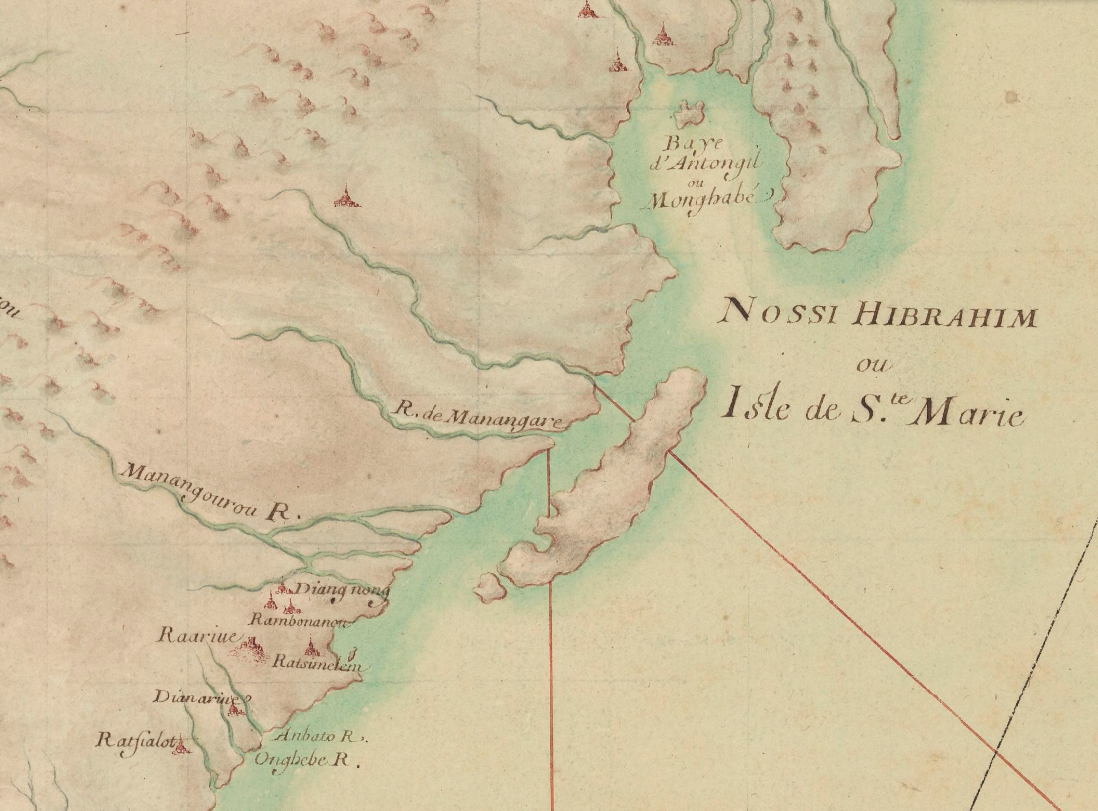
[…] Most of it has been slaughtered and poisoned by blacks, or by themselves. These are the most miserable of them who remained on the island, among which is the named La Buse [Olivier LeVasseur de la Buse], who was one of their captains, who after having dispelled or lost the unworthy fruit of his piracy, replied to those who escorted him to take advantage of the impunity offered to him. […] But the rest of the population, through the abuses they committed to procure slaves and women, did not support them with difficulty, taking advantage of the slightest disturbance to eliminate them physically or, more subtly, by poisoning them little by little. small. […] They remain distant from each other without any union. They hold this coast of Ambanivoulle from the 13 ° degree 40 minutes where is the large point which, with reefs, forms a kind of fort called Anglebay, to the river of Manangharre, not far from the bay of Antongil, it is across this coast that the island of Sainte-Marie is situated, which has a good port in a small bay, although a little spoiled by ships sunk with their entire cargo. It is not on this island that the pirates have withdrawn, as it has been believed, but only remain on one of the islets which [lies within] it [Ile aux Forbans or "Pirates Island"]. A mulatto saw there entrenched with palisades where he mounted a few pieces of cannon, as each of these brigands do in particular, who have become inhabitants of these islands, being obliged to be on guard against one another. They undertake to come and stay with them, and to take their defenses, the blacks of the surroundings where they make their establishments. Which are so fond of them that they can hope for some benefit from them, and slaughter and poison them when they can get nothing more from them. However, they keep and highly esteem their mulatto children, who came from the alliance of these pirates with the women of the country. Many are masters of such establishments and have a great deal of authority among the blacks who gladly put them at their head when they go to war. Almost all of these mulattoes, when they found the opportunity, followed in their fathers' footsteps and raced [pirated].

Desforges Boucher, Governor of Bourbon. Mail to Louis XV


----------------------------