Donate to Brooks Historical

Showing posts with label la buse. Show all posts

Friday, April 10, 2026

Deposition: Olivier Levasseur in La Louise takes Le Grand Bretagne of Nantes

 Deposition: *Le Grand Bretagne de Nantes* [125 tons]

Of the said day, May 28, 1718

(Source: Rapports des capitaines à l'Amirauté de Nantes, Les Archives départementales de Loire Atlantique, B4578, 62)

Appeared Maurice Libaudiere, Master and Commander of the ship named *Le Grand Bretagne de Nantes*, of a burthen of 125 tons or thereabouts, armed with eight cannons and manned by a crew of 33 men, fitted out by Sieur Du Mottay, owner of the said ship. The said Captain, having taken the oath with uplifted hand, promised and swore to tell the truth, and did state and declare to us that his said vessel, having been loaded with lawful merchandise and being furnished with all the necessary clearances for the voyage to Saint-Domingue, departed from the lower reaches of this river on July 27, 1717—sailing with the morning tide—to undertake his said voyage. On the following September 1st, he encountered a pirate ship named *La Louise*—armed with 22 pieces of cannon and a crew of 200 men (Frenchmen)—at a location near the Tropic [of Cancer? Presumably north of the Leewards and East of the Bahamas], to the northeast. 


The said pirate fired two cannon shots at the deponent in order to force him to strike his colors and surrender, having first hoisted the black flag. The deponent returned fire with two cannon shots of his own; however, seeing the superior strength of the said pirate vessel, he was compelled to surrender. They plundered the greater part of his cargo—such as wines, brandy, linens, flour, and other merchandise—and likewise seized the greater part of his rigging and tackle, as is more fully substantiated by the official report drawn up at the Admiralty of Cap-Français, dated September 30, 1717, which he has presented and deposited here, signed by him in the margin, to be consulted should the need arise. Thereafter, he proceeded to the said Cap-Français with the remainder of his crew and merchandise, arriving on September 29th; at that location, he traded the remainder of his cargo and reloaded for the return voyage, partly as freight and partly on his own account. ...comprising, belonging to this bourgeois, a total of 520 casks—specifically 518 casks of raw sugar and two barrels of indigo. Of this quantity of sugar, 198 casks originate from the slave trade conducted by the ship *L'Emanuel Fortune*—referring, naturally, to its most recent voyage to the Guinea Coast. He declares that he was compelled to engage, at the aforementioned Cap, four sailors and one surgeon to replace an equal number of men whom the said pirates had forcibly seized and abducted from him—a fact detailed in the official report mentioned above. He further declares that the following men died at the Cap: Jacques Guerlared, a cabin boy from Paimbœuf, in October 1717; Louis Cernanal, a turner from Brest, in the same month; and Étienne Bonsergent, a sailor from St. Nicholas, in the same month. Regarding these men, he arranged for their burial and sold their personal effects—with the exception of one chest containing the deceased's natural heirs' clothing—upon his return to Paimbœuf. He notes that the ship's supply of buccaneer guns had been seized by the pirates, as attested by the certificate issued by Mr. Merchand, Keeper of the King's Magazine, dated March 22nd last. Following this, he departed from the said Cap on April 1st last to proceed to his intended destination; during this voyage, he endured severe weather, leading him to fear that his cargo may have sustained damage—for which reason he hereby formally lodges his protests and requests, as is customary. He arrived at Paimbœuf yesterday, where he remained to rest; this constitutes his declaration, which, having been read back to him, he swore to be true and accurate. In witness whereof, he has signed below.


M. Libaudiener

Friday, July 09, 2021

An Unwelcome Visit from Pirates!


Defense and Cassandra with tender attack Fort Lijdzaamheid on Rio Delagoa (Southeast Africa) circa 30 April 1722 
 

Occupation of Fort Lijdzaamheid (Fort Agility) & Debauchery of the Pirates: 22 April - 30 June, 1722:

Narrative of Jacob de Bucquoy in his "Zestien Jaarige Reize Naar de Indien," published in 1757, 27-36, concerning the attack and two-month stay of pirates Richard Taylor in 72-gun Defense (formerly Portuguese Viceroy of Goa's vessel, Nossa Senhora do Cabo) and Olivier LeVasseur (La Buse) in 44-gun Cassandra (former East India Company vessel of Capt. James Macrae) and their crews at the newly-built Dutch fort on Rio De La Goa or modern Maputo Bay on southeast shore of Africa.

Narrative broken up for easier reading...

------------------

We lived in the Fort, apart from sickness among our new recruits, and death, in a moderate rest, and feared no foreign enemies: but then often the danger is near, as will appear in the following.

It was on the 11th April [22 April by Gregorian calendar], (a year after we arrived here) that the natives informed us that there were three ships in the Bay, but they had not raised the flags: at once an order was given to ship to the corner [bend] of the River constantly setting out posts to learn what kind of Ships they might be: 

Every day the Natives came to our Fort, with pieces of Indian Lynwaet [lijnwaet; "linen"] for the body, which they said they had bartered from other Ships; What they had left they used for flags and pennants on their canoes and tubes. 

It lasted until the 19th of April [G: 30 April] when the said ships, bearing an English King's flag and pennant, approached the mouth of the River; we could not imagine what this might mean. English King's ships to be seen here in an unknown region, where there was no War, seemed strange, and on Sea Rovers no suspicion [English pirates were usually welcome]; but the outcome soon showed us; what people they behold. 

We prepared our pieces [canon], and enabled us to resist, if they should be against us: to this end we took a crowd of Blacks in the Fort, and led the Hoeker there, to defend us like a Watercastle, meanwhile the approaching ships; as two large ones, one of 72 [Defense], and the other of 44 cannon [Cassandra], plus a Brigantin up to the Lodge [entry building before Fort?]; they were crammed with people, who blew on the Kampanje [trumpets] lustily; then the largest ship dropped anchor and fired a shot in front of the Hoeker and our Fort, and then gave the whole broadside, likewise the other. We did not owe it to the shore, and gave them in the same language [returned fire], but in such a way that with the first volley the largest Pieces shook in the sand, for we had no fixed batteries yet, but loose planks deposited on the sand. We recovered as much as we could, when we saw with amazement that the Hoeker had already lowered the flag, and prepared as a prize. 


Jacob de Bucquoy, Plattegrond van Fort Lijdzaamheid on Rio de Lagoa, 1721.


They were still firing steadily with their 12-pounders, loaded with bullets and scrap; all the Blacks rushed over the patisfaden [palisade?], and fled into the woods. We saw that 78 men who were still alive at the Fort, and many of them sick, could not stand this crowd: but it seemed reasonable with the Commande while I was busy getting the Pieces ready to fire. 

As I acted for Opperkonstapel [Chief], I was told that someone had lowered the flag in the hole; This dropping of the flag communicated to the ships that we had surrendered: at once boats full of people came to the shore. Our Chief, Monsr. [Jean] Michel exclaimed "par Dieu wat dat ly wat dat! What that, I said, they have cut the flag in the hole, and we are taken." 

Under this message of Monsieur the people came ashore, four of whom emerged from the heap with pistol in one hand and saber in the other as far as the Lodge [entrance battery?]; Each of them looked with astonishment that so few men had such boldness; while one asked in a gruff voice, Where is the Chief? who answered here, asking them at the same time what kind of people they were? They answer that they were Kings of the Sea and of the World. 

Each was silent and looked at the other, and did not know what the further consequence would be, which we learned shortly. He immediately commanded the people to lay down their rifles, and at once ordered the Chief [acting-Chief Jean Michel] to sail aboard the great ship [Defense]: against which he long protested, [to no avail.] I [Bucquoy] accompanied him, and meanwhile they made sure of their accommodation. 

Round about, and seeing it necessary, they set up sentries, and divided the defenders (whom they immediately disarmed) here and there: while more and more people came ashore for their reinforcements. We left the second, one Jan van de Capelle, ashore, and sailed with the barge from the shore to board the great ship, where the Sea-robbers' flags were waving from the top of the stern and aft. 

When we were on the side of the ship, the Captain [Richard Taylor] stood with a saber in hand, aboard, waiting for us. Monsr. Michel, seeing a Negro approaching from his sight, Did not want him to climb over first; I said that to him [the Chief] that honor belonged, that otherwise I wished to be the first, as he then bid me: so I climbed by a rope, so that there was no stairway, and came over. Monsr. Michel was joined by 6 to 7 men; 

On his behalf we were ordered to follow the Captain who entered a room, and we with him: there we found the whole Assembly in order, with a box of punch in the middle, accompanied by an agreement of Muzyk, according to the English style, immediately wares we sat, or the punch box went round, and then, after the occasion of the country, and our condition, we were asked very accurately, by articles; whereupon Mr. Michel replied. Furthermore, they asked about Victuals [food provisions] for their ships, Water, etc. were available here. 

After we seemed to have satisfied them with a few things, they declared that upon their last visit that they had found a Dutch Comptoir [trading post] here [surprised at the presence of a fort]. They needed a place in these Indian regions, but if they had known this, they would have called upon another; but the matter now being so, it was their custom to lay down the anchors with little effort; Money, Tobacco, and Liquor, were Contrabands, and they were in need of them. 

Then our Victuals and Ammunition came, miraculously, and what more they thought could be of service. For the rest we must console ourselves with fate, and be at peace. 

Here people played merrily and drank about clearly. After an hour or two, my curiosity caught my eye to go downstairs to go between decks; and there to consider their lives; it seemed like a complete Robber's Fair; all the guests sat about their bowls, and drank profusely. Here I found all sorts of nations among each other, even black Negroes. 

Jeder spoke to me, Brother! 

Before and after: so the night ended with us: but it had not gone like this normally; for when they are drunk they live boldly with their captives; the Konstaple [leader; in this case, Richard Taylor] had a heart in the Arm [love of arms?], and the others had dutifully queried [parried] with the Sabers: a steady alarm, frightening the peasantry, and in fear for their lives, that the Second [Chief?], with twenty-one men more, would take flight in secret; chests and treasuries were opened with crowbars, and the well demolished;

In the morning the People [pirates] were divided on the shore and on the ships; and I was utilized to trade Vee [cattle] and Victuals for them. I was quite pleased with this; for whole bales of Lynwaat [lijnwaet; "linen"] were but cut up, and exchanged in pieces, for trifles, of Hoenders [Afrikaans: "chicken"], Fruits, etc.; the barrels of Corals and trifles, like Nuremburg Kramery [haberdashery; British: small items used in sewing, such as buttons, zippers, and thread (see thimble below)], which we had for Negotie [negotiating] at the Comptoir [trading post], everything was now in common. This was riotous and rude. I'm glad to have read the Hellish Fair, but it was one hell of a job. Offending women, drinking publicly drunk, and then inflicting violence on the native, was the same work; 

Briefly they [pirates] were at war with them [natives]; day and night they shot sharply across the plains: the natives grew so bitter, that is to observe the Ships and Vessels and then throw in with their Assegayen [a slender, iron-tipped, hardwood spear used chiefly by southern African peoples], wherewith several [pirates] have already been killed. 

Thimble | German, probably Nuremberg - Metropolitan Museum of Art


A curious case occurred on the birthday of King George the Second [must be the First, b. May 28; Second was b. 11 November and was not yet king (1727)], weekday, when they usually spend boozing and like a Sea-robbers Joyful feast.

Captain Tailor and Captain Labous, beside some officers, sat separately with a Punch bowl, drinking together. Tailor, looking before the Fort about Botree, a Native, standing somewhat to the side of the others, standing near the wood, and looking elsewhere, little thinking that death was so near to him, his Snape [Snaphaan; snaphaunce, or flintlock pistol], which sat beside him, and said to his company: Would you see that Karel [derogatory reference to a native] make a cabriolet [type of one-horse carriage]? they, according to their degenerate natures, said yes: Indeed he aims and shoots him, that he fell to the ground and gave up the ghost after a little thrashing; Having done this, he set the Snaphaan [Flintlock pistol or Snaphaunce] aside again, continued his conversation with the same composure as if nothing had happened, and I never heard him speak of it again.

I am ashamed to inform the reader of the liberality which I saw that day, as much about malking [associating with an untidy woman] as the violent treatment of women in public practice, so as not to introduce vexatious ideas of it into anyone's imagination or memory.

This lasted until the 26th June, when they had their ships ready and clean: As for my interest, I changed my clothes daily; the one took everything from me, and the other gave me a skirt again, or vest: in short I had changed fashion all day long; long, short, wide, and narrow, all was my pass; that which I gained in exchange, I again venerated to those who had not, 'Never have I looked better at the world and life, and learned to know its intemperance and futility; now I had it by experience.

Finally being supplied with Victuals, and being there their time of departing again, they shot a lap, and waved the Black Flag to Pitsjaaren [signal].* By this it was well thought to take the Hoeker as foresailer: but so their great ship [Defense] went 22 feet deep [draught], and in the bay was but 18 feet of water by common cyn [average, measurement?], and knowing that I had drawn the map of the bay [see map above], they beseeched me that I might cast them out in the open sea; that in return they would give 5 bales of Lynwaet [lijnwaet; "linen"] to the people, to sustain life; and the Hoeker, after they had removed the masts in advance, before leaving in the Comptoir [trading post] to us for storage. 

Though I had little inclination to go with them, as they cannot take much on their word, but we were in need. I suggested this to the Chief [Michel], who advised me to do it: but being like a Frenchman, not trusting much with him, I told him that if he were so to me as Chief, and for that I recognized him, to command my self, I was then ready to obey his commands; which he then did in the presence of the rural folk, and the master of Hoeker, a Frans van Haften; thereupon I beg of them 2 or 3 helmsmen to go with my self, to lay the weights and bearings of the deep with barrels, and to mark as marks of course, for their and my assurance; which they approved. We were here for eight days. On the 30th June (J: 11 July) we lifted our anchors, and after the cannon's praise, we bid farewell to Rio de la Goa.

* Pitsjaaren - To make a sign on ship board for giving notice to the other Commanders that a Council of war is to be kept, or something like to be done. [A Compleat Dictionary, English and Dutch, to which is Added a Grammar, for Both Languages, Volume 2 (Amsterdam: K. de Veer, 1766), 639]


Thursday, October 15, 2020

La Buse: Mutiny on Le Postillon, 3 June 1715

Early events in the Golden Age of Piracy at Saint Domingue

Excerpt from Le capitaine La Buse: L'âge d'or de la piraterie (2018) by Jacques Gasser:

Olivier Le Vasseur, called "La Buse" and ten other mutineers left Fort Saint Louis on the south coast of Saint Domingue (French colony on the Caribbean island of Hispaniola from 1659 to 1804, or modern Haiti) aboard a large vessel under Capt. La Lande de Rochefort on June 3, 1715. They took it from that captain as they passed the Isle de la Vache that afternoon and became pirates. One official later stated that this vessel named Le Postillon is an "excellent sailor that was ideally suited to its black designs."

In a letter dated 14 June 1715, Mr. Barthomier, the king's lieutenant at Fort Saint Louis, recounts La Buse’s escape in great detail:

I have the honour to inform Your Lordship that Mr. Devaux, director for the affairs of the Royal Company of Santo Domingo in St. Louis, having purchased on behalf of the company about five months ago a large boat named Le Postillon, the said boat was kidnapped by the crew of eleven men who went pirates. This happened on the 3rd of June at three o'clock in the afternoon when the said boat having left the port of Saint Louis at about one o'clock in the afternoon where it had been loaded with three complete sugar crews consisting of a copper boiler and loot and some other effects.

Hardly then, Monseigneur, the said boat was out of sight of the fort that these eleven men revolted against their captain named La Lande de Rochefort having all taken the weapons they had hidden in the hold and deliberated strongly a long time if they would kill him and the pilot who refused to be with them. But they made up their minds to lock them both up with another male passenger in a room, and when they found themselves strong off Isle à Vache about eight leagues from here, they boarded them the next morning in a small canoe [periagua] that belonged to a poor man who was in the back of the boat; which man took advantage of this opportunity to return to the Isle à Vache from where he had come two days ago. These pirates also sent back along with the others this captain and this pilot, [and] instead of coming straight to the fort to warn, [they] went to the safety of Isle à Vache saying that the sea was too rough to go to the fort's side. So that I was not informed until June 5 at 9 a.m. [such] that these pirates must be far away and that Monsieur de La Rigaudière who arrived at this port on May 30 with two frigates of the Company and I did not feel that it was worth time to go after [them], both for the time that this vessel had in advance [a head start] and because it is one of the best sailing boats in the sea and furthermore we had not yet begun to unload the cargoes of these two [company] ships. Nevertheless, I sent people by land on the coves and at Cape Tiburon to see if this vessel [Le Postillon] would not go on these sides but we did not see or hear it and following all appearances it had taken off and set sail for the coast of Spain (Mainland America) and get to Bocator which is a place where pirates retreat. This pirate ship [Le Postillon] has four mounted guns and has about ten to twelve pounds of gunpowder. 

I have given notice of the theft of this vessel to Mr. [Archibald] Hamilton Governor of Jamaica and to the Governor of Curacao on occasions I found in those days.*


*A.N. Colonies C9 B2 . Lettre du sieur Barthomier, du fort Saint Louis le 14 juin 1715.

Friday, September 25, 2020

Dumas to Maurepas: The Order to Execute La Buse - 1730


FR-ANOM COL C3/5/002 ff. 120 


-----------------------------------------------------------------------------

[Attached:]
Sent to France in 1770
Bales of Coffee, harvested in Bourbon [no pirate mentioned here?]

-----

Notice to the arrest or force of pirate Olivier Le Vasseur or La Buse, our Mr. D'Hermitte.
They had read, the condemnation to his execution.

-------------------------------------------------------------------------------


[Document: FR-ANOM COL C3/5/002 ff. 120-121]
Monseigr. The Count of Maurepas

Mr. Dumas
L'isle de Bourbon this December 20, 1730 [J: 9 Dec 1730]*

My lord

This year we are shipping the vessel La Meduse commanded by Sr. D'Hermitte fully responsible for the 770 bales of coffee amounting to 3166 [.] 00[lt: livre] from the region of this Isle [Bourbon]; and we still have a considerable part of it in the store which has not been taken on board.

Sr. D'Hermitte in the last trip he made to Madagascar, having arrested and caught him there [ca. April 1730] named Olivier Le Vasseur known as La Buze, famous pirate captain, his procedure was made at the request of the Attorney General, and he was condemned by order of council of July 17, In.[instant?: 1730; this was the date of his condemnation and order of execution - still he was hanged on 7 July - might be a typo on the original document with an added "1" and repeated - see next doc]

This man made in 1721 in harbor of this Isle [Bourbon] two captures one of a vessel of King of Portugal [Nossa Senhora do Cabo or Vierge de Cap; then of only 21 guns, but pirates refitted her with 60 guns] of 60 pieces of guns, which he boarded, and the other from a vessel called The Ville d'Ostende [City of Ostend] belonging to the Comp. from the same city - he also took and burnt after taking in the same time the vessel of Comp. of France the Duchess of Noailles commanded by Sr. Grâve of St. Malo [Platel was former captain; Sr. Robert was then in command when she was destroyed, Grâve was the owner], this Buze then mounted the pirate ship the Victorious and to have with him another ship named Defense [at this time, it was Cassandra; Defense was the new name given to the refitted Nossa Senhora do Cabo; Dumas mixed up his info after 9 years] commanded by an Englishman called Taylor.*

Rhubarb [an expression or the plant?] is starting to multiply in Isle Bourbon, there are currently more so-called seedlings, I have the honor with deep respect.

Mr.

Your humble obedient servant
Dumas

* It should be noted that Pierre Benoist Dumas had not been present for the piratical events in 1721 when Nossa Senhora do Cabo or Vierge de Cap was captured by LeVasseur et al. He arrived on La Bourbon about 1727, replacing Desforges-Boucher, who in turn replaced Beauvollier, who was the governor who originally offered pardons to LeVasseur, Cleyton, Adam Johnson, and their crews in 1724.


-----------------------------------------------

From: Archives Colonials – Bourbon, carton 2 – Letter de M. Dumas, 29 December 1730 [J: 18 Dec 1730]; also Mr. Dumas, Governor of Bourbon, to Minister de Maurepas, December 29, 1730, Centre des Archives dOutre Mer, Aix en Provence, Correspondance générale de Bourbon, t. V, 1727-1731.

According to the deliberation of the Superior Council of Bourbon on 7 July 1730 [J: 26 Jun]:

By advice, the criminal proceedings extraordinarily made and instructed at the request and diligence of the Attorney General of the King [illegible] and accusation against Olivier Levasseur nicknamed “La Bouse” accused of the crime of piracy, prisoner in our prisons, defendant in the affirmation made the 26 of March [J: 15 Mar] and 19 of May [J: 8 May] last at the declaration of Sieur d’Hermitte captain of the ship La Méduse, [showing as evidence] the letter of said Levasseur dated March 25, 1724 [J: 14 Mar] addressed to Monsieur Desforges and signed Olivier La Buse, by him recognized and initialed, nor variation.

[Also offered to the court, the] Letter from the Superior Council to Sieur La Buse for response dated 23 September of the same year granting Amnesty and Surety, [and supported in the] interrogation suffered by the accused on 15 May [J: 4 May] and 20 May 1730 [J: 9 May] and 03 [J: 22 Jun] of this month. First general conclusion of the king of the 04 [July] [J: 23 Jun], [and] preparatory judgment of the same day which orders that it will proceed to the final judgment [to be] awaited [by] the public notoriety.
Final conclusion of the Attorney General of the King of the 06 [July; J: 25 Jun], sudden interrogation in the room of the council [illegible] and all considered the council declared and [illegible] the name “Olivier Levasseur dit la Buse,” native of Calais, hard hit of the knowledge of the crime of piracy for several years, for having ordered several pirate ships to be taken and brought to the roadstead of Bourbon Island, a vessel belonging to king of Portugal and another named the City of Ostend belonging to the company of the same city, but equally participated in the capture, plunder, and firing of the vessel La Duchesse de Noailles belonging to the company of France and other [illegible], for repair of which the council condemned him and ordered to make amends in front of the principal door of the church of this parish, naked in a shirt, the rope at his collar, in hand, a torch of two pounds of pitch for there, to say and declare with high and intelligible voice, that For a long time, he was a reckless and reckless man who became a filibuster [pirate] and asked for forgiveness from God, the king and justice. [note that there is no mention in any primary source of him throwing a cipher on a large piece of parchment in the crowd - where would an essentially naked man hide one, anyway?]

This sentence will be carried out in a public place to be hanged and strangled until death ensues on a gallows erected for this purpose. (He) will be hanged in the usual place his dead body will remain there 24 hours and then exposed to the waters’ edge… his belongings are confiscated for the benefit of the king, and he must also pay a fine of one hundred pounds for the offense done to “the Lord King.” Done and declared in the council chamber on July 17, 1730 [J: 6 Jul; note this is probably a typo]. Dumas.**

*Julian dates are included because French dates were based on the Gregorian calendar and were 11 days later than English who used the Julian.

** This is obviously partly copied into his letter of 20 Dec 1730 to Maurepas. 


The Degradation of La Buse - 30 September 1724

ANOM COL C3 4 1-22 - 30 Sep 1724 Desforges Boucher


30 September 1724 

M. Desforge a Boucher to Louis XV

Only forty of these unfortunate degraded people without a ship remain on the island of Madagascar, who implore their amnesty unable to support themselves and perish there of misery, although they have a number of diamonds, which are of no use to them for to obtain the necessary for life, not having, moreover, a penny in cash. There were still about sixty there at the beginning of this year, but eighteen or twenty got loose in a boat of about twenty-five tons and came here to ask for their amnesty and that of the others who remained after them in Madagascar. While the greater part of their colleagues were here ashore [~23 Sep 1724 at Saint-Paul, Ile de Bourbon], those remaining on board murdered at ten o'clock in the evening their own captain, named John Cleyton, English, with a pistol shot charged with three bullets fired from behind, and at the touching point the wadding set his shirt on fire. And immediately removed the boat, after nevertheless having thrown into their small canoe, five of them all chopped from the wounds they had received, wanting to avenge their captain. Those wounded as they were fled to the ground, and since then we have not heard of what became of them. Those who were ashore and those who fled have since remained very dependent on the colony, where their diamonds are not common commodities although they do have quite considerable quantities. I sent to France on the Company's ship, the Royal-Philippe, almost all these wretches with their iniquitous booty, willingly shedding such vermin on a colony which had objects more useful to the State

[…] Most of it has been slaughtered and poisoned by blacks, or by themselves. These are the most miserable of them who remained on the island, among which is the named La Buse [Olivier LeVasseur de la Buse], who was one of their captains, who after having dispelled or lost the unworthy fruit of his piracy, replied to those who escorted him to take advantage of the impunity offered to him. […] But the rest of the population, through the abuses they committed to procure slaves and women, did not support them with difficulty, taking advantage of the slightest disturbance to eliminate them physically or, more subtly, by poisoning them little by little. small. […] They remain distant from each other without any union. They hold this coast of Ambanivoulle from the 13 ° degree 40 minutes where is the large point which, with reefs, forms a kind of fort called Anglebay, to the river of Manangharre, not far from the bay of Antongil, it is across this coast that the island of Sainte-Marie is situated, which has a good port in a small bay, although a little spoiled by ships sunk with their entire cargo. It is not on this island that the pirates have withdrawn, as it has been believed, but only remain on one of the islets which [lies within] it [Ile aux Forbans or "Pirates Island"]. A mulatto saw there entrenched with palisades where he mounted a few pieces of cannon, as each of these brigands do in particular, who have become inhabitants of these islands, being obliged to be on guard against one another. They undertake to come and stay with them, and to take their defenses, the blacks of the surroundings where they make their establishments. Which are so fond of them that they can hope for some benefit from them, and slaughter and poison them when they can get nothing more from them. However, they keep and highly esteem their mulatto children, who came from the alliance of these pirates with the women of the country. Many are masters of such establishments and have a great deal of authority among the blacks who gladly put them at their head when they go to war. Almost all of these mulattoes, when they found the opportunity, followed in their fathers' footsteps and raced [pirated].

Desforges Boucher, Governor of Bourbon. Mail to Louis XV


----------------------------


Tuesday, September 22, 2020

The True Story of La Buse's Grave on the Island of La Réunion

"La véritable histoire de La Buse" from the Office of Western Tourism, Department of the Island of La Réunion at https://www.ouest-lareunion.com/La-veritable-histoire-de-la-buse :


 March 04, 2020

The tomb of La Buse, surmounted by a cross marked with a skull and crossed tibias, it is quite a story ...

…. and it is impossible that La Buse could have been buried there [at the marine and slave cemetery of Saint-Paul], the cemetery having been created long after his death [58 years].

 It is the site of a number of popular practices. An affixed plaque tells the story ...

 Here is the real story of this "real / fake grave":

Convicted of piracy crime, Olivier Levasseur [said to have been born in Calais, France where a baptism was recorded at Pas-de-Calais archives, Notre Dame de Calais church (5 MIR 193/30,
p.817) for "Olivier, the son of Olivier and Anne Lensse Vasseur" in 1695], nicknamed "La Buse" was executed in Saint-Paul on July 7, 1730 and his body exposed by the sea [see note below]. The exact place of burial remains unknown and the current cemetery was established only in 1788.

[BCBNote: His body was likely buried in a shallow grave below the high-water mark of the shore. "The Judgement of La Buse," available on Laura Nelson's blog The Whydah Pirates Speak, at http://petercorneliushoof.blogspot.com/2014/08/the-judgment-of-la-buse.html states that the body of La Buse "will be planted at the usual place his dead body remained there 24 hours and then exposed to the edge from the sea." Pirates were usually treated in this careless fashion, their souls or "last rights" to eternity having been forfeited by their unrepentant criminal lives. So, it's highly likely that his actual remains have washed out to sea.]

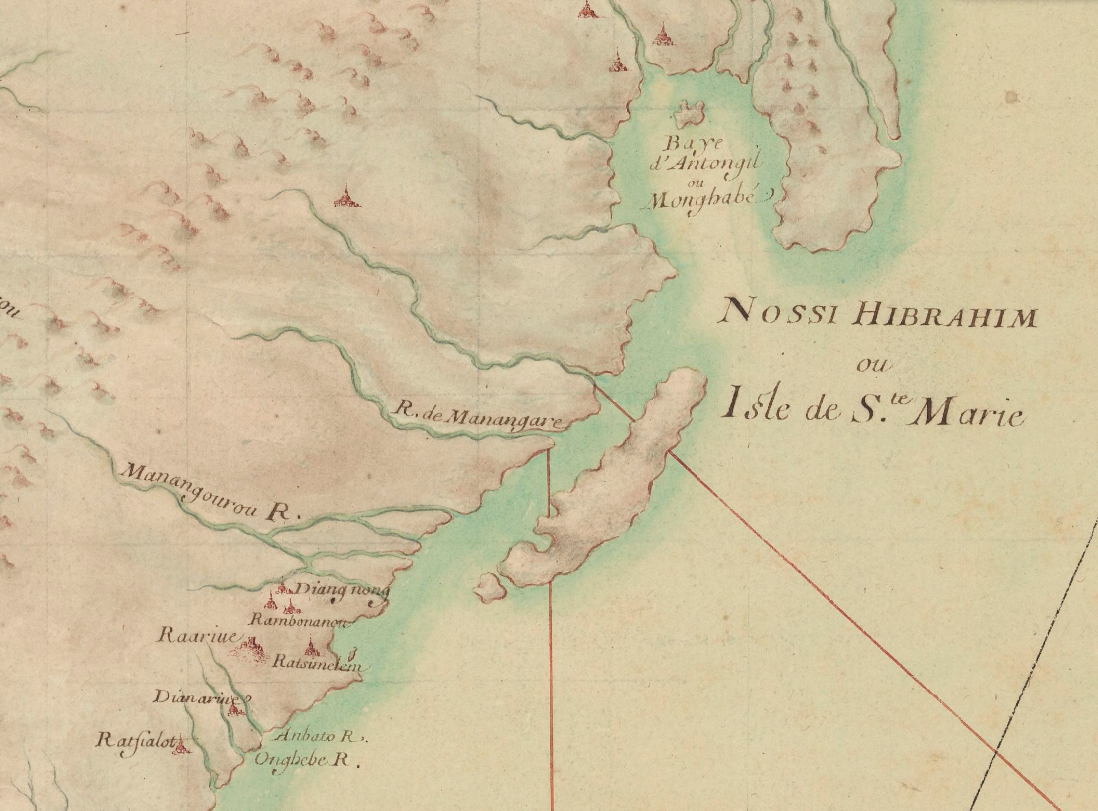
[BCBNote: furthermore, as I argue in Sailing East: West-Indian Pirates at Madagascar, this document and all the writings to and from Dumas, the governor who signed his death warrant, about La Buse state that the former pirate was hung in only a night shirt and could not have hidden a parchment containing any cipher to the location of his treasure - and they also never spoke of any parchment that he supposedly threw out at his hanging - so please stop digging up the beautiful tropical islands of the Indian Ocean looking for it! Dumas and his men took whatever treasure might have been in La Buse's possession in 1730 - Dumas even said so! La Buse's operations on Nosy Mangabe in Antongil Bay were also taken over by the man who captured and took him from there, Capt. Hiacynthe d'Hermitte of La Méduse]

On April 11, 1944, the day after a devastating cyclone and tidal wave, the Saint-Paulois Ignace de Villèle found a stone cross among the devastated walls of the cemetery. Since it bears no indication other than pirate symbols, he moves it here and places it against the enclosure of his family's graves.


It was on this site that in the 1970s that the current funeral monument was erected in memory of La Buse. It attracts so many visitors that it has come to be regarded as the real tomb of the character thus contributing to his fame.

Since 2010, it has been discovered that the tombstone used came from an abandoned burial, that of the former slave Delphine Helod. Having been freed in 1835 by her masters, the Mallac family, she could have been buried in the cemetery of the whites and the free unlike the pirate in 1730. The stone had been turned over.

Its engraved face still bears this inscription:

“In memory of Delphine Hélod, born in Sainte-Marie on August 7, 1809, died on May 13, 1836.
His good behavior, his good feelings, his affection for his masters earned him freedom and this weak testimony of their regrets ”