Donate to Brooks Historical

Showing posts with label smithsonian. Show all posts

Friday, January 11, 2019

Who is Pirate Advocate Richard Fitzwilliam?

Dictionary of Virginia Biography (DVB) notes: 
Richard Fitzwilliam (d. by 19 April 1744), member of the Council, was probably the son of Thomas Fitzwilliam and Mary Luttrell Fitzwilliam of County Dublin, Ireland. Very little is known about his personal life, including the dates of his birth and death and whether he married or had children.
"Very little is known about his personal life"... sound familiar? Isn't this the exact same thing that people used to claim about Edward "Blackbeard" Thache? A genealogical-historical study proved the formerly "mysterious" pirate quite an average wealthy British-American gentleman with a large Jamaican family - even a daughter and also a conservative grandfather who studied the ministry at Oxford! - not such an unknown or "villainous" enigma.

Well, again, let's blow this "very little is known" thing apart, shall we?

The same source also noted that: "Vain, self-centered, stubborn, inflexible, and greedy, Fitzwilliam often found fault with others, and his combative willfulness annoyed numerous influential Virginians."

I certainly do not doubt that Richard Fitzwilliam was a controversial man, but many English gentlemen (the 1% in any century) who gave up everything that such privileged blowhards enjoyed about their ancient English (and Irish) civilization to make their lives and futures in the jungle wilderness of early America did often exhibit similar characteristics!

Also, when's the last time you considered living in the Amazon rain-forest... without internet or cellphones?

Still, many American historians have difficulty contemplating that a wealthy, privileged man like Richard Fitzwilliam - or Edward Thache, for that matter - would ever venture to this godforsaken and remote cesspool of European religious detritus, with wild unknown beasts and Jacobite rebel prisoners - a land which Native Americans liked, understood well, lived upon for thousands of years, and from which they simply wished Europeans would just bugger off!

Fitzwilliam Museum Interior
This bias often crept into their analyses. A similar bias infects our British cousins who tend to think that absolutely no British Fitzwilliam ever had anything to do with America! And... if you look at the interior of the Fitzwilliam Museum in Cambridge, England, you could hardly believe that any British family who inspired such artistic grandeur could ever have lived in a remote provincial backwater like early 18th-century America!

Likewise, the American-focused DVB saw Richard Fitzwilliam as an "outsider," just another foreign Blackbeard-ish interloping enigma: "January 1715 Fitzwilliam received an appointment as comptroller of customs in Currituck, North Carolina. A year or two later he moved to Virginia to be collector of customs for the lower district of James River. On 13 August 1717 Fitzwilliam petitioned the governor and Council for a grant of land in Hampton and permission to erect a wharf there."

Lt. Gov. Alexander Spotswood (essentially another foreign interloper and relative of the king) regarded Fitzwilliam's customs accounts - and his favor of pirates (specifically, Edward Thache's quartermaster, but also a few others at New Providence Island) - as contrary to his service "to his Majesty" and on 18 August 1719 informed the commissioners of customs in London that he was "guilty of malfeasance." A Royal Navy ally of Spotswood, Capt. Ellis Brand of HMS Lyme, mentioned in a letter to the Admiralty of "One [Richard] Fitzwilliams a Costom house Officer in Virginia as being an Agent for the pyrats and in what Manner we ware perplext with law Suits...." For Brand and Spotswood, Virginia, much like North Carolina, was wholly filled with pirates and their supporters, for Brand also regarded the Virginian Judge of Vice-Admiralty, John Holloway, as if he were a corrupt Donald Trump appointee, bearing a huge conflict of interest, actually serving as a lawyer for pirate William Howard, Blackbeard's quartermaster! Holloway also had Capt. George Gordon of HMS Pearl arrested for false arrest of William Howard and fined ₤500!

Fitzwilliam eventually left the office of collector of customs on 17 November 1720, obviously (from a modern point-of-view) because of the "contrary and factious people" of Virginia, but he returned to that position on 1 April 1721.

Why were Virginians seen by Spotswood and modern Americans as "contrary and factious"? The subject of piracy in America involves a complicated political-historical and intentional misunderstanding, involving early media and both sides of the Atlantic, deftly hiding the early beginnings of our nation... you'll just have to read my book to fully understand what I mean.

It's not a stretch to say that the wealthy English-appointed govermor Spotswood had a particularly low opinion of the average Virginia "ignorant" citizen, as he styled them on 22 December 1718, when he explained to the Board of Trade why he illegally assassinated Edward Thache in North Carolina - not in his own colony (actually, a privately-owned one), by the way. The very English (and anti-American) Spotswood also called Fitzwilliam, who "undertook" the cause of pirates, and his ilk "knavish," causing the citizens to choose "such Representatives as are agreable to them."Clearly, Spotswood saw Americans as a low class sort.

The DVB then tells:
The conflicts with officials [actually local Burgesses] in Virginia did no injury to Fitzwilliam's career. By late in July 1725 he was appointed surveyor general of customs for the southern district of America, which included the mainland colonies from Pennsylvania southward and also the Bahamas and Jamaica.
Eventually, as the DVB also notes, Fitzwilliam left Virginia after even the House of Burgesses censured him, "relinquished his position as surveyor general of customs in September 1731 and by 3 January 1733 had received an appointment as governor of the Bahamas... Richard Fitzwilliam died four years later, probably in Dublin, and was buried there on, or shortly before, 19 April 1744 in the Parish of Donnybrook."

 Yes... he was appointed to yet another supposedly grandiose position - though the Bahamas were even more remote and lacking in resources than the mainland American wilderness!


Richard, 5th Viscount FitzWilliam of Merrion's will in England & Wales, Prerogative Court of Canterbury Wills, 1384-1858 - PROB 11; Piece: 732 - dated 20 April 1744


Imagine my surprise at finding Richard, 5th Viscount FitzWilliam of Merrion's will in England and Wales, Prerogative Court of Canterbury Wills, 1384-1858 - PROB 11; Piece: 732 - dated 8 January 1743, but probated in 20 April 1744! Remember the death date of 19 April 1744 given by the DVB? Burke's Peerage, as quoted on the Wikipedia page, imagines the 5th Viscount Fitzwilliam to be a totally different person (but, certainly not): "Richard FitzWilliam, 5th Viscount FitzWilliam PC [a member of the Privy Council of Ireland] (c. 1677 – 6 June 1743) was an Irish nobleman and politician. The will was written and dated several months before this latest date of death assessment, so it does not disqualify the comparison with the Virginian collector Fitzwilliam.

In reality, the family's history is well-preserved. From this genealogical perspective (with little, if any political bias), Richard was the only son of Thomas FitzWilliam, 4th Viscount FitzWilliam and his first wife Mary Stapleton, daughter of the English statesman Sir Philip Stapleton." Still, I think I know why 19 April 1744 was assumed by the DVB to be his date of death... I'll come back to this.

Thomas 4th Viscount and Mary Stapleton Fitzwilliam, parents of Richard 5th Viscount Fitzwilliam. Fitzwilliam Museum, Cambridge, UK.

Moreover, Thomas and Mary "Luttrell" Fitzwilliam (as quoted by the DVB) versus Thomas and Mary "Stapleton" Fitzwilliam (quoted by Burkes)? Why the confusion? Well, the Luttrells were related, but not that way: Thomas Luttrell married Richard Fitzwilliam's aunt Mary, sister of Thomas 4th Viscount Fitzwilliam. Mary Stapleton (shown in the picture above) was clearly Richard's mother.

The first line of this will states "Richard Fitzwilliam Esquire late Governor of the Bahama Islands in America," and his wife is shown as "Right honourable Frances [Shelley] Lady Viscountess Fitzwilliam" so if there's any question about whether this is the same Richard Fitzwilliam who gave Spotswood multiple ulcers, let's just settle that question here and now! It's our guy!


Portrait of Richard (5th Viscount FitzWilliam of Merrion) & Frances Shelley FitzWilliam, b. circa 1677; 1685, d. 06 June 1743; aft 1762. Frances separated from her husband c.1730. She entered a convent abroad. The fact that she entered a convent indicates that she stayed Catholic, even as her children were bapt. Protestant. Source: Fitzwilliam Museum, Cambridge, UK.

Again, the history given by Wikipedia (about the English statesman) for Richard, 5h Viscount Fitzwilliam states that he "became a member of the Irish Privy Council in 1715. He was elected Member of Parliament for Fowey in 1727, a seat he held until 1734."

It might surprise the reader that I have no dispute with these dates or the positions which he held.

According to the DVB, he received a commission in January 1715 as "surveyor of Elizabeth River" and "comproller of customs in Currituck, NC" but that he moved to America within the next two years and settled instead in Virginia. These positions he received as a result of patronage, or favor, and they carried a definite financial reward:

Richard FitzWilliams, Surveyor of Elizabeth River, Virginia; same time
₤22
10
0
Richard FitzWilliams, Comptroller at Currituck, North Carolina; 11 July 1715 to Midsummer 1716
₤47
17
6

Note that he simply collected the money - he never had to actually assume the responsibility. This is similar to the corruption that later sparked the American Revolution. For example, you may not realize that Alexander Spotswood was not actually the governor of Virginia in Blackbeard's time, but the "Lt. Gov." The actual governor at this time was George Hamilton, Lord Orkney, who had responsibilities to the Prince of Wales at the time and never left England for America! He still received the appointment as a political favor and still collected his ₤2000 salary, though! Spotswood's salary was only half of Orkney's despite the fact that he is the one who actually administered Virginia for the Crown!

Even the Treasury assumed that Lord Orkney would not actually assume the governorship of Virginia - perhaps they did not expect the refined aristocratic gentleman to travel to such a dangerous and remote wilderness - but they didn't mind paying him for it!:
    September 1711:
George, Earl of Orkney, Lieutenant and Governor General: by letters patent: with the salary of 2,000l. per an.
    Alexander Spotswood, Lieutenant Governor: by royal commission: with an allowance of half the Governor's salary in the latter's absence.
Later, Fitzwilliam became a collector for the lower district of James River - which brought him into direct contact with pirates not even a year later. "On 13 August 1717 Fitzwilliam petitioned the governor and Council for a grant of land in Hampton and permission to erect a wharf there." So, there's no evidence that he was in America much before this date.

Being elected a member of the Irish parliament for Fowey in 1727 appears to pose more difficulty - probably also due to a misunderstanding of how patronage worked. DVB states "On 14 December 1727 the governor and Council appointed him one of the commissioners to survey and settle the boundary between Virginia and North Carolina. He offered to sell the colony a tent for the expedition, suggesting that his interest was more mercenary than altruistic. Fitzwilliam's investment in an iron foundry the following year [1728] reflects a similar desire for personal profit without regard for improving Virginia's infrastructure.

No dispute that he was a corrupt rich guy! 

But, this appointment did not prevent him from assuming his position in Parliament. Again, such appointments were often political and not pragmatic positions. Indeed, The Excise Crisis: Society and Politics in the Age of Walpole, in its Appendix C shows "Richard Fitzwilliam, Viscount Fitzwilliam, Fowey" on a list of "Absent Members." He did not have to actually live and serve in Ireland in 1727! Still, the survey of the Virginia-North Carolina boundary did not actually begin until spring of 1728. He really could have been anywhere in 1727 - at least until he accompanied his fellow commissioners on the 1728 survey! Furthermore, another peerage account showed that he served on "his Majesty's Privy-Council" since September 1714, marrying Frances, only daughter of Sir John Shelley of Michalgrove in Sussex - another position for which he was no doubt absent. He apparently ignored a lot of his "official" responsibilities! I have to wonder if his wife accompanied him in America for any of these remote appointments - perhaps he ignored her, too! After all, she later left him for a convent and I did compare him to Donald Trump... lol.
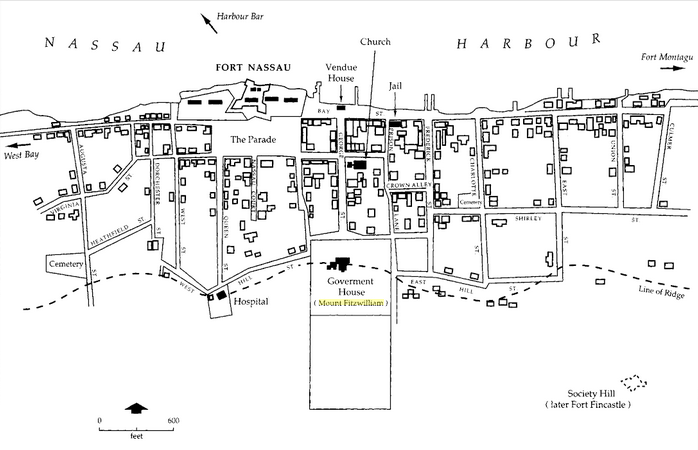
Location of "Mount Fitzwilliam," still the official governor's residence in Nassau, New Providence, the Bahamas
Mount Merrion House (Dublin, Ireland) - The Fitzwilliams built Merrion Castle on lands which are today the property of the Sisters of Charity and St Mary's Home and School for the Blind. By 1710 Merrion Castle was in such a bad state of repair that Richard, the 5th Viscount Fitzwilliam, selected 100 acres (0.4 km²) on which he built Mount Merrion House, surrounding the house by an 8-foot-high (2.4 m) granite wall. The house was completed in 1711 and served as a new seat by the 5th Viscount Fitzwilliam on the hill at Mount Merrion. The Fitzwilliam family left for England (Dover Street in St. George, Hanover Square, Middlesex) around 1726. Although the family no longer lived in Mount Merrion House, they retained possession of it, and rented the house out. "Mount Merrion and Its History" by Francis Elrington Ball, in The Journal of the Royal Society of Antiquaries of Ireland, Fifth Series, Vol. 8, No. 4 (Dec. 31, 1898), pp. 329-344.

Fitzwilliam was removed from his "absent" responsibilities in Fowey in 1733, about the time he became governor of the Bahamas (replacing Woodes Rogers), where, despite making a lot of useful lime in his kilns and building his home on his newly purchased "Mount Fitzwilliam" estate (reflecting the name of his "Mount Merrion" estate in Dublin) in Nassau, was considered a controversial governor and later removed. As Michael Craton and Gail Saunders wrote in Islanders in the Stream: A History of the Bahamian People,
The records in general were in a deplorable state. “Tis impossible to get an exact Account of the Persons born, christen’d or buried yearly in this Government,” complained Fitzwilliam, “because no Register has hitherto been kept thereof, nor could the Inhabitants be prevailed upon to acquaint anybody appointed by the Governor [Rogers] when any such happened.”

Efforts to repair the records were made through the SPG-appointed Reverend William Smith, and Governor Fitzwilliam set about making a census with his customary mixture of force and tactlessness. The New Providence free coloreds were especially incensed by the governor and council’s decision to list them separately.
Note that Englishmen of this day were nowhere near as racist as Americans after the Civil War, so this bias against African-Bahamians happened to carry a strongly conservative tone in the 18th century. 

His eldest son, Richard succeeded him as Viscount upon his death on 20 June 1743, which is the date shown on the Wikipedia page. His will was not probated until 20 April 1744, but this is not at all uncommon at this time - Fitzwilliam had possessions in three countries, requiring administration with long letter response times. Thus, the DVB's date of death assumed as "19 April 1744." This demonstrates a modern, if inexperienced, historical presentism. Past historians, inexperienced in modern genealogical methods, obviously assumed that he died the day before, as is most common today. Better training in genealogical methods for historians could easily cure this.

Researched by Baylus C. Brooks - 2019

Henry Herbert, 10th Earl of Pembroke (died 1794), husband of Mary, daughter of Richard 5th Viscount Fiztwilliam. At the Fitzwilliam Museum, Cambridge, UK.

Obviously, the Virginian statesman and pirate favorite was the same man as the wealthy Irish member of the Privy Council and Parliament. Admittedly, Irish records were quite sparse for the early 18th century, but this Fitzwilliam was well known and recorded in England, as well - he actually died in his home on Dover Street in St. George Hanover Square in Middlesex, England - not in Dublin! So, we can now establish that he was born about 1677, died 20 June 1743 (the date given by Wikipedia and from English records), and had his will (written 8 January 1743 with codicil 12 January) probated 20 April 1744. His mother was Mary Stapleton Fitzwilliam... NOT Luttrell! That was simply an honest genealogical mistake! The confusion, I hope, is finally over! Now, somebody go and fix the DVB and Wikipedia pages!


-------------------------

admiralty, adventure, Africa, african, alternative facts, appalachee, arcadia, art glass, bahamas, bar harbor, Barbados, barham, baylus, baylus brooks, bbc, blackbeard, bonnet, book, boston, boston news-letter, bourbon, bristol, British, brooks, burgaw, burrington, buse, calusa, cape fear, capitalism, caribbean, carolana, carolina, castillo, charles johnson, church, cimaroon, cimarroon, clone, cnn, cocklyn, colchester, colonial, condent, confederacy, confederate, congdon, conservative, corruption, Davis, democrat, depression, document, dunn, dutch, east carolina, east indies, ecu, England, fake news, family, florida, french, gale, Gambia, genealogy, genetics, glass, grovesnor, hispaniola, historian, history, hornigold, howell davis, indians, iron gall, itchetucknee, jamaica, jersey, jesus knocking, jolly roger, kkk, la concorde, lawler, lawson, levasseur, liberal, lighthouse, lillington, lyme, lyndon, madagascar, maine, Manhattan, maritime, maroon, martel, maynard, McLaggin, mist, moore, mortar, moseley, mount desert, New York, newfoundland, newspaper, north carolina, original, painting, panama, paper, pearl, pender, pestle, phenney, philadelphia, phoenix, piracy, pirate, pirates, plantation, politics, privateer, profit, progressive, pyrate, QAR, racism, rebel, republican, rice, robert e. lee, rogers, romance, rothschild, Royal African, royal navy, Salem Towne, sawtelle, seager, seal cove, seminole, shark, Sierra Leone, slave, slavery, smithsonian, south, south carolina, southern, spanish, St. Augustine, st. helena, stained glass, staines, symonds, Taylor, teach, thache, thatch, theach, timberlake, time travel, timucua, traitor, treason, treasure, trump, victory, walker, west indies, windows, windsor, witchcraft, witches, woodard, worley, wrecking, write


https://www.bbc.co.uk/sounds/play/p06s6zfx

BLACKBEARD: 300 YEARS OF FAKE NEWS.
from BBC Radio Bristol

300 years ago on Thursday - 22 November 1718 - Bristol born Edward Teach (aka Blackbeard, the most famous pirate in the history of the world), was killed in a violent battle off the coast of North America. And after 300 years we can finally separate the truth from the myth. You can hear the whole story this Thursday at 9am in a one off BBC Radio Bristol special: BLACKBEARD: 300 YEARS OF FAKE NEWS. With new research by Baylus C. Brooks, narrated by Bristol born Kevin McNally - Joshamee Gibbs in PIRATES OF THE CARIBBEAN, and produced by Tom Ryan and Sheila Hannon this is a very different Blackbeard from the one in the story books...

https://www.bbc.co.uk/programmes/p06s6zfx

You can hear it at https://www.bbc.co.uk/radio/player/bbc_radio_bristol

Author Spotlight

#Blackbeard #pirate #twitterstorians


Also:


Three Centuries After His Beheading, a Kinder, Gentler Blackbeard Emerges - Smithsonian Online

By Andrew Lawler
smithsonian.com
November 13, 2018


http://www.lulu.com/shop/baylus-c-brooks/murder-at-ocracoke/paperback/product-23588556.htmlRead about the final end of Edward Thache:
Murder at Ocracoke! Power and Profit in the Killing of Edward "Blackbeard" Thache


In commemoration of "Blackbeard 300 Tri-Centennial":


As always, drop by baylusbrooks.com and check out the primary source transcriptions

Sunday, January 06, 2019

More Primary Sources Available!

There are a few new transcriptions available on my website at http://baylusbrooks.com/index_files/Page7226.htm


Keep watching... more coming!

Author Spotlight: http://www.lulu.com/spotlight/bcbrooks

#Blackbeard #pirate #twitterstorians
---------------------------

https://www.bbc.co.uk/sounds/play/p06s6zfx

BLACKBEARD: 300 YEARS OF FAKE NEWS.
from BBC Radio Bristol
300 years ago on Thursday - 22 November 1718 - Bristol born Edward Teach (aka Blackbeard, the most famous pirate in the history of the world), was killed in a violent battle off the coast of North America. And after 300 years we can finally separate the truth from the myth. You can hear the whole story this Thursday at 9am in a one off BBC Radio Bristol special: BLACKBEARD: 300 YEARS OF FAKE NEWS. With new research by Baylus C. Brooks, narrated by Bristol born Kevin McNally - Joshamee Gibbs in PIRATES OF THE CARIBBEAN, and produced by Tom Ryan and Sheila Hannon this is a very different Blackbeard from the one in the story books...

https://www.bbc.co.uk/programmes/p06s6zfx

You can hear it at https://www.bbc.co.uk/radio/player/bbc_radio_bristol

Author Spotlight

#Blackbeard #pirate #twitterstorians


Also:


Three Centuries After His Beheading, a Kinder, Gentler Blackbeard Emerges - Smithsonian Online

By Andrew Lawler
smithsonian.com
November 13, 2018


http://www.lulu.com/shop/baylus-c-brooks/murder-at-ocracoke/paperback/product-23588556.htmlRead about the final end of Edward Thache:
Murder at Ocracoke! Power and Profit in the Killing of Edward "Blackbeard" Thache


In commemoration of "Blackbeard 300 Tri-Centennial":


As always, drop by baylusbrooks.com and check out the primary source transcriptions


admiralty, adventure, Africa, african, alternative facts, appalachee, arcadia, art glass, bahamas, bar harbor, Barbados, barham, baylus, baylus brooks, bbc, blackbeard, bonnet, book, boston, boston news-letter, bourbon, bristol, British, brooks, burgaw, burrington, buse, calusa, cape fear, capitalism, caribbean, carolana, carolina, castillo, charles johnson, church, cimaroon, cimarroon, clone, cnn, cocklyn, colchester, colonial, condent, confederacy, confederate, congdon, conservative, corruption, Davis, democrat, depression, document, dunn, dutch, east carolina, east indies, ecu, England, fake news, family, florida, french, gale, Gambia, genealogy, genetics, glass, grovesnor, hispaniola, historian, history, hornigold, howell davis, indians, iron gall, itchetucknee, jamaica, jersey, jesus knocking, jolly roger, kkk, la concorde, lawler, lawson, levasseur, liberal, lighthouse, lillington, lyme, lyndon, madagascar, maine, Manhattan, maritime, maroon, martel, maynard, McLaggin, mist, moore, mortar, moseley, mount desert, New York, newfoundland, newspaper, north carolina, original, painting, panama, paper, pearl, pender, pestle, phenney, philadelphia, phoenix, piracy, pirate, pirates, plantation, politics, privateer, profit, progressive, pyrate, QAR, racism, rebel, republican, rice, robert e. lee, rogers, romance, rothschild, Royal African, royal navy, Salem Towne, sawtelle, seager, seal cove, seminole, shark, Sierra Leone, slave, slavery, smithsonian, south, south carolina, southern, spanish, St. Augustine, st. helena, stained glass, staines, symonds, Taylor, teach, thache, thatch, theach, timberlake, time travel, timucua, traitor, treason, treasure, trump, victory, walker, west indies, windows, windsor, witchcraft, witches, woodard, worley, wrecking, write

Thursday, December 06, 2018

Blackbeard after Capture of La Concorde

A ship resembling Queen Anne's Revenge or QAR
The events following the capture of the famed French slave ship La Concorde, renamed Queen Anne's Revenge in a decidedly Jacobite tone, involving Edward "Blackbeard" Thache are quite well known. This is due to many sources of information, only a few of which were newspaper articles. These recently discovered sources often wholly contradict the traditional 1724 source for pirates - fast becoming a known polemical piece of uncited fact blended with elaborate fiction. FYI: the factual bits are to be found in other, more reliable primary sources. So.... why do we still use this heavy historical anchor weight to reality?

More importantly, there were also other primary sources not utilized by the controversial author of that 1724 historical fiction. These include depositions of eyewitnesses to some of these important events - events which include French captains, officers and officials of French ports, Stede Bonnet, David Herriot and his sloop, Adventure, Capt. Thomas Jacobs of HMS Diamond, and the various vessels that eventually composed the four-ship flotilla used to blockade the Port of Charleston!

Archaeologist David D. Moore, for the first time, presented a few of these valuable sources in his article “Captain Edward Thatch: A Brief Analysis of the Primary Source Documents Concerning the Notorious Blackbeard,” NCHR, vol. 95, no. 2 (April 2018), 156-160. Moore has spent a great deal of time analyzing these records. He also seems to have discovered more on the history of Stede Bonnet, the so-called "gentleman" pirate who, in an alleged letter to Col. Rhett, says that he was essentially coerced into piracy by that mean ol' nasty "notorious" pirate Blackbeard - once again titled by the Johnsonite Moore! Still, long before he ever met other pirates, Bonnet seems to have absconded from Barbados with Godfrey Malbone's old sloop Revenge, as the collector noted "Gone without Clearing" and after which a Royal Navy captain warned of a new pirate on the loose!

Barbados Shipping Record referred to by David D. Moore in “Captain Edward Thatch: A Brief Analysis of the Primary Source Documents Concerning the Notorious Blackbeard,” NCHR, vol. 95, no. 2 (April 2018), 156-160. It shows the moment that a 35-ton sloop Revenge absconded from Carlisle Bay, Barbados in spring 1717, "Gone without Clearing" - perhaps with a wealthy Maj. Stede Bonnet then aboard! Capt. Bartholomew Candler mentioned this in a letter to the Admiralty as well. He said the sloop then had "126 men and 6 guns."

Using all of these sources, it is now possible to reassemble the events following La Concorde's capture and the events that followed as they probably played out. Still, many of the ideologies and intents of Edward Thache can truly only be assumed. Some of the events that occurred may not have happened for the reasons that we believe - especially if influenced by other disreputable sources.

My findings in Jamaica, published in Quest for Blackeard: The True Story of Edward Thache and His World, that show a gentlemanly and wealthy Edward Thache - indeed with very different intentions than expected from a lowly "notorious" pirate - may not necessarily need that much "more work" as Moore asserts. Moore still clings - hopelessly, in my opinion - to "Capt. Charles Johnson's"  A General History of the Robberies and Murders of the Most Notorious Pyrates, that controversial 1724 source that more and more scholars are finding increasingly disreputable. Using this old controversial anti-American (read: anti-pirate counterfactual) rhetorical source can hamper good work. But, so many devotees are reticent to give up the fiction!

For instance, in the paragraph directly following the erroneous telling of Blackbeard's "falling in with the Scarborogh [Scarborough's own log does not confirm this] Man of War," Johnson (whose real name was Nathaniel Mist) mentions that Bonnet then had a sloop of ten guns when he met Thache, which is possible if he had added four guns since leaving Barbados. Still, the passage goes on to explain:
In his Way he met with a Pyrate Sloop of ten Guns, commanded by one Major Bonnet, lately a Gentleman of good Reputation and Estate in the Island of Barbadoes, whom he joyned; but in a few Days after, Teach, finding that Bonnet knew nothing of a maritime Life, with the Consent of his own Men, put in another Captain, one Richards, to Command Bonnet’s Sloop, and took the Major on aboard his own Ship, telling him, that as he had not been used to the Fatigues and Care of such a Post, it would be better for him to decline it, and live easy and at his Pleasure, in such a Ship as his, where he should not be obliged to perform Duty, but follow his own Inclinations.
It should be noted that Stede Bonnet, himself, attempted to regale (and sway) Col. Rhett with a slightly different version (that Bonnet letter to Col. Rhett) of these events with the following passage:
God the knower of all secrets, will lay to my charge; and must intreat you to consider that I was a prisoner on board Captain Edward Thatch, who, with several of Captain [Benjamin] Hornigold's company which he then [Aug 1716-summer 1717?] belonged to, boarded and took my sloop from me at the island of Providence, confining me with him eleven months.
Admittedly, Bonnet was allegedly pleading for his life to Col. William Rhett, the man who had captured him in the Cape Fear River - once he returned there from pirating vessels in Delaware Bay (on his own, without Thache, I might add). Bonnet, himself, in this passage, admits that he was guilty of these events - and of escaping from justice! So... maybe not all he allegedly wrote in that letter can be trusted? Also this assumes that he had, indeed, written such a letter!

Don't get me wrong... I do believe that this letter has a high chance of validity. I'm just exercising the customary caution.

Johnson goes on to explain how Benjamin Hornigold took the French slaver La Concorde (renamed Queen Anne' Revenge or QAR) and then gave it to Thache. This probably did not happen, of course, which Moore tells. French records (transcribed by Jacques Duqoin for the QAR team at East Carolina University) definitely state that Thache took the vessel himself in a 12-gun sloop (presumed to be Revenge), with the help of another sloop of eight guns (probably Thache's former vessel). So... Benjamin Hornigold did not bestow the magnificent mantel of "pirate grand pubbah" upon his not-so-pupilish "pupil" Thache with this ship... another blasting historical error of the inventive Johnson... er... Mist!

Secretary of State for the Navy - Correspondence to the arrival from Martinique 1717-1727: Feuquieres (François de Pas de Mazencourt, Marquis de), Governor General of the Windward Islands - Correspondence ◦ Mesnier (Charles) the Navy to Martinique ◦ December 10, 1717, EN ANOM COL C8A 22 F ° 438

Moore concentrated upon particular French records, from those gathered by the ECU QAR team member Jacques Duqoin, author of Barbe-Noire [Blackbeard] et le négrier La Concorde. Moore assures that Duqoin had believed these records belonged to Blackbeard, but they simply could not pertain to this particular pirate. Agreed. Moore leads into the traditional tale of Blackbeard at the Bay of Honduras at this point.

Still, other French records (which Moore did not go into, but were also transcribed by Jacques Duqoin) do refer to Blackbeard's deeds prior to his meeting others at the Bay of Honduras. These records describe the taking of other French ships: Roy Guillaume de Rochefort, Saint-Antoine de Marseilles, and his semi-military actions against the French of Petit Goave that Thache et al undertook after taking of La Concorde off Martinique, Christopher Taylor's Great Alleyne at Bequia, and the other French ships.

Thache's taking part in a 17 or 18-vessel attack on the French at Petit Goave in Saint Domingue (modern Haiti) shows much more revolutionary initiative (and singular disdain for the French) than a average pirate of the Golden Age. These attitudes may easily have evolved from Thache's higher and wealthier "gentleman" status and the long-running ubiquitous French abuse against his home of Jamaica!

One French record dated 21 Jan 1718 tells of the pirate's capture of "Concorde of Nantes charged with 500 blacks, Roy Guillaume from Rochefort and the Saint-Antoine de Marseille from Martinique to Santo Domingo. They gathered at the islands of Providence [probably Long Island in the Bahamas] to the number of 18 boats... it was said [in warning of French pirate Jean Martel (who Johnson said was an Englishman)] that they were waiting for 17 pirate ships to go and burn the Petit-Goave... in fact they were gathered in the number 18 boats at Longueland [Long Island is an island in the Bahamas that is much further south and closer to St. Domingue], one of the small islands of Providence [rather, Bahamas]... [the French assembled] 500 good men at Petit Goave, cavalry and infantry, not to mention the 3 armed ships and well-stocked batteries."  From Long Island, pirates planned to launch their anti-French attack by Christmas 1717. Then...  they did:

Jean Morange, captain of La Volante de Saint-Pierre, deposed afterward that:
Two Spanish Corsairs who had arrived in Puerto Rico prior to the expedition to the Crab Island, reported that the pirates, numbering 25 vessels [the pirate fleet had grown!], were at Cape Tibron [Tiburon - western tip of St. Domingue or Haiti], and that they had been burning the French district of Lautibonette* [l’Artibonite—at mouth of Artibonite River north of Petit Goave] at St Domingue... it was the same pirates who had taken the Concorde before [Thache, of course], and had since added forty guns they had taken from an Englishman [Christopher Taylor at Bequia?].

Map of Haiti showing locations of l’Artibonite and Petit Goave

Then, the events that Moore describes in the Bay of Honduras occurred in April-May 1718. As stated, the depositions which Moore reveals spoke more detail to these events of an allegedly "notorious" pirate - if that's how you want to interpret them. But, indeed... was that really what he was? Was he "Notorious" or "wicked" or a "villain" as Johnson-Mist describes in his heavily elaborated pages? I do not think so. Did I mention that Johnson... er.. Nathaniel Mist was a controversial Jacobite newspaper publisher who was arrested often, held in stocks once that we know of, and even nearly died in Newgate Prison? I'd suggest we take this into consideration when we evaluate his motives for writing a popular pirate "counterfactual" hit-piece a few years later!

Note that Johnson's book was first published in 1724. Only 15 years later, in 1739, Barbadian Charles Leslie, in his A New History of Jamaica, described a family quite like that which I described from the Jamaican Anglican Church records. Leslie wrote "that Blackbeard was born in Jamaica of very creditable Parents; his Mother [Lucretia Thache, died in 1743] is alive in Spanish Town to this Day, and his Brother [Cox Thache, died in 1737] is at present the Captain of the Train of Artillery." The family of Thaches that I found (Edward Thache Sr. with 2nd wife Lucretia and eldest son Edward Thache Jr.) in Jamaican Anglican Church records were living in St. Jago de la Vega, aka "Spanish Town" from about 1686-1743... and were there c1735 when Leslie visited the Jamaican capital city to research his book.

Patrick Pringle, c 1953
Later pirate author, Patrick Pringle also recognized Leslie's book in 1953 as carrying a very different impression of Blackbeard than we have attributed to Edward Thache for the last 300 years, due to Johnson's unreliable book. He asserted that "Pirates had been Maligned" in a Louisiana newspaper article about his new book, Jolly Roger: The Story of the Great Age of Piracy. Pringle, too, looked for the records that I found (through Ancestry.com and Familysearch.org), but was unable because he relied on the new local archivist (started 1950) who had to clean up quite a mess before he could do any kind of research for anyone. Of course, these records were well-kept in St. Catherine's Parish Church, just a couple of miles away from his office at the time. He just didn't look there.

Dr. Manushag N. Powell
Nathaniel Mist was not telling a history, but writing an entertaining and experimental type of "piratical counterfiction" as described by Associate Professor of English at Purdue University Dr. Manushag N. Powell - you might also had heard me mention this before. She regarded "Blackbeard, meanwhile, was popular in large part due to his sensational treatment as a theatrical, lascivious devil in A General History of the Pyrates (1724-1728)." Her treatise "The Piratical Counterfactual from Misson to Melodrama" properly explores Johnson or Mist's book as a work of fanciful historical fiction, experimenting with "a number of modes—including history and romance and, through their combination, counterfactual writing. This is more than just an interesting quirk of composition. It is radical experimentation, an extremely early and atypical example of the counterfactual mode... This is what counterfactual writing does: it plays upon readers’ willingness and even desire to invest in an alternative world in which we pretend a thing we know did not happen, did."

Really, my hat's off to Moore and other researchers like him who ply through the records for each and every clue. But, we all must exercise some measure of caution when using A General History as actual "history," as Dr. Powell suggests. We must analyze all records and the biases and intents of each and every one found before making judgements. We must analyze our own inner biases as well - tradition does not a history make! The new era of mass digitization which helped me find Blackbeard's family will reveal many more past biases and secrets heretofore unknown to historians. There are now billions of records out there of which historians have yet to analyze - genealogical and historical. These records will also help expose the art of modern genealogy as absolutely essential and worthy of an exalted place in the professional historian's toolkit!


admiralty, adventure, Africa, african, alternative facts, appalachee, arcadia, art glass, bahamas, bar harbor, Barbados, barham, baylus, baylus brooks, bbc, blackbeard, bonnet, book, boston, boston news-letter, bourbon, bristol, British, brooks, burgaw, burrington, buse, calusa, cape fear, capitalism, caribbean, carolana, carolina, castillo, charles johnson, church, cimaroon, cimarroon, clone, cnn, cocklyn, colchester, colonial, condent, confederacy, confederate, congdon, conservative, corruption, Davis, democrat, depression, document, dunn, dutch, east carolina, east indies, ecu, England, fake news, family, florida, french, gale, Gambia, genealogy, genetics, glass, grovesnor, hispaniola, historian, history, hornigold, howell davis, indians, iron gall, itchetucknee, jamaica, jersey, jesus knocking, jolly roger, kkk, la concorde, lawler, lawson, levasseur, liberal, lighthouse, lillington, lyme, lyndon, madagascar, maine, Manhattan, maritime, maroon, martel, maynard, McLaggin, mist, moore, mortar, moseley, mount desert, New York, newfoundland, newspaper, north carolina, original, painting, panama, paper, pearl, pender, pestle, phenney, philadelphia, phoenix, piracy, pirate, pirates, plantation, politics, privateer, profit, progressive, pyrate, QAR, racism, rebel, republican, rice, robert e. lee, rogers, romance, rothschild, Royal African, royal navy, Salem Towne, sawtelle, seager, seal cove, seminole, shark, Sierra Leone, slave, slavery, smithsonian, south, south carolina, southern, spanish, St. Augustine, st. helena, stained glass, staines, symonds, Taylor, teach, thache, thatch, theach, timberlake, time travel, timucua, traitor, treason, treasure, trump, victory, walker, west indies, windows, windsor, witchcraft, witches, woodard, worley, wrecking, write


-------------------------------------------------------------

Recent publicity by BBC Radio Bristol and the Smithsonian:


https://www.bbc.co.uk/sounds/play/p06s6zfx

BLACKBEARD: 300 YEARS OF FAKE NEWS.
from BBC Radio Bristol
300 years ago on Thursday - 22 November 1718 - Bristol born Edward Teach (aka Blackbeard, the most famous pirate in the history of the world), was killed in a violent battle off the coast of North America. And after 300 years we can finally separate the truth from the myth. You can hear the whole story this Thursday at 9am in a one off BBC Radio Bristol special: BLACKBEARD: 300 YEARS OF FAKE NEWS. With new research by Baylus C. Brooks (found in Quest for Blackbeard: The True Story of Edward Thache and His World), narrated by Bristol born Kevin McNally - Joshamee Gibbs in PIRATES OF THE CARIBBEAN, and produced by Tom Ryan and Sheila Hannon this is a very different Blackbeard from the one in the story books...

https://www.bbc.co.uk/sounds/play/p06s6zfx


Author Spotlight

#Blackbeard #pirate #twitterstorians


Also:

https://www.smithsonianmag.com/history/three-centuries-after-his-beheading-kinder-gentler-blackbeard-emerges-180970782/


Three Centuries After His Beheading, a Kinder, Gentler Blackbeard Emerges - Smithsonian Online

“The real story of Blackbeard has gone untold for centuries,” says Baylus Brooks, a Florida-based maritime historian and genealogist.

 By Andrew Lawler
smithsonian.com
November 13, 2018


Please keep up with updates on my website at baylusbrooks.com and at my Facebook pages: Baylus C. Brooks and Quest for Blackbeard.

Meanwhile, visit my Lulu page for already published material, including Quest for Blackbeard! You can also purchase the book at Amazon.com

 
Quest for Blackbeard is 15% OFF ALL PRINT FORMATS now at: http://www.lulu.com/spotlight/bcbrooks

Friday, November 23, 2018

Blackbeard 300 News - Baylus C. Brooks

Recent publicity:


https://www.bbc.co.uk/sounds/play/p06s6zfx

BLACKBEARD: 300 YEARS OF FAKE NEWS.
from BBC Radio Bristol
300 years ago on Thursday - 22 November 1718 - Bristol born Edward Teach (aka Blackbeard, the most famous pirate in the history of the world), was killed in a violent battle off the coast of North America. And after 300 years we can finally separate the truth from the myth. You can hear the whole story this Thursday at 9am in a one off BBC Radio Bristol special: BLACKBEARD: 300 YEARS OF FAKE NEWS. With new research by Baylus C. Brooks (found in Quest for Blackbeard: The True Story of Edward Thache and His World), narrated by Bristol born Kevin McNally - Joshamee Gibbs in PIRATES OF THE CARIBBEAN, and produced by Tom Ryan and Sheila Hannon this is a very different Blackbeard from the one in the story books...

https://www.bbc.co.uk/sounds/play/p06s6zfx


Author Spotlight

#Blackbeard #pirate #twitterstorians


Also:

https://www.smithsonianmag.com/history/three-centuries-after-his-beheading-kinder-gentler-blackbeard-emerges-180970782/


Three Centuries After His Beheading, a Kinder, Gentler Blackbeard Emerges - Smithsonian Online

“The real story of Blackbeard has gone untold for centuries,” says Baylus Brooks, a Florida-based maritime historian and genealogist.

 By Andrew Lawler
smithsonian.com
November 13, 2018


-------------------------------------

Edward "Blackbeard" Thache's murder came as a great surprise to King George I, who had issued a pardon to cover him and counted upon his help against the Spanish in the impending new war. Virginia's Lt. Gov. Alexander Spotswood changed that verdict. The local "Family" business syndicate in North Carolina colluded with Spotswood against the king's wishes, helping to kill the retired pirate.

http://www.lulu.com/shop/baylus-c-brooks/murder-at-ocracoke/paperback/product-23588556.htmlRead about the final end of Edward Thache:
Murder at Ocracoke! Power and Profit in the Killing of Edward "Blackbeard" Thache


In commemoration of "Blackbeard 300 Tri-Centennial"