|
"Anne Bonney" illustration from A General History of the Pyrates
|
Ever since the pirate trial of 1720/21 at St. Jago de la Vega, or "Spanish Town" Jamaica, historians have contemplated the only two female pirates ever mentioned in the modern (and, of course, disputed) Golden Age, from 1715-1726. Mary Read and Anne Bonny have fascinated thousands for at least three centuries!
Spanish Town, of course, was the colonial capital of the fairly fresh English colony of Jamiaca - having been taken from the Spanish in 1655. Thus, the oft-used named of "Spanish Town" for the captured Spanish capital of St. Jago de la Vega.
Most modern assumptions stem from Charles Johnson's A General History of the Pyrates, which has, in recent years, come under a great deal of scrutiny. Also, it's author was more than likely Nathaniel Mist, a controversial newspaper publisher, often jailed for supporting the Jacobite cause (not unlike MAGA dissension in America today).
Jacobites desired to place James III, the "Pretender," (Donald Trump in this analogy) back on the throne of England. Parliament (similar to our Congress) prevented James III from succeeding his sister Anne in 1714, but Jacobites still saw the "Pretender" as the rightful King of England and rebelled twice in 1715 and 1745.
Most scholars presume that pirates of the Caribbean and in the Americas more generally, held a strong fascination with Jacobitism - especially the early iteration in 1715. Still, how durable that fascination actually was is a matter of debate. It is known that pirates at least identified with the "Pretender" and his Stuart royal family, reflected in the naming of their vessels, like "Revenge," "Royal James," or the two pirate ships named "Queen Anne's Revenge."
Anne Bonny rose into legend over that 300 years since the 1720s - something of a tricentennial, in fact. Due to the scarcity of records - especially from former pirate strongholds such as Jamaica or the Bahamas - many scholars have relied quite loosely upon questionable sources such as Johnson's - or Mist's or the ubiquitous flood of popular literature about them since - most all based on one source: A General History.
Based in A General History and owing to this flood of popular literature since, Anne Bonny's supposed history has blossomed from being virtually unknown to... the daughter of William Cormac, a man reputed to have "first moved to London to get away from his wife's family, and he began dressing his daughter as a boy and calling her 'Andy.'"
A great deal of literary license over the centuries by numerous authors - all hinging upon A General History - a book called by literary scholar Dr. Manushag Powell a "counterfactual" (think: "alternative facts" or, at best, historical fiction) - culminated in this extraordinary passage found on Wikipedia:
When Cormac's wife discovered William had taken in the illegitimate daughter and was bringing the child up to be a lawyer's clerk and dressing her as a boy, she stopped giving him an allowance. Cormac then moved to the Province of Carolina, taking along his former serving girl, the mother of Bonny. Bonny's father abandoned the original "Mc" prefix of their family name to blend more easily into the Charles Town citizenry. At first, the family had a rough start in their new home, but Cormac's knowledge of law and ability to buy and sell goods soon financed a townhouse and eventually a plantation just out of town. Bonny's mother died when she was 12. Her father attempted to establish himself as an attorney but did not do well. Eventually, he joined the more profitable merchant business and accumulated a substantial fortune.
It is recorded that Bonny had red hair and was considered a "good catch" but may have had a fiery temper; at age 13, she supposedly stabbed a servant girl with a knife. She married a poor sailor and small-time pirate named James Bonny. James hoped to win possession of his father-in-law's estate, but Bonny was disowned by her father. Anne's father did not approve of James Bonny as a husband for his daughter, and he kicked Anne out of their house.
However, it is known [but, not really] that sometime between 1714 and 1718, she and James Bonny moved to Nassau, on New Providence Island, known as a sanctuary for English pirates called the Republic of Pirates. Many inhabitants received a King's Pardon or otherwise evaded the law. It is also recorded that, after the arrival of Governor Woodes Rogers in the summer of 1718, James Bonny became an informant for the governor [also, unsupported - the Calendar of State Papers - the usual source for this info, does not seem to notice James]. James Bonny would report to Governor Rogers about the pirates in the area, which resulted in a multitude of these pirates being arrested. Anne disliked the work her husband did for Governor Rogers.
While in the Bahamas, Bonny began mingling with pirates in the taverns. She met John "Calico Jack" Rackham, and he became her lover. He offered money to her husband James Bonny if he would divorce her, but her husband refused and apparently threatened to beat John. She and Rackham escaped the island together, and she became a member of Rackham's crew. She disguised herself as a man on the ship, and only Rackham and Mary Read were aware that she was a woman until it became clear that she was pregnant. Rackham then landed her at Cuba where she gave birth to a son. She then rejoined Rackham and continued the pirate life, having divorced her husband and married Rackham while at sea [possibly - but her actual husband's name might have been Fulford].
Seriously?? I have to say that this elaborate tale depends on absolutely NO primary sources - unless you consider A General History to be a primary source, which I - and Dr. Powell - do not - up until we get to the line "Bonny, Rackham, and Read stole the ship William, then at anchor in Nassau harbor, and put out to sea."
How do we know this? Because the Boston Gazette issue of October 17, 1720 printed an ad by Gov. Woodes Rogers of the Bahamas, searching for the absconders! Williams' owner Capt. John Ham probably wouldn't stop bugging Rogers about it:
 |
Boston Gazette, 17 Oct 1720, page 3
|
Note the name "Ann Fulford alias Bonny." She was known on the Bahamas by both of these names. The term "alias" did not usually mean she was hiding from the law. It simply meant "another name for" or "also known as." Her married name - whether ecumenically or common law - was probably Fulford.
For example, George Washington's wife might have been called "Martha Washington alias Custis."
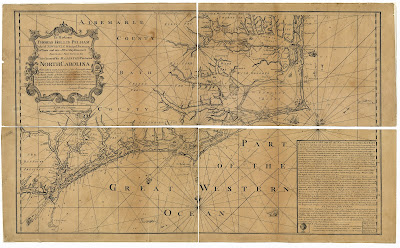
So far, no theory explains this "Fulford" name, apart from Bath, North Carolina merchant John Fulford and his wife Dorothy, in NC as early as 1705, who appears in South Carolina records as receiving men's hair products for sale through Hallan Delamare, probable relation of Francis Delamare of Pasquotank County, North Carolina. Ann could be either: 1) the daughter of John and Dorothy, or 2) the wife of their sons James or William Fulford, about whom almost nothing is known:
Certainly, if Ann Bonny was the wife, by license or common-law, of either Fulford brother, they most likely met while in the Bahamas, perhaps on a trading voyage. Still, the Fulford mariner could have met her in Jamaica, and they might have come to New Providence together. Jamaica records at the Registrar General's Department, however, show no Fulfords until 1793.
If I have to say it... that the Boston Gazette newspaper article is a valid primary source - and one that does NOT depend on A General History - from a contemporary who knew these people - and was responsible for apprehending them... well, let's just say that Woodes Rogers had to know what he was talking about! He deserves more credit than to be completely ignored!
The court records from the Spanish Town Trial mentioned Rackham, Bonny, Read, Vane, and a great number of other pirates captured by Jonathan Barnet, a privateer of Jamaica since at least 1715 - the time of the wreck of eleven Spanish vessels known as the "Plate Fleet" today - or specifically from Gov. Archibald Hamilton's response in November 1715 to the massive flood of pirate activity that followed the hurricane of July 30, 1715 and the spilling of millions of pieces of eight on the shallow shores of La Florida - in easy fishing distance - a virtual fortune for anyone who would risk his neck to fish it or take it from others who had. And, a great many mariners took that chance!
Many of the "wreckers" who filled the streets of Nassau, New Providence Island in the Bahamas to fish those wrecks came from New England, England, both Carolinas, Virginia, Bermuda, Antigua, and yes - Jamaica! From all over the Atlantic World!
Until my exposure to the historical community of the Jamaican Anglican Church Records - available on microfilm since 1960s and online for the past decade at familysearch.org, almost no one searched Jamaica looking for any pirate's origin... the island just sat there - in the Caribbean - certainly noticed by most 18th century writers - even by Johnson - but never accessed by anyone since!
I found Edward Thache's family there in the capital city of Spanish Town through those records. So, what about Ann Bonny? What about Mary Read?
Well... just from the Anglican Church records in the Thache's church of St. Catherine's Cathedral come these records for Bonny, researched by me on familysearch.org:
1695 July 1 - Burial of Mary Bonny
1698 Nov 22 - Phillip & Ann christen child Mary
1699 Feb 9 - Phillip & Ann christen child Elizabeth
1700 July 19 - Burial of Edward Bonny [son or brother of Phillip?]
1701 June 6 - Burial of Annie a child [father unknown]
1702 May 17 - Burial of Mary Bonny [likely 1st dau. Mary of Phillip & Ann, ch. 1698]
1704 Nov 12 - Phillip & Ann christen child Mary [married Sir Simon Clarke & d. 1762]
1710 April 6 - Phillip & Ann christen child John
1713 April 5 - Burial of Ann, a child
1714 Sep 1 - Burial of Mary, a child [child of another Bonny?]
1714 Nov 16 - Burial of James, a child
1718 Aug 19 - Phillip & Ann christen unnamed son [John? Thomas? or William?]
1726 June 30 - Burial of Sarah Bonny
1732 Oct 16 - Burial of John Bonny [son of Phillip & Mary, ch. 1710?]
1733 Dec 29 - Burial of Ann Bonny [who is this? next man buried was from "gaol" - coincidence?]
1736 Jan 14 - Burial of William Bonny Mul. [mix of European with African]
1748 March 15 - Phillip & Ann Bonny {man & wife buried in one coffin} [appar. died the same day]
1748 April 22 - Burial of Thomas Bonny
1748 April 27 - Burial of Charity Bonny free child [presumed of African ancestry]
---------updated 2/21/21----------------------------
Vere Parish shows numerous Read/Reed/Reids, but only one baptism for Bonny:
"Bonny - Mary, Dr.[daughter] of Willm. & Thoma... born Jan 7th. bapts. April 4th 1707"
Note: the family of Gordon Bonny cannot be fully explored as the Anglican Church records from St. John's Parish - like most remote Jamaican parishes - did not begin until later - in this case, 1751.
---------------------------------------------------------
There were more records already researched from the Register General's Department there:
WILL OF EDWARD CLARKE
PUBLIC RECORD OFFICE: PROB 11/1024
Will proved: 6th December 1777
Date within document: 3rd August 1773
Persons Mentioned, Places Mentioned
Edward Clarke [planter] [testator], Hyde Plantation, Trelawny, Jamaica
Thomas Worth [godson] & son of Thomas Worth Chief Justice of Jamaica, Mount Pleasant St John, Middlesex in Jamaica [home of William Bonny]
Robert Cooper of London [friend], Hyde Cheshire, England [home of George Clarke]
The Governors of the College of the province of New York, Swanswick plantation in St James, Jamaica
Mary Clarke [daughter], Land in the province of New York, America owned by Edward Clarke
Anne Clarke [daughter]
Mary Bonny [Anne, Edward & Penelope Clarke's mother]
William Bonny [Mary Bonny's father]
Penelope Clarke [daughter]
Edward Clarke
George Clarke [brother]
William Innes of London [Merchant & friend]
Edward Clarke [grandson & son of George Hyde Clarke]
George Hyde Clarke [son]
Samuel Williams Haughton [son in law]
Helen Camberbarh[?] [daughter in law]
Elizabeth Cork [Sister]
Mathew & Letitia Cork [nephew & niece]
Ballard Beckford [nephew]
Susanna Beckford [daughter of Ballard Beckford]
Precis:-
This is the will of Edward Clarke who appears to have owned Hyde Plantation in Trelawny at the time of his death in 1777 and lands in the province of New York State. He appears to have had a brother, George, living in Hyde, Cheshire in England and various children whose mother was Mary Bonny also a grandson, Edward, son of his son Edward Hyde Clarke... [the will goes on interminably long, so I'll stop it here.]
Also, INDEX TO DEED BOOKS - JAMAICA 1669-1797 showed James-Bonny transactions for Phillip Bonny (who's wife was Ann):
Phillip Bonny Sold land in 1715 to Henry James - Vol. 54, f.92
Phillip Bonny Sold land in 1727 to Henry James - Vol. 76, f.19
And, "Jamaican Landowners in 1754" show:
Bonny, Philip, St. Catherine 533, St. John 194, Total 727 [acres]
Bonny, Gordon, St. John, 200 [acres]
Phillip Bonny was the most well-known Bonny of Jamaica, having been officially appointed to government positions there - why he appears in the capital city, no doubt - as per Calendar of State Papers:
September 1703, 11-20
Sept. 15th - Writ of election and return for the parish of St. Katherine's read. It was resolved that Noah Delauney* was duly elected a Representative in the room of Henry Brabant, who was expelled the House. Ordered that the writ and return be entered in the Minutes of this House. The return is signed by Jno. Hickman, Provost Marshall, Henry Willis, John Hanson, Beaumont Pestell, Wm. Parker, John Palmer, Edward Rowland, Geo. Fletcher, Tho. Powell, Richd. Bradford, John Morris, Phillip Bonny, John Ellis, senr., John Ellis, Matt. Gregory, Robt. Nedham, Wm. Nedham, Tho. Flower, Richd. Masters, Bartho. Fant, Tho. Mercer, Arthur Sparke, John Bancks. [C.O. 140, 7. pp. 107–112.]
*"Noah Delauney" or Noah Delanmey or Delanney was a probable godfather of one of Edward and Lucretia Thache's children in 1704.
Phillip, who owned 727 acres and plantations in at least two parishes, also earned a place in the MONUMENTAL INSCRIPTIONS JAMAICA - PARISH OF HANOVER.
ST. LUCEA CHURCH AND CHURCHYARD.
Page 329
IN THIS CHURCH IS DEPOSITED THE MORTAL PART OF SIR SIMON CLARKE BART., WHO WAS BORN IN THIS ISLAND, A.D. 1727, AND DIED ON THE 2d OF NOVEMBER, 1777, HAVING THAT DAY COMPLETED HIS 50th YEAR.
M. M. Sculptured by Flaxman.
(The remainder of the inscription is a general character of the deceased.)
Sir SIMON was 7th Baronet; lie married Anne Haughton.* He was the eldest of six children of Sir Simon, 6th Baronet, by his wife Mary, daughter of Philip Bonny, of Jamaica. Philip Clarke, a younger son of the 3rd Baronet of that name and family, held the office of Patent Clerk of the Crown, in Jamaica, in 1722. The 5th Bart. was an officer in the Navy, in 1730, but was transported to Jamaica, for a highway robbery committed by him and another man, near Winchester, and died in the former island, without issue, in 1736, whereupon the eldest son of Philip, Clerk of the Crown, above mentioned, succeeded to the Baronetcy.
These records show a definite family group with a government official Phillip and Ann as the parents and multiple children, having arrived in the island at the beginning of the 18th century (Like Edward and his first wife Elizabeth Thache, Phillip & Mary were not born or married on Jamaica - so, probably in England or another island). Phillip could have had brothers Edward and Gordon (living in St. John's Parish), too.
 |
1733 burial record for Ann Bonny in St. Catherine's Parish, Jamaica
|
It is at least as possible that Anne Bonny could be from this family - and perhaps maybe why she was spared the hangman's noose - well, for that reason as well as pregnancy. The Anglican Church burial record for "Ann Bonny" on December 29th, 1733 may show an Ann not immediately related to Phillip and his wife Ann herself, but may be a daughter of the Edward mentioned as dying there in 1700 or perhaps a daughter of Gordon in St. John's Parish, or William in Vere Parish, and both may be related to Phillip. She might very well have shacked up with some Fulford guy on New Providence Island while hoping for massive riches of her own. The family and the Jamaican Anglican authorities never recognized the marriage and simply recorded her with her family as "Ann Bonny!" John, William, Thomas, or Charity - only one male of whom is Phillip and Ann's - could be her child.
David Fictum in "Colonies, Ships, and Pirates: Concerning History in the Atlantic World, 1680-1740" writes "A record of burials in St. Catherine, Jamaica, notes the death and burial of a Mary Read on April 28, 1721." Yes. And, there a lot of Reid, Reed, Read family names in Jamaica - quite a few in St. Catherine's Parish. Two "Mary Reed"s were christened in St. Catherine's in the mid 1680s and another slightly older in St. Andrews. It may be that she's also from Jamaica. Note that the infamous female pirate's entry reads "pirate" immediately after her name, leaving little doubt who she was! Time to erase the "unknown" added to most of her times of death in secondary sources!
Just down the page, noted for June 28th, also shows "A Pirate from the prison."
That Anne Bonny escaped the gallows seems unusual at best. But, perhaps not if she had family there in the capital town - especially a government official - her freedom may have been purchased... or at least a sentence reduced. I should also note that it was rare for a pirate to be buried in Christian fashion and noted in an Anglican burial record. Their bodies were usually left hanging in a gibbet for the birds to peck on - like Rackham himself - or on a beach below the low water mark, so as to eternally damn their souls to hell!
 |
St. Catherine's Parish Burial Records, April 28, 1721 for "Mary Read pirate" - note that the incidental "pirate" part should not appear in the digitized transcriptions or finding aid on the genealogical website, but only by viewing the actual record itself.
|
I can say that Fulford is not a name found on Jamaica - but, it is on nearby Barbados and early in North Carolina's Bath Town - and there were men from every part of the Atlantic World in Nassau, New Providence - a small backwater shanty town seething with masses of greedy mariners at the time!