Donate to Brooks Historical

Showing posts with label buse. Show all posts

Wednesday, November 18, 2020

Review: Quest for Blackbeard


Review of original 2016 edition...

Now updated and expanded.. and affordable e-book edition!

A truly groundbreaking Book!
By Mark Martinez on July 16, 2017
 
Baylus C. Brooks' Quest for Blackbeard I believe will help to usher in a sea change in the field of piracy in the 18th century West Indies. A highly sourced and entirely readable work, Quest presents a much needed critique of Captain Charles Johnson's 1724 book "A General History of the Robberies and Murders of the most notorious Pyrates" which has served as the principal source used by researchers since the time of its writing in defining the character and exploits of the famous pirate.
 
Brooks helps to reinforce the emerging theory among researchers that the Captain Johnson who wrote "A General History" was actually the 18th-century Jacobite printer and journalist, Nathaniel Mist. Mist's reputation is best understood by examining his "Weekly Journal" which was the most vocal and extreme resistance newspaper to emerge in opposition to the Hanoverian Whig takeover of the British parliament in 1715. Brooks explains how Mist, under the Johnson pseudonym, wrote "a General History" largely as an exploitation and/or propaganda narrative designed to appeal to the unique political sensibilities of his readers. As such, it has been wrong for researchers to use it blindly, as it has been, to define who Blackbeard was and how he should be understood in history.
 
In this regard, Brooks has done groundbreaking work in uncovering the true origins of Blackbeard. Unlike the image painted by Mist of a vulgar and brutal monster of low birth, Brooks has discovered through records he has brought to light found in St Catherine's Parish registries of Jamaica and Jamaican deed books as well as through genealogies compiled from wills kept by the Prerogative Court of Canterbury in England that Blackbeard, whose given name was Edward Thache, was actually from a minor aristocratic family who was not far removed from high level players in the political circles of his time - principally among them, the Lechmeres of Hanley Castle in Worcestershire who supported the 1st Whig Junto and who were, through marriage, connected to the Winthrops of Connecticut. Brooks has discovered that Thache began his career, surprisingly, as a well-respected mariner serving in the British Royal Navy aboard the HMS Windsor.
 
Put simply, Brooks has made a compelling case that Thache was perhaps more privateer than pirate, at least in his early days, with sympathies more aligned with the ousted Stewarts than with the ascendant Hanovers. These alignments appear to have led him onto the wrong side of history. It can be argued that he may have gotten caught in his own emerging reputation fostered by his own press along with the unstable politics of his age, a combination that led him into an outlaw career that he perhaps couldn't escape.
 
In all respects, Quest is a groundbreaking book. It offers much food for thought no matter what opinions the reader holds on the subject and, at a minimum, presents much newly discovered source material that makes the light of day for the first time in this work. These documents, by themselves, make the book worth purchasing. The well-conceived conclusions Brooks draws makes it invaluable. In all respects Quest for Blackbeard is well worth the read for all who are interested in the subject.

Sunday, August 12, 2018

French Slavers & English Pirates off the African Coast!

Print by Nicolas Ozanne, painter of the Navy, dated 1776. | DR  

Jacques Nadreau, commander of 130 ton, 12-gun French slaver l'Union de Nantes probably descends from the Flemish architect Jacques Nadreau. The elder Nadreau was a basically unknown architect who made it famous when he constructed L'orgue du Collège Royal de La Flèche, an organ gallery consisting of a low-bay central bay and two conical horns at the east end of the nave of La Chapelle Saint-Louis du Prytanée militaire de La Flèche in the town of La Flèche, in La Sarthe, a department or county of the Loire region. This afforded his family some prominence and wealth.

The younger Jacques Nadreau, perhaps a grandson, had recently sailed from Nantes, a port 50 miles up the Loire River, as consort to 266-ton L'Aurore, commanded by Mathurin Joubert in 1713, carrying slaves from West Africa to the French Windward colony of La Martinique. Early in 1719, Nantes merchant René Montaudouin, previous owner of the ill-fated La Concorde de Nantes (which became Edward Thache's Queen Anne's Revenge), outfitted 130 ton, 12-gun l'Union de Nantes, to be commanded by Jacques Nadreau. 

As found in "When Nantes was the capital of the slave trade" by Jean-François Martin, just in the 18th century alone, ships of Nantes transported between 450,000 and 600,000 Africans to the European colonies of the New World. As gleaned from The Diligent: A Voyage Through the Worlds Of The Slave Trade, by Robert Harms, sugar markets no longer sought sugar from the nearby island of São Tomé, Portuguese for "Saint Thomas," and gold was available from New World Spanish colonies. With the advent of lucrative West-Indian sugar plantations in the latter 17th century, slaves became highly valuable. African slaves from the Guinea Coast and elsewhere became a profitable trade in the Atlantic for other European items such as cloth and guns. By the early 18th century, Judah or Whydah had recently become the principle location from which to obtain their human cargo.

Nadreau departed 1 April that early spring for the coast of Guinea to obtain slaves in the West African port of Judah, or Whydah, arriving there 12 August, 3 days after three English pirates had left in pursuit of another slave trader, Le Victorieux de Nantes, captained by Guillaume Hais. 

French West Africa, with Judah, and islands of Princes, Sao Tome, Anabon and Corista.
Jeremiah Cocklyn, Richard Taylor, and Olivier LeVasseur, most commonly known as "La Buse," or the "Buzzard," had held complete control of Judah from 22 June until 9 August 1719. 

Le Victorieux, on her way to Judah that March, like most merchant captains, learned of pirates on that coast while trading with locals at Grand Sestre for wood, water, and rice. This lay some 90 miles southeast of Sierra Leone River and west of Judah at the Bight of Benin. Hais and crew arrived in Judah 22 March and began to trade with the directors of the fort of São João Baptista de Ajudá for their slaves. 

Exactly three months later, on the 22nd of June, at "four or five o'clock in the afternoon, three pirate ships [Cocklyn, Taylor, and LeVasseur] entered the harbor, flying English flags. After some time, [Edouard Hais, brother of Guillaume and 2nd officer of Victorieux], then in command, believed the pirates were recognized. They then fired cannons and hoisted black flags. Hais cut two cables on the bits" and fled, leaving his brother ashore, where he was then trading with French director, Sieur Bouchet, and his English, Dutch, and Portuguese counterparts. The pirates anchored before Judah in two places, with two prize vessels.

Pirate Jeremiah Cocklyn, in particular, had an eye on capturing Le Victorieux, and, so, took up the hunt for her in William Snelgrave's captured former Bird Galley. After the pirates had agreed to meet at Corisco Island to careen their ships, and rendezvous later at Anabon Island, they parted from Judah on the 9th of August. Afterward, Hais, having evaded Cocklin, returned in Le Victorieux to conclude their business and Le Victorieux also parted on 15th of September.

Not all of the slave traders on the Guinea Coast, however, believed that these three vessels were pirates. Of course, Capt. Nadreau, having just arrived 12 August, had not yet had the displeasure of their company and he argued that they were simply English merchants. The other merchants, particularly Hais, assured him that they were, indeed, pirates. The 30th of September, while Nadreau loaded three hundred and fifty-six slaves, Richard Taylor, then in command of his prize, Richard Blincko's former Heroine, returned to prove Hais absolutely correct! 

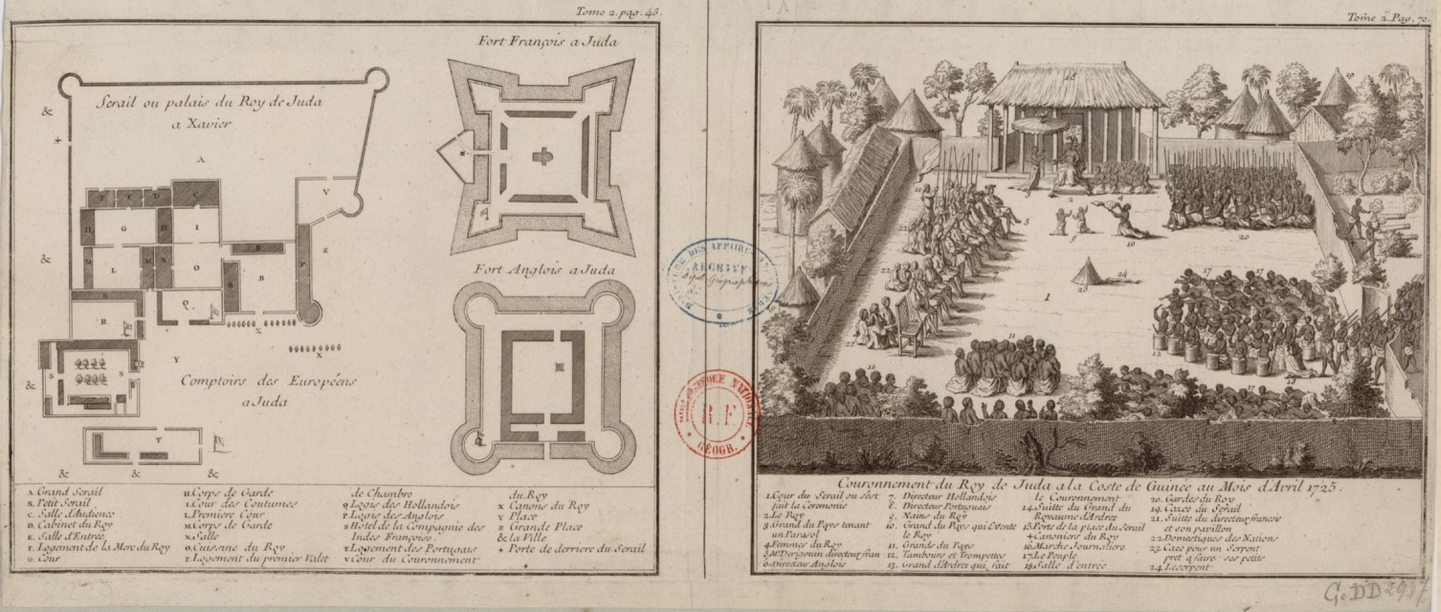
[Plan du fort françois à Juda et couronnement du roy de Juda a la coste de Guinée au mois d'avril 1725] (1730), Labat, Jean-Baptiste (1663-1738).
Nadreau wrote that "pirates on September 30th 1719, gave chase to his ship," l'Union de Nantes, and that 24 of his crew had been trading ashore and were left behind when Taylor raided. Nadreau was forced to change his opinion of these pirate "merchants" when they plundered his vessel of his "passport and all his other papers," "looted his cables and liquors by the bottle, and left the deponent on the ground [at Judah] with twenty black cargo." At least he had been reunited with his 24 crew members. The worst part was the semi-betrayal of his first mate, "obliged to plunder his canoe, and a mast," who then departed for Saint Domingue in his ship, at the direction, and probable amusement of the English pirates!

Nadreau was "obliged to remain at Judah for a month and a half with his men and the twenty negroes... obliged to make heavy expenses for the subsistence of the negroes and sailors." He found passage on Jacques Hego's l'Heureaux Avanteuries, who had also been taken by pirate Edward England on 15 September at Cap de Trois Pointes, just west of Judah


Capt. Helle Lavigne, commander of Le Preni de Nantes, had also been warned about these pirates at Grand Sestre, where other merchants assured him that he needed a pass from the brigands to trade on the Guinea Coast. Like Nadreau on the pirates' first visit to Judah, he missed Richard Taylor's return to Judah, arriving on the evening of the same day, the 30th of September, having heard of the scuffle from other merchants. He may have felt fortunate to have missed these pirates, but, as I write in the upcoming new book, Sailing East: West Indian Pirates in Madagascar:
Coming this fall!
What was Richard Taylor doing at this time? Capt. Helle Lavigne, commander of Le Preni de Nantes, may be able to tell us. While Cocklyn and LeVasseur were occupied with Le Solide, a pirate ship again raided Judah on 30 September, taking l’Union de Nantes, captain Jacques Nadreau. Lavigne heard the rumors and arrived that night to speak with the directors ashore. After departing, on 2nd of October, two days en route for Anabon, he and a Portuguese ship were also taken probably by Taylor. Lavigne told little about this pirate, except that he pillaged his cargo. The pirate kept him near Judah until 11 November 1719, and then ordered him to follow, as the pirate had to leave – probably to rendezvous with LeVasseur and Cocklyn. The timing was perfect! Moreover, Lavigne would meet fellow French pirate captive Guillaume Hais of Le Victorieux quite soon!


Capts. Hais and Lavigne would partner up at Cape Lopez that December after being released by the pirates.. who would then be sailing eastward for Madagascar! Read their stories and the story of the captured pirate ship Victory or Le Victorieux, famously involved in capturing the East India Company's Cassandra, in Sailing East: West Indian Pirates in Madagascar.


Note: corrections made 14-Aug-2018.
----------------------------------------------

Read about the final end of Edward Thache:

Murder at Ocracoke! Power and Profit in the Killing of Edward "Blackbeard" Thache


http://www.lulu.com/shop/baylus-c-brooks/murder-at-ocracoke/paperback/product-23588556.html

In commemoration of "Blackbeard 300 Tri-Centennial":


As always, drop by baylusbrooks.com and check out the primary source transcriptions available there!


Friday, April 06, 2018

Time and Tide Make Us Mercenaries All!

As pirate victims go, they are generally concerned with reporting their losses and hurt feelings to the Admiralty. Their depositions are usually filled with details of how pirates rifled their goods, threatened and sometimes tortured them to learn the whereabouts of any gold, silver, rum, or other valuables they had on board. What they generally don't report are the illegal goods that they often willingly accept from the pirates... goods that they later try to sell for profit at their next ports of call. 

There are no heroes in pirate stories!

36-year old Capt. Thomas Creed (d. 1721) of Coward was captured 17 June 1719 by Edward England. He testified that another victim, like himself, had joined with England's crew and had directed a small pirate sloop, Buck, to take his vessel in only "two fathoms of water." He argued that if Capt. Henry Hunt of Sarah galley had not piloted this pirate, his vessel would not have been taken, his goods stolen, and his ship burnt! Furthermore, he charged Hunt with sailing away 5th July after helping pirates to rifle his sloop and that of Capt. Thomas Lynch's Carteret, stealing "several brass Panns & bottles" from him and an unknown quantity from Lynch. 

Creed may have been the only honest one in the bunch, but it didn't pay!

Weekly Packet of 24 October 1719 provided a long list of vessels said to have been taken by pirate Edward England in his ship 30-gun, 160-man Royal James, also said to have been former Capt. Edward Tyzard or Tyzach's Pearl of Bristol. The pink Eagle was probably captured by Howell Davis, on the Gambia River in March, but not during the period May-July when the rest of these ships were taken. The rest, however, probably were the prizes of Edward England.


Newspapers often misquote or get some facts wrong, but are usually fairly reliable. Certain details of this article, however, had been skewed. Charlotte listed in the article was actually commanded by Capt. Branson Oulson, not Oldson, but this was a minor mistake, especially at a time when spelling was phonetic and not yet standardized. Another simple misspelling appears with Sarah, Capt. "Stunt." His name was actually Capt. Henry Hunt, a defendant in this criminal case at the Old Bailey. Another huge error, though, was Carteret, Capt. Snow. While Carteret was a snow-rigged vessel, the captain's name was actually Thomas Lynch. 

The error-filled article above did actually get the date of Capt. Thomas Creed's Coward correct as 17th of June 1719. This assumes that Thomas Creed's deposition of 27 September 1720 gave the correct date. Presumably, Weekly Packet obtained this news from the deposition. It's actually common practice even today for journalists to obtain their information from police reports and depositions.

 
As Creed stated in his deposition,  he was captured by pirates in "Buck Sloop," probably the vessel shown as "Bank" in the Weekly Packet, a vessel of Capt. Sylvester originally used as a packet boat in the Gambia River. This should not be confused with Buck sloop on which Howell Davis mutinied on his way to the Cape Verde Islands from New Providence earlier. Davis was hundreds of miles too far south at Principe Island in King James at this time, most likely accompanied by his old Buck sloop.  

Trade winds ran north to south down the African Coast and northward travel was more difficult. That's why ships usually entered at the Cape Verde Islands in the northern latitudes adjacent Gambia River before sailing south to Sierra Leone, Whydah, Old Calabar, and Cape Lopez, off Angola. 


The pirates aboard Buck included, as Creed observed, 25-year-old Henry Hunt, "then on board the sd pirate Vessel & piloted her at the time." Creed believed that "if the sd Henry Hunt had not piloted the sd Sloop and directed her Company... she would have escaped." 


There is logical merit to his argument. River topography is such that dangerous shoals develop in rather shallow waters, drastically varying the depth of the water where only a few feet could mean you run aground. Without a pilot familiar with those particular waters, a vessel, even a sloop. might easily founder near two fathoms of water, or only twelve feet - possibly shifting quickly to only a few feet. The younger Hunt must have been in Gambia River before. perhaps with his brother Thomas in Saint Quintine the year before. This is why pirate Capt. Edward England would have desired him to pilot one of his vessels - in this case, Buck. It might easily appear to Creed, arriving later, that Hunt had indeed, joined the pirates!

An unmarried Henry Hunt (d.1739), later of Poplar, but then also of the parish of Stepney, Middlesex where mariner Thomas Creed lived with his wife Sarah and their son, Thomas, testified as well on the same day. He stated that he had been captured on 27 May 1719 by Edward England in Royal James already accompanied by two former prizes, Charlotte or Charlot, Capt. Branson Oulson, and probably the snow Carteret, Capt. Thomas Lynch.  

According to Hunt,  the pirates "forced [him] into their Service" on the pirate sloop when Coward was taken. He said that he knew nothing about any stolen goods or the burning of Creed's vessel. 

The Political State of Great Britain, a monthly news digest, for October 1720 shows that Capt. Hunt and Oldson (or Oulson) were tried and acquitted for piracy. 


As Creed said that he saw, the stolen goods were placed on Sarah, Hunt's vessel before it was released (Delight was Creed's most recent command). Hunt visited the Admiralty Office in late summer of 1720 to obtain a Mediterranean pass and was arrested for piracy. He was then incarcerated in Marshalsea Prison, awaiting trial, the results of which you can read in the Political State of Great Britain. The owners of Sarah and Charlotte appeared for them, vouched for their conduct, demeaned Creed's accusations, and obtained an acquittal. Still, Hunt probably did take advantage of the pirates' generosity. It appears that Oulson did also.

Capt. Branson Oulson, a mariner of Swedish descent, was also brought up on charges of piracy with Hunt, apparently also because of Thomas Creed's testimony. It should be noted that the wording of his deposition, however, did not accuse Oulson. He may have indicated to the Admiralty earlier that Branson was also involved. Any deposition that he gave against Oulson no longer survives. 
 
Primary sources of genealogical content make exploring these early mariner's lives quite possible now. Unlike the singly-married Creed and the bachelor Hunt, Branson Oulson had been married three times: to Mary Cable in 1710 while living in Woolwich, Kent; after Mary's death, to Elizabeth Woodard in London in 1716; and upon her death to Dorcus Berry in the same place on 9 February 1721, just after settlement of this court issue. He and Dorcus had two daughters, Rebecca and Margaret. Dorcus also died in 1727, followed closely by her husband, Capt. Branson Oulson in 1731. 


 Branson Oulson had also been released by the pirates, but with some "added extras" for his cargo. He proceeded to Barbados after his release and attempted to sell his "piraiticall slaves" merchandise there in September 1719. Henry Lascelles, who famously arranged for the disposal of French pirate Olivier LeVasseur de la Buse's vessel Blanco in 1717, denied that he knew anything of this illegal cargo of Charlotte: "I never understood that they belonged to any particular person," as he described to a very interested Board of Trade and Plantations. 


Another interesting detail is that Thomas Creed, Henry Hunt, and Branson Oulson were all residents of Stepney Parish, Middlesex County in 1720. Creed, the accuser, at age 37, died in April 1721, just a few months after this trial of Hunt and Oulson at the Old Bailey. 

The cynic in me wonders... lol. 


“Looters become looted while time and tide make us mercenaries all.”
~ Patrick Rothfuss in The Wise Man’s Fear

--------------------------------------------


Look for the new booklet for the Blackbeard 300 Tri-Centennial festivities, Murder at Ocracoke: Power and Profit in the Killing of Edward "Blackbeard" Thache, available now at Lulu Publishing!

Sunday, October 29, 2017

Pirate Edward Congdon retires...

Excerpt from the soon-to-be-released Sailing East: West Indian Pirates in Madagascar:

 Le Mercure told of a letter dated November 1721 that arrived from [the island of] Bourbon with the details of Congdon’s experiences after taking the West African ship full of rubies, diamonds, and specie. Soon arriving back at Madagascar 1 October 1720, Edward Congdon, “who has an arm cut off,” met a Mr. Henry Beker, master of Cooker, seeking slaves from Madagascar.

Similar to Capt. Stratton, Beker and Congdon had transacted some business for wine and liquors at Îsle St. Marie. Suddenly, Congdon then took his captain, surgeon, and carpenter, and two sailors, as well as some of his cargo. Congdon, however, had no intention of keeping these people and items. Congdon wanted to insure that Beker sailed Cooker to Îsle de Bourbon to deliver a message. He needed the governor there to know that Congdon wished to surrender and beg for a pardon. He sent three surgeons, one a Parisian named Du Vernet, a Flemish man, and one English, the latter two taken off vessels of Ostend, as a measure of good faith.[1]

Beker agreed to his terms, not as if he had a choice. He sailed from Madagascar and arrived at the port of Saint-Denis on Bourbon on 15 November 1720. Beker and the three surgeons made depositions before Gov. Joseph de Beauvoilier de Courchant, who had orders from the French East Indies Company, based in L’Orient, France,  to employ all means of attracting pirates to surrender themselves and settle there. All those who would hand over their vessels to them and abandon piracy would receive full pardons. The rich pirates were expected to be quite helpful for the island’s economy.[2]

Congdon drove a hard bargain, but so did Courchant. Congdon had ordered Beker to tell the governor that in case there was no amnesty for them, that his men would fortify in four months, and would do the most harm and injury, till an amnesty of Europe had been sent. Courchant offered “that the Pirates had to assure them that if they were granted an Amnesty, they would come to the Îsle de Bourbon to deliver their ship, arms and ammunition to the Governor, to submit to his orders, Good & faithful Subjects of the King of France.”[3] They were to bring with them only peaceable and mild-mannered slaves. For each of these slaves (and each white man could retain only one), they were to pay twenty piasters to the French Compagnie des Indies in L’Orient, in compensation for the loss to their commerce.[4]

Gov. de Courchant assembled the Provincial Council of the island. After maturely examining the details, they granted Congdon’s wishes, for the benefit of all nations which traded in India, for the French CDI, and for their own local economy. Beker returned to Madagascar with an approved and signed pardon, dated 25 November 1720, for 135 men, accompanied by a letter for Capt. Congdon.[5]

By the end of December, Congdon returned Beker in Cooker to tell him that they happily accepted the pardon and were preparing to burn Dragon and proceed to Bourbon in Cooker. Some of the pirates had already died, of what is unknown, but they were increasingly anxious to leave Madagascar. They set fire to two other of their ships, after spiking their cannon. It took twenty-seven days to finish preparations and Beker returned on 3 January 1721 to pick them up.[6]

In the meantime, a plot was brewing amongst the Betsimisaraka of Îsle St. Marie. They had happily traded through Congdon for a year by then and desired to keep the merchandise of Dragon and its crew. Sudden news of his departure was quite unwelcome.

The natives poisoned Congdon’s crew, probably in food that they prepared for them. Many of Dragon’s crew took sick and Congdon soon realized what had happened. He ordered his crew to get aboard Cooker as fast as they could, but “several of them having dragged themselves to the shores of the sea to embark, were falling dead before they could set foot in the shallop.”[7] On the 30th of January 1721, 42 out of 135 set sail and left some of their brethren still dying on the beach. The fleeing 42 were in little better shape, “nearly all in very bad condition by the poison given them by the blacks of Madagascar.”[8] In the crossing four of their comrades died, leaving a miserable 38 sickly ex-pirates for delivery to Bourbon.


[1] G. Cavelier, ed., Le Mercure, May 1722, p 152-156; Joan DeJean, The Essence of Style: How the French Invented Fashion, Fine Food, Chic Cafés, Style, Sophistication, and Glamour (New York: Free Press, 2005), 47.
[2] Cavelier, Le Mercure.
[3] Ibid.
[4] Ibid.
[5] Ibid.
[6] Ibid.
[7] Ibid.; Alfred Grandidier, (19031907), Collection des Ouvrages Anciens concernant Madagascar, Vol. 5: 1718-1800 (Paris: Comité de Madagascar, 1907), 104 n1; Translated: In a manuscript of the Deposit of Maps and Plans of the Marine of Paris, volume 84 ', Sea of India, Exhibit 17, at the bottom of page 7, it says: "In 1722, Mangaely [Mamoko Islands, of Ampasindava] was repaired by pirates, and it is said that there was a massacre of pirates made there by the blacks of the country, and that the king of Massailly [Bombetoke Bay], named Ratocaffe [Ratoakafo] sent his soldiers there to cover all the black men, women and children, even the dogs, and pillaged all the cattle, and since that time the place has been deserted."
[8] Ibid.


---------------------------------------------------

Coming Soon!

Baylus C. Brooks' books: http://www.lulu.com/spotlight/bcbrooks

#pirates #Blackbeard #eastindies #Levasseur #labuse


Facebook page for Sailing East:

Join us!