Donate to Brooks Historical

Showing posts with label rogers. Show all posts

Saturday, February 20, 2021

Anne Bonny, Possible Neighbor of the Thaches of Spanish Town, Jamaica?


"Anne Bonney" illustration from A General History of the Pyrates

Ever since the pirate trial of 1720/21 at St. Jago de la Vega, or "Spanish Town" Jamaica, historians have contemplated the only two female pirates ever mentioned in the modern (and, of course, disputed) Golden Age, from 1715-1726. Mary Read and Anne Bonny have fascinated thousands for at least three centuries!

Spanish Town, of course, was the colonial capital of the fairly fresh English colony of Jamiaca - having been taken from the Spanish in 1655. Thus, the oft-used named of "Spanish Town" for the captured Spanish capital of St. Jago de la Vega. 

Most modern assumptions stem from Charles Johnson's A General History of the Pyrates, which has, in recent years, come under a great deal of scrutiny. Also, it's author was more than likely Nathaniel Mist, a controversial newspaper publisher, often jailed for supporting the Jacobite cause (not unlike MAGA dissension in America today). 

Jacobites desired to place James III, the "Pretender," (Donald Trump in this analogy) back on the throne of England. Parliament (similar to our Congress) prevented James III from succeeding his sister Anne in 1714, but Jacobites still saw the "Pretender" as the rightful King of England and rebelled twice in 1715 and 1745. 

Most scholars presume that pirates of the Caribbean and in the Americas more generally, held a strong fascination with Jacobitism - especially the early iteration in 1715. Still, how durable that fascination actually was is a matter of debate. It is known that pirates at least identified with the "Pretender" and his Stuart royal family, reflected in the naming of their vessels, like "Revenge," "Royal James," or the two pirate ships named "Queen Anne's Revenge." 

Anne Bonny rose into legend over that 300 years since the 1720s - something of a tricentennial, in fact. Due to the scarcity of records - especially from former pirate strongholds such as Jamaica or the Bahamas - many scholars have relied quite loosely upon questionable sources such as Johnson's - or Mist's or the ubiquitous flood of popular literature about them since - most all based on one source: A General History

Based in A General History and owing to this flood of popular literature since, Anne Bonny's supposed history has blossomed from being virtually unknown to... the daughter of William Cormac, a man reputed to have "first moved to London to get away from his wife's family, and he began dressing his daughter as a boy and calling her 'Andy.'" 

A great deal of literary license over the centuries by numerous authors - all hinging upon A General History - a book called by literary scholar Dr. Manushag Powell a "counterfactual" (think: "alternative facts" or, at best, historical fiction) - culminated in this extraordinary passage found on Wikipedia:

When Cormac's wife discovered William had taken in the illegitimate daughter and was bringing the child up to be a lawyer's clerk and dressing her as a boy, she stopped giving him an allowance. Cormac then moved to the Province of Carolina, taking along his former serving girl, the mother of Bonny. Bonny's father abandoned the original "Mc" prefix of their family name to blend more easily into the Charles Town citizenry. At first, the family had a rough start in their new home, but Cormac's knowledge of law and ability to buy and sell goods soon financed a townhouse and eventually a plantation just out of town. Bonny's mother died when she was 12. Her father attempted to establish himself as an attorney but did not do well. Eventually, he joined the more profitable merchant business and accumulated a substantial fortune.

It is recorded that Bonny had red hair and was considered a "good catch" but may have had a fiery temper; at age 13, she supposedly stabbed a servant girl with a knife. She married a poor sailor and small-time pirate named James Bonny. James hoped to win possession of his father-in-law's estate, but Bonny was disowned by her father. Anne's father did not approve of James Bonny as a husband for his daughter, and he kicked Anne out of their house.

However, it is known [but, not really] that sometime between 1714 and 1718, she and James Bonny moved to Nassau, on New Providence Island, known as a sanctuary for English pirates called the Republic of Pirates. Many inhabitants received a King's Pardon or otherwise evaded the law. It is also recorded that, after the arrival of Governor Woodes Rogers in the summer of 1718, James Bonny became an informant for the governor [also, unsupported - the Calendar of State Papers - the usual source for this info, does not seem to notice James]. James Bonny would report to Governor Rogers about the pirates in the area, which resulted in a multitude of these pirates being arrested. Anne disliked the work her husband did for Governor Rogers.

While in the Bahamas, Bonny began mingling with pirates in the taverns. She met John "Calico Jack" Rackham, and he became her lover. He offered money to her husband James Bonny if he would divorce her, but her husband refused and apparently threatened to beat John. She and Rackham escaped the island together, and she became a member of Rackham's crew. She disguised herself as a man on the ship, and only Rackham and Mary Read were aware that she was a woman until it became clear that she was pregnant. Rackham then landed her at Cuba where she gave birth to a son. She then rejoined Rackham and continued the pirate life, having divorced her husband and married Rackham while at sea [possibly - but her actual husband's name might have been Fulford].

Seriously?? I have to say that this elaborate tale depends on absolutely NO primary sources - unless you consider A General History to be a primary source, which I - and Dr. Powell - do not - up until we get to the line "Bonny, Rackham, and Read stole the ship William, then at anchor in Nassau harbor, and put out to sea." 

How do we know this? Because the Boston Gazette issue of October 17, 1720 printed an ad by Gov. Woodes Rogers of the Bahamas, searching for the absconders! Williams' owner Capt. John Ham probably wouldn't stop bugging Rogers about it: 


Boston Gazette, 17 Oct 1720, page 3

Note the name "Ann Fulford alias Bonny." She was known on the Bahamas by both of these names. The term "alias" did not usually mean she was hiding from the law. It simply meant "another name for" or "also known as." Her married name - whether ecumenically or common law - was probably Fulford.

For example, George Washington's wife might have been called "Martha Washington alias Custis."

So far, no theory explains this "Fulford" name, apart from Bath, North Carolina merchant John Fulford and his wife Dorothy, in NC as early as 1705, who appears in South Carolina records as receiving men's hair products for sale through Hallan Delamare, probable relation of Francis Delamare of Pasquotank County, North Carolina. Ann could be either: 1) the daughter of John and Dorothy, or 2) the wife of their sons James or William Fulford, about whom almost nothing is known: 


Certainly, if Ann Bonny was the wife, by license or common-law, of either Fulford brother, they most likely met while in the Bahamas, perhaps on a trading voyage. Still, the Fulford mariner could have met her in Jamaica, and they might have come to New Providence together. Jamaica records at the Registrar General's Department, however, show no Fulfords until 1793.

If I have to say it... that the Boston Gazette newspaper article is a valid primary source - and one that does NOT depend on A General History - from a contemporary who knew these people - and was responsible for apprehending them... well, let's just say that Woodes Rogers had to know what he was talking about! He deserves more credit than to be completely ignored!

The court records from the Spanish Town Trial mentioned Rackham, Bonny, Read, Vane, and a great number of other pirates captured by Jonathan Barnet, a privateer of Jamaica since at least 1715 - the time of the wreck of eleven Spanish vessels known as the "Plate Fleet" today - or specifically from Gov. Archibald Hamilton's response in November 1715 to the massive flood of pirate activity that followed the hurricane of July 30, 1715 and the spilling of millions of pieces of eight on the shallow shores of La Florida - in easy fishing distance - a virtual fortune for anyone who would risk his neck to fish it or take it from others who had. And, a great many mariners took that chance!

Many of the "wreckers" who filled the streets of Nassau, New Providence Island in the Bahamas to fish those wrecks came from New England, England, both Carolinas, Virginia, Bermuda, Antigua, and yes - Jamaica! From all over the Atlantic World!

Until my exposure to the historical community of the Jamaican Anglican Church Records - available on microfilm since 1960s and online for the past decade at familysearch.org, almost no one searched Jamaica looking for any pirate's origin... the island just sat there - in the Caribbean - certainly noticed by most 18th century writers - even by Johnson - but never accessed by anyone since!

I found Edward Thache's family there in the capital city of Spanish Town through those records. So, what about Ann Bonny? What about Mary Read?

Well... just from the Anglican Church records in the Thache's church of St. Catherine's Cathedral come these records for Bonny, researched by me on familysearch.org:

1695 July 1 - Burial of Mary Bonny

1698 Nov 22 - Phillip & Ann christen child Mary

1699 Feb 9 - Phillip & Ann christen child Elizabeth

1700 July 19 - Burial of Edward Bonny [son or brother of Phillip?]

1701 June 6 - Burial of Annie a child [father unknown]

1702 May 17 - Burial of Mary Bonny [likely 1st dau. Mary of Phillip & Ann, ch. 1698]

1704 Nov 12 - Phillip & Ann christen child Mary [married Sir Simon Clarke & d. 1762]

1710 April 6 - Phillip & Ann christen child John

1713 April 5 - Burial of Ann, a child

1714 Sep 1 - Burial of Mary, a child [child of another Bonny?]

1714 Nov 16 - Burial of James, a child

1718 Aug 19 - Phillip & Ann christen unnamed son [John? Thomas? or William?]

1726 June 30 - Burial of Sarah Bonny

1732 Oct 16 - Burial of John Bonny [son of Phillip & Mary, ch. 1710?]

1733 Dec 29 - Burial of Ann Bonny [who is this? next man buried was from "gaol" - coincidence?]

1736 Jan 14 - Burial of William Bonny Mul. [mix of European with African]

1748 March 15 - Phillip & Ann Bonny {man & wife buried in one coffin} [appar. died the same day]

1748 April 22 - Burial of Thomas Bonny

1748 April 27 - Burial of Charity Bonny free child [presumed of African ancestry]

---------updated 2/21/21----------------------------

Vere Parish shows numerous Read/Reed/Reids, but only one baptism for Bonny: 

"Bonny - Mary, Dr.[daughter] of Willm. & Thoma... born Jan 7th. bapts. April 4th 1707"

Note: the family of Gordon Bonny cannot be fully explored as the Anglican Church records from St. John's Parish - like most remote Jamaican parishes - did not begin until later - in this case, 1751.

---------------------------------------------------------

There were more records already researched from the Register General's Department there:

WILL OF EDWARD CLARKE

PUBLIC RECORD OFFICE:  PROB 11/1024
Will proved: 6th December 1777
Date within document: 3rd August 1773

Persons Mentioned, Places Mentioned

Edward Clarke [planter] [testator], Hyde Plantation, Trelawny, Jamaica
Thomas Worth [godson] & son of Thomas Worth Chief Justice of Jamaica, Mount Pleasant St John, Middlesex in Jamaica [home of William Bonny]
Robert Cooper of London [friend], Hyde Cheshire, England [home of George Clarke]
The Governors of the College of the province of New York, Swanswick plantation in St James, Jamaica
Mary Clarke [daughter], Land in the province of New York, America owned by Edward Clarke
Anne Clarke [daughter]
Mary Bonny [Anne, Edward & Penelope Clarke's mother]
William Bonny [Mary Bonny's father]
Penelope Clarke [daughter]
Edward Clarke
George Clarke [brother]
William Innes of London [Merchant & friend]
Edward Clarke [grandson & son of George Hyde Clarke]
George Hyde Clarke [son]
Samuel Williams Haughton [son in law]
Helen Camberbarh[?] [daughter in law]
Elizabeth Cork [Sister]
Mathew & Letitia Cork [nephew & niece]
Ballard Beckford [nephew]
Susanna Beckford [daughter of Ballard Beckford]

Precis:-

This is the will of Edward Clarke who appears to have owned Hyde Plantation in Trelawny at the time of his death in 1777 and lands in the province of New York State. He appears to have had a brother, George, living in Hyde, Cheshire in England and various children whose mother was Mary Bonny also a grandson, Edward, son of his son Edward Hyde Clarke... [the will goes on interminably long, so I'll stop it here.]


Also, INDEX TO DEED BOOKS - JAMAICA 1669-1797 showed James-Bonny transactions for Phillip Bonny (who's wife was Ann):

Phillip Bonny Sold land in 1715 to Henry James - Vol. 54, f.92
Phillip Bonny Sold land in 1727 to Henry James - Vol. 76, f.19

And, "Jamaican Landowners in 1754" show:

Bonny, Philip, St. Catherine 533, St. John 194, Total 727 [acres]
Bonny, Gordon, St. John, 200 [acres]


Phillip Bonny was the most well-known Bonny of Jamaica, having been officially appointed to government positions there - why he appears in the capital city, no doubt - as per Calendar of State Papers:

September 1703, 11-20

Sept. 15th - Writ of election and return for the parish of St. Katherine's read. It was resolved that Noah Delauney* was duly elected a Representative in the room of Henry Brabant, who was expelled the House. Ordered that the writ and return be entered in the Minutes of this House. The return is signed by Jno. Hickman, Provost Marshall, Henry Willis, John Hanson, Beaumont Pestell, Wm. Parker, John Palmer, Edward Rowland, Geo. Fletcher, Tho. Powell, Richd. Bradford, John Morris, Phillip Bonny, John Ellis, senr., John Ellis, Matt. Gregory, Robt. Nedham, Wm. Nedham, Tho. Flower, Richd. Masters, Bartho. Fant, Tho. Mercer, Arthur Sparke, John Bancks. [C.O. 140, 7. pp. 107–112.]

*"Noah Delauney" or Noah Delanmey or Delanney was a probable godfather of one of Edward and Lucretia Thache's children in 1704. 


Phillip, who owned 727 acres and plantations in at least two parishes, also earned a place in the MONUMENTAL INSCRIPTIONS JAMAICA - PARISH OF HANOVER.
ST. LUCEA CHURCH AND CHURCHYARD.

Page 329

IN THIS CHURCH IS DEPOSITED THE MORTAL PART OF SIR SIMON CLARKE BART., WHO WAS BORN IN THIS ISLAND, A.D. 1727, AND DIED ON THE 2d OF NOVEMBER, 1777, HAVING THAT DAY COMPLETED HIS 50th YEAR.

M. M. Sculptured by Flaxman.

(The remainder of the inscription is a general character of the deceased.)

Sir SIMON was 7th Baronet; lie married Anne Haughton.* He was the eldest of six children of Sir Simon, 6th Baronet, by his wife Mary, daughter of Philip Bonny, of Jamaica. Philip Clarke, a younger son of the 3rd Baronet of that name and family, held the office of Patent Clerk of the Crown, in Jamaica, in 1722. The 5th Bart. was an officer in the Navy, in 1730, but was transported to Jamaica, for a highway robbery committed by him and another man, near Winchester, and died in the former island, without issue, in 1736, whereupon the eldest son of Philip, Clerk of the Crown, above mentioned, succeeded to the Baronetcy.


These records show a definite family group with a government official Phillip and Ann as the parents and multiple children, having arrived in the island at the beginning of the 18th century (Like Edward and his first wife Elizabeth Thache, Phillip & Mary were not born or married on Jamaica - so, probably in England or another island). Phillip could have had brothers Edward and Gordon (living in St. John's Parish), too. 

1733 burial record for Ann Bonny in St. Catherine's Parish, Jamaica


It is at least as possible that Anne Bonny could be from this family - and perhaps maybe why she was spared the hangman's noose - well, for that reason as well as pregnancy. The Anglican Church burial record for "Ann Bonny" on December 29th, 1733 may show an Ann not immediately related to Phillip and his wife Ann herself, but may be a daughter of the Edward mentioned as dying there in 1700 or perhaps a daughter of Gordon in St. John's Parish, or William in Vere Parish, and both may be related to Phillip. She might very well have shacked up with some Fulford guy on New Providence Island while hoping for massive riches of her own. The family and the Jamaican Anglican authorities never recognized the marriage and simply recorded her with her family as "Ann Bonny!" John, William, Thomas, or Charity - only one male of whom is Phillip and Ann's - could be her child.

David Fictum in "Colonies, Ships, and Pirates: Concerning History in the Atlantic World, 1680-1740" writes "A record of burials in St. Catherine, Jamaica, notes the death and burial of a Mary Read on April 28, 1721." Yes. And, there a lot of Reid, Reed, Read family names in Jamaica - quite a few in St. Catherine's Parish. Two "Mary Reed"s were christened in St. Catherine's in the mid 1680s and another slightly older in St. Andrews. It may be that she's also from Jamaica. Note that the infamous female pirate's entry reads "pirate" immediately after her name, leaving little doubt who she was! Time to erase the "unknown" added to most of her times of death in secondary sources!

Just down the page, noted for June 28th, also shows "A Pirate from the prison." 

That Anne Bonny escaped the gallows seems unusual at best. But, perhaps not if she had family there in the capital town - especially a government official - her freedom may have been purchased... or at least a sentence reduced. I should also note that it was rare for a pirate to be buried in Christian fashion and noted in an Anglican burial record. Their bodies were usually left hanging in a gibbet for the birds to peck on - like Rackham himself - or on a beach below the low water mark, so as to eternally damn their souls to hell! 

St. Catherine's Parish Burial Records, April 28, 1721 for "Mary Read pirate" - note that the incidental "pirate" part should not appear in the digitized transcriptions or finding aid on the genealogical website, but only by viewing the actual record itself.

I can say that Fulford is not a name found on Jamaica - but, it is on nearby Barbados and early in North Carolina's Bath Town - and there were men from every part of the Atlantic World in Nassau, New Providence - a small backwater shanty town seething with masses of greedy mariners at the time!


Friday, October 05, 2018

Howell Davis and the Royal African Company

Fort James on Kunta Kinteh Island
Renowned pirate Howell Davis is famous for using trickery to gain access to and burn the Royal African Company's (RAC) slave entrepôt on what was then called "James Island" in the Gambia River on the west coast of Africa - a fortified structure known as "Fort James." The island is now called "Kunta Kinteh Island,"  listed as a UNESCO World Heritage Site and an historical site in the West African slave trade.

A controversial Jacobite newspaper publisher named Nathaniel Mist, writing under the pseudonym "Capt. Charles Johnson," published A General History of the Robberies and Murders of the Most Notorious Pyrates in 1724. This extravagant, flamboyant, and ultimately popular narrative was literally a "political hit piece" on the "Commonwealth of Pyrates" across the Atlantic Ocean - a wilderness colony of England's, created by the cruder and more conservative Stuart Dynasty. We call it "America." The Stuarts had launched nearly a century of theft, native enslavement, and general mayhem originally intended to allow England's rise to power over their Spanish and French competitors in a land raped of its material wealth by all - America's nominal life of crime or piracy.

In that respect, a then financially-troubled Mist intended his book to be only partly a "history," while he had also been coerced by the new stabilizing Whig government to write derogatory references to this "Commonwealth" and its nests of maritime criminals known as "pirates" - commissioned to tell little white lies, as it were. England's desire was to use information warfare to end this Stuart menace to their trade in America. As Shakespeare knew all too well, "the evil that men do lives long after them [especially if in print] - the good is oft interred with their bones." Anyone in journalism or politics understands this human truth - including Nathaniel Mist and Lord Sunderland's Whigs. Sunderland intended to stop this century-old trend and bring America back into the fold of civilization by shaming them into giving up their evil ways - it may have only partly worked.

Mist also liked the idea of profiting from his book, which certainly would have effected it's accuracy! His property taxes and number of rental properties increased greatly after 1724!

Mist's tale for Howell Davis told of three similar incidents of his using slight of hand and playacting to fool administrators, governors, and others into believing that he was a gentleman merchant or official... and not a pirate! The last incident at Principe Island killed the amateur actor.

Davis had supposedly become a pirate because he was taken at Sierra Leone by Edward England off a vessel supposedly named Cadogan, Capt. Skinner. Skinner's first mate, Howell Davis (according to Mist), turned pirate a few months after being taken and imprisoned on his return to Barbados. His annoyance at being treated by Barbadian authorities as a pirate caused him to actually turn into one! He then supposedly surrendered at New Providence, the Bahamas, when Capt. Vincent Pearse arrived there late in February 1718. So, the Cadogan was supposedly taken by England at Africa before February 1718 - in other words, probably in 1717.

The problem with Mist's narrative is that the timing on these events does not fit. England probably began his career after capture of Cadogan - a vessel actually called Coulston and captained by Peter Skinner on a voyage to Africa throughout most of 1718, not 1717. The most damning part for Mist's elaborate and "villainous" (Mist's comic-book characterization of Edward England had him being allegedly rather rough with Skinner, killing him in 1718) narrative was the fact that Skinner's 1st mate was not named "Howell Davis," but "Hugh Vaughn," and Vaughn remained master of Coulston for another two years - he did not become a pirate. Oh, and there was the disappointing fact that Skinner died in 1719, not 1718 when Coulston was actually captured, and not in 1717 when England supposedly killed him! Mist apparently manipulated data to fit his literary needs - he wrote historical fiction, not history!

So... the actual history of Howell Davis probably never involved Edward England. The "enhanced" narrative (I'm being kind to Mist) that Mist provides for the events following the spring of 1718, after the pardoning at New Providence, however, could have been true - only the partisan Jacobite journalist Mist (not an historian) probably conflated (or intentionally faked) a great deal of information concerning Howell Davis with a pirate mentioned on Pearse's list of surrendered pirates named Othniel or "Othenias" Davis. This Davis, partner to pirate brothers Thomas and Daniel Porter on New Providence, was one-time master of Moville Trader, a vessel mentioned in Mist's "Howell Davis" narrative as Mumvil Trader, one of the two vessels (including Buck) fitted out by the Bahama's new governor, Woodes Rogers - as alleged by Nathaniel Mist. These events had to have occurred after April 1718 when Rogers arrived at the Bahamas. They are not the same men. The later legitimate anti-Spanish privateer Othniel Davis is discussed in Quest for Blackbeard: The True Story of Edward Thache and His World.

Again, Mist failed as an historian. 

Still, Mist's continued narrative after April 1718 for Howell Davis has him serving as a crewman aboard Buck, consorting with Mumvil Trader on a voyage to Martinique, "where Davis having conspired with some others, rise in the Night, secured the Master and seized the Sloop [Buck]." Davis called to the Mumvil Trader, "among whom they knew there were a great many Hands ripe for Rebellion," joining with them on Buck, and sending Mumvil Trader "to go where they pleased."

Mist then has Davis cleaning Buck, then crewed by 35 hands, at "the East End of the Island of Cuba" and then making sail to the north side of Hispaniola where they captured a French sloop of 12 guns and another of 24 guns and 60 men, keeping them for two days. Presumably, some of the French crewmen joined Davis, but Mist didn't say. He then "steered Northward, in which Course he took a small Spanish Sloop; after this, he made towards the Western Islands, but met with no Booty thereabouts; then he steered for the Cape de Verde Islands," which lay off the coast of Africa not far from the Gambia River and Fort James.

Cape Verde Islands location and detail


Mist then told that Davis cast anchor at the Portuguese island of São Nicolão or St. Nicholas where the inhabitants believed him to be an English privateer - perhaps giving him the idea for his future "piratical acting career." Davis and crew remained there for 5 weeks, "caressed by the Governor and the Inhabitants," exploring to the island's interior and enjoying their fortunate sojourn. Five of his crew remained behind for the "free Conversation of some Women" (leaving 30?); one, "Charles Franklin, a Monmouthshire Man, married and settled himself," supposedly still there in 1724 when Mist published his book. Presumably, these events occurred in late 1718, for by February-March 1719, Davis and his crew raided and burnt the RAC's Fort James.

Coast of modern-day São Nicolão
"From hence they [Davis and crew in Buck] sailed to Bonevista [Boa Vista; to east of São Nicolão], and looked into that Harbour, but finding nothing, they steer’d for the Isle of May [Maio; to south of Boa Vista]." Maio had been a source of salt, especially for the English, who exported it regularly from Porto Inglês (hence the name). There Davis and crew met "a great many Ships and Vessels in the Road" and plundered them. They took on new crew from those vessels, most of whom joined them willingly and "One of the Ships they took to their own Use, mounted her with twenty six Guns, and call’d her the King James (prob. former Loyal Merchant, Mathew Golding, commander)."

Afterward, as Mist wrote, Davis' crew could find no fresh water at the Isle of May and so they sailed for "St. Jago [Santiago]." Mist wrote:
Davis, with a few Hands, going ashore to find the most commodious Place to water at, the Governor, with some Attendants, came himself and examined who they were, and whence they came? And not liking Davis’s Account of himself, the Governor was so plain to tell them, he suspected them to be Pyrates. Davis seemed mightily affronted, standing much upon his Honour, replying to the Governor, he scorn’d his Words; however, as soon as his Back was turn’d, for fear of Accidents, he got on Board again as fast as he could. Davis related what had happened, and his Men seemed to resent the Affront which had been offered him [even though they actually were pirates]. Davis, upon this, told them, he was confident he could surprize the Fort [Forte Real de São Filipe is a 16th century fortress in the city of Cidade Velha in the south of the island] at in the Night; they agreed with him to attempt it, and accordingly, when it grew late, they went ashore well arm’d; and the Guard which was kept, was so negligent, that they got within the Fort before any Alarm was given: When it was too late there was some little Resistance made, and three Men killed on Davis’s Side. Those in the Fort, in their Hurry, run into the Governor’s House to save themselves, which they barricadoed so strongly, that Davis’s Party could not enter it; however, they threw in Granadoe-Shells, which not only ruin’d all the Furniture, but kill’d several Men within. [Oh, no... not the furniture! That was a beautiful Georgian desk! - "Not any more!" (French accent; sarcasm for those who've watched Pink Panther movies)...]
São Filipe fortress at Cidade Velha, Santiago island, Cape Verde. The fort has been restored in 1999-2001.

Forte de São Filipe: Walls and cistern


Mist told that Davis and crew, in King James and Buck, consisting now of 70-men, left the Island of Santiago, "having dismounted [and taken] the Guns of the Fort." The pirate ships then made for the Gambia River where "Davis, he having been employ’d in that Trade [Atlantic Slave Trade], was acquainted with the Coast." Davis added, in Mist's entertaining words, "a great deal of Money always kept in Gambia Castle [The RAC's Fort James], and that it would be worth their while to make an Attempt upon it."

A list of historic details and data regarding the RAC's Fort James is here: Data about Fort James


Kunta Kinteh Island is suffering heavy erosion, and is now approximately 1/6 of its size during the time when the fort was active.
Mist continued:
Having come within Sight of the Place [Fort James on James Island; today, Kunta Kinteh Island], he ordered all his Men under Deck, except as many as were absolutely necessary for working the Ship, that those from the Fort seeing a Ship with so few Hands, might have no Suspicion of her being any other than a trading Vessel; then he ran close under the Fort, and there cast Anchor; and having ordered out the Boat, he commanded six Men in her, in old ordinary Jackets, while he himself, with the Master and Doctor, dressed themselves like Gentlemen; his Design being, that the Men should look like common Sailors, and they like Merchants. In rowing ashore he gave his Men Instructions what to say in Case any Questions should be asked them.
Being come to the landing Place, he was received by a File of Musqueteers, and conducted into the Fort, where the Governor accosting them civilly, ask’d them who they were, and whence they came? They answered they were of Liverpool, bound for the River of Sinnegal, to trade for Gum [Olibanum; Frankincense] and Elephants Teeth... 
Mist goes on with tremendous detail about how Davis playacted, fooled, and tricked Agent Charles Orfeur, captured him and burnt the Royal African Company's Fort James, "dismounting the Guns, and demolishing the Fortifications."

Ruins on Kunta Kinteh Island (James Island)

An actual primary source document, a deposition from the Island of Barbados, reveals some similarities as to this story told by Nathaniel Mist. They suggest that he used this deposition as a base document on which he abundantly added the greater detail and elaboration, whether true or not. William Slade of Barbados, master of Guinea Hen, formerly in the service of the RAC under Solomon Raynesford and John Gill, had left Bridgetown, Barbados on December 23, 1718 for Gambia River, arriving by February 8, 1719. They had anchored by James Island before Davis entered Gambia River and made his way to raid the fort - thus, they were eyewitnesses to the arrival, deception, and raid by Howell Davis.

----------------------- Detail from Donnan, Documents of the Slave Trade, page 111
James Fort, and Island, in the River Gambia; the island walled round; Out-works, great Guns, small Arms, and Stores; formerly mounted with 90 great Guns; with several Warehouses, Rooms for Factors and Officers; Work-houses for Smiths, and other Artificers; by means whereof, together with the Agreements with the several Kings of that Country, the Company have heretofore enjoyed the Trade of that River upwards of 300 Leagues, with Settlements and Factories at the Places following; viz. Barracunda, Alunjugar, jamassar, Geregia, Tankerwall, Jovy, Sangrigo, Vintan, Gellifree, Barrafatt, Furbrow, Cumbo, and Benyoun, all within that River; and the Factories of Portodella, Joallee, Felan, and Bassally, without the said River; and by Sloops and Vessels, trading from the said James Island to Rio Pungo, Rio Nunez, Bissow, and Catchow, Places adjacent to the said Island; by all which in the time of settled Trade Carried forward £216,194 0 0 ‘This fort the company finally surrendered in 1728. The description of the forts already cited says of this one, the property of Messrs. Richard Oswald and Company: “This Fort has not been any Expence to the Public (notwithstanding it has been kept in better repair, and supplied with every necessary for its defence), than the Forts at Senegambia, and on the Gold Coast, and Whydah have been, where so much Public Money has been expended. . . . Belonging to the Fort 33 Europeans and Mullatoes, 137 Castle Slaves, besides Women and Girls, 10 Sloops, and Schooners, the Fort in Good repair, 28 Cannon”. Eg. MSS. 1162 B, f. 78.
--------------------------------------------------------------------------------


As William Slade's deposition read:
And these Deponents Memory's a Ship [King James] Came Up the Sd: River, and Came to an Anchor & Saluted the fort and Immediately afterwards the Captain Or Cheif Officer of the Said Shipp (as these Deponents were informed) Went on Shoar and Acquainted the Company's agent [English agent from 1717-1721: Charles Orfeur (b. 1688? - d. 1745)] there, that he with his Said Ship were Drove off the Coast of Barbarry Where he had been trading for Gumm [Gum Olibanum or Frankincense?], and that he Came in there for Wood & Water; That he having told this plausible Story and the Agent belonging to the Said ffort Giving Credit to what was told him, And these Depon:ts at that time Suspecting Nothing he the said Cap:tn Or Cheife Officer of the Said Ship together with his Men Surprized & took ye Said ffort and the Said Agent & these Deponents found & Discovered them to be Pyrates, That the Said Capt:n of the Sd: Pirate Ship with his Company Immediately after they had So Surprized and taken ye Sd: ffort & Sloop, they Plundered & Ransacked the Sd: ffort [Fort James] & Sloop [Guinea Hen] of Every thing they thought fitt for them, and Sett the Said ffort On ffire; thereby burning & Destroying goods & Effects to a Great Value...
Note that the narrative is quite similar, except for one primary detail: the part above in red that reads "that he with his Said Ship were Drove off the Coast of Barbarry [North Africa] Where he had been trading for Gumm [Gum Olibanum or Frankincense?]." Mist's narrative, however, stated "they were of Liverpool, bound for the River of Sinnegal, to trade for Gum [Gum Olibanum; Frankincense]." 

Why the change in location? If Mist used this document on which to base his tale, which he apparently did, why did he change the location from which Davis claimed to have been before arriving at James Island? Yes, Slade could have gotten the details wrong but, if he did, then how did Mist know any location at all if not from Slade's deposition? Hearsay? The trade item "Gum" mentioned by both at exactly this point in the narrative is quite interesting, wouldn't you say?

Another primary source document came from Richard Luntley, a crewman aboard Guinea Hen. He tended to verify William Slade's testimony. His narrative agrees well with his captain's, but was curt on this event and did not mention details such as this Barbery-Liverpool discrepancy.

William Slade and Richard Luntley both mention that the pirate sloop Buck came up to the fort on 27 February, after Howell Davis and his crew seized the fort. They also both mention a surprise visitor, Olivier LeVasseur de la Buse, the famed "Buzzard," on the 8th of March, who "Arrived at the Mouth of the River in a Briganteen [Murrane],"  or, as Mist wrote. "a French Pyrate of fourteen Guns and sixty four Hands, half French, half Negroes; the Captain’s Name was La Bouse."

Mist wrote, "La Bouse desired Davis, that they might sail down the Coast together, that he (La Bouse) might get a better Ship." By coincidence (perhaps), William Slade deposed "Which Ship [King James] and Briganteen [Murrane] Consorted together, and on the Tenth of that Instant [March] went to Sea, having Obliged the Deponent William Slade at the perill of his life to Pilott out the great Ship [King James]," obviously accompanied by their prize, Slade's Guinea Hen

Mist next wrote:
The first Place they touch’d at, was Sierraleon, where at first going in, they spied a tall Ship at Anchor; Davis being the best Sailor first came up with her, and wondering that she did not try to make off, suspected her to be a Ship of Force. As soon as he came along Side of her, she brought a Spring upon her Cable, and fired a whole Broadside upon Davis, at the same Time hoisted a black Flag; Davis hoisted his black Flag in like Manner, and fired one Gun to Leeward.

In fine, she proved to be a Pyrate Ship of twenty four Guns, commanded by one Cocklyn.
Slade's deposition reads:

And these Depon:ts further Say, that about the 19th of ye Sd: Month of March as they were a going into the Said Port of Serraleon, they mett with Two Ships a Working out [transferring cargo?] the One proved to be another Pyrate [Jeremiah Cocklyn in Rising Sun], and the Other Ship that Pyrates Prize, being a Ship belonging to this Island Named the Two ffriends Commanded by Capt:n William Elliot, Which two Ships Commanded these Depon:ts to bring their Sloop [Guinea Hen] to an Anchor, and the Day following in the Morning the Said Pyrates Seized the Said Sloop [Guinea Hen] for the Use of an hospital Ship, they putting their Sick People On board of ye Sd. Sloop.
Mist further stated that:
... the third Day [22nd March] Davis and Cocklyn, agreed to go in La Bouse’s Brigantine [Murrane] and attack the Fort [RAC fort on Bunce or Bence Island]

They took Possession of it, and continued there near seven Weeks, in which Time they all cleaned their Ships. We should have observed, that a Galley came into the Road while they were there, which Davis insisted should be yielded to La Bouse, according to his Word of Honour before given; Cocklyn did not oppose it, so La Bouse went into her, with his Crew, and cutting away her half Deck, mounted her with twenty four Guns.

Photo from page 56 of the recently-published Sailing East: West-Indian Pirates in Madagascar by Baylus C. Brooks
"Artist's impression of Bunce Island c.1727 from the north-west" (circa 1727)

... ; they contrived it so, as to get up thither by high Water; those in the Fort suspected them to be what they really were, and therefore stood upon their Defence; when the Brigantine came within Musket-Shot, the Fort fired all their Guns upon her, the Brigantine did the like upon the Fort, and so held each other in Play for several Hours, when the two confederate Ships were come up to the Assistance of the Brigantine; those who defended the Fort, seeing such a Number of Hands on Board these Ships, had not the Courage to stand it any longer, but abandoning the Fort, left it to the Mercy of the Pyrates.
Slade went into more detail on this point regarding the RAC fort on Bunce or Bence Island in the Sierra Leone River and the many ships taken by these pirates, which compared well with the narrative of William Snelgrave (whose name shows up soon):
After Which they Immediately Weighed Anchor Carrying these Depon:ts Up the River with them to Bence Island, to Assist the Pyrate Brigantine [Murrane] their Consort, Which had Chased Up that River Seven Saile of Trading Ships & Vessels, Vizt: One Briganteen [Robert & Jane] belonging to Antigua Commanded by One Capt:n [John] Bennett, two Ships [Nightengall & Queen Elizabeth] Commanded by two Masters Named Cradons [James & David Creighton], the One belonging to London, the Other to Bristoll, One Snow [Parnall] Commanded by Capt:n [Henry] Morris belonging to Bristoll, One Other Ship [Jacob & Jael] belonging to London Commanded by Capt:n [John] Thompson, One Other Ship [Saint Antoine] belonging to London Commanded by a french Man [Clinet de Vitry], And One Other Ship belonging to London Named the Sarah Gally Commanded by Capt:n [Jonathan] Lamb. That these trading Ships having Run Up the River to Escape the Pyrates, The Pyrates Made after them in the aforesaid Ship [King James] & Briganteen [Murrane], and Coming Up with them the Commanders of these Trading Ships with Most of their People Quitted their Ships & Went on Shoar, And they together with the Company's Agent [Robert Plunkett] fled from the Fort, and Run into the Countrey to Save themselves, that the Pyrates Officers Coming to the ffort & finding but One Man there, they Writt a Letter to the afores:d Merch:ts and Agent to Come Down and take possession of their Ships and ffort, But two of the Master's (Vizt.) Capt. Bennett and Capt. Thompson Refusing to Come Down at the Pyrates Call[.] The Pyrates Sett their Vessells on fire And Burnt them, That the Pyrates after they had fitted their Ships & put the Briganteen's Company On board of the London Ship Called the Sarah Galley & Quitted the Briganteen they went Down the River where they Stayed Sometime, and took three Ships More Viz:t The Bird Gally Capt. [William] Snelgrave Commander[,] a french Ship bound for Widdah & a Company's [RAC's] Ship named the Dispatch Capt. Wilson Commander.
The RAC agent Robert Plunkett mentioned above also wrote to his superiors on April 16, 1719 telling them of the destruction of their "Factory at Bense Island" on March 22 or 23, 1719 by "the Pyrates from Gambia [Davis w/LeVasseur]." "That your Ship ye. Dispatch [Capt. Wilson] meet with the same Fate as did the Experimt. last Yeare." Plunkett took this opportunity to damn the European merchants, "so many Rascalls on Shore that Assist [pirates] wth Boats & Canoes to bring their goods on Shore" at the "Privateer Town [aka "Pirate Town" near modern Freetown at the mouth of Sierra Leone River]" as "All who live ashore except Capt. [Henry] Glynn & his Nephew [Robert Glynn?] ought to be tryd for being accessories to the Pyrates, who in 7 weeks had taken & ransacked 12 Ships [all listed in Sailing East: West-Indian Pirates in Madagascar], & no Sooner taken but his boats & Canoes were Sent from Shore on board the Prizes & plund loaden with goods & Liquors &c." Now, who doesn't love discount prices!?? ;)

BAIE DE SAWPIT, près de FREETOWN, location of the "Privateer Village" or "Pirate's Village" occupied by about 30 European merchants of ill-repute, including the ex-pirate Henry Glynn (see pic below), the only one who ironically had a good reputation with Agent Robert Plunkett at the RAC fort on Bence Island.
Capt. Vincent Pearse's List of Surrendered Pirates at New Providence (3 Jun 1718) - from the same Pearce's list showing Othenias Davis - here it shows "Henry Glinn[/Glynn]" and "Le[i]gh Ashworth." Glynn later serves as governor of the RAC Fort James in Gambia River from 6 Oct 1721 - 13 Apr 1723 as did Robert Plunkett from 28 Oct 1713 -  2 Nov 1725.

Note that this detail related on the RAC fort on Bence Island involving Capts. Bennett and Thompson was also commented upon in some detail and related in my new book Sailing East: West-Indian Pirates in Madagascar This detail came from the deposition, letter, and book of Capt. William Snelgrave, master of Bird Galley mentioned above in Slade's deposition. Pages 54-55 paraphrases and concatenates Snelgrave's various sources:
Robert and Jane, Capt. John Bennet, bound from Antigua to the coast of Guinea, was taken February 1719 at Cape Verde Islands by Howell Davis. Davis restored Bennet’s ship which unfortunately for Bennet then came into the Sierra Leone River about early March, where Capt. John Thompson of Jacob and Jael of London had arrived before him.  They carried their ships up river to “Brent’s Island” (Bunce Island; the fortified settlement of the Royal African Company) perhaps to see Gov. Robert Plunkett about slaves for their cargo. When [Davis again] approached them sometime in March, flying the “Jolly Roger,” they brought their ships very near the shore, entrenched under the fort’s guns, and having landed ammunition, resolved to defend them against the [two] pirate[s] who they saw coming after them.
LeVasseur in brigantine Murrane joined [Davis] in his March attack on these two vessels at the RAC fort. LeVasseur desperately wanted to be rid of William Moody’s old ship since before he met Davis at Gambia. He had hoped Bennet or Thompson’s vessel might suit him better. Robert Plunkett’s forces at the fort began firing at the pirates to protect the two ships under their walls. The pirates together took the day. Seeing the futility of the fight, Bennet and Thompson fled into the woods (presumably on the mainland) with the aid of Gov. Plunkett. These two captains hid from the pirates there, with only rice and oysters to sustain them.
Out of anger, Levasseur and [Davis] burned both captain’s vessels. They also kidnapped Gov. Plunkett, who would endure the same treatment under Bartholomew Roberts two years later. LeVasseur did not get a new ship that day, but soon found another to his liking, Sarah of London, Capt. Jonathan Lambert, a vessel captured by them shortly afterward. This vessel LeVasseur took and named Duke of Ormond, thereby happily scrapping his distasteful old Murrane. Snelgrave occasionally makes such diversions rich in detail.
Mist wrote about "La Bouse's" new vessel, saying "We should have observed, that a Galley came into the Road while they were there [Sierra Leone], which Davis insisted should be yielded to La Bouse, according to his Word of Honour before given; Cocklyn did not oppose it, so La Bouse went into her, with his Crew, and cutting away her half Deck, mounted her with twenty four Guns."

"A view of the new settlement in the river at Sierra Leone" (London: 1790) from the British Library
A modern view of the Sierra Leone River
"A View of the Entrance to Sierra-leone River" unknown origin

The pirates Jeremiah Cocklyn and Olivier LeVasseur left Sierra Leone on the 25th of April. Howell Davis soon followed them to Ouidah, Whydah or Judah on the coast of Benin. They caused great havoc to various French, Portuguese, Dutch, French, and English ships in that harbor. Howell Davis soon met his death on Principe Island, using the same dangerous tactics of slight-of-hand and playacting that served him so well at São Filipe and the RAC's Fort James. 

The Royal African Company suffered greatly... two forts burned within a month's time of each other! Was Davis making a statement against corporate monopolies on the African Slave Trade - a statement which favored private individual traders? Was Davis an early American Republican voter, favoring free-trade above all else? Was he yet another founding father of the "Commonwealth of Pyrates"? ;)

One thing that becomes clear in this study of documents on Howell Davis and his pirate companions, primary source data is a great deal more reliable, even if Nathaniel Mist elaborated a great deal more. A story isn't a story without the adventurous detail. Still, this is precisely why historians like myself simply cannot rely on "Capt. Charles Johnson" and his "alternate facts" or "fake news." He used sources available to him, but then inexplicably changed detail, like the "Barbery-Liverpool" quandary mentioned earlier. He appears to be bad actor in the annals of pirate history. But, then the king and Lord Sunderland's Whig ministry thought so as well - when writing under his real name: Nathaniel Mist! 


-------------------------------


This exciting new detail, including information from French and English depositions, appears in a new book, Sailing East: West-Indian Pirates in Madagascar, now available! 

Find further details at baylusbrooks.com
Author's Bookstore
Author's Amazon.com  page


My thanks to Dr. Jacques Gasser, author of :


Dictionnaire des flibustiers des Caraïbes

for his late 17th-century tales of the "Flying Gang of Toruga," or French buccaneers of the Caribbean!

Dr. Gasser was instrumental in my acquisition of these French depositions from l'Amiraute de Nantes.  

Sunday, February 19, 2017

Trial of Dr. John Howell - Pirate Events of 300 Years Ago!

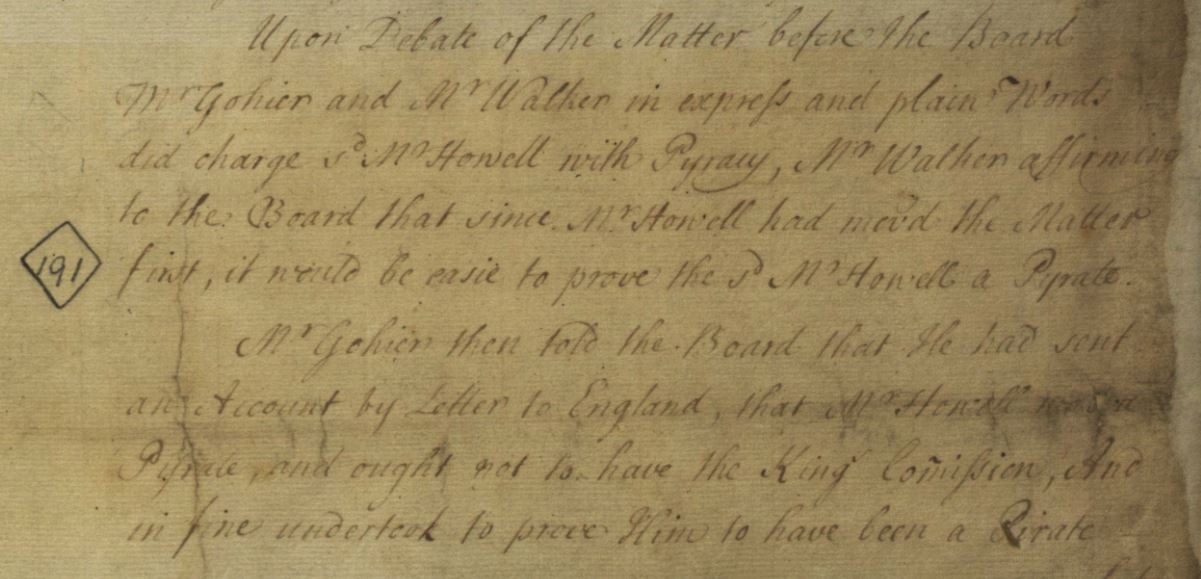
National Archives, London, CO 23/1 (1717-1725), 42 iii, Trial of John Howell, 18-29 December 1721
About the events of early 1717... 300 years ago:

Excerpt from Quest for Blackbeard, pages 306-311 (full trial transcript available in my website's "Pirate Library" ):

Capt. Musson’s kind words in support of former Admiralty Judge Thomas Walker’s alleged anti-pirate stance may have been somewhat forced. The later trial documents of John Howell in late 1721 tell a great deal about the pirates and their families of the so-called “Flying Gang” in 1717. Illuminated was their leader Benjamin Hornigold from Harbour Island, and his local nemesis, Walker, who had later occupied the position of Bahamian Chief Justice under the islands’ first royal governors Woodes Rogers and George Phenney. The evidence reveals that the Walker-Hornigold feud may have been more personal rather than official. While the Walkers had not been directly identified as pirates themselves, they, at least, benefitted from the practice – a legal definition of guilt under then current British law. Walker, in a haphazard attempt to damage a rival’s reputation, had inadvertently incriminated himself.

How a trusted, renowned Irish surgeon and former Councilman for Gov. Woodes Rogers, then serving in the island's Independent Company in Fort Nassau, a man known by many to have been captured by pirate captain Benjamin Hornigold off Florida early in 1717, and forced against his will to endure sailing with the pirate's crew twice, under guard, and well-known by his community to have never taken shares of pirate loot, became accused after three years of royal rule – of all things, piracy – is the question. The trial did not seem necessary, but two members of the governor's council accused him of this “heinous” charge: James Gohier and Thomas Walker, then Chief Justice of the Bahamas. These two angry men even wrote to England demanding annulment of Howell's commission. 


The trial occurred strategically at the change in government from Woodes Rogers to his successor George Phenney. Rogers had returned to England in financial ruin, as he alleged, a consequence of his opposition to piracy. Gov. George Phenney replaced him in November 1721 and was, thus, presiding over Dr. Howell's trial the very next month. 


Other members of the governor's council present for the proceedings were, of course, James Gohier and Thomas Walker, who had taken this opportunity of the change in government to oust their rival. Also present were Walker's son-in-law William Fairfax, Pedro Galfrido Parabow Skynner, Charles Wainwright Carrington, Nathaniel Taylor, Peter Courant, William Spatchers, Senr., Joseph Cookes, and Thomas Wood. Mr. Carrington noted the "charge of a grievous nature" and affirmed its likely truth with "I am the rather persuaded to believe it too true against Mr. Howell."  The testimony of every single witness, however, was overwhelmingly against Carrington's assertion of guilt and an obvious exoneration of Howell. By chance, a great deal of rich detail can be learned about Hornigold’s “Flying Gang” in 1717 and early the next year.
Mr. Gohier, one of the two men who had accused Mr. Howell of piracy presented four witnesses to the court to prove Howell's alleged guilt. The testimonies of Richard Noland, William Howard, Robert Brown, and Pearce Wright, as mentioned, all tended to exonerate Dr. Howell, not condemn him. 


Richard Noland, then "Inhabitant & Mariner of N[ew] Providence," Samuel Bellamy's former quartermaster and afterward, recruitment and financial agent for Hornigold, told the court that "He has known sd John Howell upwards of four Years when belonging to the Sloop Bennet, Beja. Hornigold Comander & Pirate...." Before Noland had joined Hornigold as his recruiting agent, he "then understood from one Pierce Wright Mariner belonging to sd. Sloop Bennet, that He sd Wright together with one William Howard Quartr. Msr. and others of the same Crew [had some months earlier] forcibly [taken] sd John Howell from on board a certain Snow belonging to Jamaica, [Benjamin] Blake Comander, to serve on board sd Sloop Bennet as Surgeon."  Noland, here, was mistaking the sloop Adventure, Hornigold’s former ship and the one he possessed at the capture of Blake’s snow, with the only one that he had known about after April 1717 – the sloop Bennet. He added:

Sd. Hornigold afterward took two Dutch Ships at what Time Mr. Howell was on board Sloop Bennet, But the sd Noland often heard Mr. Howell express a Dislike to the Pyratical Manner of the Living, and knows that sd Howell attempted several Times to escape but was too narrowly watcht, being the only good Surgeon whom Hornigold & Company had Dependance on.

Rd. Noland farther deposd that at the Time when the Bennet & Mary Ann Crew came from Harbour Island to Providence in quest of a Boat each wanting One, The Mary Anne Capt. Bonadvis Crew being very strenuous to take John Howell for their Surgeon; who had left Hornigold and livd then upon the Island, sd. Howell applyed himself to sd. Noland complaining that He would rather serve the English than French, if He was compelld to make choice of Either, Accordingly went with the Crew of Hornigold a Second Time but not without seeming Reluctancy.

Early 18th century map of New Providence Island, the Bahamas


Noland was merely Hornigold’s agent on Harbour Island and not a member of Hornigold’s crew at the time. He could not have witnessed certain events directly – only heard about them after the fact. Noland knew better the activities in the Bahamas where he lived. He provided seemingly damning testimony against his fellow residents Thomas Walker and his son Neal. This testimony was given openly and freely, without much thought of the conflict of interest it implied toward the former Admiralty Judge and Chief Justice Walker:
Rd Noland also observd that during his belonging to Hornigold, He saw one Hogshead of pyratical Sugar put on board a Sloop belonging to Neal Walker, And believes there might have been several More, for afterwards the sd Noland saw four or five empty Sugar Hogsheads on the Shore of a certain Key where Mr. Walker Senr. the present Chief Justice & Father of the sd Neal Walker then liv'd.
Noland indicated that the Walkers had at least traded with Hornigold, possibly through his agent Noland, for pirated goods. These goods had been stored on Thomas Walker’s own land, probably with his knowledge and similar to the actions of Jamaica’s admiralty judge earlier with Jenning’s goods and North Carolina’s officials later with Thache’s. The court then asked whether John Howell had received any share of pirated goods during his time on Hornigold's ship. Noland replied that he only knew of Howell accepting payment for his medical services for the “Cure of a free Mulatto belonging to Hornigold.”  

Benjamin Hornigold's, then Edward Thache's former quartermaster, William Howard testified next. Howard had barely escaped the hangman's noose more than three years earlier in Virginia. He returned to Nassau afterward. Five years earlier, about spring 1717, when Howard served as Hornigold's quartermaster, his boarding party, including Pearce Wright, first captured John Howell, who had since remained on Harbour Island and, later, in Nassau, New Providence Island.
Howard's testimony affirmed Noland's, that he was in charge of the boarding party off the Florida Capes, "with nine others arm'd went on board sd [Jamaican ship of Benjamin] Blake, and thence forced sd Howell with his Medicines to serve on board sd Hornigold."  Contrary to Gohier's and Walker's hopes, Howard proved to be an excellent witness for Howell's innocence. He added:

... that the sd Howell never receivd any Share for any Prize taken; But always entreated the Crew of Hornigold to put Him sd Howell on any Shore where there was any Government... sd Howell desird of H[ornigold] to permitt him to escape, but was not [allowed]. Howard also remember'd that when He and others aforesd. forct Mr. Howell from Captain Blake, that Mr. Howell desird sd Blake to do Him Justice in declaring to his Friends how He was forct. 
William Howard left Hornigold's employ late in 1717, perhaps when Hornigold and Thache briefly served as consorts off the Virginia Capes in October and just before Thache sailed to Martinique to intercept La Concorde or, the later Queen Anne's Revenge, by late November that year. He since served as Thache's quartermaster on QAR, and for which his actions since that time, he was tried by Virginia governor Alexander Spotswood and found guilty. He was barely saved by the king’s extension of an act of grace when he then returned to the Bahamas.

Artist's conception of QAR at Bequia, late Nov 1717

Neither of the next two witnesses were any help to the prosecution. Robert Brown had known Howell the longest, seven or eight years before when they were in Cork, Ireland together. He was on the Adventure when it captured Blake’s snow. Brown attested to Howell’s capture then and that he had never benefited from Hornigold’s piracy, in either of two sorties, as had the Walkers and Thompsons. Pearce Wright then affirmed his part in taking Howell from Blake’s ship. He also said that Howell had never taken prize money from Hornigold or benefited in any way.

After Gohier and Walker’s four witnesses for the “prosecution” had given their testimony, Howell presented his own; William Pindar, Robert Hawkes, Edward Carr, Neal Walker, Peter Courant, Richard Thompson, William Fairfax, Thomas Spencer, William Spatchers, Sr., and Thomas Barnett. These ten witnesses rang a resounding death knell to Gohier and Walker’s case against Howell. 


John Howell lodged with William Pindar on Harbour Island once he realized that Hornigold was not going to allow him to leave to go back to Jamaica, or leave with a recently trading Virginian vessel. Pindar, his father-in-law Thomas Barnett, and Richard Thompson all attested to Howell’s treatment under Hornigold. Pindar told of their near-assault by Bonadvis’s French crew in their home over a gallon of rum, but mostly they came to take Howell with them. Hornigold later toyed with Bonadvis over Howell, yet kept the surgeon for himself. Hornigold told Howell to get aboard his ship, to which Howell suggested that he would mix some medicines for him, but hinted that he would remain at Harbour Island and not go out with Hornigold’s crew on the next sortie. This angered Hornigold, who told Howell, “Get you on board You dog or I will mix your Soul!” 


William Fairfax, Thomas Walker’s own son-in-law, later regarded Howell as a gentleman, always opposed to piracy, whom he had met upon his arrival three years ago with Gov. Rogers. He said that he spoke with…

… sd Howell on board of his Majesty's Ships Milford, Rose, & Sloop Shark whose Comanders, Capt. Chamberlen, Whitney & Pomeroy sd Fairfax perceivd to receive and entertain sd Howell on board as a Gentleman whom they approved of, In a little Time afterwards Mr. Briett Surgeon of the Kings Garrison dying, Mr. Howell was recomended to Govr. Rogers as the fittest Person to Succeed Mr. Briett.
Chief Justice Walker’s own son, Neal, easily admitted to having been on Hornigold’s sloop Bennet. He saw a forced Howell being guarded there by nine of Hornigold’s crew. William Spatchers, Sr.’s testimony, however, accused Thomas Walker and James Gohier of bringing these proceedings for purely political purposes. He said:
… that if Messrs Gohier & Walker had not taken Quarrel wth Mr. Howell when He was One of his Majts. Council & assented with the Dty. Governor & rest of the Council to suspend Mr. Walker from being Ch. Justice for Reasons mention'd in the Council Book, and deeming sd Gohier & Walker otherwise than Friends to the Welfare of the Government, Mr. Howell would not after three Years serving his Majesty in publick Capacity been now accused of Pyracy by [them.]
After several days of testimony, essentially wasted time, an annoyed governor’s council made their recommendations to acquit Dr. Howell. They also demanded that a copy of this trial transcript be sent to England – probably demonstrating to the king the dreadful hypocrisy and malicious machinations of James Gohier and the chief justice. It undoubtedly proved that Howell was earlier justified when he recommended Thomas Walker’s removal from the Council before Gov. Rogers’ return to England. 


--------------------------


http://www.lulu.com/spotlight/bcbrooks


"Quest for Blackbeard" is available on Amazon, Barnes & Noble, Alibris, and other online booksellers. Look for it on my Lulu site at: http://www.lulu.com/spotlight/bcbrooks
 
It is already previewable on Google Books.

baylusbrooks.com