[In the Galaxy Magazine]: I shall not often
meddle with politics, because we have a political Editor who is already
excellent and only needs to serve a term or two in the penitentiary to be
perfect.
- Mark Twain, a
Biography
Also check out: B.C. Brooks: A Writer's Hiding Place: "Quest for Blackbeard" and the "Counterfactual" Politics of the South (bcbrooks.blogspot.com)
Mark Twain’s quote above might well have described the modern Republican Party, which far outnumbers the Democrat Party in criminal indictments and convictions. North Carolina has always suffered from a dominant criminal political conservatism. You might be surprised to learn it began over 300 years ago, first with Barbadians who settled Carolina, and then with Edward Moseley’s criminal “Family” syndicate. Twain was not alone in his assessment. The development of our American democracy in 1776 often brought conservatives and liberals to loggerheads in the attempt to finally realize the “American dream” proposed in the Constitution. We still haven’t reached that point and past historians, enamored with the "Great Men" who dominated our history, have often failed us all!
Carolina politics was an
early example into this uniquely American warfare from within that helped shape
the Civil War. Many battles have been waged within the colony and state – and,
most historians have viewed these conflicts as growing pains – a perhaps divine
push towards progress. Still,
social progress has stagnated and truly, North Carolina politics has not
changed a great deal since Carolina’s founding in 1671. Journalist Rob Christensen viewed
North Carolina as “nuanced, multi-layered, and at times contradictory.”[1]
He may have envisioned Jesse Helms when he wrote the title for A Paradox of Tar Heel Politics. Still,
his thoughts may have drifted farther back in North Carolina’s history to another
man who had as much influence on Tarheel politics in the eighteenth century as
Helms did in the twentieth. Christ’s
Hospital’s “Old Blue,” Edward Moseley easily defined Christensen’s notions of
the Carolina “big boys,” or powerful Carolina conservatives! He came to
Carolina from London, an educated member of an elite family fallen on ill
fortunes. English Moseleys encountered uncomfortable religious discord and liberalizing
political changes in their Tory empire of Stuart England. Edward left to escape
these changes and to seek financial redemption… to build his own empire in a faraway
frontier land of massive real potential!
He was a rare
element of Carolina’s “Family” political syndicate that did not come directly
from a “bedeviled” Caribbean world – a land “beyond the lines of amity” – most originating
in Barbados. Excusing crude methods found unacceptable at home in England, America
offered outcast conservative gentlemen like Moseley the greatest asset that
islanders could only dream about: LAND and massive tracts of it! America was
Edward Moseley’s chance to realize the riches that God had divinely ordained
for all gentleman of his fiscal ideology after England’s so-called “Glorious
Revolution” of 1688 chastised them for their Stuart impudence.
You see, that year,
Protestant Dutchman William of Orange replaced the Stuart king James II,
dispelling almost forever the Tory or
conservative notion of a divine monarch on the throne – Stuarts had one last
hurrah under Queen Anne (1702-1713). Yes, she was the last Stuart, but it
cannot be ignored that her family influenced America the most, for more than
100 years. Edward Moseley attempted to emulate the habits of his ancestors as
they followed Charles I and II and attempted to follow James III in the
Jacobite Rebellions – as any Stuart-loving pirate in America! Moseley would carry
on his own crude capitalist monarchy in North Carolina and helpd create the
political “Paradox” that Christensen saw.
These “land pirates”
– took advantage of a crude swampy wilderness in America from which they might
build their own unique – often aggressive – version of a mercantile Utopic
kingdom. It must have offered everything of which Moseley dreamed because once
he arrived, he never left.
Owing to his duplicitous
self-serving methods, Moseley’s controversial actions were barely remembered
for a century, but his posthumous reputation encountered a renaissance in the defeated
anger of other conservative North Carolinians after the Civil War – searching
for icons, heroes of their own martial political caste. Since this bloody conflict,
North Carolinians have regarded him as a great champion for the state:
Of all the men who
watched and guided the tottering footsteps of our infant State, there was not
one who in intellectual ability, in solid and polite learning, in scholarly
cultivation and refinement, in courage and endurance, in high Christian morality,
in generous consideration for the welfare of others, in all true merit in fine,
which makes a man among men, who could equal Edward Moseley.
---- Hon. George
Davis[2]
While reading this quote, we must keep in
mind that the “Hon. George Davis” of Wilmington was once the Attorney-General
of the Confederacy. He was not referring to the United States in totality, but
to his own “State” (or, perhaps, “country” is the more apt word for Davis’
thinking) of North Carolina.
Most likely, Davis never
believed that North Carolina belonged in the United States, even after the war
– in fact, he surely did not. This same anti-government Christianized ideology
and the veneration of such unlikely heroes dominated Southern Democrats through
that war, the cold war of the Janus-faced“Progressive Era,” right up through
the 1960s and Civil Rights. For these “Great Men” – compared to John Wayne by
one author – “the heroes who best embodied militant Christian masculinity were
those unencumbered by radtional Christian virtues.”[3]
Militant masculinity linked religion with secular conservatism. In 1968, these early
Southern Democrats joined the more comfortably fascist Republican Party. The
Republican Party then adopted a similar white evangelist approach in the “Moral
Majority” and truly devolved as these conservatives attempted to “Rise Again”
and defeat the scourge of Black Power that threatened the master race![4]
The Deep South’s martial
– essentially feudal – ideology was recognized quite early by many British
writers, one who called America the “Commonwealth of Pyrates” in his book as
early as 1724. Englishmen of the eighteenth century and perhaps some today considered
“provincials” or Americans to be as “notorious” as Golden-Age pirates. British
antiquarian Captain J. H. Lawrence-Archer in the nineteenth century wrote that the
young, rebellious, provincial upstart of America was still a pirate or rogue
nation and it was apparent in their Civil War. He offered that the king’s
pardon of pirates in September 1717 “gave an abiding salvo to the consciences
of English desperadoes, (similar to those under the belligerent Federals and
Confederates, in the piratical Alabamas, Georgias, and Floridas lately sweeping
the high seas).”[5]
Like many
ex-Confederates, George Davis elevated a controversial kinsman he then believed
was a “Great Man,” or hero to his “State” or “Country.” The man responsible for
this early fallacious method of inquiry, Scottish historian Thomas Carlyle,
called them “someone who was ‘unmistakably’ sent to earth by God.”[6]
The state’s twentieth-century Southern “redeemer” historiography asserted that the
byzantine Edward Moseley was, as D.H. Hill said in 1906, “always on the side of
the people.”[7]
Hill’s reference did not actually say “against a secular United States Government,”
but most of his ilk intended just that sentiment.
Although redeemer
narratives still hold great sway among popular history in the state, Edward
Moseley’s deeds did not survive as well as others before the Civil War. Then,
he enjoyed a brief resurgence. Afterwards, he was again quickly forgotten and
we must pose the question as to why that happened. What made Moseley such a
difficult subject to explore? What happened to Edward Moseley’s reputation in North
Carolina historiography?
Owing to a
lingering revolutionary fervor that followed 1776, early American historians
tended to elevate their own questionable souls – of course, I’m also thinking
of Samuel Adams and his “Sons of Liberty” – to hero status. Essentially a
terrorist – but, one for our side – Adams’ pro-American crimes were forgotten. Moseley’s
Family also contributed their penchant for conflict to the Revolution. Understandably,
American scholars were enamored with their shiny new country and all of its
founding members – even the proudly felonious ones.
Dr. Hugh Williamson
is considered North Carolina’s first official state historian. One should,
however, hesitate to call him a true “historian.” In reality, Williamson was
trained as a physician, became a soldier, and then a politician. Arguably, he was
not trained for and had little time for history – for truly examining and
studying the past in an objective, meaningful way. He was not taught the
critical discipline of historical inquiry – the proper methods and theories. Most
of these early antiquarians of past recorders and commentators had not, either
– especially those of the American South following the Civil War. Williamson
possessed similar biases to his friends in the Deep South. “Historians” of the
Antebellum Era honed their political polemicism like their Barbadians ancestors
before them – upon the blood and sweat of African and Indian slaves. They
learned to use the stories of the past as a warrior’s tool to buy and sell
people, get someone elected, pass a bill, or destroy an opponent. Like his adopted
Family in North Carolina, Williamson served as a U.S. Congressman and House
delegate to the Constitutional Convention. These types of men demonstrated
perhaps the best fit for Mark Twain’s later impression of the “criminal”
politician. As a political polemicist with a flair for the written word, Williamson
wrote many “histories” of the state that the more astute professional later regarded
as “fake news” – however, most North Carolinians were proud to call him
“historian.” He’s still much quoted today – again – mostly within the state!
The physician,
lawyer, and politician wrote History of
North Carolina, Volumes I and II in 1812, establishing him as the new
state’s official authority on history. Winners write history they say and this
is absolutely true, though the “history” that they generate is artificial, biased,
and invalid. History is supposed to
be the scholarly struggle to seek truth – although it has rarely been used in so
pure a fashion, especially by politicians with an agenda. Williamson’s writing
was carefully sculpted by such agendas and needs of his friends – those in
political power at the time – most of whom were members of Edward Moseley’s
Family.
Williamson typified
the “Great Man” “historian” or antiquarian, as most of those trained in the
historical method will recognize the word. Wealthy and educated – again like
his Carolina gentlemen friends – Williamson came to the state from Philadelphia
to practice medicine in the midst of rebellion and revolution, late in his
career. The rest of this state’s history he had to discern or recreate from
scattered records and friendly tales of blustering hubris he learned over
glasses of brandy with his fellow warriors. He learned grandiose stories of family pride from
conversations in officer’s tents at the battle for Charleston in the American
Revolution. Perhaps he heard a few in the halls of the Capitol building in
Washington, D.C.
North Carolina’s
history has relied upon Hugh Williamson like the history of Golden Age pirates
has relied upon an early eighteenth-century cheap dime novel written by a
suspicious author, sold on docks and street corners in port cities to the few
who could read, and craved a “plucky” tale to pass the time on the Atlantic
crossing. I refer, of course, to “Capt. Charles Johnson’s” A General History of the Robberies and Murders of the Most Notorious
Pyrates, published in 1724. This
book is essentially historical fiction; it makes for great reading, but
contains little if any valid opinions or analysis – simply regurgitated
bravado. Eminent professor of literature Dr. Manushag Powell’s term for this
book is “counterfactual.” Moreover, its author was actually a Jacobite
polemicist newspaper publisher in London named Nathaniel Mist, a man who had
been jailed repeatedly by government authorities – and who needed money to pay
his fines. In other words, Mist was no reputable historical source. As every
writer of fiction, he never used citations to support his tales – to
demonstrate objectivity – to invite critical inquiry.
Like pirate
populists with “Charles Johnson,” we North Carolinians have copied Williamson
over and over and over. We spin it a little this way and that, referring to it as
a valid historical source. Though more cautious today, we have rarely condemned
it in the past, considering it established “truth” on which to build. Remarkably,
his tales have essentially survived unscathed – perhaps we are yet reticent to
give up the “Great Men” of our history?
Gen. Hugh
Williamson’s associations with Edward Moseley’s Family tell the tale. He
befriended Gen. John Baptiste Ashe, Jr. of Wilmington, a nephew of Edward
Moseley and son of a man who once bailed Moseley out of jail. He served in the
American Revolution with Ashe in South Carolina and again in the first two
terms as U.S. Congressmen from North Carolina. He knew Ashe’s family well and
should have regarded his uncle Moseley at least as well as Gen. Ashe, but even he
barely mentions this “incidental” Edward Moseley in his two-volume History of North Carolina.[8]
Even an antiquarian like Williamson regarded the accomplished statesman
Moseley with suspicion. What he dares to say is brief. Moseley’s reputation
must have been “too hot to handle” – even for a conservative gentleman
polemicist! Still, his conservative friends had not yet lost a major war and popular
refutation of their martial slaving ideology!
Perhaps a bit of
light peeked through a few decades later, under a more determined examiner. Reverend
and perhaps more astute and honest historian Francis Lister Hawks declared in
1858 that Moseley was "friend of Carey in his rebellion, the opponent of
Governor Hyde while he lived, and of Colonel Pollock during the [Tuscarora]
Indian war."[9]
The good Reverend Hawks goes on to praise Moseley’s devotion to church affairs
and “patriotic” sense of duty, but intuitively questions his motives.
Hawks was not a
revisionist, a redeemer, or even sympathetic with the Confederacy. He wrote his
history before the Civil War. Even
though he was from New Bern, he lived most of his life in Connecticut and New
York. He was not inclined toward the latter Southern redeemer polemics or “fake
news.” And, he was certainly no friend of Gen. Hugh Williamson.
Hawks accurately accused Williamson of being an amateurish historian,
often giving “no reference at all” for his arguments “as was his habit.”[10]
Hawks appeared to admirably rely upon primary evidence for his conclusions –
colonial records he studied on his trips home. Hawks saw Moseley much differently
than North Carolina’s traditional historians: Hugh Williamson, George Davis, or
James Franklin Shinn, the first to brave a short essay on Edward Moseley in
1899. Hawks accurately regarded Moseley as “Hasty in his temperament and
resolute in his purposes, he unquestionably, in his moments of excitement,
sometimes overstepped the limits prescribed by a sound discretion, and made
himself more vulnerable than became a man of his talents and attainments.”[11]
He also averred that the records showed “no better impression than that he was
a factious man of acknowledged ability, who could find little use for his
talents save that of stirring up strife and encouraging contention for ends
purely selfish.”[12]
Still, the kind and forgiving reverend yet added, “We do not think this was his
true character.”[13]
Hawks’ publication,
again, preceded the civil struggle. Two
years later, the defeated state grew hardened and bitter. History became an
even more pointed weapon, an acrimonious and spiteful tool of political revenge.
The political cyclic nature of North Carolina history during the post-war era almost
never strayed from the right side of the political spectrum. Its ahistoric monarch
– defeated, but not forgotten – remained seated upon a battered throne, patched
back together and re-gilt with “Lost Cause” revisionism and more blatant lies.
During this time of Southern conservative political dominion, the academic
discipline of history well-represented by men like Francis Hawks faded. It was
replaced by Williamson’s original state-glorifying brand, like that of John
Baptiste Ashe’s descendent Samuel A’Court Ashe, or Waddell, or of many others whose
biased rhetoric demanded no argument or criticism, much like today’s Fox News.
In this vengeful martial atmosphere, historical truths became malleable objects
of stubborn opinion – not fact, but “alternative fact,” or Dr. Powell’s
“counterfactual.”
Researchers found
that they had to be cautious with Moseley. He did not attain such “Great Man”
status until well after 1865 and even then, his reign during the post-war
Progressive Era was short. This caution was a complex thing to understand. Moseley
reached “Great Man” status artificially; his misdeeds, greed, and war-profiteering
left a bad taste in the mouths of even American historians before the War
Between the States. His careful criminal methods, however, were not considered
quite so distasteful for the losers of the South after that Civil War. These
men were eager to redeem their heritage and for “Great Men” and other heroes to
defend their “Lost Cause.”
The Carolinas adopted
their uniquely Stuart/West-Indian conservative style well from their Barbadian
ancestors. This autocratic style later transmitted across the Deep South.
Indeed, Carolina was the heart and cradle of the Confederacy. One might expect
anyone associated with Carolina’s early growth to figure prominently in Confederate
redeemer history as well.
In confident
contrast before and after the Civil War, the ex-Confederate George Davis of
Wilmington – lately, the Attorney General of the Confederate States – suddenly
crowned the forgotten Edward Moseley as a man of “scholarly cultivation and
refinement.”[14]
William L. Saunders, alleged leader of the Ku Klux Klan – first man to take the
fifth-amendment in a Congressional hearing and editor of the North Carolina Colonial Records –
declared Moseley’s “undying love of free government, and his indomitable
maintenance of the rights of the people.”[15] One might
wonder to which “government” Saunders had referred: the Union or his formerly
defeated Confederacy. Saunders had read the colonial documents. He knew the
details in them; the former Confederate soldier-turned politician simply used
their words to formulate his own redeemer narratives. Secretary of the
Historical Commission, Robert Diggs Wimberly Connor’s Makers of North Carolina History agrees with Saunders and flatters
Moseley to the point of incredulity.[16]
Conner, in his History, elevated
Moseley to North Carolina’s historical “Swamp Majesty,” writing “For forty
years Moseley’s biography is practically the history of North Carolina.”[17]
He also said that few could deny this fact. “Those who did not hate him adored
him,” continued Conner in the arguably Fox News fascistic tone of Tucker
Carlson, “An aristocrat by nature, he was a [Southern] democrat by convictions
and in practice.”[18]
Historian James
Franklin Shinn wrote “Edward Moseley: A North Carolina Colonial Patriot and
Statesman” in the Publications of the
Southern History Association in 1899. This was largely another revisionist
version of Edward Moseley’s life, again depending strongly upon George Davis,
who erroneously believed the British Moseley hailed from Princess Anne County,
Virginia – in the old capital of the American Deep South – not Britain! Shinn
also erroneously argued that Moseley must have lived in Barbados – the original
origins of Carolina – for a while before coming to North Carolina. Overall,
Shinn defended Moseley, as did Davis, asserting “his good name is seriously
damaged only by the obscurity which has lasted too long.”[19] Davis, in
this line, spoke directly to historian Francis Lister Hawks, who famously
described Moseley’s aberrant behavior in 1858.
All this sudden praise
for Edward Moseley! Still, no one then, or even later, bothered to write a full
biography of the man. Odd, isn’t it?
Here, we encounter
a twisted, confusing anomaly of our political language. This “democrat” to whom
Conner refers was no Democrat of today. Ex-slaving “Southern Democrats” share
nothing in common with the South’s disdainfully-viewed “party of African
Americans” of today. Southern Democrats were highly socially conservative
people of the early twentieth century. They had once enslaved the African, yet wanted
“God” written into their Confederate Constitution. Their anti-government
Republican cousins of today wanted the federal government “drowned in the
bathtub,” as Republican lobbyist Grover Norquist so ineloquently phrased it.
They were certainly not the “party of African Americans” of today with whom Democrats
are presently associated – indeed, quite the opposite. Their glorified yet defeated
Confederacy defiantly resisted social amalgamation into the Union like
Republicans today threaten democracy. Their anti-government rhetoric then more
ideologically reflected the recent so-called “Moral Majority” evangelicals of
Jerry Falwell or today’s anti-democratic Ku Klux Klan, Tea-Party, America
First, or MAGA (Make America Great Again) seditionist Republicans who attacked
the Capitol on January 6, 2021! Politicians in North Carolina seem to have
always hidden their fascist, undemocratic ways behind contradictory labels – again, Christensen’s Paradox.
Republicans of
today – like Southern Democrats of yesterday – would have been quite fond of
the controversial Edward Moseley. Still, not quite fond enough of Moseley to
admit it openly and embarrass themselves. “Possessed of vast estates, of many
slaves, and of great wealth,” again continued Conner of Moseley, as if
describing a venerated scion of the Mint-Julip-drinking anti-government
Confederacy, “a devoted Churchman,” like Falwells “Moral Majority,” he
“espoused the cause of dissenters in their fight against the establishment.”[20]
Segregationists –
advocates of keeping blacks and whites apart – in North Carolina usually spoke
fondly both of God and slavery – often in the same breath, as though their god
would approve of their inhumane and unchristian practices. Arguably, this is the
way Conner envisioned his defeated Confederacy. Conner poured out “Lost Cause”
veneration for Moseley’s wealth and power that literally dripped with worship. And,
he asserted States-Rights ideology in his praise. He compared Moseley to great leaders,
with “the boldness of thought and of action that people admire,” and “common
sense and self-poise… and the honesty of purpose which, regardless of his own
interests, made it impossible for him to wink at the usurpations of authority.”[21]
Conner glorified Moseley’s wealth, rebellion, anti-government ideas, and
slavery in a full page and a half of lionized worship – some 40-50 years after
Robert E. Lee’s surrender! Indeed, Moseley and his Family wholly embodied the Southern
Democrat’s political point of view with the unspoken caveat of the desire to
“rise again.” And, with the establishment of segregation in Plessy v. Ferguson in 1896, the
paradoxically-named “Progressive Era” began. The second iteration of the Ku
Klux Klan came about in 1915 and numerous statues were erected on courthouse
grounds and other government property across the entire South and beyond!
Undeniably,
Southern Democrats had given rebirth to their Confederacy – it had, indeed, “risen
again.” Historian Heather Cox Richardson even declares as much in her book How the South Won the Civil War: Oligarchy,
Democracy, and the Continuing Fight for the Soul of America! And, Edward
Moseley finally became recognized as a hero – still, no biographies. The only
thing that North Carolinians remember of his accomplishments is his famous map
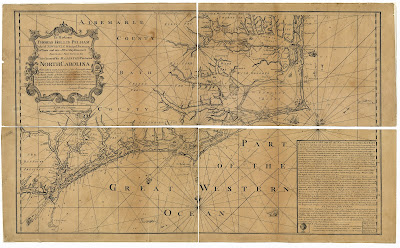
of 1733! We all love the map![22]
Moseley’s reputational
resurrection continued to encounter difficulties. Most historians and even
those who knew him best – his Family – always remained cautious and slack on
detail. Williamson, Davis, and Conner, like Republican propagandists today,
spouted praise, veneration, and sickly-sweet rhetoric – few words of actual substance.
Even his own family tended to ignore him or mentioned him only in passing. Confederate
captain Samuel A’Court Ashe, grandson of Governor Samuel Ashe and a
great-nephew of Edward Moseley, in editing the Biographical History of North Carolina, included three generations
of the Moore side of the family. Yet, he neglected to include his great-uncle,
Edward Moseley in his list of one hundred prominent men of North Carolina. Still,
Moseley literally drew the geographical boundaries of Ashe’s home state! Assuredly,
his contemporaries would have placed the capable surveyor and statesman Moseley
high on that same list – but, these men had been politically and militarily
beaten and relied solely upon polemics to get beyond that defeat. They dare not
elevate Moseley too highly or risk someone rereading Francis Hawks’ History, thereby losing their base![23]
Cape Fear author James
Sprunt, writing in 1906, speaks of Moseley’s famous map, but diverts around his
significantly criminal contributions to the development of Lower Cape Fear. Why,
certainly, did even James Sprunt not speak of him? Was it because Sprunt also
understood the criminal methods used by Moseley and his Family to gain
prominence and steal massive tracts of land in the Lower Cape Fear?
After the
Progressive Era, the political landscape changed once again – through economic
destruction and utter despair. Excessive capitalistic cycles broke down through
three consecutive Republican administrations. Finally, with Republican
President Herbert Hoover’s attacks on World-War I “Bonus Army” veterans and
Robber Barons’ abuse of the Federal Reserve and the gold standard brought on the
resulting Great Depression of 1929. Modern Democratic President Franklin Delano
Roosevelt took office after Hoover and dealt the “New Deal,” restoring public
confidence. This was despite another rebellion – an oligarchic and fascist
attempt to overthrow his presidency in the “Business Plot of 1933” – even
before Nazis came to power in Germany![24]
After the failure of wealthy capitalists in this first fascist insurrection, they
then preferred the former, long-established status
quo and Congress helped them by letting this history quietly fade into
oblivion. Franklin Delano Roosevelt’s “New Deal” established social programs to
help the majority of Americans and the country breathed a sigh of relief. This
compares to President Joseph R. Biden’s work to fight the Covid Pandemic and once
again save America from the second fascist attempt by Donald Trump to overthrow
the United States’ government on January 6th, 2021! Also comparable
to FDR’s democratic work were the more egalitarian “Society” of the Quakers in
the Albemarle during the Cary Rebellion, or the establishment of British royal
control through the duke of Newcastle in the Brunswick Settlement in the Lower
Cape Fear.
Federal Socialism
didn’t stop with Roosevelt, for the people enjoyed their Social Security – the constitutional
effort of “promoting the general welfare” of the people. Surprisingly, a
Southerner, Lyndon Baines Johnson – though perhaps not a true “Southern
Democrat” – accelerated it forward with Civil Rights in 1964, Voting Rights and
Medicare in 1965. Johnson has incurred conservative’s verbal wrath ever since. Civil
Rights dealt yet another blow against the “Old South’s” formerly segregationist
fascist regime and the Wealthy Industrialists of the North who liked cheap
labor and their old factory towns. For the old Southern Democrats, however, this
betrayal of Johnson’s resulted in great political realignments and more
“paradoxical” behavior.
Confederates, or
Southern Democrats, traded that now-despised name for one that better reflected
their ideology and mood, the rhetorically cleaner – and much more conservative
(after Civil Rights) – “Republican.”
“Democrat” remained with those who championed egalitarianism, democracy,
socialism, or the rights of all the people. African Americans – with the new rights
of a finally-growing democracy – then gained the same power as their former
masters! This later term “Democrat” this time better fit the proponents of
democracy, don’t you think?
We then elected our
first African-American president to two terms. In this fresh cycle of progress,
the revived democracy and their truly progressive social views rose to the top
again. Again, working Americans nearly triumphed over the wealthy and powerful
“Great Men” who once suppressed our democracy and ruled our history from their
gilt political thrones.
Still, the old Stuart-Tory-conservative
regime did not quietly acquiesce under a progressive pounding. Redeemers were again
determined to “rise again” and they fought back in the next administration.
They flared their nostrils like the Family did on the west shores of the Cape
Fear River in 1733. Again, white-supremacists had just another racist reaction
to our first African-American president. This time, however, they are essentially
destroying what remains of their political reputation. MAGA and Q-Anon use
blatantly ridiculous rhetoric, insanely waiting for the rising of the dead to
come back and lead them against the oppressive government! Ironically, these
conservatives trashed the reputation of their new designation of “Republican”
as they had their old “Southern Democrat.” They exhibited no less than a childish
tantrum and attempted another fascist insurrection, 2021 is 1933 like 1733,
like 1708! The hits just keep coming!
Thus, stories of
this nature can be told once again – social and economic progress and equality
may be advanced once again. North Carolina enters that older, nascent realm
once again – before the Anglicans came – before the rich slaving Barbadians
came – before the Confederates came – before their ideological friend Edward
Moseley came.
This is the history
of our struggle as a democratic people, North Carolinians and all Americans –
the cyclic high-low process of reflection and repression. The parodoxical
politics have a great deal to do with changing demographics – the descent from
“white-dominated” or master-slave power dynamics. Truly inspirational, “Moral
Mondays” has become a new phrase in our daily vocabulary, like “Me Too” or
“Black Lives Matters (BLM).” North Carolinians of the 99% are again rising up
and revolting against their wealthy capitalist “betters.” Truly inspirational! It
can happen, even here, in the merciless Stuart conservative Paradox of the “Old North State.”
Conservatives like
Edward Moseley may now be critically examined once again. “Great Man” historical bias can be pushed
aside once again. We can openly examine Moseley’s crimes – learn why he was
ignored before – and, why the reticence to write his biography! “Quakers” are his judges this time!
If history serves
any profound purpose, it is this – to inform and reveal humanity’s weaknesses,
faults, passions, and potentials. History should never be used to support fascist, anti-democratic attributes –
indeed, Nazi Germany’s Adolph Hitler’s book-burning tactics gave us a clue. History
repeats itself only because we fail to learn from it – we miss its lessons. It
very often becomes the tool of the politician, especially in early paradoxical
North Carolina, as journalist Rob Christensen viewed it when he wrote the often
humorous and yet, revolting A Paradox of
Tar Heel Politics.
Aside from
conservative redeemer politics, part of the state’s Moseley problem lay in his completely
befuddled origins. Again, no definitive work to date – until now – has ever
been produced about the controversial treasurer, surveyor-general, proprietor’s
deputy, member of the governor’s council, even briefly acting-governor Edward
Moseley. Nineteenth-century political rhetoric forced reality into near
intellectual oblivion![25]
Such an important historical
figure as Edward Moseley, having held numerous offices and producing maps of
such value, forming the shape of the state we know today, one should expect numerous
historical works devoted to him. Still, none
have emerged, certainly none of any length.
Few historians dare
to enter this miry, murky, and mysterious political swamp of North Carolina’s
early history. Voluminous extant primary records still reveal Hawks’ “factious
man of acknowledged ability” quite unlike the man described by politician
Davis, or historians Hill and Conner.[26]
This book follows that deeply-explorative new direction despite whatever actual
or imaginary dangers may be lurking in the swampy conservative political waters.
Hopefully, there’ll be no flying flagpoles or fire extinguishers.
Moseley was not the
glorified figure presented by revisionists and redeemers and it must be said!
Myth must be dispelled! John F. Kennedy Jr. will not come back to life, no
matter how many Q-Anon cultists march in the streets of Dallas, Texas!
Unquestionably, almost
the day young Edward Moseley arrived in North Carolina, he began irritating his
colleagues, presuming undeserved authority, and catalyzing rebellion. He was
young and perhaps impetuous – but also a privileged narcissist who fled to
America to find treasure – to rebuild his formerly-wealthy family’s failed
finances. He was an educated, but inexperienced opportunistic London youth that,
at first, was outmaneuvered by his betters – yet, he enjoyed the opulent gilt
trappings of his Anglican church. Truly, Moseley was a talented and
opportunistic politician. He played both sides when it gave him advantage. He
left few writings of a personal nature. His will of 1749 and several maps and
sketches are all that survive of an intelligent, yet greedy, careless, and
socially-irresponsible man.
Moseley’s
contemporary hometown bard, John Milton described “Satan” in Paradise Lost as a fallen angel who
values earthly treasure over all other things.[27]
Of course, posterity seldom looks favorably upon a follower of Mammon, greed,
or… “earthly treasures.” It could be that in the wilds of early North Carolina,
such a conservative gentleman and Mammon devotee from London might capitalize
upon resources so effectively and attain such regal status so quickly – as well
as the condemnation and reserve of many an historian.
[1]
Rob Christensen, The Paradox of Tar Heel politics: the Personalities, Elections, and Events
that Shaped Modern North Carolina (Chapel Hill, N.C.: University of
North Carolina Press, 2008), 4.
[2]
D. H. Hill, “Edward Moseley: Character Sketch,” The North Carolina Booklet, Vol. V, No. 3 (Raleigh, N.C.: North
Carolina Society - Daughters of the Revolution, July 1905), 202.
[3]
Kristen Kobes du Mez, Jesus and John
Wayne: How White Evangelicals Corrupted a Faith and Fractured a Nation
(Kindle version) (Liveright Publishing, 2020), 10.
[4]
Oh, they warned us. They did. I’m sure you’ve seen the bumper stickers,
t-shirts, and patches. As a young boy growing up with family in the Lower Cape
Fear, I possessed some of these prideful paraphernalia myself – even had a
Confederate flag once! But, I grew up, studied my family’s history, and
discovered Christensen’s “Paradox” on my own. I always felt when driving from
Fayettevile, where I was born, to Pender County where my mother’s family lived,
that there was a subtle, but definite difference to that region.
[5]
Captain J. H. Lawrence-Archer, Monumental
Inscriptions of the British West Indies (London: Chatto and Windus, 1875),
6; Nathaniel Mist, writing as “Capt. Charles Johnson” in A General History of the Robberies and Murders of the Most Notorious
Pyrates (London: 1724).
[6]
https://thedecisionlab.com/reference-guide/anthropology/great-man-theory; According
to the early-twentieth century and now-defunct “Great Man Theory,” great
leaders are born, not made. Leadership traits are inherent and cannot be
learned. Great leaders come forward when they’re most needed, in order to
become the foundation upon which history is built. Essentially, according to
the Great Man Theory, people in positions of power deserve to lead because of
characteristics granted to them at birth, which ultimately help them become
heroes.
[7]
Hill, “Edward Moseley,” 204.
[8]
Hugh Williamson, The History of North Carolina, Vol. 1 and 2 (Philadelphia: Thomas Dobson, 1812).
[9]
Francis Lister Hawks, History of North
Carolina: with maps and illustrations, Volume 2 (Fayetteville, N.C.: E. J.
Hale & son, 1858), 556.
[10]
Francis Lister Hawks, History of North
Carolina: With Maps and Illustrations, Vol. I (Fayetteville: E. J. Hale and
Son, 1858), 143.
[11]
Hawks, History of North Carolina, Vol. 2,
358.
[12]
Ibid., 359.
[13]
Ibid.
[14]
George Davis, Address Delivered Before
the Two Literary Societies of the University of North Carolina, June 6, 1855 (Raleigh: Holden and Wilson, “Standard
Office,” 1855), 18; D. H. Hill, “Edward Moseley: Character Sketch,” The North Carolina Booklet, Vol. V, No.
3 (Raleigh, N.C.: North Carolina Society - Daughters of the Revolution, July
1905), 202.
[15]
American Historical Association, “Annual report” (U. S. Government Printing
Office, 1896), 197.
[16]
R.D.W. Connor, Makers of North Carolina
History (Raleigh, N.C.: The Thompson Publishing Company, 1911), 38-50.
[17]
Robert Diggs Wimberly Conner, History of
North Carolina, Vol. I (), 94.
[18]
Ibid.; This hinted at Fox News’
fascist tendency to elevate nationalism while quelching criticism.
[20]
Ibid.
[21]
Ibid.
[22]
Heather Cox Richardson, How the South Won
the Civil War: Oligarchy, Democracy, and the Continuing Fight for the Soul of
America (Oxford University Press, 2020).
[23]
Biographical History of North Carolina:
From Colonial Times to the Present, ed. Samuel A’Court Ashe, Stephen B.
Weeks, and Charles L. Van Noppen (Greensboro, N.C.: Charles L. Van Noppen,
1905).
[24]
See… Jules Archer, The Plot to Seize the
White House (New York: Hawthorn Books, 1973).
[25]
James Sprunt, Chronicles of the Cape Fear
River (Raleigh, N.C.: Edwards & Broughton Printing Company, 1916); Noeleen
McIlvenna, A Very Mutinous People: The
Struggle for North Carolina, 1660-1713 (Chapel Hill, N.C.: University of
North Carolina Press, 2009); Stephen Feeley, Tuscarora Trails: Indian Migrations, War, and Constructions of Colonial
Frontiers, Volume 1, Doctoral Dissertation, College of William and Mary,
Department of History (May, 2007).
[26]
Francis Lister Hawks, History of North
Carolina, Vol. 1: Embracing the period of the proprietary government, from 1663
to 1729 (Fayetteville: E. J. Hale & son, 1859), 359.
[27]
C. G. Herbermann, E. A. Pace, C. B. Pallen, T. J. Shahan, and J. J. Wynne,
editors, The Catholic Encyclopedia: An
International Work of Reference on the Constitution, Discipline, Doctrine, and
History of the Catholic Church, pg. 580; "Mammon" by Hugh Pope.
The Encyclopedia Press, New York, 1913.
[28]
See “Mammon” and its importance to early 18th century capitalism in
John Francis, "Chronicles and Characters of the Stock Exchange"
(1849), in The Church of England
Quarterly Review, Vol. XXVII (London: William Edward Painter in the Strand,
1850), 130-131.