Donate to Brooks Historical

Showing posts with label slave. Show all posts

Sunday, April 05, 2026

Deep South “Piracy”


Most shockingly, but unsurprisingly, paired with the new practice of capitalist “piracy” or crime was the continuation of West Indian slavery, plantation production, and its accompanying Herrenvolk, or master race ideology. Southern agricultural capitalists and their “god of the slavemaster” disdained even the thinnest veil of morality in favor of personal profit. Edward Kimber’s accounts appeared in the pages of the London Magazine in the 1740s. He toured through and commented upon the rough American colonies and their crude methods. He pictured slavery in the form of an African "under the Torture of the Whip, inflicted by the Hands, the remorseless Hands of an American Planter.”[1] The report of Brown University’s Steering Committee on “Slavery and Justice” found that “Of the ten million or so people who crossed the Atlantic before 1800, about eight and a half million – roughly six of every seven people – were enslaved Africans.”[2] The transfer of African peoples and culture grew immense. Sugar, slaves, piracy, and American capitalism evolved in an even deeper sea of bloody, fundamentalist religious, slavery-supporting rhetoric designed to salve the soul - to justify the self-inflicted horrors that kept them up at night. They created the white-supremacist “god of the slavemaster.”

Only the most foolhardy, arrogant, and durable souls would brave disease, the sea, weather, and heat in such a rough and deadly business. Also, it was immensely more profitable than any venture yet tried. It proved the pecuniary value of ignoring morality which encouraged even further separation from England and English tradition – including the god they claimed to worship. This also encouraged a virtual separation from traditional Christian virtues, especially the hated Catholicism of old Europe.

Human nature devolved into something less than compassionate, natural and friendly. Instead, through demeaning rhetoric, it became seen as inherently greedy and self-serving. This delusion supported merchants’ needs for capitalization of these slaves and their work. Primarily Southerners believed “Inherently lazy, listless” people, especially slaves, deserved to be frightened into productivity.[3] Social underlings must “pull themselves up by their bootstraps” to succeed or die trying. Indeed, wealthy American merchants became cynical of their own species by way of tautological and religious justification for their own convoluted immoral methods – the vengeful Old-Testament “god of the slavemaster” reigned supreme in the South. One might think that all of American society – both young and old – continuously warred with one another – fighting for profit! And, it would take many lives over the next century and a half!

The lines separating America from Britain grew into a wall with thorny vines growing densely upon it and filling the remaining holes – surrounded by Donald Trump’s alligator-filled moat and topped with spikes! Americans would fight to maintain their unique culture on their side of that wall – imperialistic and warlike – ideological royal domain of the Western Hemisphere established by the “Monroe Doctrine,” similar to the earlier Carolina charter of 1665. The isolationism, a war of radical liberal versus “godly” conservative ideology, Whig vesrsus Tory, progressive versus fixed, began at this point. And, as if warned by South Carolina’s John Routledge in 1789, the ideologically similar “War Between the States,” existed since the founding of Carolina and would never quite be decisive – a continuous war between Americans. The days of old Stuart or West Indian values, indeed the values that built early colonial America and continued in the Southern United States, fortified in the Confederate States of America of the 1860s, would remain until the present, converging with Republican Party conservative interests in 1968. America could neither quite be brought to heel by her mother, nor by themselves, always at each other’s throats like unruly spawn fighting over religion, slaves, and states’ rights. Roughly half of Americans found the old ways too severe. More northern colonies had the weakest connection to the brutal and feudal West Indies plantationists; thus, the old Stuart ideology was best exemplified and reified in the Deep South. Society there descended directly from the Stuart-born West Indian ideology of Barbados, “an oligarchy of acquisitive, ostentatious plantation owners” who modeled Carolina after Barbadian society.[4] It proved a stubborn and persistent presence.

Inferring a West Indies connection to Carolina and Deep South culture, historian Richard Dunn said, “I believe that a social analysis of Barbados and Jamaica, circa 1670, does tell us something about the Goose Creek men and the thrust they imparted to South Carolina.”[5] Furthermore, Lindley S. Butler ominously surmises that “The turbulent Carolina proprietary era covers the fascinating first century of North Carolina’s history, its formative years, and sets the course for the colony and state over the next three centuries.”[6] Carolina, as the mother of the South, spread this same ideology throughout southern America. Slavery and piracy wove themselves indelibly into the fabric of our nation like a chronic violent disease.

The days of proprietary or private corruption lingered, continuing Stuart days of imperialism. Plantationist Confederate land barons embraced this same martial ideology in the Civil War and fired upon Fort Sumter to announce their decision to fight their “brothers” and “sisters” for it. They enjoyed smaller local control over larger federal control in a loose confederation of the early British colonies – at one time seen as separate “countries.” The South eschewed isolationism from the start – even before the Revolution. The Civil War saw resurgence of these martial independent ideals in the Confederacy, finally ending in their “Lost Cause” from which they claimed they would “rise again” against the hated Yankees of the North. Essentially, they attempted in that war to derail progressive radicalism in the form of abolitionism, establish a god-centered government, and protect their lucrative business of slavery. Compare these ideals to those of Jacobites of 1715 and the Republican Party since Richard Nixon’s “Southern Strategy” to bring in more Republican voters in 1968! Like their Jacobite ancestors who fought against a foreign “Dutch Dog” of a liberal king, the Confederacy literally betrayed the United States, commited true treason – as allowed by the U.S. Constitution – colluded with foreign governments, and killed 600,000 Americans. These people were sacrificed to preserve that immoral, yet highly profitable way of life – some say the figure was as high as 800,000! Make no mistake, despite the rhetoric of a god-centered Confederacy, the South attempted to maintain their immoral rights to enslave other human beings simply for profit! Moreover, wealthy Southern plantationists prosecuting the war were willing to kill more than half a million people to keep that right. They used their “god” to justify it all! This bit of capitalism was certainly not in its finest moment – if indeed it ever had one.

After losing the American Civil War of the mid-nineteenth century, unrepentant ex-Confederates politically opposed Reconstruction or reform efforts, vowing to “rise again.” Of course, not all Southerners can be blamed for this crime – the 97% merely followed the lead of their “betters,” the 3% wealthy elite – they deserved most of the blame. Their vengeance centered primarily upon profit loss on their plantations and the loss of slaves – indeed, considered their property! After incurring this perceived injustice against their property rights and losing their economic dominance, neo-Confederates following the war resisted any change – often out of spite. This “Lost Cause” desire affected civil rights of ex-slaves and installed racial segregation with Plessy v. Ferguson in 1896. More directly and ominously, it initiated the resurgence of conservative rule in North Carolina of 1898, resulting in the only coup d’etat in United States’ history, led by a former U.S. Congressman! Wilmington’s Alfred Moore Waddell and his allies fought to prevent the horrifying enforcement of “Negro Rule,” as they saw it, heavily enforced upon a stubborn South, with their greatly wounded feudal pride. Plantationists sought a redress of grievances to cure its wounded elite socially conservative ideology – against another perceived invasion at the hands of federals and liberal abolitionists – England come again! The Herrenvolk or master-slave mentality had been too well established, first in the West Indies, and later in the plantation South for them to ever seriously entertain a moral alternative. Again, the wealthy plantationists perpetrated this crime – not the general populace.[7]


[1] Edward Kimber, Itinerant Observations in America, ed. Kevin J. Hayes (Newark, Del., 1998), 49.

[2] Brown University Steering Committee on Slavery and Justice, Slavery and Justice, 7.

[3] Ralph E. Luker, The Social Gospel in Black and White: American Racial Reform, 1885-1912 (Chapel Hill: University of North Carolina Press, 1991), 120.

[4] Woodard, American Nations, 82.

[5] Richard Dunn, “The English Sugar Islands and the Founding of South Carolina,” South Carolina Historical Magazine, Vol. 101, No. 2 (April 2000), 143.

[6]Lindley S. Butler, “Proprietary North Carolina: Politics, Shipping, and Pirates,” Queen Anne’s Revenge Shipwreck Project: Research Report and Bulletin Series, QAR-R-07-03, August 2007 (Underwater Archaeology Branch, Office of State Archaeology, Department of Cultural Resources, State of North Carolina), 5.

[7] For more on this period of American history, see LeRae Umfleet, A Day of Blood: the 1898 Wilmington Race Riot (Raleigh: North Carolina Office of Archives and History, 2009).

Monday, June 08, 2020

La Gazette Pirate References - 1720


p. 45-46:

From London, January 18, 1720

We heard from Harwich that on the 15th & 16th, two Transport Vessels, on which eight hundred Dutchmen had embarked, had sailed, and that the preceding days, six hundred others had left on other vessels, en route to The Netherlands. Two ships of thirty guns order to go against the Corsairs [Pirates], who continue to disturb trade in the Colonies of America & the Coast of Guinea, where they appear in greater numbers than ever. They burned several takes they made, & we learn from letters from Barbados, that they looted or burned forty English Vessels of this Colony & other neighbors, & twenty on the coast of Guinea, from different Nations . According to the latest advice from this country, Captain Maxwel, who passed from old Calabar to Virginia, having on board a hundred Negros, had been taken near Isle of Cariscoe [Corisco] by three of these Pirates [almost certainly Olivier LeVasseur, Jeremiah Cocklyn, and Richard Taylor]; that they had taken him to serve as their Pilot; and having learned that two ships from London and one from Bristol had gone to the neighboring coasts to buy Negroes, they had sailed from this coast, and had taken them, as well as another vessel from Glascow. They have since made their way to the Gold Coast, & according to the report of Captain Maxwel who fled at night in a Rowboat, their intention was to go cruising towards the Cape of Good Hope, to await the Vessels returning there from East Indies. In the last sessions of the Justices of the Peace, it was ordered to the Connestables or Commissars of the districts, to have the Loix enforced against those who have seditious libels, or who sing insolent songs in the streets.


p. 214:

From London, April 25, 1720

The Duke of Shandois & others, Bought, the Patent of the Company of Africa, for two hundred and fifty thousand pounds sterling. We learn from Virginia that the Pirates started their races again, and that they had taken two Bristol Ships.


p. 227:

From London, May 2, 1720

The letters from America and the costes of Africa are known that the Pirates continue to make great disorders there, ransoming or plundering almost all the merchant ships they meet, & even attacking some of them under the cannon of the Forts. Several highway robbers have been executed to death here and in the Provinces, but thefts are very frequent.


p. 370-371:

From London, July 25, 1720

[excellent context:]
The Directors of the African Company wishing to restore their trade which was considerably diminished by the losses which the Pirates caused him to suffer there, made equip ten ships, to send there, besides the two warships of fifty piece of cannon that the Lords Justiciers granted them. The purpose of the Company is to fortify the ports where it has trading posts, & to put them out of insult, because their buildings were not there in rage, & to make a new establishment in the river of Gambia, ten leagues or so from its mouth, hoping by this means to attract the principal trade in elephant teeth, gold dust, and other merchants of the country, with the Cafres [of Southeast African origin] on the continent. She sent for this purpose a large number of all strong laborers, and quantity of materials, in addition to two hundred soldiers divide into four Companies each commanded by a Lieutenant, who will enter in garrison in the Fort which it is intended to build there . The Lords Justiciers having examined the project sent from Ireland, to establish in Dublin a Bank similar to that of England, had approved it: but on the admonitions which were made to them of the prejudice that this one could suffer from it, they have suspended the execution of the project until further notice. Some ships have arrived from Virginia, and others are expected to load tobacco and other country goods. We learn that the Pirates are causing disorder every day, & that the Spaniards have recently taken an English Vessel, because the suspicion of all hostilities, was not yet published in this country. The East India Company has made the sale of the goods which are loaded with the last Vessels which make them arrive, and it has been about seven hundred thousand pounds sterling, instead that above it was much stronger. We attributed this decrease to
little debit that the painted canvases and other manufactures of the Indies had, which the Merchants had obliged to give at low price, because of the Acts of the last Parliament. Notwithstanding the penalties imposed by the last Act of Parliament, highway robbers continue to cause a great deal of disorder: some of their leaders have been arrested, they have declared their accomplices, who are being researched. The Actions on the South Sea Company are today a thousand miles away.


p. 382:

From London, July 29, 1720

... The Directors of the Africa Company having resolved to establish a new dwelling in the Gambia river, ten leagues or approximately from its mouth, must send workers there incessantly, to build a fort there which can put the costes under cover from pirates who take a lot of it, we have even learned recently that they had taken three English Vessels, of which the Officers and the Sailors had been made slaves. On the assurance that the Resident of the Czar in this Court gave the Merchants that they could send their Vessels to the ports of Estats du Roy his Maistre, & traffic freely there, they sent several of them to Russia, & they ship goods every day for these countries.


p. 406-407:

From London there on August 15, 1720.

... The Merchants learned that the Pirates had kidnapped several of their Vessels in the Gambia river, which caused them great losses. They hope that the warships that the Government has granted to the different Companies, for the safety of their Trade, will deliver these Costes from all these Pirates. We write from Plymouth, that there had passed three Vessels from the Mediterranean Sea Wing, and we await the rest of this fleet. It is believed that that which was intended for this Sea, and which was to be commanded by Admiral Wager, will be disarmed, and we have already sent orders to two of the Vessels which compose it, to set sail, to go to the Costes of Guinea, & to assure there the Trade of the Company of Africa, which must make leave at the same time its Vessels. We continue to transport a lot of gold & silver for France, & for Holland.


p. 418-419:

From London, August 22, 1720.

The Lords Justiciers who had referred to the ordinary Judges the decision of the concertation which is between My lord Craven & My lord Londondery, for the property of the Isles of Bahama in America, examined this affair for a third time, in the Council which was held on the 20th of this month, & it was ordered that the Attorney General would draw up an Act to annul the Charter which was granted to My Lord Craven under the reign of Charles II & to reunite these Isles to the Crown. This judgment did not, however, prevent the Company formed by My lord Londo [n] dery in favor of a Patente which was given to him by the Roy [king], to continue his projects to make an establishment in these Isles & she must send there immediately any strong of workers, on the Vessels which leave at the end of the month for the Isle of Providence. The Duke of Grafton, Viceroy of Ireland, to whom the Lords Justiciers had referred the examination of a Request, to establish in Dublin a Insurance Company for fire, having made a very favorable report to this establishment, the interestez hope more than ever to obtain a Charter which authorizes it, & they have chosen a Governor & Directors of this Company, whose project is to establish Insurance Offices in London, Dublin, & in all Trade cities of the Kingdom of Ireland. The South Sea Company Books have been opened to receive new Subscriptions, but the eagerness has not been so great for a few days, which causes them to close them until next week. The East India Company & that of Africa, always continue to engage Officers, soldiers & workers, to send in their establishments, and work to build new there. They become more and more everyday necessary, all the news of these countries containing only the various catches made by the Pirates who make them become so powerful on these coasts, that the Merchant Vessels no longer dare to go to sea without escort.


p. 575-576:

From London, November 21, 1720

... The Attorney General has handed over to the Court of Bench of Roy [king] the information he has given by order of the Lords Justiciers against Mr. Lowther Governor of Barbados who is to be tried at the next term. For the past few days, there have been several proceedings against the commitments made between individuals on the Shares of the Compagnie de la Mer du Sud, but it appears that the Judges will decide nothing on these strong cases only when they will be informed of the intentions of Parliament on these commitments. Interested in the latest Subscriptions, await the Assembly of Parliament with great impatience; & they still hope it will do them justice. There are a very large number of Briefs which must be presented on this case, and particularly against Directors who hope to glue them to justify themselves of what is imputed to them on the discredit of Actions, the price of which has been further reduced since the news come from the considerable bankruptcies that take place in Holland. Six large Vessels & six others a little smaller which belong to the Company of Africa made sail of the Dunes last week, under the escort of two Vessels of war, & there are still in the Thames two large vessels which must incessantly put sailing. This Company has embarked on these Vessels a large number of soldiers and workers, to build new Forts in their establishments. The warships escorting these vessels are ordered to hunt down the Pirates & destroy them entirely, so the Company, whose trade has been much smaller for some time, hopes to make it much more profitable, and to build up Your credit, Don Hyacinthe Pereyra de Castro Envoy Extraordinary of the King [king] of Portugal in this Court, died here on the 20th of this month. Four thousand three hundred and thirteen ounces of gold were sent to Douanne this week for Holland, and two hundred ounces for being transported to France. The shares of the Compagnie de la Mer du Sud are now two hundred and ten.


---------------------------------------------------------------------


2020 Updated 2nd Kindle Edition
by Baylus C. Brooks (Author) Format: Kindle Edition
Price: $19.99


Wednesday, May 22, 2019

Progressive Liberal Minister Born in the Confederacy!

Rev. E. M. Brooks (1861-1943)
Parties are quite enjoyable for me. You see, I have the best ice-breaker. My family is unique for having their kids at an advanced age and stretching out the generations and it provides me with the best conversation starter!

My grandfather - no, not a great grandfather - was born two months before the start of the Civil War - the reactions from my fellow party-attendees are usually shock and surprise! 

Still, the Civil War started only 158 years ago... by chance the precise range between my Grandpa and myself (plus my current age of 57). The shelling of Fort Sumter was actually not that long ago! 

Grandpa was born 5 Feb 1861. The Southern States had already seceded after the election of Abraham Lincoln on 20 Dec 1860, and the Montgomery (Alabama) Convention (to organize the Confederacy) was held 4 Feb 1861-17 Feb 1861 - so he was essentially a child of the emerging new country - the Confederate States of America. 

But the war would not begin until 12 Apr 1861 when Confederate forces demanded the surrender of Federal Fort Sumter in Charleston and shelled it. So, Grandpa was actually born a couple of months before the Civil War! 


You should have seen the looks from my history professors in college!

Map of the Confederate States and Territories - c1860. In early 1865, after four years of heavy fighting which led to 620,000–850,000 military deaths, all the Confederate forces surrendered and the Confederacy vanished. The war lacked a formal end; nearly all Confederate forces had been forced into surrender or deliberately disbanded by the end of 1865, by which point the dwindling manpower and resources of the Confederacy were facing overwhelming odds. By 1865 Jefferson Davis, the President of the Confederate States of America for the duration of the civil war, lamented that the Confederacy had "disappeared" - but that wasn't exactly true. See: North Carolina: The Subtle Politics of Slavery Before and After the Civil War for events leading to the Election of Donald Trump in 2016

Despite Grandpa's birth as a Confederate, he later became a staunch liberal progressive of the restructured United States who actually practiced what he preached! He desired not money, just good will to all men and opposed the conservatives of that former Confederacy in which he was born - a hateful racist political machine active in recovering their harsh dominance after the end of Reconstruction and ridding their society of African-American influence. They were essentially successful in 1896 with Plessy v. Ferguson - or the establishment of "separate but equal" education. This did not end until 1954 and Brown v. Board. The subsequent Civil Rights Act in 1964 was simply a slap in the Southern face - and signed by a Southern Democrat!

Consequently, Grandpa could have been in danger from hometown terrorists in his home in Stanly County, North Carolina, especially after the special election in 1898 when conservatives retook the state and reinforced their control... almost exactly the time he was ordained as a minister! This was a time of white political dominion and African-American suppression. It eventually led to the Great Migration of nearly half of the African-American population to the North - refugees from a hateful Southern theocracy. By 1970, the African-American population in the United States fell from 90% living in the South in 1890 to 53%. They were lucky compared to the Syrian people. The 37% who left the South is only paralleled by a full 60% of the Syrian population needing humanitarian relief today - whereas only 22% have actually been able to leave Syria as refugees.

Ironically, Grandpa had been the great-grandchild of a slave-owner, William Brooks I of Stanly County, North Carolina - just east of Charlotte. His grandfather William Brooks II also owned slaves, but may have manumitted them. His maternal great grandfather (father of his grandmother Mary Burleson), David Burleson (later of Rutherford County, Tenn.) had transacted slaves with him. The most notable thing about this deed was that Burleson paid about ten times the going rate of a horse for this single slave from William Brooks II. Slaves were an enormously valuable commodity in the South - they were simply free labor for a harsh capitalistic society, a boon to any business' "bottom line." William Brooks I owned as many as thirteen slaves at one time, the financial equivalent of 130 horses of free labor on his farm! The family lost their financial prominence (most probably gained through slave labor) after the war ended in 1865 - about $150,000 - calculated at $4,618,337 today!


1814 deed for a slave from William Brooks

The war occurred during the time that my great-grandfather Culpeper "Cullen" P. Brooks and his wife Louisa Lowery Allen birthed and raised my grandfather and their only surviving son, Edgar Marcelus Brooks (he had two sisters who lived and two brothers who died young). This was only 4-5 years following the death of Culpeper's mother, Mary Burleson.

William II and Mary both died in 1846 and 1852 respectively, so very little is known about their son's life in 1861 - all of the court documents ended before - but we can extrapolate from census records. Unfortunately, there are no slave census records to help. The first census they appear on is the 1850 Union County, as a young couple of two years with two young children. Union was formed from Anson just a few years before and was the home county of his father on the south side of the Rocky River, just adjacent to the old Brooks home of William Brooks I, still standing on north side of the river in Stanly County. 

William Brooks I (1736-1818) homeplace near Oakboro, Stanly County, North Carolina

My Uncle Cullen (Dad's brother, named for Culpeper) found it fascinating when I told him that his grandfather was listed as "Cullen" and not "Culpeper" on this census (and a few other records). He never knew! Turns out that "Cullen" was a nickname that got passed down to him - he had no idea, but then like myself, he had never met his grandfather... who died before he was born. That's that having kids late in life thing... rough on the grandkids!

In 1860 - just before the war started - Culpeper was a 43-year-old farmer living on the north side of Rocky River in what was then Stanly County, but further east from the old Brooks homeplace. Apparently, Culpeper and Louisa Allen Brooks had moved closer to her family's homestead near the Pee Dee River. Her grandfather, a wealthy former Revolutionary War soldier originally from Henry County, Virginia by the name of Darling Allen (emigrated c1792) may have died a decade after arriving in North Carolina in an interesting way, according to History and Genealogy of the Nances (Charlotte, 1930), 22:

History and Genealogy of the Nances (Charlotte, 1930), 22

This was, of course, passed down by oral tradition, so.. it may or may not be true. Still makes for a good tale. It's interesting that an alleged murderer "Mose Speaks" was captured in Anson County almost twenty years before publication of the Nance history book. Although he wasn't a slave, this event may have influenced the oral tradition somewhat since "Mose" or "Moses" was a common slave name. The story could still be true, however... I have no way of knowing except that I can't find details in any other source - including court records. As a genealogist, I'm always fascinated - when I read amateur genealogies - by how all us white folks are suddenly descended from "Indian Princesses," too.. lol

Messenger and Intelligencer (Wadesboro, Anson County), 23 Feb 1911, 2.


Culpeper and Louisa Brooks had $2,000 in real estate in 1860 - worth $61,577 today. They owned personal estate valued at $4,200 or $129,313 today - worth a total of about $191,000 in today's value (not poor by any means - but not rich either.. certainly a small smattering of William Brooks I's $4 million!). They probably lived near Norwood, Center Township, Stanly County. In 1870, they appear again in Center Township, with land at $1,500 value with personal estate at only $500 - a total then of about $61, 577. Their total worth had reduced by 56% in a single decade. By the time Culpeper grew sick some years before his death in 1893, they had relocated to Anson County near Polkton and both he and his wife were buried at Rocky River Baptist Church Cemetery, Polkton, Anson County... back to their old home territory.

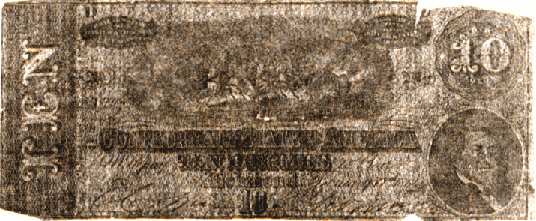
Where did most of the money go? My Brooks-Allen family had supported the Confederacy in the war, converting their U.S. currency into Confederate bills in 1864 when their nation was badly in need of funds. When the Confederacy fell in 1865, these bills were then made worthless.

Interestingly, Grandpa, who settled his father Culpeper's estate, kept the pre-war chest of his family's old Confederate money, including a bundle of the family's papers wrapped in tobacco twine. My Aunt Clara noted that the chest full of $150,000 worth of Confederate money was just "worthless paper," probably repeating just what her relatives had told her after the war. I have seen a sample of several of those bills scooped up by my Uncle Cullen when Grandpa died in 1943 - xeroxing a copy of a ten dollar note after interviewing him back in the 1990s:


$10 note from Brooks Family fortune before the Civil War

A somewhat clearer facsimile of the same $10 note from 1864


Few details of a farmer's life - even well off - entered the newspapers. After the war, everyone had it hard, but there's little evidence that Culpeper kept slaves. There's not much on him at all, actually, after the deaths of his parents - so I don't really know if he inherited slaves from his father's estate - or Louisa from her Allen family. William Brooks II's estate was settled in 1846 in Union County and included the old family land adjacent to Drury Morgan on the Rocky River. If he owned slaves, they were not on his 3-page estate sale inventory nor were there any on his wife Mary Burleson Brooks' estate in 1852.  Still, William I's original thirteen slaves would have been divided at his death in 1818, so few slaves were inherited by any single kid and no further purchases have been found. Still, this was an agricultural community and slaves were often used, especially by the wealthier families.

The most liberal Brooks to certainly break with this trend became my grandfather, a late arrival in Culpeper and Louisa Brooks' home. Their first three sons, William H., Robert Julian, and Preston L., died in infancy. The last two were buried in the Wall-Almond Cemetery (AKA Almond Cemetery, William Wall Cemetery) near Norwood in Stanly County. My Grandpa's two sisters, Eliza Jane Teal and Mary Frances High were a full ten years older than him and their families rarely associated with my grandfather's children. 

The Monroe Journal, 17 Aug 1909, 2
What was a young boy growing up just after a major war - then in dire straights - with only older sisters as an influence, bound to experience? Cullen and Louisa's Rocky River Baptist Church, founded in 1776, became a definite influence in my Grandpa's lonely and sparse life - penance and poverty surrounded him - as well as thousands of freed slaves.  

It may be that Grandpa had planned to settle on a small farm of seventeen acres in Burnesville near Ansonville in 1894, but - thanks to Rocky River Baptist Church and various influences after the war, I believe - he soon became an itinerant Baptist Minister and family historian, bringing the family back together for numerous reunions and writing The Brooks of Union County in 1925. 

It should also be said that he certainly influenced me to study genealogy since I was 16 and to obtain my master's degree in America History. Thanks, Grandpa.. even though we've never met!

Brooks Reunion, c1940


His first appearance in the Biblical Recorder (Raleigh, NC) was on 17 Aug 1898, telling that he was ordained 3 Aug and then served two churches in Anson and Stanly Counties:

Biblical Recorder, 17 Aug 1898, 22

The North Carolinian
Raleigh, North Carolina
21 Jun 1900, Thu  •  Page 4
As I said, thousands of freed slaves searched for a new life when Grandpa was just a young boy of four years. He grew up seeing destitute blacks and whites panhandling and begging, suffering from the ravages of a lost war... the "Lost Cause." That desire for vengeance to get back at the "Damn Yankees" of the United States would spark much resentment among whites after William Woods Holden and Reconstruction ended abruptly. Henry Louis Gates' RECONSTRUCTION: AMERICA AFTER THE CIVIL WAR is a must see presentation!

The special election in North Carolina for 1898 which sparked the racial violence and killings in the Wilmington Race Riot coincided with the beginning of his service in the ministry. Grandpa had to be very careful, for 40% of the people lynched in America were white! Most were killed by the Ku Klux Klan for supporting blacks or for other reasons not considered "desirable" in their neighborhood. It was typical for the KKK or "red shirts" (active in 1898 Wilmington Race Riot) to make up a valid-sounding story to uphold their mob verdict of death by lynching - especially when their victim was a white man.

Ku Klux Klan on horseback

One lynching occurred in Stanly County in 1892 - a white man named Alexander Whitley, allegedly for murder. But, there was little evidence and more hearsay, he stood no trial, and was lynched by a vigilante mob "all wearing red shirts." His descendant has written a book with a title that expresses how society dealt with such violence: Stanly Has a Lynching: The Murder of Alexander Whitley: A Family Legacy Entangled in a Web of Fiction & Folklore 

Enterprise, 13 Aug 1903
As M. Lynette Hartsell tells in chapter nine, a lynching of "Pharoah the Bull" occurred in 1880 - a tale which carried many racially-charged anecdotes of a black man as "savage," a reflection of one Prohibitionist preacher's political animus. I have included the article in Stanly News and Press: "Old King Pharoah Was Stoned For Goring Man". Prohibitionists had tied race to their cause, suggesting that anti-Prohibitionists were in league with the " beastly negroes." As Hartsell suggests, this gave their racism - even violence - a religiously righteous flavor - another parallel with Trump's evangelical supporters today, angered as they are by "Negro Rule" reminiscent of Barack Obama's administration. Hartsell does an excellent job of weaving through the political rhetoric to find reality. 

Still, lynching or attempts to lynch seemed forever on the minds of the more meek shepherds - like I suspect my Grandpa was - attending their flock!

"Indian Doctor" J. L. White was held in prison a full year and narrowly escaped lynching for rape in 1896. In 1900, another lynching of a black man accused of killing a Dr. S. J. Love occurred "by a mob of some 25 person, all disguised" who took the man from the jail, with no resistance from Sheriff McCain, at 2 a.m. in Stanly County. Henry Young was accused of assaulting a white woman in 1908 and nearly lynched by a mob. And, yet another lynching was narrowly averted in Dec 1909 and again, with two black men accused of murder in 1913. Certainly, only a few lynchings and other forms of racial violence had been recorded in newspapers and, contrary to my reporting, they were not just happening in Stanly County - this was a Southern-wide phenomenon. 

The "Lynching Mania" appeared in Stanly Enterprise of 7 March 1901 and almost a full column appeared in the Stanly Enterprise for 13 Aug 1903 which asked the question "But lynching is now on? How can we stop it?" The insincere answer was for faster trials! Whites should ensure swifter justice and that "it would largely stop in the South if negroes would stop committing rape, and this is true." Look at the cartoon below from 1892 of the large black man with bats wings, reaching out for the young white fleeing women - tine and helpless. The caption read "The dangers that hover over North Carolina." It is certain that these accused black men had not raped these women, but were accused nevertheless and hanged. The article went on "It comes of course, as a result of low, uncontrolled bestiality, fed fat by the habits of the life of the negro." As we've seen especially today, "bestiality" appears rather a human quality, practiced by anyone, regardless of any particular skin hue. 

Lynchings from 1835-1964. From data of Monroe Work.

Grandpa's association with, or admiration for, the liberal secretary for populist Gov. Lindsey Russell would be the first clue as to his liberal Christian nature. That secretary was Rev. Baylus Cade of Lenoir, inventor and Baptist Minister, a man who was reviled by conservatives as "Decayed Cade," "once a useful Baptist preacher," for "slandering his church." The North Carolinian of 21 June 1900 spouted a lot of likely "non-sense" as Donald Trump's supporters today, but the last sentence told the strongest sentiments and the original spark for the "righteous flames" - "When a man joins with the negroes in politics, he is ready to tear down the church and slander its good name!" Another article of similar venom spouted "[Cade] is not content to misrepresent the amendment and traduce the white people - that's what all fusion orators do - and Decayed Baylus could not stand to be merely conventional." 
The Semi-Weekly Messenger
Wilmington, North Carolina
03 Jul 1900, Tue  •  Page 2


Oddly enough, Rev. Cade was also a man respected by a quite reverent servant of God, and frequent contributor to the same Christian journals as Rev. Cade - my Grandpa - who named his 4rd son and 5th child - my father - Baylus Cade Brooks in 1916 in his honor!

Rev. Cade's story is an extraordinary tale of rife with the conservative political machine of the day in their battle against "Negro Rule!" The parallels with the Trump Administration today cannot be ignored! I encourage you to click the link above and read about him!


Raleigh News and Observer, 27 Sep 1898


It was in the middle of this tense racial division that my grandfather met and married my grandmother, Emma Eugenia Morton, daughter of Rev. David Stanley Morton on 23 Jan 1902. Their first son was born in 1902 - my Uncle Cullen - already mentioned with the handful of "worthless paper."

Rev. E. M. Brooks and Emma Eugenia Morton, married 23 Jan 1901


Many articles in both the Biblical Recorder and in the Stanly Enterprise newspaper detail his biblical devotion to living a humble life. His personal ministry was directly with the people - he was a do-gooder for sure - and he made various contributions to several Baptist churches in Stanly, Union, and Anson Counties. One of these articles details how Grandpa lived this life and even gave a family historian like myself a unique surprise about my great-great-great grandfather!


Enterprise of 6 Sep 1906 told that Pleasant Grove Baptist Church had given him a "handsome gold watch, Elgin movement" that they wanted him to have to replace his "98-cent timepiece he has been wearing." The article also mentioned a gift he gave them in return - a family heirloom of his great-grandfather's which I'll come back to momentarily.

The same wording appeared also in Carolina Watchmen of Salisbury, 12 Sep 1906. The paragraph before it also included a bit of political news that hints at a "great evil" from which we suffer today - voter suppression by the modern conservative Republican Party. It's helpful to know that, in the 1898 Election, conservatives tried to kill Gov. Lindsey Russell on his train trip home to vote Republican:
It is to be hoped that in Stanly this year there will be no vote buying or vote selling. If a man is honestly a Republican [liberal], he deserves credit and should be allowed his right of suffrage. If honestly a Democrat [conservative], he is entitled to the same privilege. There can be no honesty in elections when there is traffic in votes. In the end the country suffers therefrom and the voter holds the remedy for granting us immunity from this great evil.
[but...] "If the radicals [liberal Republicans] stay in power two years more, the roads in Stanly will be in such a fix that a man won't be able to get anywhere," remarked a citizen of Harris township on Monday.
It seems that any excuse against liberals was fit to print. Everything I read about my grandfather convinces me that he would be seen as a liberal Democratic Socialist today. Of course, in his time, conservatives - actually ex-slavers - were termed the "Democrats," and these cruel conservatives would move into the Republican Party by 1968. My grandfather would certainly not have associated "Democrat" with his own way of thinking!


As promised... Grandpa also mentioned that he gave Pleasant Grove Church a gift in return - one powder horn, "considerably over a hundred years of age," that had belonged to his "grandfather," William Brooks II, made from a gourd. Messenger and Intelligencer of Wadesboro reported in its issue of 10 Apr 1890 that "Cullen" or Culpeper Brooks had the horn in his possession then, that it was his grandfather's (William I) and that it had been used so often it "appeared to be varnished." The 1906 article mentioned "from the seventies," meaning that it had definitely belonged to Ensign William Brooks I when he and his brother Lt. John Brooks went in Capt. John Culpeper's regiment of Rutherford's Campaign against the Cherokee about 1770, before the Revolution. BTW, care to guess where my Great Grandpa "Culpeper" got his name? The powder horn "furnished many a charge when a deer proved a fallen victim," they said. It had done more than that, but I doubt that my Grandpa knew its full history! Or maybe he did and that 's why he gave it away?

Grandpa helped establish the Stanly Baptist Union, a circuit of Baptist churches in Stanly County. He often preached at various locations, but was limited to his place of residence. He had worked in Norwood from 1909 to November of 1915. He and his wife, Emma, pregnant with my father then moved to Palmerville, near Oakboro and "Big Lick" and their child arrived on New Year's day, 1916. 

The next day, Grandpa penned a letter to Rev. Baylus Cade, informing him of his "little namesake" and named "for a great man. One whose ripe scholarship and faultless English excites our admiration.":


Letter of Rev. E.M. and Emma Brooks of Palmerville, NC to Rev. Baylus Cade of Shelby, 2 Jan 1916

Rev. Cade responded ten days later, saying "I value the honor you have done me in giving your dear little boy my name...."


Letter of Rev. Baylus Cade of Shelby to Rev. E. M. Brooks, 12 July 1916

The next year, for my Dad's first Christmas, the family transferred to New London, Stanly County. There, the true followers of a beneficent Jesus celebrated a special "White Christmas" for the "destitute poor" of Stanly County. But, he still visited to other parts of Stanly, like the more western village of Pleasant Grove.

It was not longer after my father's birth, in May 1916, that my grandfather demonstrated his interest as historian - not just as family historian - when "E.M. Brooks of Palmerville gave a historical sketch of the history of" Norwood Baptist Church. He gave a "field meeting" in the open for Palmerville, Ebenezer, and New London in 1918.

By 1919, while living at New London, Grandpa helped initiate an effort to educate the people of Stanly county, with a "Mobile School" for which he served as Dean. According to the Stanly County Herald of 17 July 1919, the school would travel from town to town and spend five days at a time teaching to the children. While the curricula was based on church studies, it did also include various scholarly subjects. The next year, the town of Badin presented him with a gift of $24 to further the poor preacher's pursuits. 

Stanly County Herald of 9 Oct 1919 announced a distant move for the Brooks - nearly to the town of my own birth of Fayetteville - in the small town of Lumber Bridge, southwest of Fayetteville. My father would spend his childhood and later years here - maybe why he chose to purchase his first home near Hope Mills, a bit closer to the metropolis of Fayetteville. 

 
Stanly County Herald, 9 Oct 1919, 1


The Robesonian of Lumberton noted his arrival 20 Nov 1919, where he instructed their parishioners "more perfectly in the ways of finance," and Emma Morton Brooks appeared to have become ill late in September of 1922 but the paper noted that she was "convalescing." On 7 June 1923, the same paper noted him as "Rev. E.M. Brooks of Fayetteville, pastor of the Baptist Church of Boardman," a small town ten miles south of Lumberton. My Grandpa, Rev. E.M. brooks served as pastor at the Person Street Baptist Church in downtown Fayetteville and was listed on the Fayetteville City Directory for 1924. Albemarle Press reported that they were back in Albemarle 25 Oct 1925, but still noted him as "of Fayetteville." My father spent six years from ages 3 - 9 in Lumber Bridge, but his family then resided in Peachland for a number of years.

I remember my father telling me that he walked about a mile to go to school while in Peachland. He and his elder brother Julian Allen used to play pranks on folks by tying fishing line to a dollar and laying it in the street. When someone bent over to pick up the dollar, they'd snatch it away. Dad also told me that he and Allen would try to hit each other's mouths with milk, squeezed straight from a cow! Of course, he laughed at the look on my face!

At some point, my father left Peachland and moved to Fayetteville to live with his older brother Macon - I'm guessing by time of the 1930 census - certainly by the 1931-2 school year, when he was found attending Fayetteville High School (today's Terry Sanford) and working at Matthew's Pharmacy on Hay Street. He graduated from there in 1933 and continued "jerking sodas" at the pharmacy. 

Grandpa retired about that time. He spent his remaining years reading the local papers, clipping articles and exploring history, as he loved it so much. Grandpa saved a collection of newspaper articles, personal anecdotes, and facts that he collected in a scrapbook, dating from about 1931-1939. One of those articles was "Black Mammy Tells Graphic Story of Slavery." This huge article caught my Grandpa's liberal eye.. and I know why. It described a woman who had been severely affected by her servitude as a slave and, later, as a free woman. She never left the home of her former master. This sparked a long, detailed study you'll find in "North Carolina: The Subtle Politics of Slavery Before and After the Civil War." It's not hard to imagine what must have gone through my Grandpa's mind when he read it.


Article written by Charlotte Story Perkinson titled "Black Mammy' Tells Graphic Story of Slavery," Charlotte Observer (North Carolina), 19 March 1933
I can't say that Grandpa was an activist in any meaningful way, but I can discern his thoughts. Maybe the South was the source of the general meek image of a liberal today... as Grandpa would say, they "shall inherit the Earth." Let's hope he's right.

Rev. Edgar Marcelus Brooks passed away from a heart attack at his home in New London, Harris Township, Stanly County just after midnight at 12:45 on the morning of 25 March 1943. My Dad was away in the Navy, oddly enough, stationed at New London, Connecticut. He received an early discharge as a result. 

And, I received one of the best family histories of all time!


Monroe Enquirer, 8 Apr 1943


-----------------------------------------------


Fountain of Hope: Dimensions

Available at Lulu.com

Epub version, too!

Also on Amazon.com!