Donate to Brooks Historical

Monday, February 29, 2016

North Carolina's Political Pirate Nest

"An Eclipse signifies an intense time of energy, which can spark the beginning or end of relationships and situations" according to a fairly recent New York Daily News article. This article involved horoscopes. While I'm not overly enthusiastic about such things, other people are. This enthusiasm and knowing about such an event can create something of a self-fulfilling prophecy - you may act a certain unusual way because of these thoughts and thereby create the weirdness through no fault of nature itself. 

Of course, the events of January 7, 1730 in Edenton, North Carolina may not have depended upon such an unusual event as a total solar eclipse. That was still four days away from the wintry and weird events of this cold Saturday afternoon, but perhaps the eerie howling of the wind foretold an omen. All of these events occurred nearly three hundred years ago, following just after the Golden Age of Piracy.

Perhaps the maritime residents of this fledgling backwater, yet growing colonial outpost of Great Britain felt an eeriness due to the building affects of the prescient natural phenomenon. Then again, perhaps the illusion of power and position in the ever-humbling, diseased, and mosquito-infested swamps of early North Carolina played a bigger part in their reactions. 

Still, it was winter, a time of reprieve from disease as well as working fields - and the self-induced hysteria of January 11, 1730 was still four days away.

No... the assassins probably had no excuses for attempting to murder Vice-Admiralty Judge Edmund Porter. But, it would not be the last time that an attempt would be made on North Carolina's admiralty officers...

Unsurprisingly, the backgrounds of two men involved in these events were gorged with wealth, status, power, and piracy. 

Miles Gale, master of the sloop Two Brothers, who made regular runs from North Carolina to Boston, was the son of Chief Justice Christopher Gale, who had served in that capacity both in North Carolina and in the Bahamas. Christopher Gale captained the Delicia, the vessel that carried former privateer Gov. Woodes Rogers from London to his new station as first royal governor of the Bahamas. Rogers had been appointed the daunting task of ridding that dilapidated island of the "Flying Gang" of pirates, led by Benjamin Hornigold, who infested that chain of nearly 700 islands. Still, Rogers depended upon ex-pirates like Hornigold to aid in capturing unrepentant ones... and the ex-pirates often returned to piracy themselves.

As for Edmund Porter, he came from a Virginian family of Quakers, son of John Porter. John was as much a controversial figure as Bahamian pirates. He led the Quaker faction against the legal Anglican government of North Carolina, reinvigorated in their state-supported religious resolve in the Vestry Act of 1701 against dissenters or Quaker "heathens" like Porter. The Cary Rebellion (1708-1711) collapsed the government and initiated the Tuscarora Indian War of 1711-1715. Edmund probably found it more comfortable to go with Gale to the home of the pirate gangs. There, he met Elizabeth Peterson, daughter of Bahamian planter Richard Peterson. Edmund and Elizabeth married and he returned to North Carolina a decade later and took the position of Admiralty Judge in the capital of Edenton. 

North Carolina was between governors at this time in 1730. George Burrington last filled that position, but due to his irascible nature, alienated much of the colony and left for the Lower Cape Fear in 1725, then for home in 1726. Sir Richard Everard, Bart. filled his place during the interim. It appears that Miles Gale and his partner Mr. James Chamberlain took issue with Everard and Porter, probably for political and/or financial reasons - maybe even due to affects of the coming eclipse. Well, probably not.

Whatever the reason, these issues broiled almost an entire year, well past the eclipse on January 11th, from a sneak attack and attempted murder of Judge Porter that month to outright attack in broad daylight on the marshal and his deputy in October. The Judge escaped with his life because he was warned and placed mock judges and court officials in place of the real ones to fool the attackers. The open attack in October appeared rather erratic in nature. It begs the question of just what emotional catastrophe must have befallen these fellow Carolinians.  

Pre-1801 Union Flag flies at Fort York, a former British Army base in Toronto

On October 4, 1730, the sloop Two Brothers had recently offended acting governor Everard by "lately at Several times in a very insulting manner, wore the Union Jack; pendant in the Harbour and Port of Edenton; has also in a Dareing Manner fired Guns and Hoisted up an Union Jack or Flag at Mast Head at three Several times (vizt) first on or about the last of August, and on the 18th and 19th of September last in the Harbour aforesd." The governor stated that Miles Gale had been cautioned about this insult to the "Jurisdiction of the Admiralty," but continued it nevertheless.

Gov. Everard explained: Gale's actions, he said were "contrary to the holsom Orders and Ordinances of the Treaty of Union [1 May 1707] and the Queens [Anne] Proclamation in pursuance thereof our Merchant Ships or Vessels, wearing Flaggs, Jacks, or any Pendants whatsoever, without particular warrant from the Lord High Admiral or the Lords Comrs. of the Admiralty." Everard, "conceiving the Offense to be attended with ill consequence" demanded on October 4th a citation be issued for Miles Gale to appear in Vice-Admiralty Court.  

Treaty of Union (1 May 1707), adopted under Queen Anne
Soon after, Samuel Snowden, Marshall of the Admiralty and son of Thomas Snowden who had recently passed away (1728), went with his deputy in a small boat one afternoon to the sloop, laying at anchor just off Edenton. Snowden carried the citation for Miles Gale, sole owner of the vessel Two Brothers from Judge Porter. Miles Gale's crew again insulted the authority of admiralty officers.

As Snowden and his deputy crossed the calm cool waters of Albemarle Sound before the docks of Edenton, they approached from astern. James Chamberlain, then master of Two Brothers  and another man saw their approach, ducked into the cabin, and brought out muskets. Chamberlain told Snowden that if "he came one foot farther, he was a dead man." Before Snowden could negotiate with Chamberlain, he asked someone for a match to fire the cannon, forcing Snowden to retreat back to the shore. 

Sauthier's map of Edenton, 1769. Edenton was formerly “The Towne on Queen Anne’s Creek" and was named "Edenton" in 1722 to honor Gov. Charles Eden who had just died that year.

Capt. Joseph Kidder, whose vessel was anchored nearby when Snowden and deputy approached Two Brothers, confirmed Marshall Snowden's testimony and added that Chamberlain at first presented a small arm that he had on his person before ordering the muskets to be brought up.

Shortly afterward, on October 16, 1730, Gale, Chamberlain, and three of their men came on shore, armed with pistols and cutlasses. They swore that "they valued the Govr. no more than they did the Judge of Admty." Gale claimed that Porter had no authority over him, that admiralty jurisdiction, he claimed, was "His Father's business." And, he added that "no man else had any thing to do wth such things or things of that nature but his Father [Christopher Gale]."

Edmund Porter ordered Gale and his men to appear in court on the 24th to answer these further charges. 

No further records exist to illuminate the end results, but since Miles Gale and Edmund Porter survived past them, few people were probably killed and the howling wind died down a bit. 

Why did Miles Gale begin his acting out or protests in favor of his father that August 1730? 

Politics - plain and simple.  

Biographer George Stevenson explained the events that alienated George Burrington from Chief Justice Christopher Gale in the Dictionary of North Carolina Biography. Everything was copacetic in April 1724 when Gov. George Burrington first became governor. He put Gale and his brother Edmund on his council. The trouble centered around Gov. Charles Eden's (deceased in 1722) will and, when July 1724 came around, the Gale-Burrington relationship began to unravel:
Toward the end of July 1724 Burrington received a petition asking him to grant redress in his capacity as ordinary of the colony. The petition was from Eden's niece, Margaret Pugh, and Ann and Roderick Lloyd. They denounced the will said to be Eden's as a fraud and alleged that Lovick had obtained it illegally. On 31 July, Burrington carried the petition to a meeting of the council that was attended by both Lovick and Gale. The governor explained that the council would proceed in the matter as a Court of Ordinary. An order-in-council was issued requiring the recordation of the London petition and power in the records of the General Court. (The court was then in session.) It must have been an exhilarating occasion. To have proceeded in the matter would have meant an examination and scrutiny of Lovick, Clayton, the Badhams, and possibly Gale himself.
Gale refused to give Badham the order and Burrington went ballistic. Burrington threatened to "ruin Mr. and Mrs. Badham and declared that he would have Lovick and Gale in irons. In fact, he announced his intention to crop Gale's ears and slit his nose like a common felon." Burrington had denounced Gale on the bench as a rogue and a villain before the entire General Court. He even planned to assail Gale at his house, only to discover that he had left the colony. 

Stevenson assures that it was an easy matter for Gale to have Burrington removed, which did happen only a couple of years later. In the meantime,
Burrington and the council declared Gale's offices vacant on 24 Oct. 1724 and filled his seat on the council as well as the office of chief justice. Gale's son-in-law Henry Clayton was dismissed as provost marshal, his brother Edmund was turned off the General Court, and after the October term Badham was replaced as clerk of the court by Samuel Swann. 

In essence, Gale was publicly and officially humiliated within North Carolina. Things had calmed down once Burrington left the colony in 1725 and replaced in the interim with Sir Richard Everard:   
The peremptory removal of Burrington ended any real threat from Eden's English heirs. The heirs petitioned the Court of Chancery for relief in April 1725, Burrington presiding; their bill was thrown out in July 1725, Sir Richard presiding, when the death of one of the plaintiffs was falsely suggested.
There had been political divisions and struggles in the colony before now, but none of them equaled the fight that arose upon the removal of Burrington and the substitution of Sir Richard Everard as governor. Gale resumed his seat as chief justice, Little was restored as attorney general, and Gale gave back to Badham his old office as clerk of the General Court. For a time the coalition of Everard, Lovick, Gale, and Little ruled the colony. The General Court became first a political tool in the hands of Gale and his faction, then an object of contempt in the province. Similarly, the Court of Vice-Admiralty in the hands of Edmond Porter (who had been one of the attorneys for Eden's heirs-at-law) became a tool of political opposition against Gale's faction.

The Lords Proprietors of Carolina ignored any possible mishandling of the Eden will probate. They had much more with which to concern themselves at the time - ridding themselves of their other "nest of pirates," after the Bahamas in 1718 and South Carolina in 1719.

The Proprietors had negotiated to resume North Carolina under royal, as opposed to private, control by July 1729. Maybe this way, they could get some sleep. Never was a more fervent argument proposed against privatization!

The next governor would be the first royal governor of North Carolina. The sitting Secretary of State, the Duke of Newcastle, argued for that governor to be - George Burrington! They officially made the announcement that August 1730, but Newcastle's intentions had already been known for months, even before January. 

Chief Justice Gale's hated enemy would be returning as commander-in-chief of North Carolina. This undoubtedly prompted Miles Gales' defense of his father's authority. Then, an apparently "unknown" assailant attempted to murder Admiralty Judge Edmund Porter, Burrington's old ally, on January 7, 1730. As if defiantly slapping the Gale family in the face, on that same day, the Duke of Newcastle wrote to the Board of Trade and Plantations:

                                                Whitehall Janry 7th 1729/30.

My Lords,

His Majesty having been pleased to appoint George Burrington Esqr Governor of North Carolina has commanded me to signify to your Lordships His Pleasure, that you prepare a Commission and Instructions for him accordingly
                                                 I am
                                                 My Lords
                                                 Your Lordships most obedient humble servant
                                                 HOLLES NEWCASTLE

As for George Burrington, the "Family" friends that he had earlier made in the Lower Cape Fear settlement of Brunswick, before he left North Carolina in 1726, characteristically became his certain enemies almost immediately upon his return. He began his mission to found the enormously successful port town of Wilmington, in direct opposition to the Family's Brunswick Town.  He won, but at great expense to his own reputation.

The Family took their vengeance upon Burrington - even in death!  But that's another North Carolina pirate tale!
 

 ------------------------------------------------------------------------


Read about North Carolina's piratical birthpangs in the Brunswick Town & Wilmington affair and the hero that saved the Port of Wilmington from the Family's political opposition, Capt. James Wimble: 
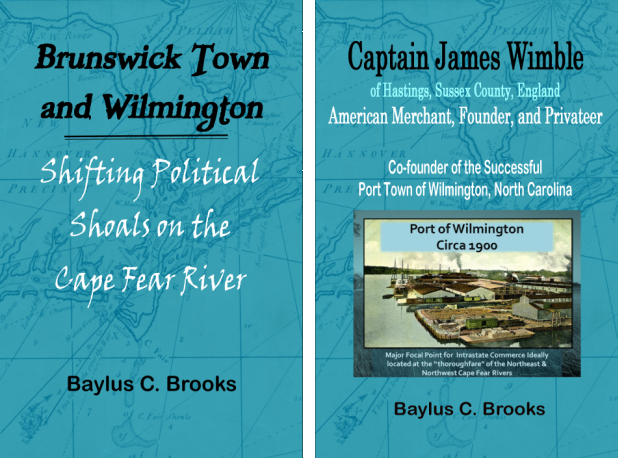

Both can be found at the author's Amazon page and at Lulu.com

From the author of Blackbeard Reconsidered! 


Tuesday, February 16, 2016

News from America! Gov. Woodes Rogers Arrives in a Nest of Pyrates!


With the Stars! TV series, Black Sails, doing their third season on the surrender of the Bahamas to Gov. Woodes Rogers, I thought it would be nice to read the newspaper article that provided much of the context for this event. I've enjoyed Black Sails not for its history per se, but for its contextual representation of pirate life, owing undoubtedly to Benerson Little being the historical consultant. Still, much of the historical events the show represents did, indeed, happen - maybe not exactly the way you're seeing it, but basically, it's right. Anyway, sit back in your favorite coffee house near Charing Cross (as it is a lot safer in London, as opposed to Nassau!), pick up this electronic copy of the London Gazette for December 27, 1718 and enjoy!


London Gazette (December 27, 1718):

Town of Nassau on the Island of Providence, Nov. 11.

On the 25th of July last in the Evening, His Majesty's Ship the Rose, which had come in Company with Mr. Woodes Rogers, Governor of the Bahama Islands, came into our Road; but one Charles Vane, who commanded the Pyrates, caused a French ship of 22 Guns that he had taken to be set on fire, in order to drive out the Rose; which was obliged to cut her Cables and run out in the Night.

The next morning, His Majesty's Ship the Milford, and the Delicia, on board was the Governour, being seen at some Distance standing in for this Harbour; Vane and about 90 of his Men made off in a Sloop: Two Sloops were sent after them, but could not get up with them. 


The Governour sent Officers ashore at his first coming in on the 26th; but his Ship and the Milford running a-ground, he delayed landing till the 27th; when he took Possession of the Fort, and caused His Majesty's Commission to be read in the Presence of his Officers, Soldiers, and about 300 of the People found here, who received him under Arms, and readily surrendered, expressing great Joy for being restored to a regular Government. 


The most recent chapter in Black Sails brings Gov. Woodes Rogers. "Governor of the Bahamas and savior of Nassau, much of Rogers life is well known with the help of his biographer. He was a well-known English sea captain and sailed the world as a privateer with 2 ships and offered support against the Spanish. He was viewed as a national hero having been the only Englishmen to sail the known globe and return with his original ships and most of his crew. Rogers even saved Scottish sailor Alexander Selkirk, who was marooned on an uninhabited island for 4 years. Selkirk’s rescue would later inspire the character Robinson Crusoe and also be part of Rogers own novel, A Cruising Voyage Round the World."
The Governour haveing chosen six of the Persons who with him, viz. M. Robert Beauchamp, William Fairfax [later land agent in Virginia in 1734 whose daughter Ann married Lawrence Washington], Wingate Gale, George Hooper, Christopher Gale [formerly of North Carolina], and Thomas Walker, and six of the Inhabitants who had not been Pyrates, and were of good Repute, viz. M. Nathaniel Taylor, Richard Thompson, Edward Holmes, Thomas Barnard, Thomas Spencer and Samuel Watkins, to form a Council; he assembled them on the 1st of August, when Mr. William Fairfax was received as Judge of the Admiralty in the Bahama Islands, and Mr. John Graves [see note 1 below] as Collector of the Customs, pursuant to the Commissions they had brought with them from England; and Mr. Robert Beachamp (1st Lieutenant of the Governour's Independant Company) was appointed Secretary, as were Mr. Christopher Gale Chief Justice and Register, Mr. William Walker Provost Marshall, and Mr. George Hooper Naval Officer, to continue till His Majesty's pleasure be known.

  
From: Boston News-Letter, December 9, 1717

That day came before the Council about 100 of those who had been pyrates, and surrendered themselves to the Governour, claiming the Benefit of His Majesty's Proclamation relating to Pyrates, and took the Oaths of Allegiance to His Majesty, as did also several Inhabitants of these Islands.
 
A Number of the Inhabitants and of their Negroes have since been employed to put this Fort into the best Repair possible, and to mount Guns upon it; as also to clear the Ground of Brushwood and Shrubs within Gun-shot of the Fort, and to cut Pallisadoes to be placed round the Fort, that this Place may be defended from all Insults of Pyrates or Enemies.

Encouragement has likewise been offered to such as shall build and settle in this Town, or come and settle in the Country of this and the other Bahama Islands.

There had been a Sickness upon the Island about a Fortnight before the Governour came in, imputed to a great Number of raw Hides put on Shore near the Town, which putrified and infected the Air.

The Inhabitants were soon freed from the Distemper, but several of the Soldiers, Passengers, and Seamen who came with the Governour sickened and died. 

This was such a Mortality as Persons who have lived here these forty Years never knew of the like; on the contrary they all agree, that People when they become sickly in most of the other American Plantations, find Relief when they come hither [doubtful, in the 18th century!].


“An exact draught of the island of New Providence one of the Bahama Islands in the West Indies” (c1700) – Library of Congress # 74692182.

This Island every where affords the best Stone, Lime and Timber, and the Soil is very productive of Grain, &c.

The Governour has caused a small Fort of eight Guns to be built at the Easternmost Entrance into the Harbour, where Watch is kept.


The Independent Company, consisting of 112 Men, garrison the Forts.

The Inhabitants and all the rest of the Men on this Island are formed into three Companies of Militia under their own Officers, who by turns keep Guard in the Town every Night.

A Guard-Ship also, well provided for Defense, lies in our Road.

Our Governour has appointed Mr. Holmes, one of the Council, to be Deputy-Governour of the Island of Elutheria [Eleuthera], where there are about 50 Families and 70 Men formed into a Militia Company, and Mr. Thompson, another of the Council, to be Deputy-Governour of Harbor Island, where there are about 60 Families and 80 Men which are also a Company of Militia, they have fortified themselves and secured the Harbour which is very narrow at the Entrance, but a Ship of 18 Foot Water may go in and ride very safely: Our Governour has supplied them with Powder and shot [which the proprietors earlier refused to do], for they have two small Forts, one having six Pounders, and the other 4 nine Pounders, which command the Entrance and Harbour.

One of the Men of War that came with the Governour sailed the 16th of August, the other on the 14th of September.


1732 Herman Moll Map of the West Indies, Florida, Mexico, and the Caribbean

That Day came Advice that three Vessels, supposed to be Vane and his Prizes were at Green Turtlekey near Albacoa [Abaco], whereupon the Governour caused a Sloop to be fitted out under the Command of Captain [Benjamin] Hornigold [see note 2 below] to go and view them, and bring them an Account what they were: In about three Weeks Captain Hornigold returned, having lain most of that Time concealed and viewing Vane the Pyrate, with design to surprize him or some of his Men, who they expected would pass near them in their Boats; but tho' he failed in this, he brought in with him a Sloop of this Place which had got Leave of the Governour to go out a Turtling, but had been trading with Vane, who had then with him two Ships and a Brigantine, his Sloop that he escaped in from hence being run away by some of his Fellow-Pyrates.

Those two ships he had taken coming out of Carolina, one of 400 and the other of 200 Tuns, laden with Rice, Pitch, Tar and Skins bound for London; the Neptune Captain King, being the largest, he sunk; the Emperour Captain Powers, he left without doing her any great Damage, except taking away her Provisions.

Our Governour has caused the Merchant who traded with Vane to be seized and laid in Irons, to be sent to England by the next Ship; there to be tried for his Offense.

He has sent to England three Criminals, who pyratically ran away with the Vessel they belonged to, leaving her Master and Merchant on St. Lucia one of the Caribbee Islands inhabited only by Savages.


 -------------------------------------------


Notes:

1. From: Homeward Bound: A History of the Bahama Islands to 1850 with a Definitive Study of Abaco in the American Loyalist Plantation Period :

Gov. Rogers had some difficulty installing William Fairfax as Deputy Customs Collector:
 

I did indeed receive an order from the Lords of the Treasury to appoint him [William Fairfax] Deputy to Mr. Graves, Collector, in case of that old man's inability to act, which he has not been able to do otherwise than in his chamber or bed, but is Of so petulant a temper that I have been unwilling to interfere, and Mr. Fairfax not pressing to serve under such a peevish gentleman without the manner of his acting and pay, or fees, was settled, for which I have no direction how to divide it, and Mr. Graves having no other support but this employ which he has been several years possess'd of. I am very unwilling to meddle in this affair without its first being settled in England. But beg leave to propose for His Majesty s approbation that Mr. Graves may enjoy his annual sallary Of L70, and the fees of Collector will content Mr. Fairfax during Mr. Graves's life.

 2. From: “America and West Indies: July 1716;” Calendar of State Papers:


240. i. Deposition of John Vickers; late of the Island of Providence. 

In Nov. last [1715] Benjamin Hornigold arrived at Providence in the sloop Mary of Jamaica, belonging to Augustine Golding, which Hornigold took upon the Spanish coast, and soon after the taking of the said sloop, he took a Spanish sloop loaded with dry goods and sugar, which cargo he disposed of at Providence, but the Spanish [probably the French Mary of Rochelle] sloop was taken from him by Capt. [Henry] Jennings of the sloop Bathsheba [Barsheba] of Jamaica. In January Hornigold sailed from Providence in the said sloop Mary, having on board 140 men, 6 guns and 8 pattararas, and soon after returned with another Spanish sloop, which he took on the coast of Florida. After he had fitted the said sloop at Providence, he sent Golding's sloop back to Jamaica to be returned to the owners: and in March last sailed from Providence in the said Spanish sloop, having on board near 200 men, but whither bound deponent knoweth not. [he was going to the north coast of Cuba - see map insert]


About 22nd April last, Capt. Jenings arrived at Providence and brought in as prize a French ship [Marianne] mounted with 32 guns which he had taken at the Bay of Hounds [Bahia Honda], and there shared the cargo (which was very rich consisting of European goods for the Spanish trade) amongst his men, and then went in the said ship to the wrecks where he served as Comodore and guardship. 

There are at Providence about 50 men who have deserted the sloops that were upon the wrecks, and committ great disorders in that Island, plundering the inhabitants, burning their houses, and ravishing their wives. 

One Thomas Barrow formerly mate of a Jamaica brigantine which run away some time ago with a Spanish marquiss's money and effects, is the chief of them and gives out that he only waits for a vessell to go out a pirating, that he is Governor of Providence and will make it a second Madagascar, and expects 5 or 600 men more from Jamaica sloops to join in the settling of Providence, and to make war on the French and Spaniards, but for the English, they don't intend to meddle with them, unless they are first attack'd by them; nevertheless Barrow and his crew robb'd a New England brigantine, one Butler master, in the harbour of Providence and took a Bermuda sloop, beat the master and confined him for severall days, but not finding the said sloop fitt for their purpose, discharged her. 

About a year ago one Daniel Stillwell formerly belonging to Jamaica, and lately settled on Isle Aethera, went in a small shallop, with John Kemp, Matthew Low, two Dutchmen, and—Darvell to the coast of Cuba and there took a Spanish lanch having on board 11,050 pieces of eight, and brought the same into Isle Aethera; and Capt. Thomas Walker of Providence having received advice thereof from the Governor of Jamaica, seized Stillwell and his vessell, but upon the coming of Hornigold to Providence, Stillwell was rescued and Capt. Walker threatned to have his house burned for offering to concern himself, Hornigold saying that all pirates were under his protection. 

It is common for the sailors now at Providence (who call themselves the flying gang) to extort money from the inhabitants, and one Capt. Stockdale who came passenger with deponent to Virginia was threatned to be whipp'd for not giving them what they demanded, and just upon his coming from thence he payed them 20sh. for which the aforementioned Barrow and one Peter Parr gave him a receipt on the publick account. Many of the inhabitants of that Island had deserted their habitations for fear of being murdered. 

Sometime about the beginning of March one Capt. [Francis] Farnandez, an inhabitant of Jamaica, in the sloop Bennet mounted with 10 guns and with about 110 men took a Spanish sloop with about three millions of money as it was reported and silks and cochenile to the like value and brought the sloop into Providence and there divided the money and goods among the men and is returned to the North side of Jamaica to try whether he may go home in safety and if he found he could not he gave out that he would return to Providence and settle amongst the Rovers. 

Signed, John Vickers. Endorsed as preceding. 2 pp.


A good early history of the Bahamas before the Golden Age (how it fell to pieces and became a pirate nest) is included in Pirates & Slaves: Making America


Links:

Why did pirate hunter Woodes Rogers lose his governorship? by Colin Woodard...

A Cruising Voyage Round the World: The Adventures of an English Privateer by Woodes Rogers...


Monday, February 01, 2016

Are Jacobites Criminals or just Political Protestors?

It was a general practice to raise the British flag (colors) before any ship in harbor fired a salute. To do so without raising colors was considered a violation of proper Royal maritime tradition and a slight against the king or queen. It might also reflect one's political stance, whether conservative or liberal - for the king/queen or against - Tory or Whig. The years following the end of the Anglo-Scottish or British House of Stuart and the beginning of the new German House of Hanover, completely foreign to the British people, caused political reverberations in the Empire that "disaffected" individuals could only safely protest by subtle means, such as not raising colors before a salute - to purposely slight the reigning German monarch. 

Tories, or those conservatives who supported the monarchy over an increasingly powerful Parliament (British Congress), had lately become outraged at the end of the Stuart line in 1713, when Queen Anne died. That supposedly divine Royal line was subsequently replaced by a Whig or liberal Parliament with a foreigner, German George I of Hanover. Some British still saw the monarchy as an extension of God himself and any removal of a monarch by man or any group of men - such as Parliament - heresy. This had been boiling under the surface since the Glorious Revolution in 1688 when the Catholic James II was ousted.

James III - "Pretender"
Adding to the religious-political division since the Hanoverian succession in 1714, German Palatine refugees were flooding England under George's overt support. To make matters worse, George nor his son, George II spoke English. Only George III, the grandson who oversaw the war with Americans in the American Revolution, had grown up in English tradition. 
Queen Anne - Last Stuart Monarch
Parliament's "outrageous" act, placing a German on the English throne in lieu of the rightful successor and son of James II, typically annoyed British conservatives, who again attempted to restore the Stuart line with James III in 1715. This was one of many Jacobite Rebellions (1688-1750s) in which these pro-establishment conservatives suddenly became staunchly anti-establishment revolutionaries against what they viewed as an oppressive government. Many involved in that rebellion were shipped off to America, adding to the growing political division that already existed there. Conservative Jacobites also held court in Rome (the Stuart line held a generally "Papist" or Catholic persuasion) to support their political position and had great hopes that God would restore the Stuart line in England. 

In fact, a great many English favored restoration. Nathaniel Mist, Jacobite polemicist journalist of London's Weekly Journal and suspected author of A General History of the Pyrates, stirred up some trouble from time to time, especially in 1721, but he was largely supported by the general population, even while protected by the crowds while being pilloried in Charing Cross.

Pillory
This all occurred at the beginning of the Golden Age of Piracy, which some have described as a type of Jacobite Rebellion. I, however, would describe it as more of a treasure lust after 14,000,000 pesos worth of silver alone spilled on the Florida shore, just west of the Bahamas, and in easy reach of the wreckers and pirates there, as well as the wealthy privateers and smugglers from Jamaica and Bermuda. A hurricane of July 30, 1715 wrecked eleven Spanish treasure galleons full of three years worth of produce from mines in Mexico and South America. The chance of riches drove the entire Atlantic community mad. This only exacerbated the religious-political division that had developed between Tory and Whig, and largely between England and the American colonies, where pirates virtually ruled their own kingdom.

George I of Hanover
Enter into this political turmoil, the gentleman pirate Capt. Richard Tookerman, wanted in South Carolina for breaking fellow pirates Stede Bonnet and David Herriot from prison in October 1718, stealing money and jewels from William Rhett Jr., stealing horses, forging passes to Virginia, escaping British authorities in Virginia to Barbados, there obtaining the sloop Adventure, stealing slaves and trying to sell them in the Leeward Islands... then, at last back in Port Royal Harbor and while eating lunch with several important grandees of Jamaica, including a colonel of the militia and Mrs. Pendigrass, on the Pretender's (James III - the "Jacobian" exiled Stuart would-be king from England) birthday, June 10th, in 1721, fired a 5-gun salute from Adventure WITHOUT raising colors - TWICE, even after once being warned... all of these things showed himself decidedly to be one of those people "Disaffected toward the king" (the new German king George I), or known as a "Jacobite."

Being Jacobite, however, was merely a political position, much like being a conservative Tea Partier today with a Democrat president. It was not a criminal thing, unless you protested outside of the law, like the rebels sent to the West Indies and the Carolinas.


Port Royal Docks

Once arrested, "friends of the said Tookerman," headed by an ex-Royal Navy Lieut., Thomas Cardiff, attempted to murder the commander of His Majesty's navy in Jamaica, Capt Edward Vernon. Vernon hauled Tookerman to London for trial where the Lord Chief Justice let him go. Tookerman then sued Vernon for false arrest and won the case, resulting in L1200 damages from Vernon.Tookerman then joined his pirate friends Daniel and Thomas Porter in the Bahamas and went on the account again with Bartholomew Roberts. He finally died in 1726, a wealthy gentleman with a namesake who later helped to found a local church in Goose Creek, South Carolina.

You can find more details of this story in Really! Pirates and Tea Party Conservatism

In light of these results, London authorities obviously only arrested suspected Jacobite rebels when they broke the law... similar to the protests of the occupiers of the Oregon federal sanctuary by those sympathetic with rancher Cliven Bundy.

Pirates were largely Jacobite; however, Jacobites, like Tea Partiers in America today, were simply extreme British conservatives; this is certainly not a crime within itself - assuming you don't try to overthrow the government. Whigs and Tories, Progressives and conservatives, even those of the extreme varieties, get along just fine, as long as they don't talk politics. It's like a progressive today barbecuing chicken or steaks with his conservative next-door neighbor when the Carolina Panthers football game is on. Unless one decides to turn pirate and steal all the food, then everyone, Whig and Tory alike, can have a good time and enjoy the game. ;)

--------------------------------------------------
Note that pirate scholar E. T. Fox has disputed some of this article. His article "Jacobitism and the “Golden Age” of Piracy, 1715-1725" in the International Journal of Maritime History describes a bit more seriousness to perceived Jacobitism. It is excellent work and is available here: https://www.academia.edu/772352/Jacobitism_and_the_Golden_Age_of_Piracy_1715-1725
--------------------------------------------------


Blackbeard Reconsidered: Mist's Piracy, Thache's Genealogy on Amazon.com

Today's popular image of the pirate Blackbeard as a bloodthirsty criminal, "a Devil incarnate," has its origins in Nathaniel Mist's A General History of the Robberies and Murders of the Most Notorious Pyrates (1724). Mist's narrative only accounts for the last two years of Blackbeard's life, yet subsequent historians and scholars accepted and promoted this colorful but unsubstantiated image for three centuries. In Blackbeard Reconsidered, historian Baylus Brooks examines the myth of Blackbeard in the light of official government records in Jamaica and Church of England records. This new evidence allows Brooks to present the immediate lineage of Edward Thache, a respected resident of Spanish Town, Jamaica, and to place the gentleman's actions within an accurate historical context that successfully challenges the violent image of Blackbeard.


Was Blackbeard a GENTLEMAN? Historical records show feared pirate was actually an aristocratic family man who gave up his wealth to help his brother and sister